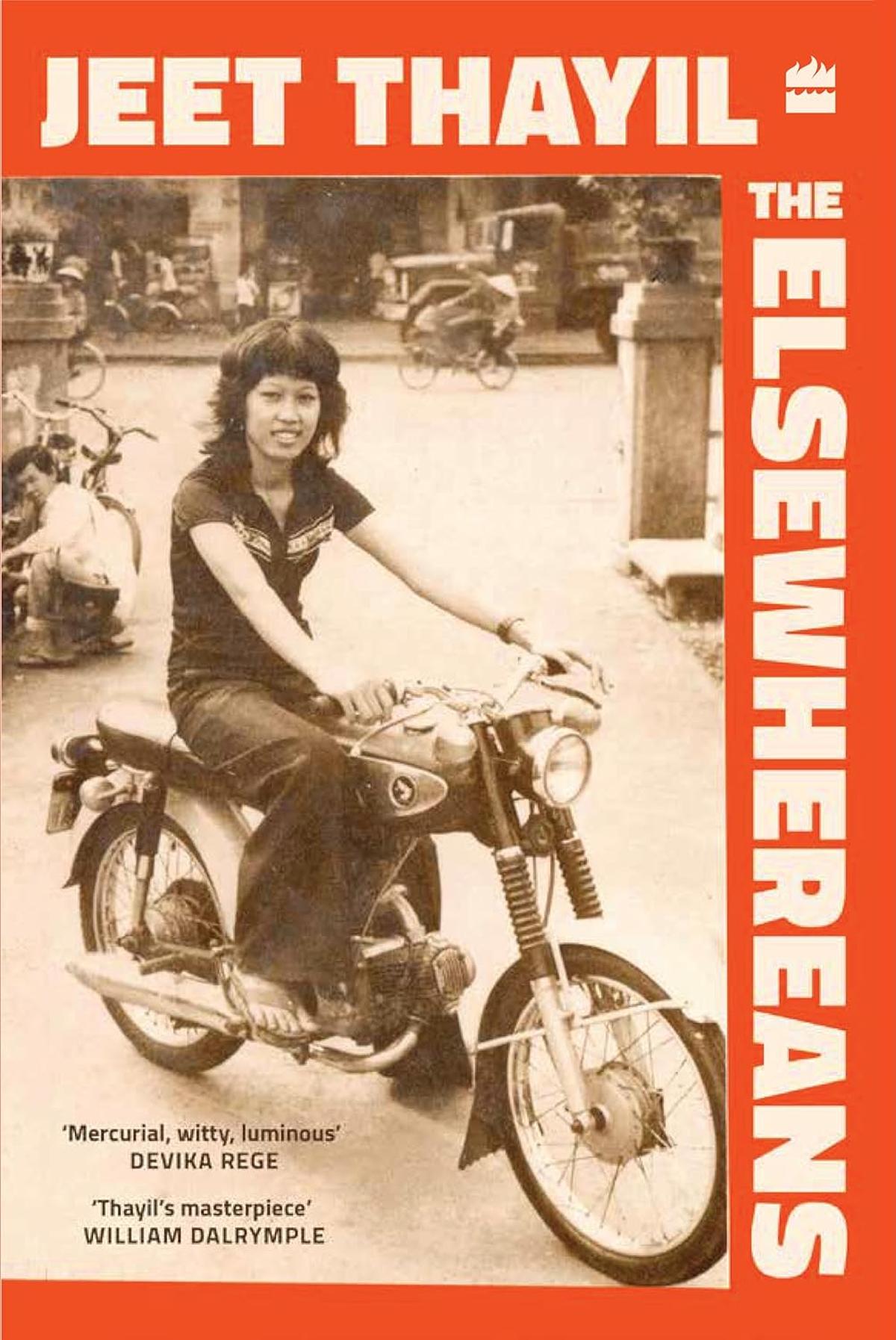
Jeet Thayil’s new work, The Elsewhereans (published by Fourth Estate), defies genre, forcing readers to reconsider everything they think they know about literary strategies. The subtitle calls it a documentary novel but it is biography, autobiography, family history, ghost story, travelogue, ityaadi.
We meet Ammu and George in a village in Kerala and travel with and without them to Mumbai, Hanoi, Saigon, Hong Kong and Paris. On this periplus, ghosts surface and evanesce, skeletons tumble out of closets, one of which smiles at us from the cover. At the heart of this magnificent and compelling mélange, the narrator, Jeet lui-meme, forces us to decide: is this an unreliable narrator?

In my opinion, there is no such thing as an unreliable narrator because there are no reliable narrators; there are only compelling narrators and boring ones. Jeet is a compelling storyteller, descended from an ancient line of mariners — water plays an important role in this story. His first commitment will be to the story and so should ours be.
I believe that a family story that leaves the family happy will be boring; the real stories are the ones we hold close to our chests, the family’s asps. (The more the writer bleeds, the better it reads.) To bring these stories out into the world, to talk about the failures and the addictions, the desires and the disappointments is to remind all of us that every family is a work in progress. Perhaps the first and most natural question to ask the author who turns his hand with elegance and strength to the forms of poetry, the novel and the anthology is about the risk a genre-agnostic book takes in a world obsessed with categories. Excerpts from an email interview:
Q: This genre-shifting is an enormous risk in a world of categories. Did it happen organically or was it planned?
A: It was very much an organic process. I started with a book that was twice the size, about 400 pages or more. Which might have been some form of Proustian anxiety, the obsessive compulsive need to record every passing digression. Then, in a moment of clarity, I jettisoned everything that didn’t fit the single and singular story being told — and ended up with a leaner, tighter, better manuscript. The form revealed itself three or four years into the writing. It might have been the most crucial stage of the whole process, and the most difficult.
Q: But at the heart of this magnificent mélange is Jeet Thayil telling us a story so close to him that we sense the vulnerability of the storyteller. Could you talk a little about the psychic cost of such writing?
A: Since my parents are a part of the story, I had to ask their permission. It was only right. My mother gave her permission reluctantly, but there was never any question that she would refuse. She’d probably agree wholeheartedly with the epigraph that begins the book: ‘When a writer is born into a family, the family is finished.’ I guess the psychic cost is one every writer must confront: by telling your story, which is also the story of the people you have known, are you usurping or co-opting their voices? If there’s a sense of guilt, a residual guilt, it is offset by a sense of duty. That it is your job to tell the story however the chips may fall.
Q: As readers, we encounter a series of enigmatic and intriguing women: Ammu, Nguyen Phuc Chau, Da Nang, Lijia, Chachiamma, a dead wife, M. We half recognise these women from our own histories and yet they are completely new. Perhaps this question is about the choice of characters populating the book.
A: It started with Ammu, and the novel ends with her. She died in January, at which point I knew it was time to bring this novel to a close. It was always going to be her story. Though I didn’t realise until I saw your question that she is only one among half-a-dozen compelling women characters, and that the women own the book. This wasn’t planned, but it seems absolute and inevitable. I come from a long line of strong women. There’s no way to tell this story without acknowledging and honouring them.
Q: The poet and the novelist work together here. For me, this is about the lapidary care with which conversations are constructed or events outlined. Would you like to say something about the interaction between these selves?
A: It isn’t always possible to separate those selves. If you practise, or embody, both disciplines, it’s difficult to know where one ends and the other begins. In my case, and in yours, the poet and the novelist bleed into each other. Which is the way it should be. Genres or labels are for book shops. If you are both those things, how do you separate? And more to the point, why should you separate? If the point of a novel is to tell a story only you can tell, why would you discriminate between your separate yet adjacent selves?
Q: You take for granted — and expect perhaps your reader to also take for granted — the osmosis between the world of the dead and the living. Our generation, I believe, was trained to be rational. Was this something you struggled with?
A: We have been trained to be rational. We are told to believe half of what we see and none of what we hear. And at this point, in the age of AI, we can’t believe much of what we see, either. I can’t say I’ve ever struggled with the question of what is rational and what isn’t. The rational world would have us endorse the viewpoint that when the dead die, they cease to exist. And yet, and yet. I’ve never had much doubt about where the dead go. I know they are among us, unable to fully be here or to fully leave. In that sense, the difference between the world of the dead and the world of the living is nothing more than a veil. All we have to do is look past the veil. It’s a way of seeing, of believing in the world that lies beyond the waking world. Or to quote from The Elsewhereans: “This is where the dead go. To torment us in our dreams. They have nothing else to do and nowhere else to be.”
Q: Is ‘Elsewhereanism’ an inheritance? Or is it a choice?
A: I’d say it’s a state of being, and in that sense, it’s an inheritance. But in every other way, it’s an ongoing choice. Is it possible to live in the modern world and be of one place? Who can answer with one word the question, ‘Where are you from?’ Even if you’ve never left your place of birth, you may feel like a stranger at home. You may choose to believe that your hometown is wherever you happen to be. You are not of single origin, like a coffee varietal. You are from multiple places. You contain multitudes. Home is where you lay your hat.
The interviewer is a poet and novelist.
Memory and soundscapes
Continuing his experiments with form and genre, Jeet Thayil recently released his second studio album, Speak, Amnesia. Written and recorded during the pandemic, in collaboration with producer Yashas Shetty and Bengaluru label ISSAI, the album features poetry readings as well as guitar and vocals by Thayil, themed on loss and memory. Drawing from his long association with language and sound, Thayil describes the album as “future ghost music” and “the soundtrack to an imaginary apocalypse movie”.
Details: jeetthayil.bandcamp.com/
Published – July 04, 2025 07:05 am IST