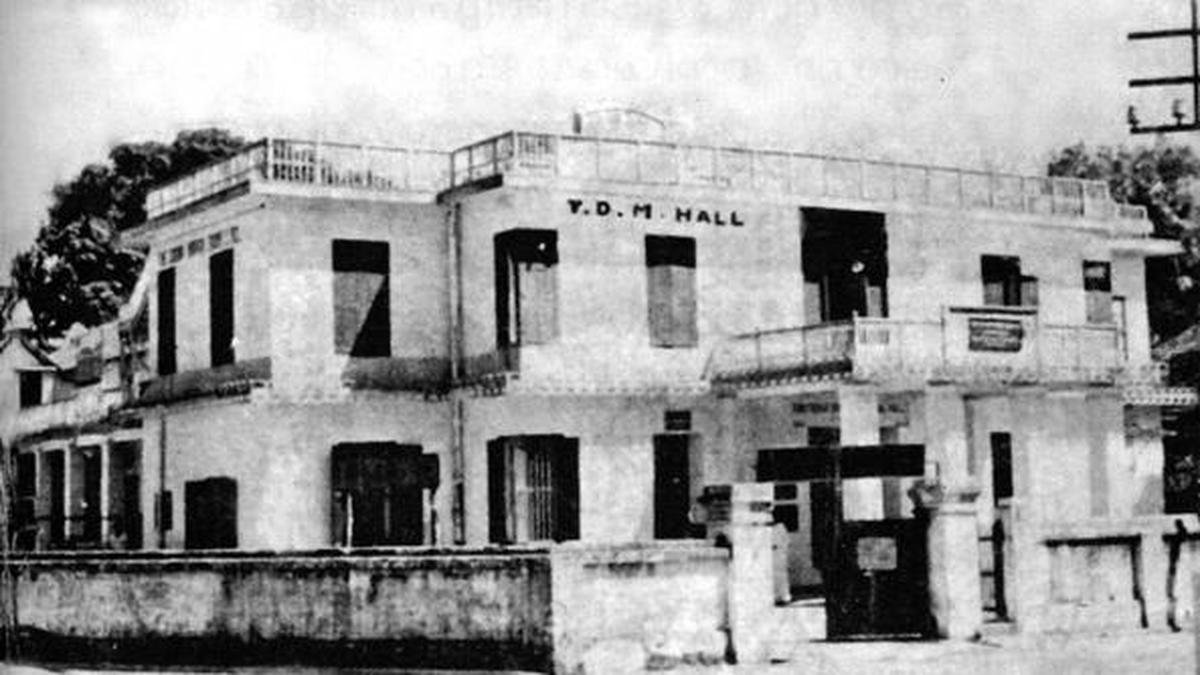
Thottekat Diwan’s Memorial (TDM) Hall, located in the heart of the city, is the headquarters of the Ernakulam Karayogam which, over the past 100 years, as a socio-cultural organisation, continues its commitment to social service irrespective of caste. This is worth mentioning because when the Karayogam was formed, registered under the Cochin Literary, Scientific and Charitable Societies Act in 1925, by prominent members of the Nair community; one of the goals was the “welfare of the Nair community”. However, since inception it has not limited engagement to caste-based activities and instead adopted an approach to service where caste does not play a role.
Bearing testimony to it is the fact that the funds for the construction, in the 1930s, of TDM Hall came from a cross section of society, which included the Archbishop of Ernakulam apart from other prominent and not-so prominent citizens of the city. “Everyone donated to the cause, which is why we have no restrictions of caste, creed or religion, when it comes to our charitable services,” says P Ramachandran, the general secretary, Ernakulam Karayogam.
An organisation for the Nairs
Although officially formed in 1925, the ball was set rolling in 1913 when a few Nairs from prominent families felt the need for an organisation to “protect the rights of the Nairs in Ernakulam”. Says history enthusiast Rajith Nair, “Most of them lawyers — Ambadi Sankara Menon, TK Krishna Menon, VK Kochunni Menon and C Achutha Menon — came together to discuss the need for an organisation to safeguard the rights and advance the interest of the Nairs. The Nair way of life was falling apart by this time, their tharavads were disintegrating and they were being left behind economically. ”
Nothing came out, immediately, of the discussions which dragged on endlessly. Neighbouring Travancore had already taken the lead in 1903, with C Krishna Pillai forming the Travancore Nair Samajam. “Then, in 1905, he would collaborate with CV Raman Pillai to form the Keraliya Nair Samaj. Two years later at a conference organised by the Samaj there were participants from the Malabar and Cochin as well. . At this conference, the creation of Nair Karayogam’s (village branches) across the Malabar, Cochin and Travancore were recommended. The Cochin group’s desire to start a Karayogam can be seen in this light,” Rajith adds.
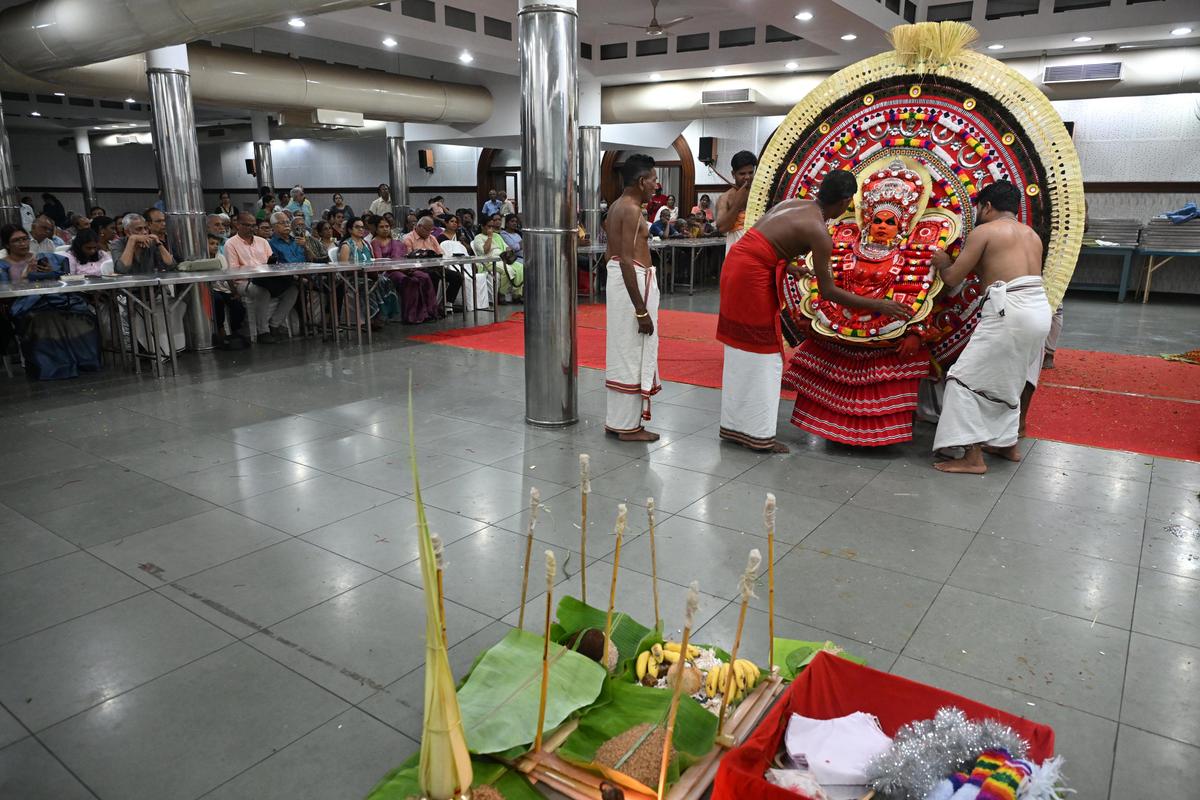
Priyesh Panikker and group from Kasaragod performing Panchuruli theyyam at TDM Hall as part of the Ernakulam Karayogam’s year-long centenary celebrations
| Photo Credit:
THULASI KAKKAT
He goes on, “After much delay, a plan for Karayogams in every village of Cochin and a central Nair Samajam began to take shape in 1923. In June that year draft rules were published, a Karayogam at Ernakulam seems to have been started by TK Krishna Menon sometime in October 1923, however, it would only be in October 1925 that the decision to formally register the Ernakulam Nair Karayogam was taken. An All Cochin Nair Karayogam or Cochin Nair Maha Samajam seems to have been born alongside.” When the Ernakulam Karayogam was finally formed, it was the word of 11 men, most of them lawyers.
Part of the land on which TDM Hall stands today was handed over to the Ernakulam Karayogam, by the East Thottekkat family. The family planned to construct a memorial for two ancestors — Diwan Sankunni Menon and Diwan Kochugovinda Menon — on 23 cents of land that was entrusted to a trust and handed over to the Karayogam to build a memorial. Since the land was insufficient for a ‘memorial befitting the stature of the Diwans’, Ambadi Sankara Menon, the president of the Karayogam, requested the Diwan of Cochin, CG Herbert to allot 49 cents of land adjacent to it which also had a pond which would be reclaimed. The land was given, “free of land value” for the hall. TDM Hall is the main source of the Karayogam’s income and its activities.
An office during the Second World War
Even before construction was completed, in 1939, during Second World War , the building served as the office of the Extra Assistant Recruiting Officer Ernakulam, during which period 6,712 persons were recruited into the defence forces. In 1941 it was handed back to the Ernakulam Karayogam.
The Karayogam’s focus continues to be charity and social service. Among its welfare activities are the Ladies Hostel (1969), working women’s hostel (1977), ambulance service (1971), employment training centre, computer centre, matrimonial data bank, schools, technical library and Prasanthi Old Age Home among others.
“We have many dreams and aspirations when it comes to the Karayogam. Over the 100 years of our existence, we have put service first. One of our big dreams is a residential project, Vasudhaiva Kutumbakam, spread over 200-300-odd acres, where senior citizens and families would be able to live. It is a huge project. Another big dream is a follow-up hospital/clinic for those in need. Usually people sponsor or donate for the treatment of major illnesses or diseases. But these require follow-ups which are expensive, and we hope to provide the service free of cost with the infrastructure we have! We have so many dreams, we live on the wings of those dreams, hoping to realise them!” says Ramachandran.
The centenary celebrations of the Ernakulam Karayogam, on at TDM Hall, conclude on December 25.
Published – December 20, 2025 03:01 pm IST