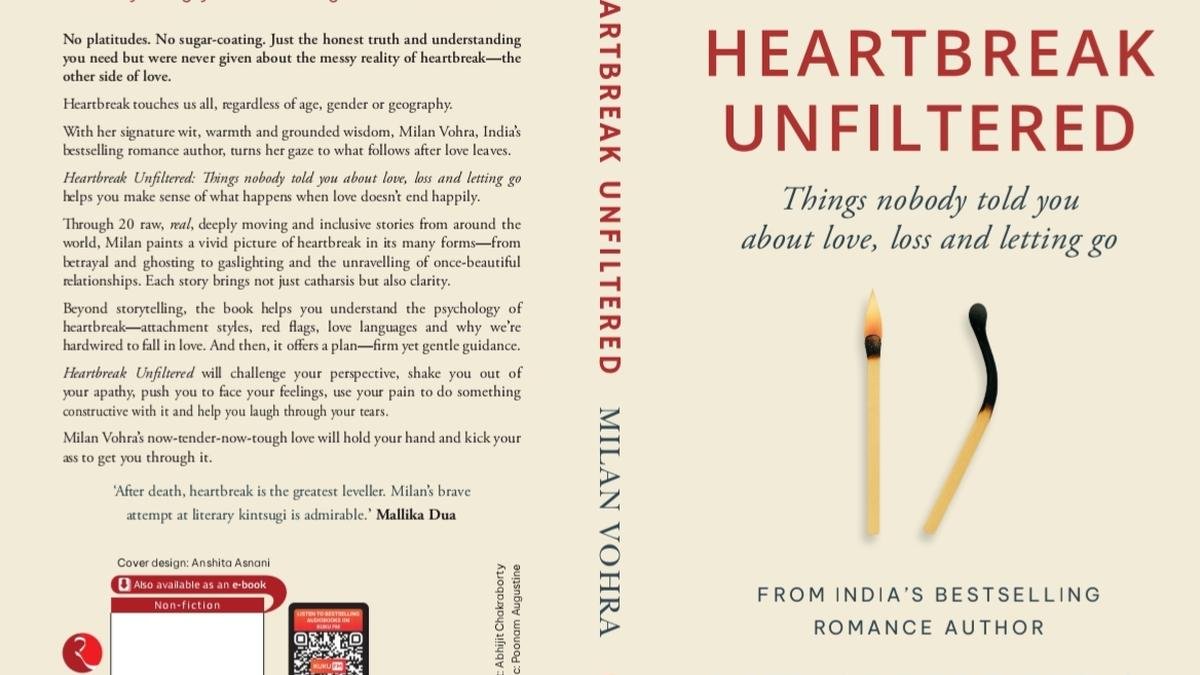
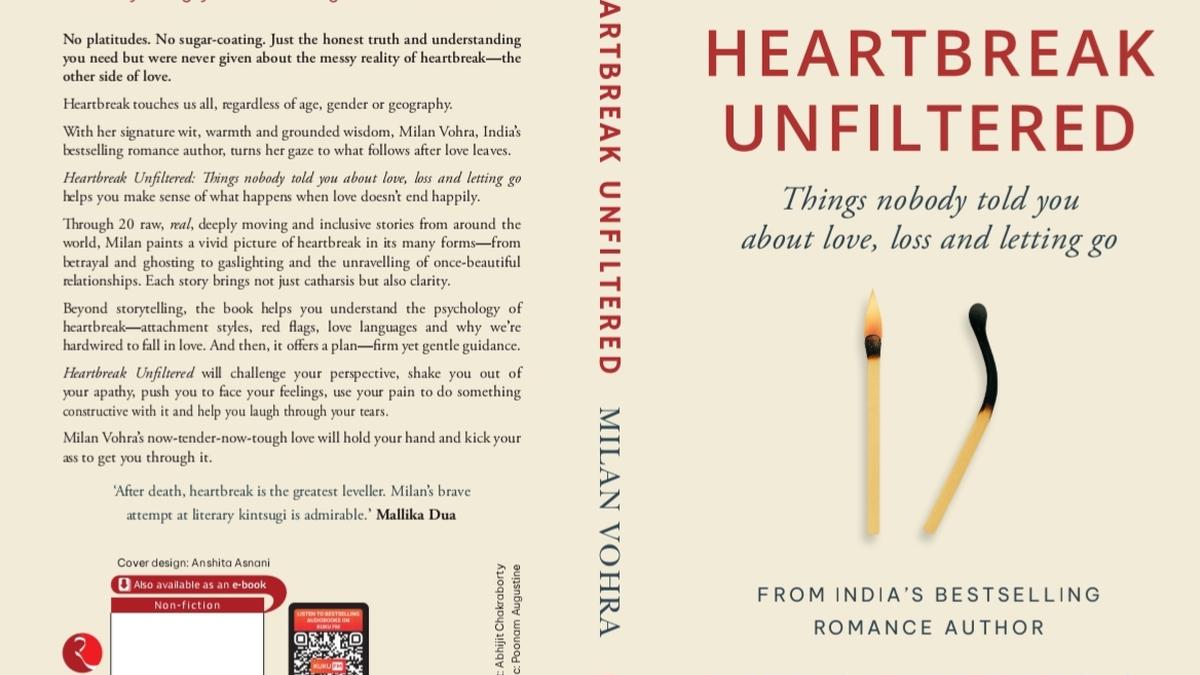
Milan Vohra’s new book
| Photo Credit: SPECIAL ARRANGEMENT
I am on a flight, stuck in the middle seat. I know it is only a matter of time before someone to the right or left of me begins chatting. Soon enough, the 20-something-year-old man on the left opens up. “Yesterday only, I completed my induction as a CSA.” I congratulate him, say something about how he should be so proud of himself. His face falls. “It feels empty,” he says. “You know, on this exact date, my ex-fiancée and I got engaged five years ago. We broke up last November,” he sighs. “Now she works in a not-for-profit. I’m with a bank. She was my classmate from intermediate. Our families were fine with it, even though our castes were different. The problem was over-possessiveness.” He lapses into silence. Minutes later, he continues. “Love will make you weak,” he says. “Now, I feel, why should I fall in love again? I’m clear now. I’m supposed to roam, earn, spend. If at all I want to marry, I’ll tell my parents to find someone for me.”
For the last 10 years, I have noticed a growing sentiment among Indian 20 and 30-year-olds that points to a return to arranged marriages. They would rather have the decision of who they spend their life with taken out of their hands. It is either that or a resolve to stay single. It led me to research how my peers and I view love, versus people today.
One thing has stayed constant, and that is the need to love and be loved.
Author Milan Vohra.
| Photo Credit:
SAMPATH KUMAR GP
We do not actually have much control over that impulse. Research by scientists Helen Fisher and Lucy Brown proved that romantic love is hardwired in the human brain’s neural circuitry. So we can beat ourselves up all we like about why we had to fall so hard for that person. But it is actually a biological driver that goes back to the time we lived in caves. These neural connections kept us mating to keep the human race going. Our brains even have little hot-spots that light up with the heady in-love feeling and push us to stay obsessed or drive us towards lust and even towards getting attached to someone. That whole fuzzy feeling of love is linked to the oxytocin and vasopressin high from neurons firing in our brains.
So, if the desire for love, its euphoria and despair have not changed, what has?
Let us look at some facts. That there is a proliferation of dating apps. That dating app users are from across all age groups, not just millennials or Gen Z. That there are also dating apps for people looking to get some outside of their marriage. There is a growing number of people choosing to stay single. As well as a significant number of grey divorces — people above 40, 50, 60 years who say ‘enough’ to their long, no-longer-happy marriages and want to give themselves a fresh start on life.
What is a given is also that (with the exception of a few) most dating apps are viewed more and more as hook-up apps. Nothing wrong with that at all, but it is also viewed clearly as something transactional; to scratch an itch, so to speak. It still does not satisfy the deep yearning to love and be loved.
Love has almost always brought heartache in its wake. Lyrics, poetry, art, and cinema are all testimony to that. But what we see increasingly now is a huge fatigue with the emotional journey of love. It does seem that women deal with this differently from men. They communicate more. Men seem to find comfort in speaking less and shouting more — over the outcome of a game. Or in re-installing dating apps, sitting on WCs and madly swiping right on every profile. (Future research will conclude this.)
Inasmuch as people have more agency today to assert their choice to stay single (and deal with the family music) or trust their family (better than themselves) to choose a partner for them, it is astonishing to me that even with all the education we had, nothing really taught us self-love. It is essential without doubt. But does it replace the need to love and be loved? This pervasive pain of heartbreak is not just about breakups or a failed relationship. Somewhere along the line, love itself seems to have failed us. It stopped representing the safety and comfort it once did. Maybe in a few centuries, our brains will be re-engineered, and babies will be conceived only out of self-love.
But until such time, the heartbreaks and the hunger to love and be loved will continue.
Milan Vohra is the author of ‘Heartbreak Unfiltered : Things nobody told you about love, loss and letting go’ (Rupa Publications)
Published – January 09, 2026 04:50 pm IST