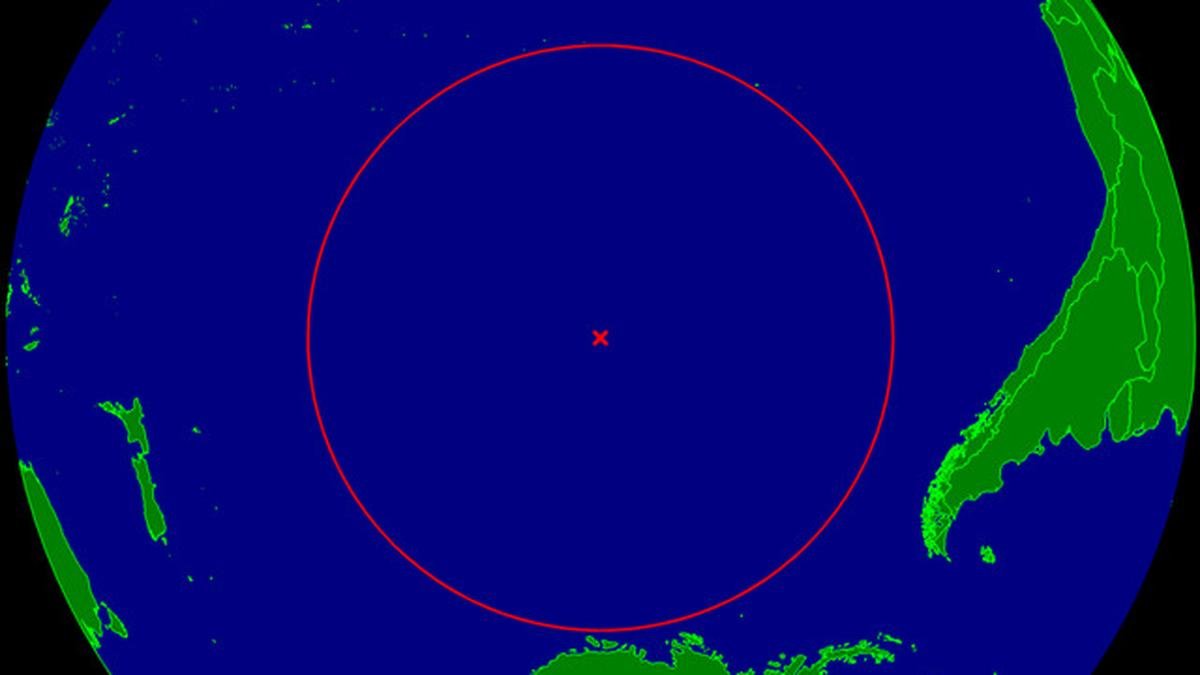
Point Nemo lies in the South Pacific Ocean, at 48°52.6′ south latitude and 123°23.6′ west longitude to be exact. It is about 2,700 kilometres away from the nearest land in all directions. Also known as ‘pole of inaccessibility’ which is used to describe locations that are harder to reach than any other point on Earth and Point Nemo is the most extreme example of this.
Interestingly, Point Nemo wasn’t discovered by a sailor or an explorer. In 1992, it was identified by Hrvoje Lukatela, a Croatian-Canadian survey engineer—using a computer. Lukatela ran a specialised program to calculate the exact point in the ocean that was farthest from any landmass. The result was a location surrounded by emptiness in every direction.
The name “Nemo” comes from Latin, meaning “no one”, and also references Captain Nemo, the fictional explorer from Jules Verne’s 20,000 Leagues Under the Sea—a fitting name for a place no one truly reaches.
Why the ocean here Is almost lifeless
Point Nemo lies within the South Pacific Gyre, a massive system of slow-moving, rotating ocean currents formed by the Antarctic Circumpolar Current, the Humboldt Current, and the West Wind Drift. The gyre is enormous—twice the size of North America—and is often described as the most barren part of the world’s oceans.
But why is it so empty?
The region is so far from land that winds carry almost no nutrients or organic matter into the water. At the same time, the circular currents act like a barrier, preventing nutrient-rich deep water from rising to the surface. With no food supply to support plankton, very little marine life can survive here. As a result, Point Nemo sits in what scientists call a biological desert.
The nearest land is still very far away
If you were somehow floating at Point Nemo, the nearest landmasses would still be around 2,700 km away. These include Ducie Island in the Pitcairn Islands, Maher Island near Antarctica, and Motu Nui, a small rocky islet off Easter Island. To find inhabited land, you would need to travel thousands of kilometres west to New Zealand’s Chatham Islands, or east toward Chile.
Closer to space than to people
Here’s a surprising fact: the closest humans to Point Nemo are often astronauts aboard the International Space Station. Orbiting roughly 400 km above Earth, astronauts can be physically closer to this point than any person standing on land.
Earth’s space cemetery
Because of its extreme isolation, Point Nemo serves another unusual purpose. Space agencies use it as a controlled “space cemetery”, officially called an orbital graveyard. Decommissioned spacecraft are guided to crash into this part of the ocean to minimise risk to populated areas.
More than 300 spacecraft have ended their journey here, including the Soviet space station Mir, which was deliberately de-orbited in 2001. NASA and its partners currently plan to de-orbit the International Space Station around 2031, with Point Nemo designated as its final resting place.
Mystery of “The Bloop”
Point Nemo is also linked to one of the ocean’s most famous mysteries. In 1997, underwater microphones called hydrophones detected an extremely loud, ultra-low-frequency sound near this region. The signal, nicknamed “The Bloop,” was so powerful that it was recorded by sensors thousands of kilometres apart.
For years, speculation ran wild. Some even joked it was the call of a giant sea creature—drawing comparisons to H.P. Lovecraft’s fictional monster Cthulhu, which was imagined to dwell near similar coordinates. Scientists later solved the mystery: the sound was caused by a massive icequake, produced when a huge Antarctic iceberg cracked and melted.
Even here, plastic finds a way
Even Point Nemo is not free from plastic pollution. During the 2017–18 Volvo Ocean Race, two yachts—Turn the Tide on Plastic and Team AkzoNobel — collected water samples near Point Nemo using advanced sensors. The samples revealed the presence of microplastics, with scientists finding between 9 and 26 plastic particles per cubic metre of seawater, showing that human pollution has reached even the most isolated place on Earth.
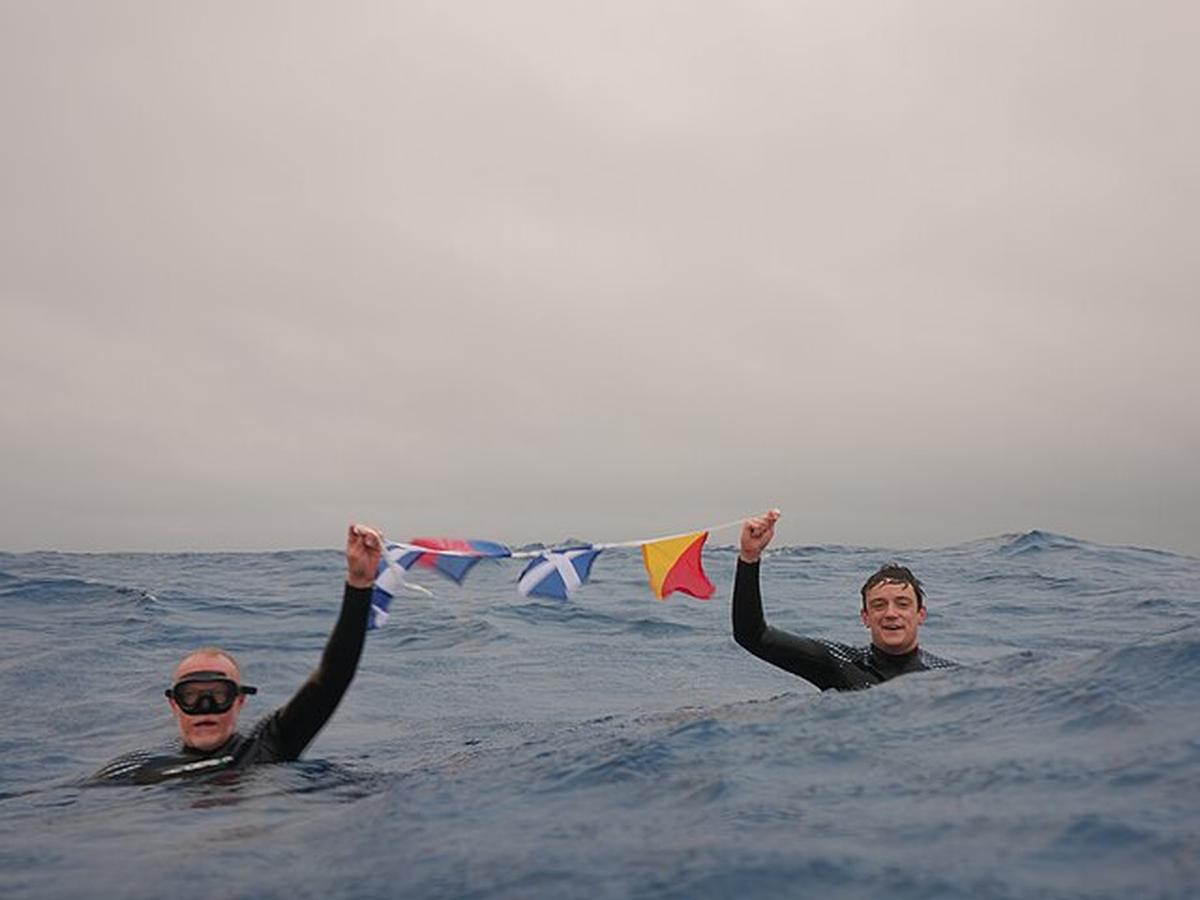
Fun Fact: A Human Finally Reached Point Nemo
For decades, Point Nemo existed only as a set of coordinates on a map. That changed on March 20, 2024, when British explorer and tech entrepreneur Chris Brown (L), along with his son Mika (R), made history. After an arduous 10-day voyage aboard an expedition ship from Chile, they reached the exact “pole of inaccessibility.” To celebrate, they jumped into the freezing, 4-kilometer-deep water, becoming the first recorded people to ever swim at Point Nemo.
| Photo Credit:
Photo: Wikimedia Commons
A place almost untouched
No regular ships pass through Point Nemo. No flight paths cross overhead. Life struggles to exist in its waters. Yet this silent spot plays a role in both ocean science and space exploration. Point Nemo remains a reminder that even on an increasingly crowded planet, there are still places where Earth feels completely empty.
Published – January 18, 2026 11:54 am IST