Kalpana Karunakaran’s grandmother, Pankajam, was, by her own definition, ‘a woman of no consequence’. Not allowed to complete schooling—she had just six years of formal education before being pulled out—and confined to domestic duties within a marriage marked by little love, she nevertheless cultivated a ‘kingdom of the mind’, an alter universe that she built through extensive reading, friendships that defied boundaries and an ability to see the world through the eyes of others, even as she remained conscious that, consequential or not, she was still a subject of the history that was unfolding around her.
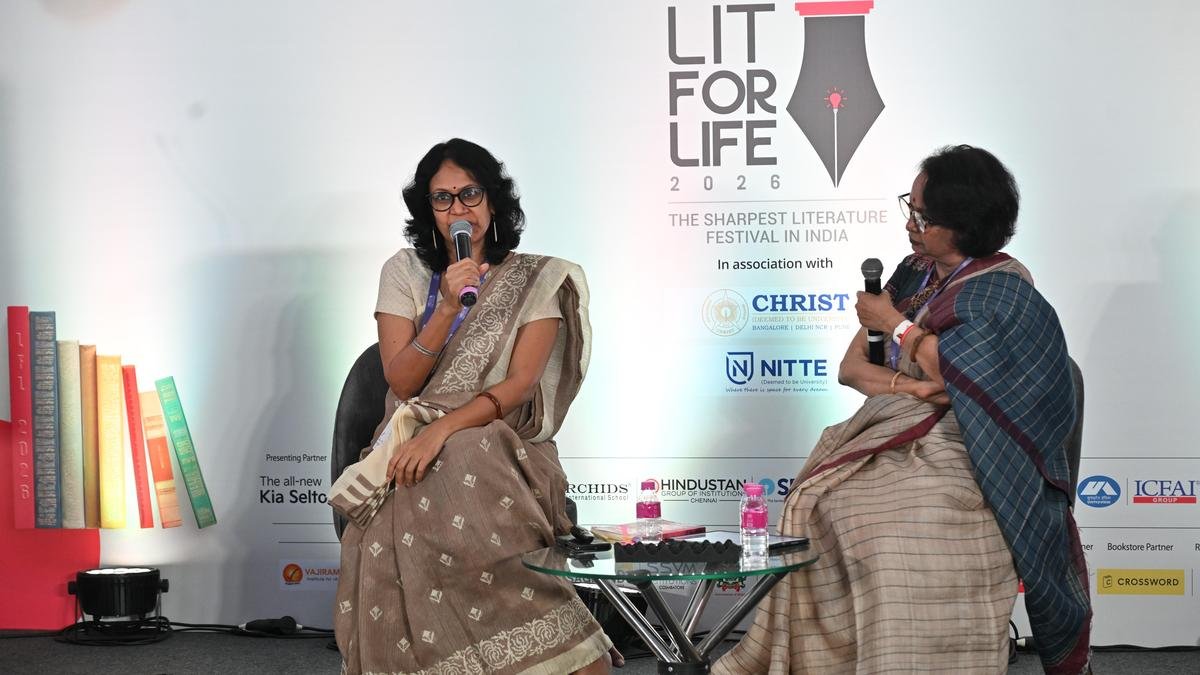
Her life and her story formed the subject of discussion between Ms. Karunakaran, who teaches in the Humanities and Social Sciences Department at IIT Madras, and Sreemathi Ramnath, a polyglot consultant and writer, at The Hindu Lit for Life on Saturday (January 17, 2026). Ms. Karunakaran’s book, A Woman of No Consequence: Memory, Letters and Resistance in Madras, was published in 2025.

How much to reveal was one issue, Ms. Karunakaran says, she grappled with. Pankajam, she says, had written her life story in bits and pieces from 1939 to 1995 in the “school essay notebooks of her children and grandchildren”, but she had also turned to autofiction—fictionalised autobiographies—using three characters, Kamala, Lakshmi and Meena, to portray the unsavoury, unsayable parts of conjugal life. These raw, intense stories were perhaps a way of distancing herself, Ms. Karunakaran reflects, and wonders, “Do I really reveal the skeletons in the family closet?” How much should be revealed? And then, she says, she realised that through the autofiction, Pankajam had herself said everything and then some. “If she dared, how could I not?” Ms. Karunakaran says.
On the subject of marriage and the ways men treated the women in their lives and the many ways of looking at this, including through the lens of gender and community, Ms. Karunkaran says that nobody is a villain in the story. The same men who wanted to crush their wives under their feet, she points out, also wanted their daughters to soar. Pankajam, however, wanted her daughter Mythili Sivaraman— a well-known social activist, trade unionist and Communist leader— to find a man very different from the one she had landed, Ms. Karunakaran says.
Pankajam’s story plays out in the backdrop of India’s freedom struggle, and though she referred to herself as a ‘mere housewife’, her writings, Ms. Karunakaran says, were self-reflexive; she witnessed the anti-colonial freedom movement, she witnessed changes in the city of Madras. Ms. Karunakaran says she herself was conscious to pull all of these elements into her story and this is seen in her writing of the book: the idealism and optimism of the Nehru (India’s first Prime Minister Jawaharlal Nehru) years, for instance, seems to evaporate in the 1960s, amid many movements that defined the country: workers’, peasants’ and women’s. Pankajam’s household was not untouched by these events, as witnessed by Mythili’s ‘explosion’.
Ms. Karunakaran stressed that she could not claim that this was the entire truth about her grandmother — she’d relied on different sources alongside Pankajam’s writing, including her memories as well as letters Pankajam had written to Mythili — she says she had attempted to provide an interpretation but gave an open invitation to readers to agree or disagree.
There are many such stories out there to be written, she says — stories of ‘housewives only’ who were much more. “That resurrection, recovery of their voices and agency is a project that is still waiting to happen in many cases,” she says, adding that if readers felt inspired to write about one of their female ancestors after reading her book, it would be well worth it.

The Hindu Lit For Life is presented by The all-new Kia Seltos. In association with: Christ University and NITTE, Associate Partners: Orchids- The International School, Hindustan Group of Institutions, State Bank of India, IndianOil, Indian Overseas Bank, New India Assurance, Akshayakalpa, United India Insurance, ICFAI Group, Chennai Port Authority and Kamarajar Port Limited, Vajiram & Sons, Life Insurance Corporation of India, Mahindra University, Realty Partner: Casagrand, Education Partner: SSVM Institutions, State Partner: Government of Sikkim & Uttarakhand Government
Official Timekeeping Partner: Citizen, Regional Partner: DBS Bank India Ltd, Tourism Partner: Bihar Tourism, Bookstore Partner: Crossword and Water Partner: Repute Radio partner: Big FM
Published – January 17, 2026 05:18 pm IST