I am often hesitant to say I love the colour red. Being a Malayali, many joke that it reveals my (non-existent) Communist leanings. Being dark skinned, others warn me to skip it in my wardrobe. But for me it’s the colour of manjadikuru, the lucky red seeds I used to collect in my grandmother’s overgrown backyard in Alappuzha. Of piping hot red matta rice that my mother would serve every visit home.
And now, thanks to Asian Paints’ A Story in Red, perhaps of my (next) living room ceiling? The immersive multi-room exhibit at Bafna House in Fort Kochi has certainly given me options: scarlet, fig shell, Bordeaux burgundy, otter brown, and a stunning fuchsia.
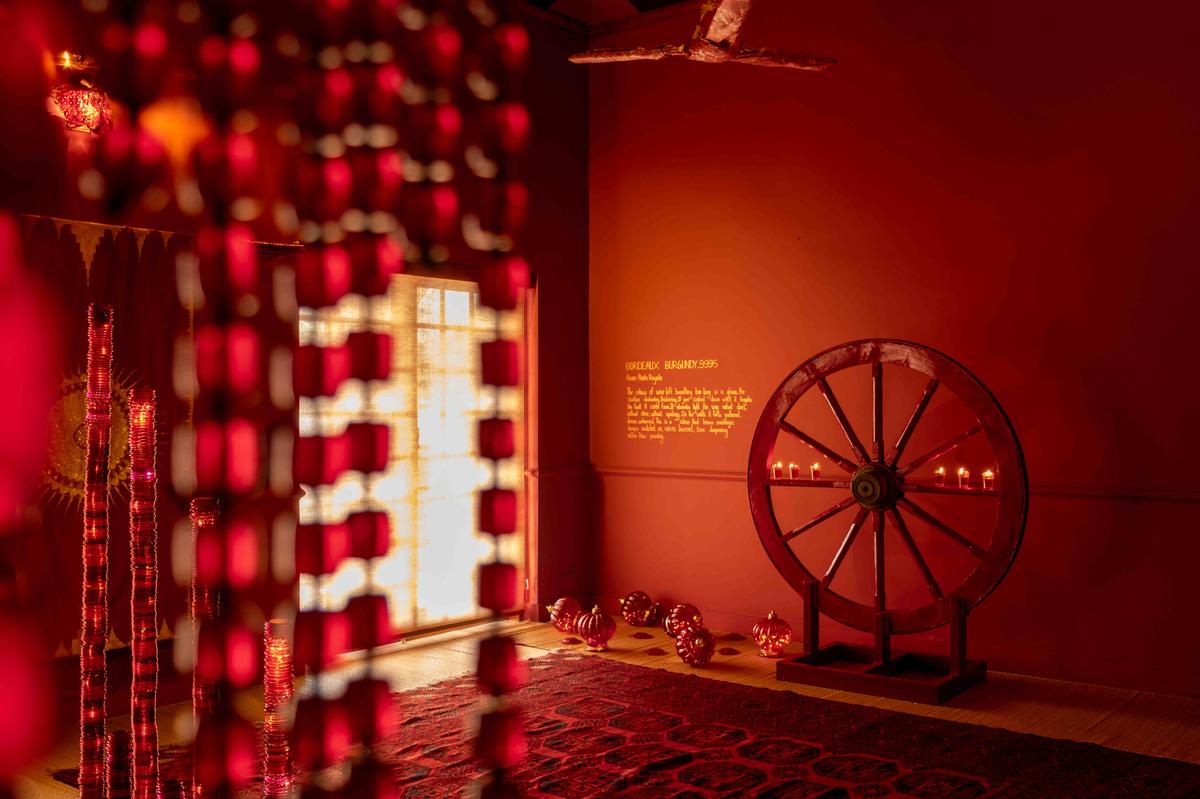
Curated by interior stylist and textile aficionado Ranji Kelekar, the site-specific experience has been put together with the intent to showcase the potential a colour can have to move between forms and textures, to travel across cultures and communities, and even to “perform”. As Amit Syngle, MD and CEO of Asian Paints, puts it, red is “rooted in craft, design and ritual — in the protests of Kerala, the auspiciousness of festivals in Tamil Nadu and West Bengal”, the bangles clinking on wrists across India. “It has a certain kind of storytelling that merges seamlessly with the installations at the [Bafna] house,” he says, “the interplay of light, form and pigment coming together to give the space and its objects multidimensionality.”
Blown glass to Parsi slippers
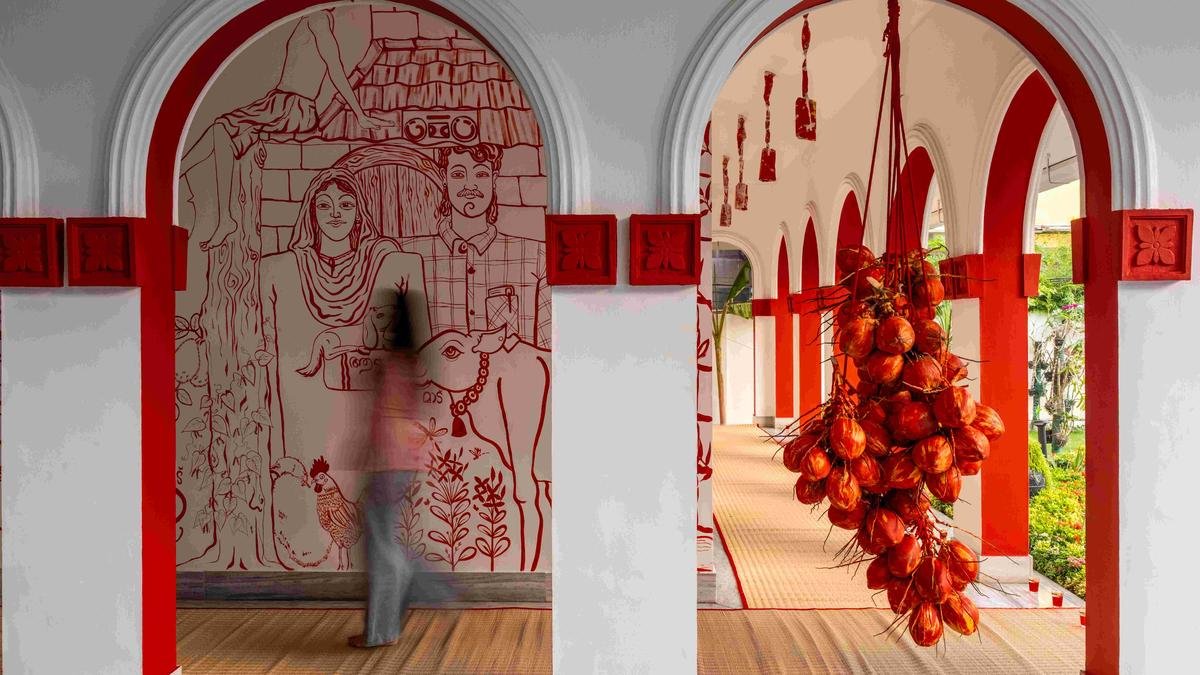
A bunch of coconuts painted red hang from the verandah of the quiet Kochi residence on Tower Road. Behind it is a mural by five young Kerala artists: Harisankar Muraleedharan, Athul P., John Martin, Affin Anu Singh, and Sudharsana B. Shenoy. Titled Dhesham, it picks out vignettes of their lives in dark red.
As you walk in, the scene shifts to Goa, with a stunning okmus displayed at the entrance. Kelekar shares that designer Savio Jon created the ceremonial red and white robe (worn by pallbearers in the Procession of Saints during Lent) with satin, velvet and lace, and a pussybow at the collar, specially for the event. Next come the trio of rooms where the full “story” unfolds, cocooned by Asian Paints Royale’s red repertoire — in bold stripes on the walls and chevron-esque patterns on the ceiling.
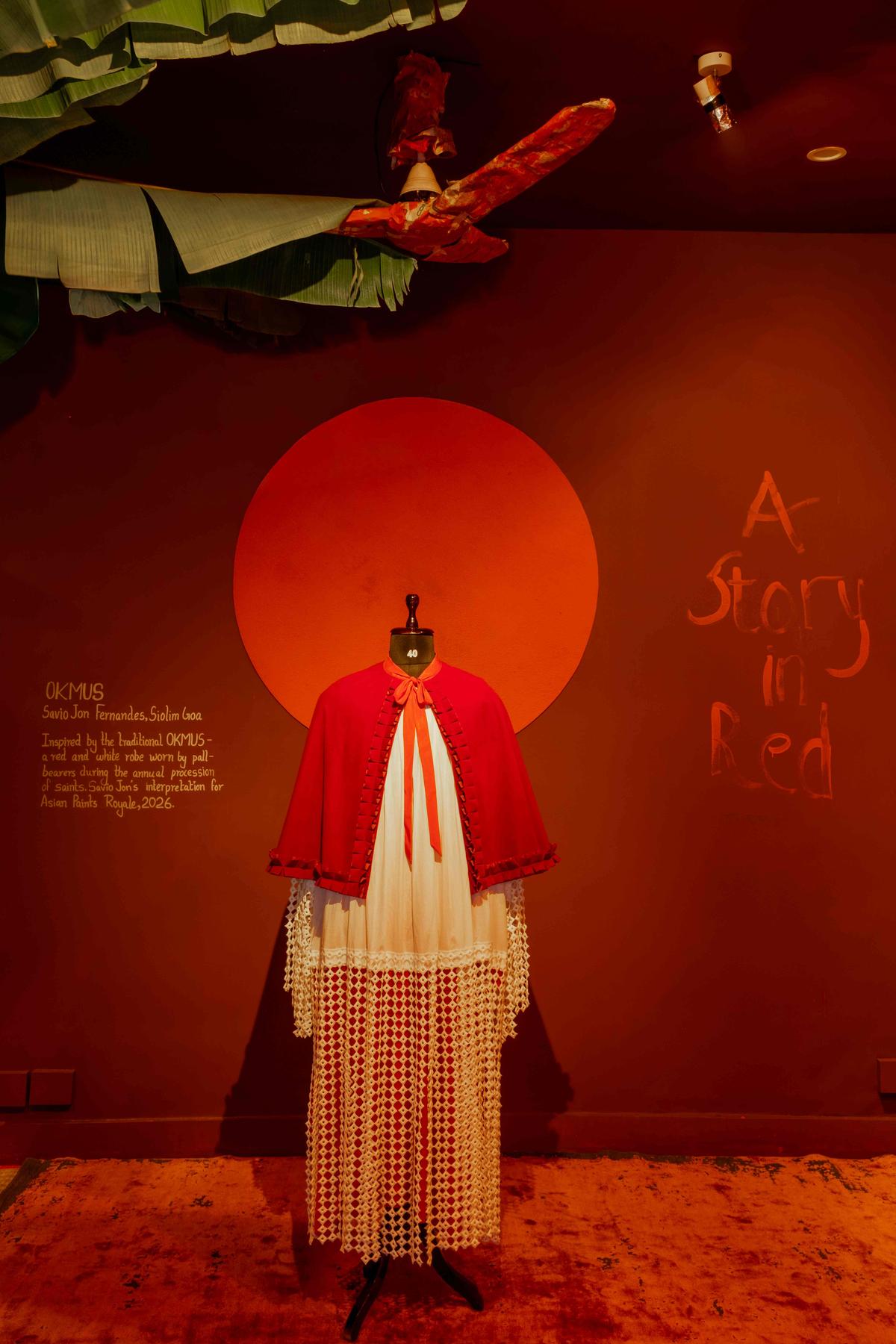
Savio Jon’s okmus, with satin, velvet and lace
A 100-year-old gharchola from Kelekar’s personal collection catches the light. Traditionally worn by brides, a symbol of fertility and stability, each yellow dot on the sari, he says, is individually knotted around a mustard seed and dyed. Elsewhere, there is an installation of handblown glass bangles from Rajasthan (with roots that can be traced back to Czechoslovakia); pairs of Parsi bedroom slippers in red velvet strewn on a reed mat; and Four Poy by interior architect Kunal Shah, a contemporary take on the ubiquitous charpai — its frame painted red, and its weave detailed in black and white.
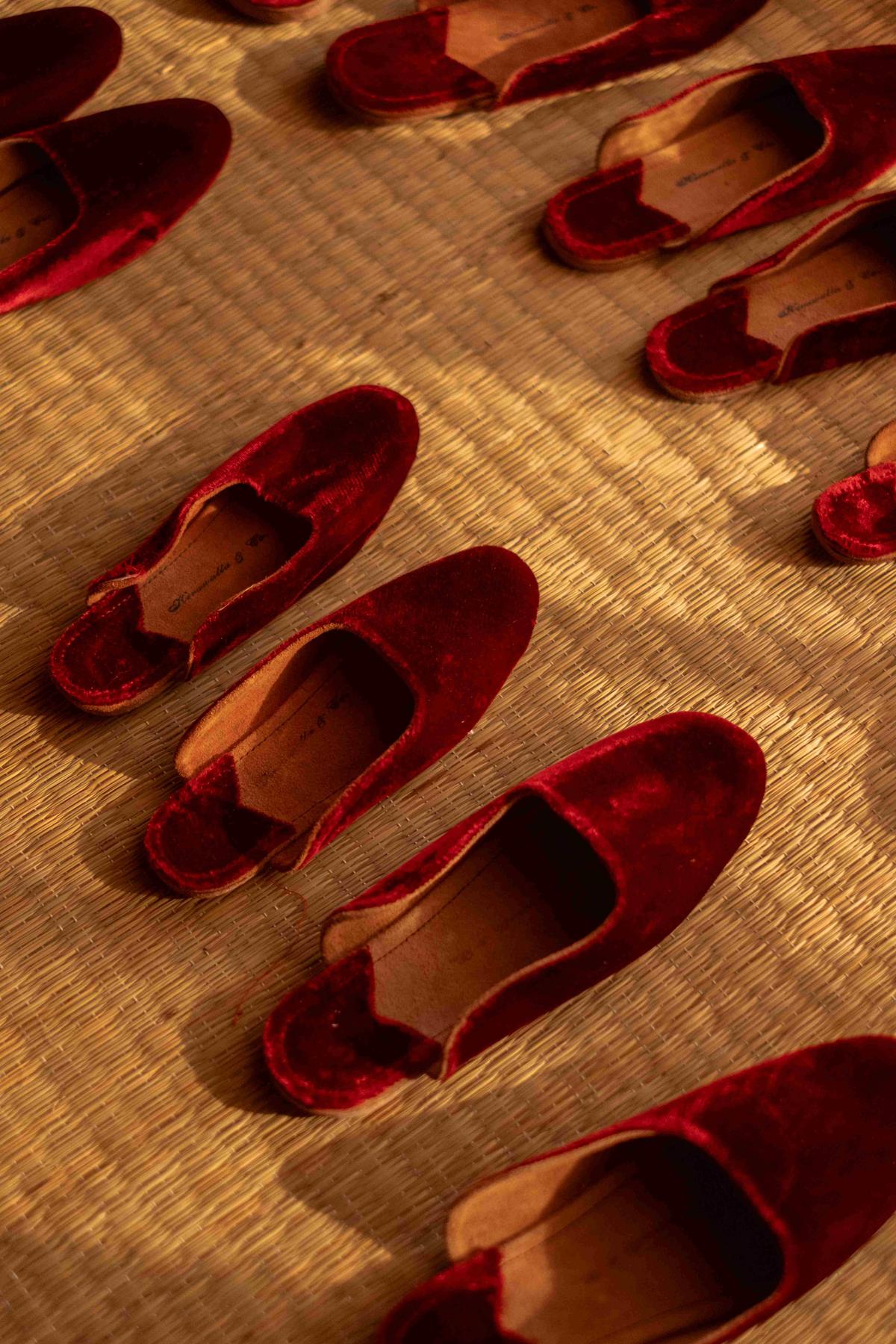
Red velvet Parsi slippers
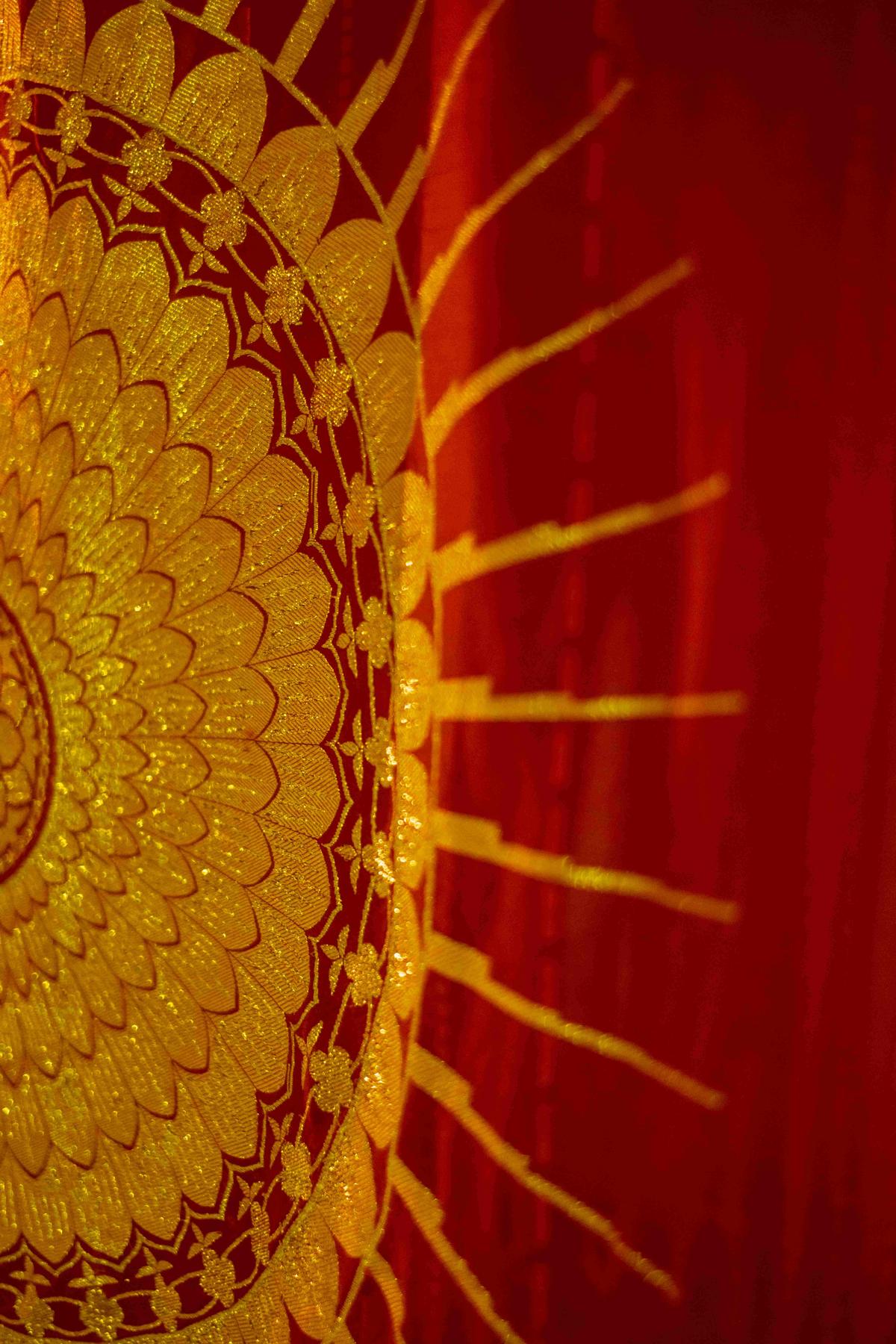
Designer Smriti Morarka’s custom-woven tapestry, Aarambh, from her weaving initiative Tantuvi, takes up a wall, the gold zari in its central sun motif and intricate temple border offering a striking contrast. And because it’s Kochi, there’s an uruli filled with local matta ari (red rice) beside a large bunch of kadali pazham (red banana often offered to deities). “Red is in your day-to-day existence. If you build a home, the bricks are red. If you grow a garden, the mud is red. You wear red for your wedding; Christmas and pujo are full of red,” shares Kelekar. “It may sound cliché, but red has a feeling of home for me.”
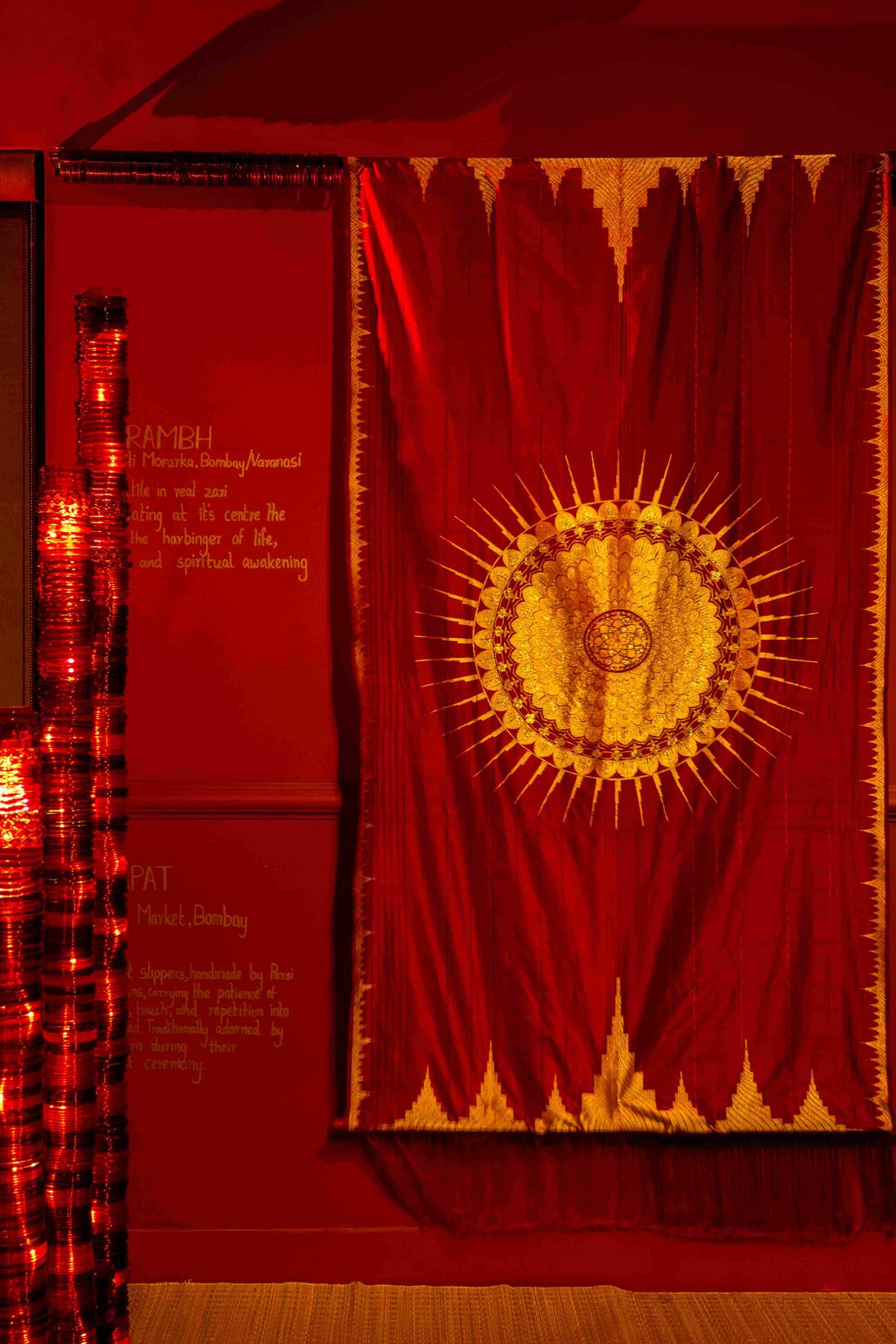
Smriti Morarka’s custom-woven tapestry, Aarambh
Playing with duality
As the story nears its finish, it ventures outside India. “The curation isn’t forced,” says Kelekar. It grew organically through conversations with friends, browsing personal collections, and “just dunking a house in red” and seeing what would come from it.
For instance, he says, “I visited my friend Sonal Chowdhary at her [Goa-based gallery] Whalesong, and saw this beautiful furisode [a formal kimono worn by unmarried girls in Japan]. And I said I’m taking it.” It is mounted at the Kochi house with its distinctive long sleeves stretched out.
Then there’s a kalamkari tapestry of Iranian origin (late 19th-early 20th century) featuring a ruler and his red-coated soldiers in conversation around a bowl full of ripe pomegranates, which Kelekar found in a Parisian market. Interestingly, its twin was auctioned by Christie’s in 2016 for £4,000 (approx. ₹4.9 lakh).
Turns out, several colours were bandied about in the initial phases, including indigo and ochre, but the duality of red won. And in the Chinese year of the Fire Horse, the fiery shade holds even more meaning. It is warmth and energy, but also caution and control, used to signal boundaries and regulate movement. In the midst of a performance-forward Kochi-Muziris Biennale (KMB), this ‘performative’ colour fits right in.
An eight-minute walk from Aspinwall House, the main KMB venue, A Story in Red, is on till February 15. Entry is free.
The writer was at Bafna House on invitation.
Published – February 13, 2026 10:52 am IST