On certain mornings, the drive out of Mumbai begins in compression with glass towers, flyovers, and the low-grade impatience of traffic, before loosening into the long, engineered sweep of the Mumbai–Pune Expressway. It is a road of tunnels and viaducts, banking curves and sudden descents, cutting through the basalt folds of the Western Ghats.
As the ascent toward Khandala begins, the mood shifts. The Bhor Ghat section — historically a crucial rail and trade pass — remains one of the most dramatic stretches of the route. In the monsoon months, waterfalls streak down the rock faces; fog gathers without warning. The journey is efficient by design, but the landscape refuses to remain neutral. You move from velocity to vertigo to a certain suspended quiet.
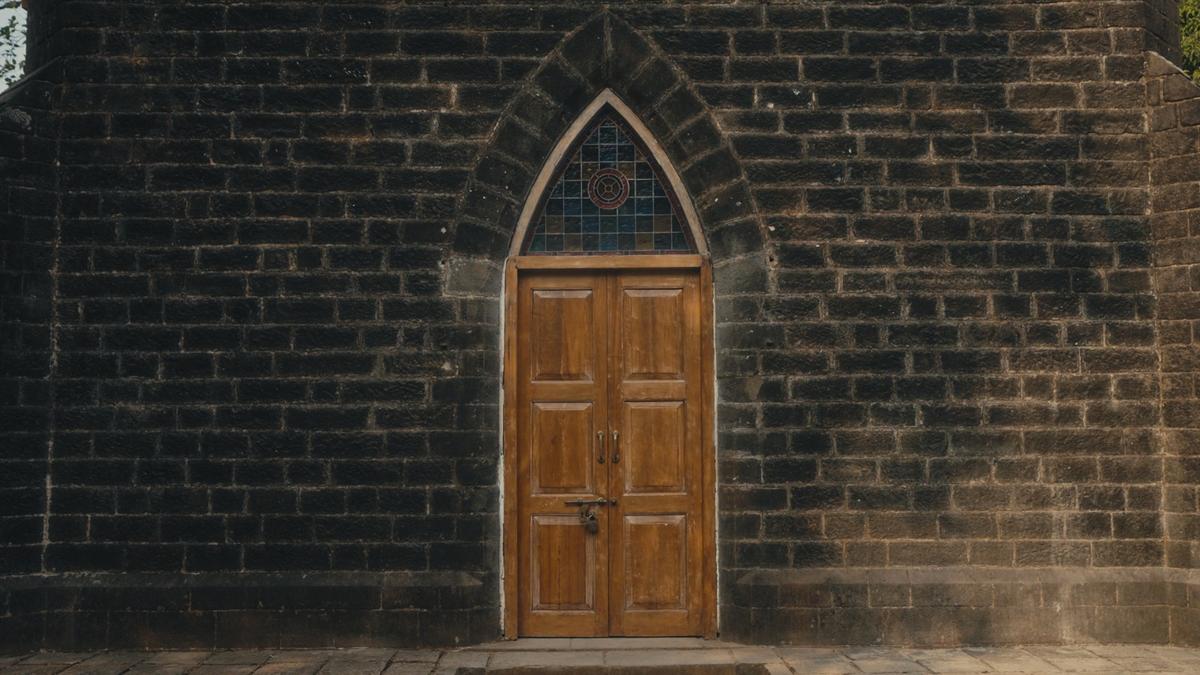
One of the entrances to the chapel
| Photo Credit:
Special arrangement
It is within that quiet that Abbey 301 now stands.
The chapel, named after the area’s postal code, predates the Expressway by nearly two centuries. Held by the Kotak family since 1973, the nearly 200-year-old black basalt chapel has entered a new chapter under Kamini Kotak and architect Adil Dholakia of Five Cross Architects, who led its recent restoration.
The property was acquired by the late Bhagwanbhai Kotak, the family patriarch, who encountered the former Anglican chapel at a time when its congregation had thinned in the years after Independence and the building stood decommissioned and locked. With deep roots in the Sahyadris, the family already considered the region home. Drawn to the chapel’s gravitas, Bhagwanbhai persuaded the Church to sell it to him, initially imagining it as a library for his personal collection.
What began as a private act of preservation has since evolved into a broader gesture of cultural reclamation.
“Abbey 301 began with a simple question: what would it mean to restore a historic structure not as an object of nostalgia, but as a living space for listening and exchange?” Kamini says. “The founding idea was never scale but depth.”
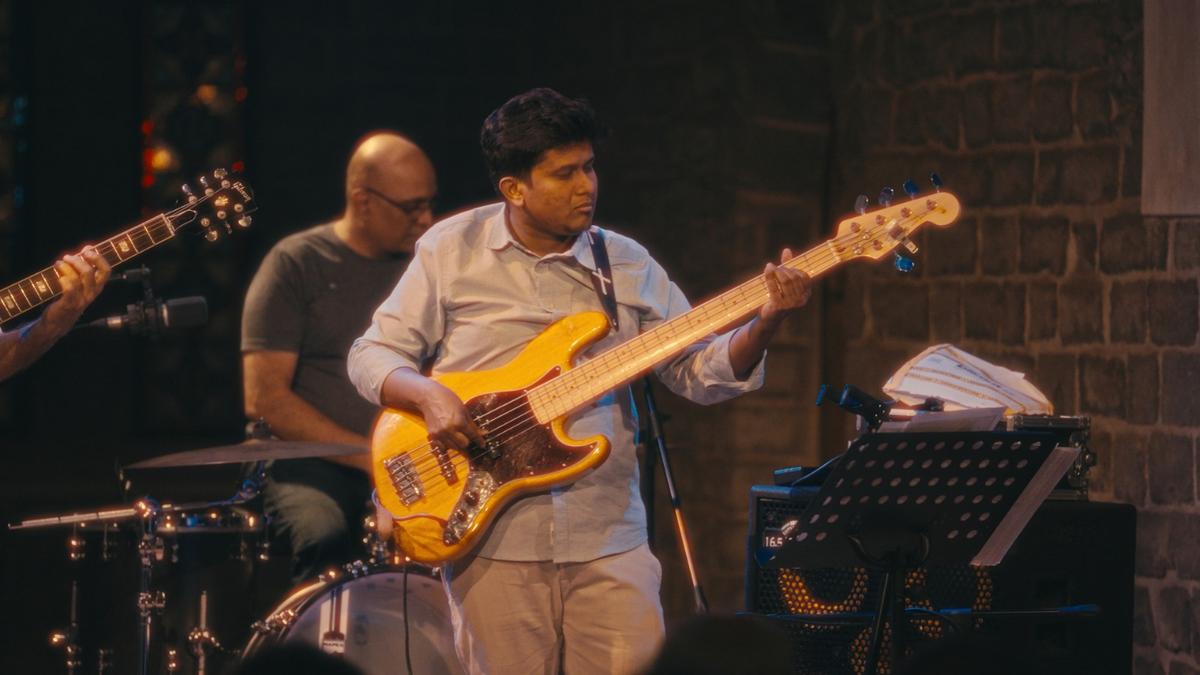
A musical act in performance
| Photo Credit:
Special arrangement
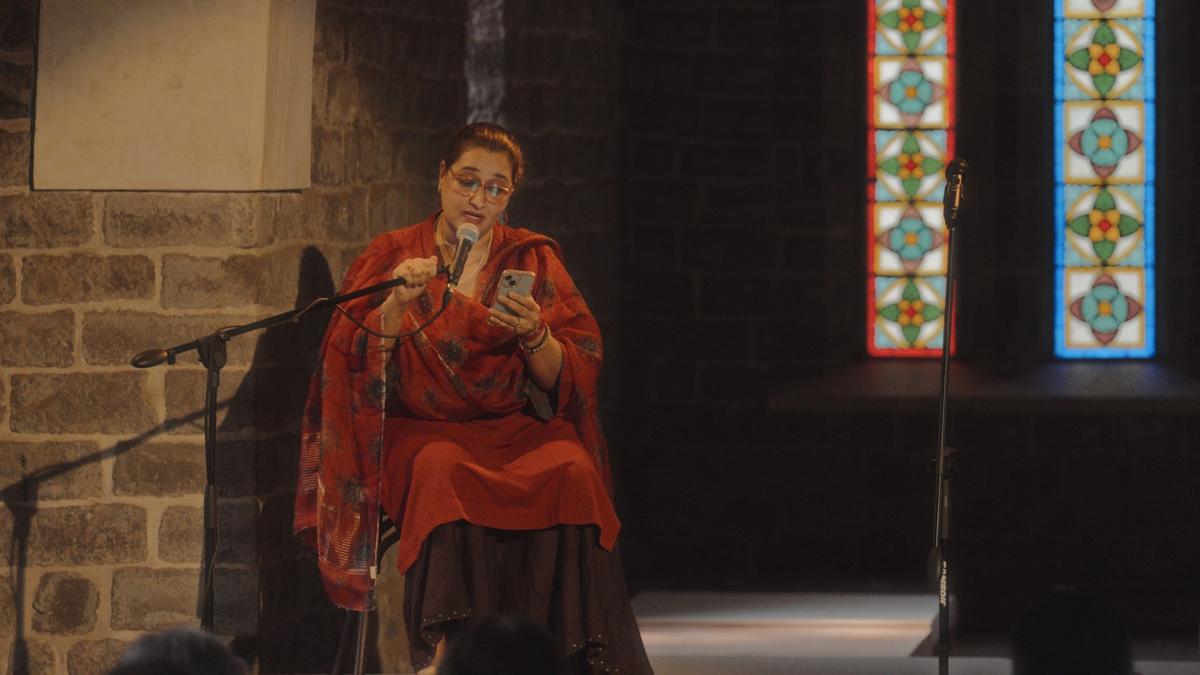
Poets of Our Time — spoken word with Kausar Munir
| Photo Credit:
Special arrangement
Building legacy
Depth, in this case, is architectural as much as philosophical. Churches were built for collective attention. A nave is, at heart, a long room calibrated for listening. Vaulted ceilings and reflective surfaces carry sound with an ease that modern halls often attempt to simulate electronically. The chapel’s stone masonry, timber roof-truss framework and generous volume were treated as non-negotiable during restoration.
Adil describes a conservation approach guided by minimal intervention and reversibility. The most pressing concern was the roof, where prolonged moisture exposure had weakened timber joints and allowed water ingress. “Each truss was documented and assessed individually; wherever possible, original members were retained and strengthened through consolidation and splicing. Only elements beyond recovery were replaced with matching sections. The roof slope was corrected, drainage addressed, and the interior spatial character left intact. The aim was structural longevity without erasing the building’s accumulated voice,” he says.
Modern systems were inserted carefully and services were routed underground across the site. The chapel’s seasoned timber surfaces already offered acoustic richness, so heavy treatments were avoided.
“The chapel’s ambience is not ornamental; it shapes behaviour,” says Safala Shroff, chairperson, Abbey 301’s Steering Committee. “Technically, this means favouring acoustic performance over excessive amplification, subtle lighting over theatrical rigging, and modular interventions that remain reversible. Contemporary performance does not require domination of space — it requires clarity.”
Pushan Kripalani, the creative director, speaks of the building almost as a collaborator. “The space lends itself to intimate gatherings from one human heart to another. We have no neutral space like a conventional theatre lobby or foyer, so the experience begins immediately. Other spaces try to bring down the metaphorical fourth wall. We just decided not to build one.”
That absence — no buffer, no proscenium distance — shapes the programming. The chapel seats just 100. It cannot afford spectacle; it depends on presence.
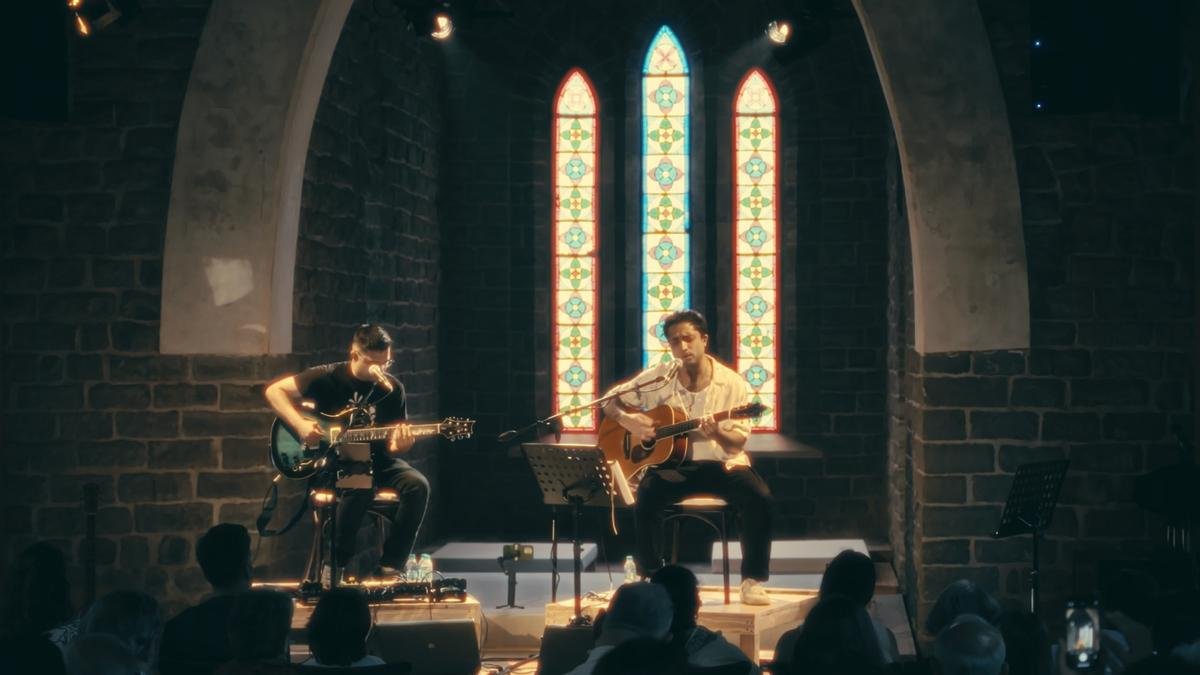
The opening weekend, at the end of January reflected that sensibility. It began with reflection and poetry by Kausar Munir, interwoven with readings by Shanaya Rafaat, before moving into the acoustic textures of Nikhil D’Souza. Jazz followed with the Sanjay Divecha Trio, and the weekend closed with morning ragas on the bansuri by Rakesh Chaurasia. In a room that holds only a 100 listeners, each shift in tone registered palpably.
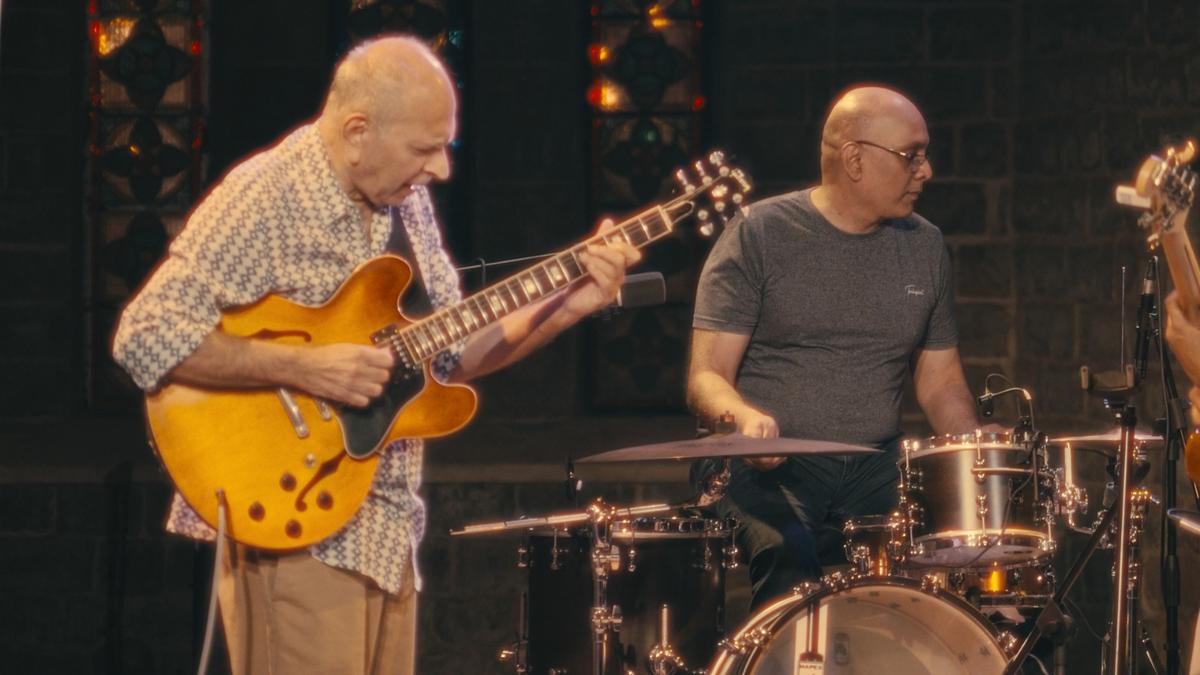
Sanjay Divecha Trio live at Abbey 301
Viability, of course, hinges on geography. Khandala sits roughly 80 kilometres from Mumbai — close enough for a considered weekend drive, far enough to deter the casual attendee. The Mumbai–Pune corridor carries steady traffic year-round, yet the ghats impose seasonal moods: monsoon fog, holiday congestion, the occasional landslide advisory. Abbey 301 cannot rely on walk-ins but must cultivate intention.
“We’ve just started. It’s a slow process,” Pushan says of the curatorial vision. Outreach and collaborations are in the works and residencies are envisaged. “Abbey 301 is a space where people can develop new ideas, play off the audience, and let the historical and the contemporary coexist in time. We aim to be for and of the community.”
That ambition extends beyond ticketed evenings. The venue’s outreach initiative, Setu, is already active in local schools. “It goes beyond arts instruction to strengthen language skills, self-confidence, and empathy through drum therapy and spoken word,” says Kate Currawalla, a member of the Steering Committee. The programme seeks to identify and support resource persons from the region to deliver workshops across schools and the wider community, creating employment alongside artistic engagement.
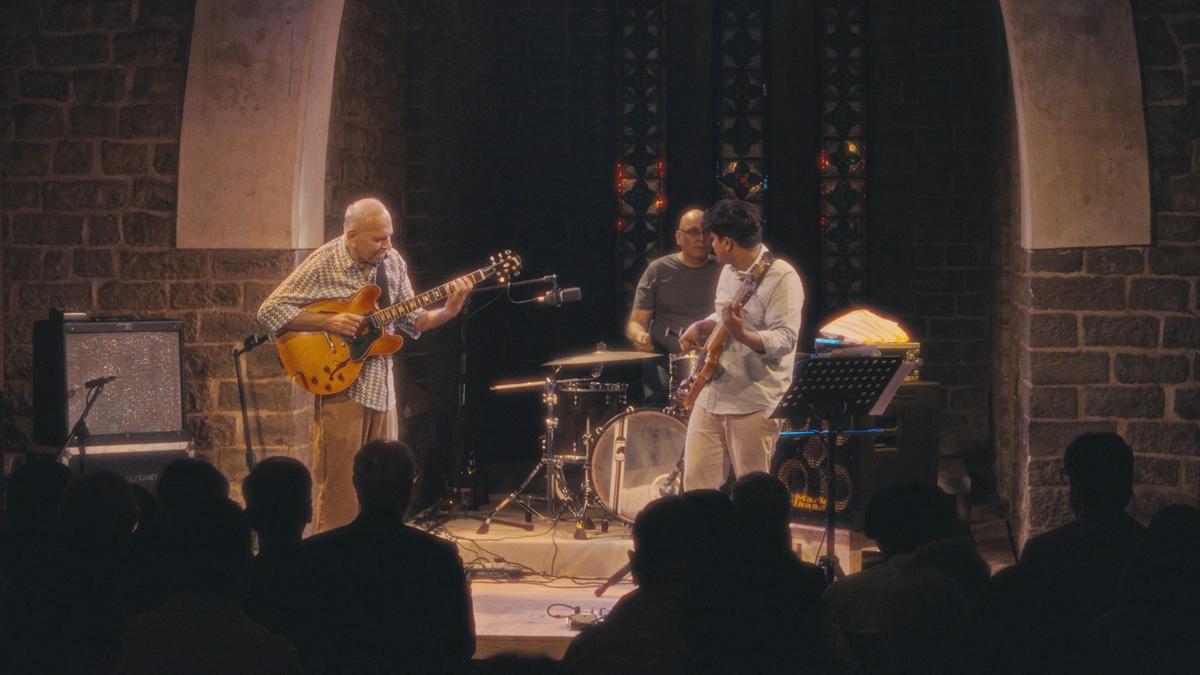
Sanjay Divecha Trio
A restored chapel in a hill station can easily become picturesque — another backdrop for metropolitan leisure. The harder task is embedding it within the rhythms of the region. Abbey 301’s experiment lies somewhere between pilgrimage and participation: a place worth driving to, and a place that belongs where it stands.
For upcoming shows and ticket details, visit www.abbey301.org
Published – February 27, 2026 05:13 pm IST