What must a meditative room provide? Silence, an absence of sensorial overload, a focus on nature or maybe a guiding voice? What if an entire museum could use its spatial plan, surfaces, and immersive experience to drive inward reflection? The Aatma Manthan Museum, located in Nathdwara, Rajasthan, has been envisioned as a material meditation on form where the space is the muse, and the method of arriving at stillness is movement across its zones.
Winning the prestigious BLT Built Design Awards – Interior Design of the Year last December, the project was recognised for its imaginative design of a meditative museum. The museum offers a technology-assisted meditative experience, without guidance or intentional direction by a voice.
Sanjay Puri
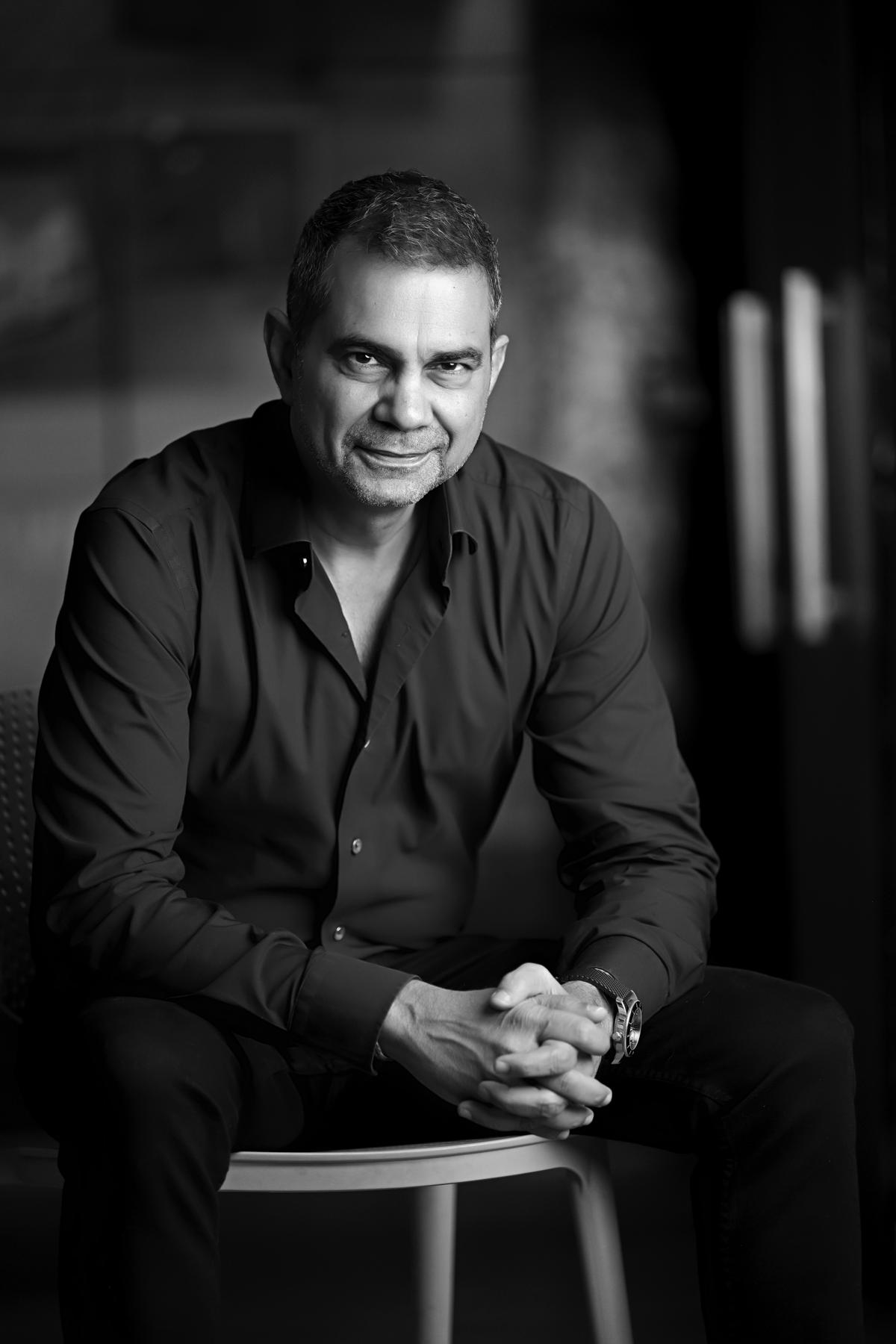
The moniker of the museum is derived from a combination of aatma (soul), mana (mind), and tan (body) to evoke a meditative state. Spread out over a sprawling 18,000 sq. ft. and built on a budget of ₹9 crore, the project was designed by the Mumbai-based firm Sanjay Puri Architects. Its principal architect, Sanjay Puri, says the shape of the plot presented both an opportunity and an obstacle in creating a sequential, immersive space.
Located at the base of the State of Belief, the space is not a regular geometrical one; it is an undulating, irregular expanse that requires a reimagining of the traditional meditative room.
The area had to set itself apart from the traditional museum template. “Our biggest challenge during ideation was the irregular shape of the plan, and how best to create a meditative space that would immediately offer visitors an oasis of calm from the crowds outside. We also moved away from the museum as a space for artefacts, to a more sensorial experience,” Puri explains.
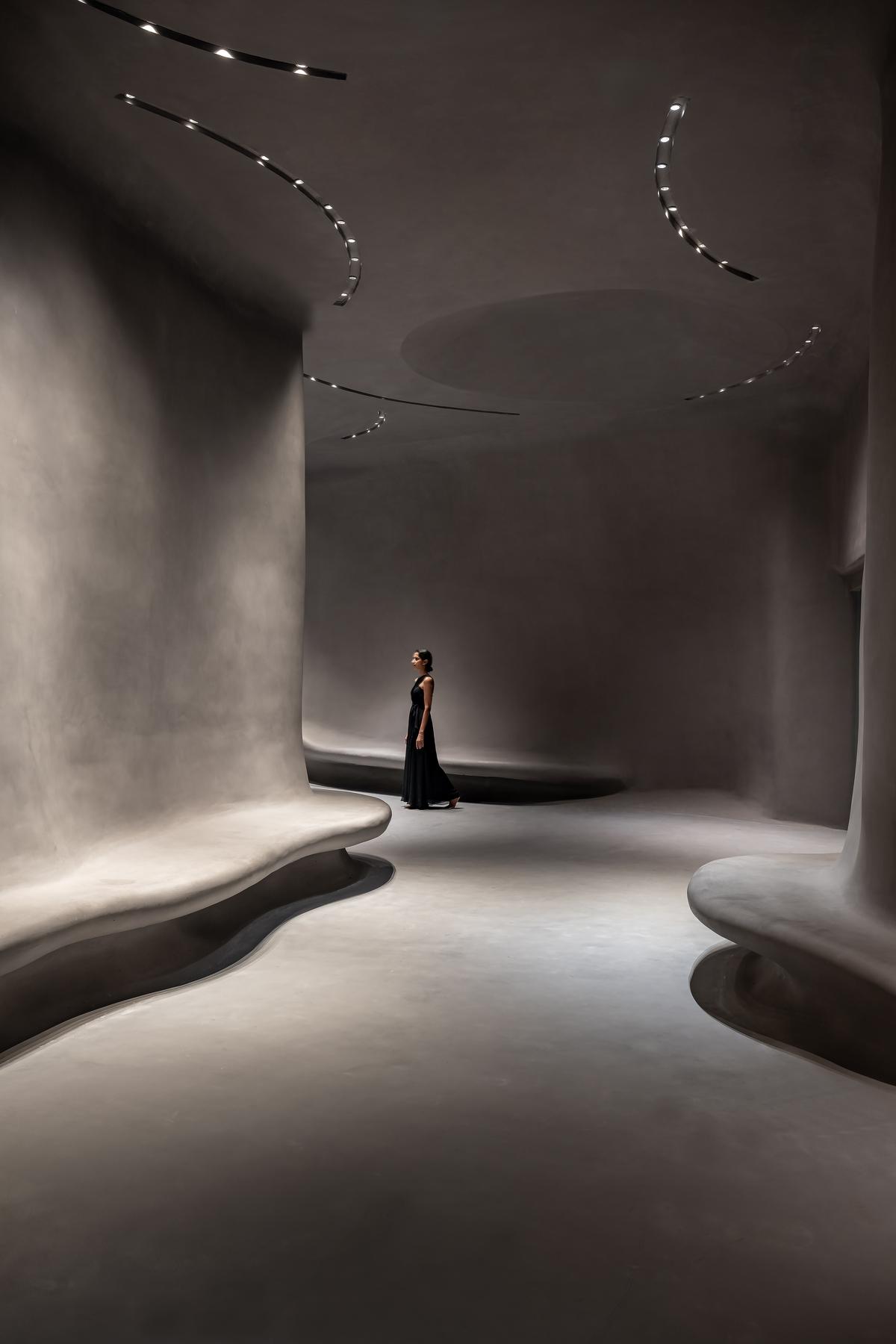
The 18-room museum starts with a stark grey undulating reception where seats seem to mushroom from the cavernous walls, and the floor flows into the structure as easily as the ceiling encasing it.
“We decided on one seamless space, one material, one palette. So, we chose to create a 2,000-sq.ft. open reception with a singular table-like surface that grows out from the floor, and seats along the perimeter. With simple track lighting that peeks out at intervals within the ceiling, it’s efficient without being overwhelming,” he says. Tall grey columns lead the eye to the corridor ahead, while the entire area is designed to mimic organic forms in a single tone. “Grey was better than white for the museum. It does not show dirt, is not as stark as black, and yet is an ideal vehicle for the floor-to-ceiling projections across all the rooms,” he adds.
The nanoconcrete (a hybrid polymer coating applied over a solid framework to provide smooth, flowing surfaces) is seamless, so there are no lines on the floor, and the museum’s visuals flow beautifully across all surfaces. To create the finish, wire mesh was moulded on site. Insulation was then added for better sound absorption, followed by a nano-concrete layer by Flexstone to complete the look. “The entire project took just six months,” says Puri.
What is nanoconcrete?
Flexstone provided the surface application. Its FlexNano Coating System®, a hybrid polymer modified coating (composed of liquid polymers, hardeners, specific aggregates, and a water-based resin mixture), was used to cover the entire surface of the museum. A uniform coating of up to 2mm was applied without joints (grouting) on the floors, ceilings, roofs, and walls. The coating is a no-VOC (Volatile Organic Compound), water-based solution so there is no fear of strong aromas or oily surfaces tarnishing the sensorial experience within the space.
To allow visitors to dwell in complete silence and enter a meditative state, the reception is shorn of ornamentation or foliage. “This was intentional. We did not want anything to distract the visitor, so there’s this absence of sensory overload. It prepares you for what’s inside,” shares the architect.
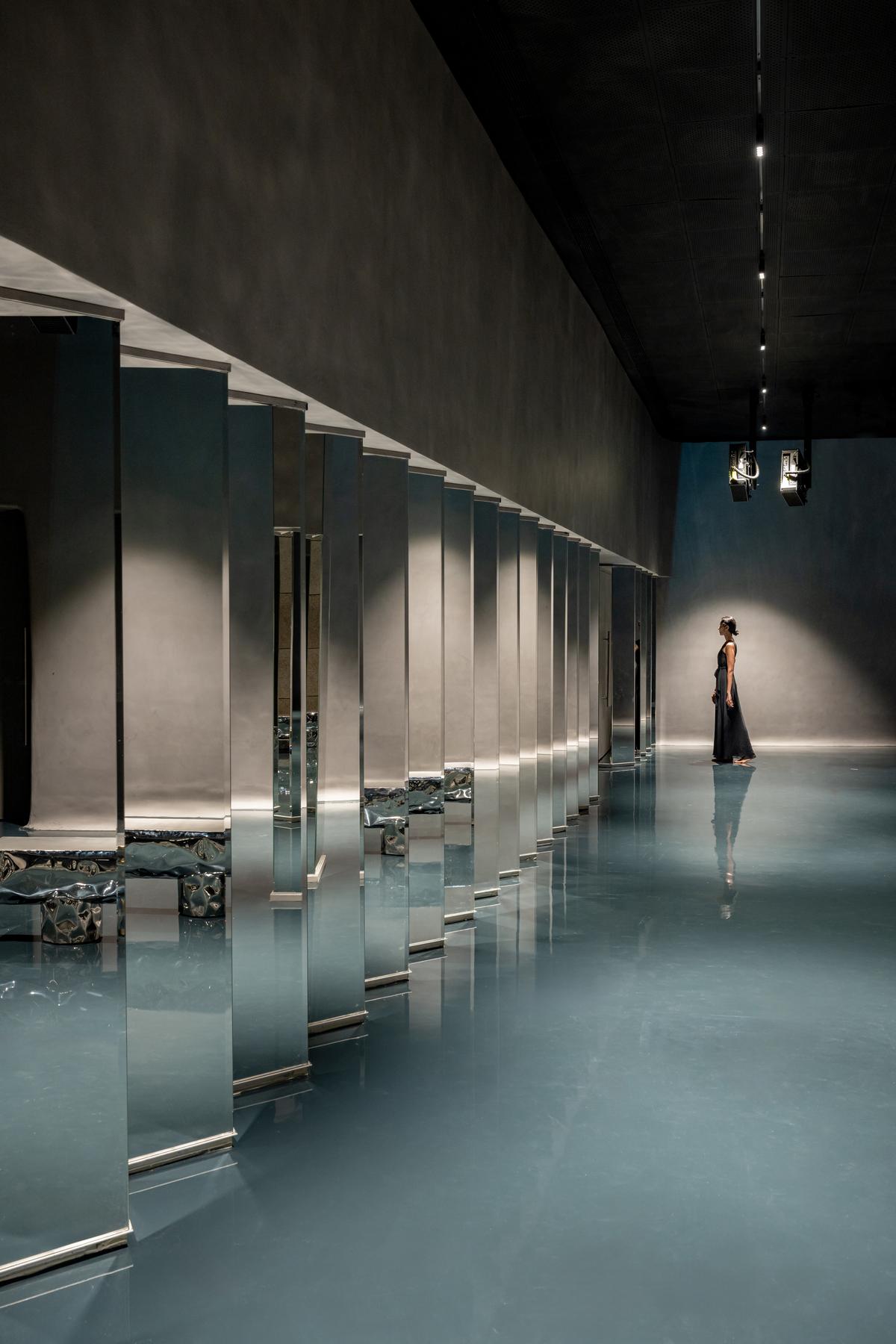
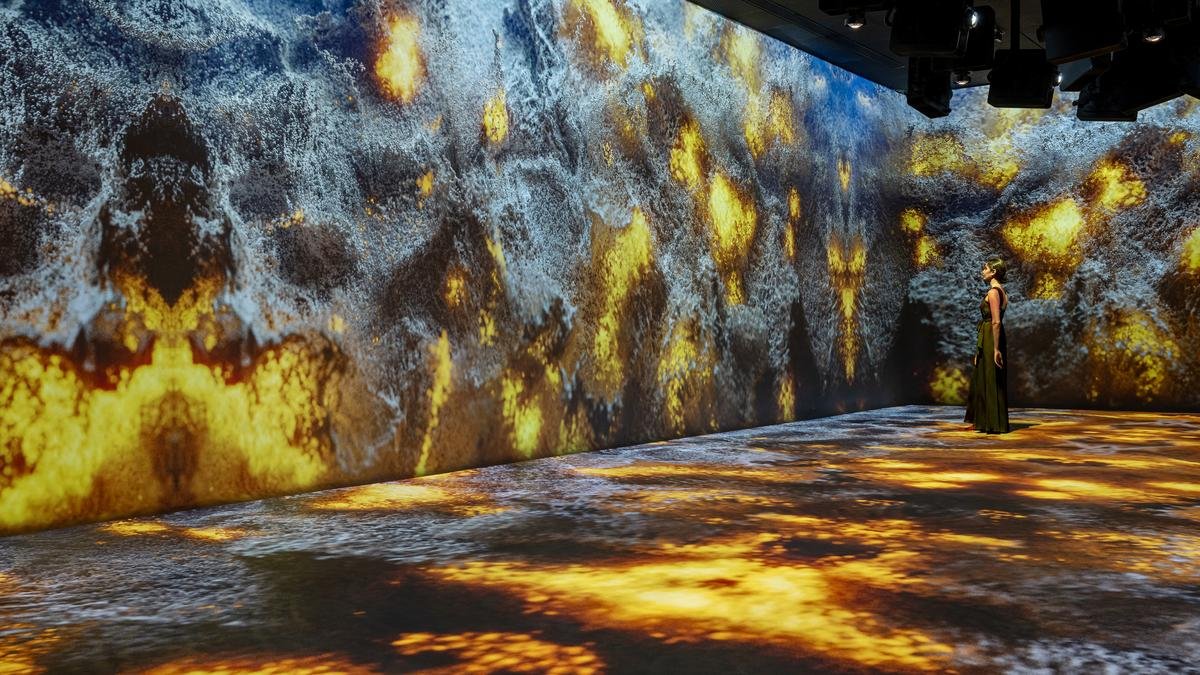
If the reception evokes a sense of space, it leads into a long, narrow corridor with a serpentine queue of images from the making of the museum. This sets the tone for what is to come, moving from just visual cues to both visual and auditory cues for meditation in the rooms. The first elemental room has large floor-to-ceiling screens that project calming visuals of flowing lava, foamy waves, and a star-riddled night sky. Visitors can take a seat and observe them before moving on to the next space.
Global recognition
Sanjay Puri has been on the jury of the World Architecture Festival since 2010, and is the first Indian architect to serve on it. The firm has won over 475 awards, including 350 international design awards, and been no. 32 on Archello’s list of Top 100 Architects Worldwide.
Each immersive experience thereafter employs more real estate. First, visuals appear only on the walls; in the second room they cover the walls and ceiling; by the third, the walls, floor, and ceiling immerse visitors in nature.
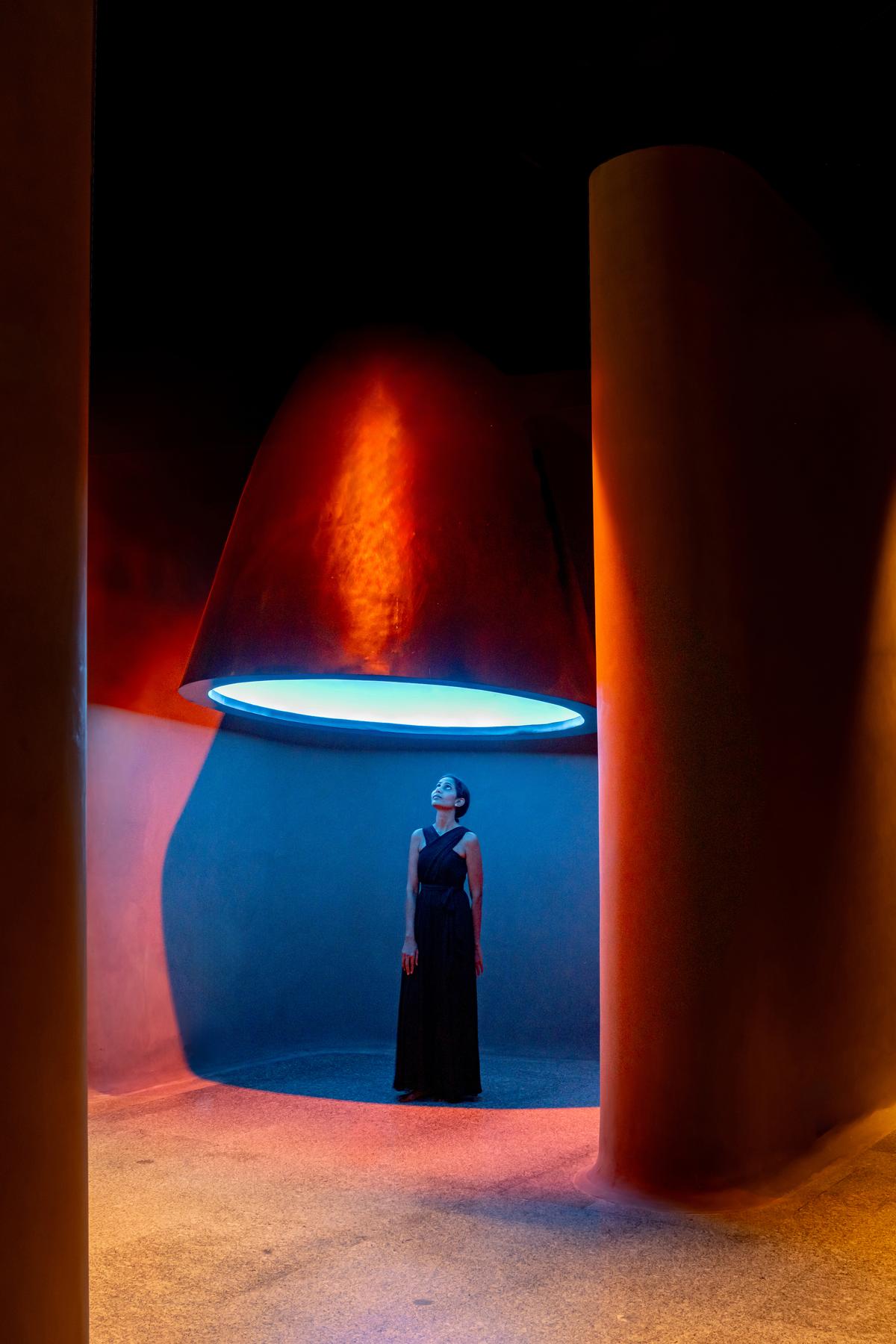
“The rooms gradually add more sensory cues — visuals and audio. Botanical imagery, floating space rocks, crystals arising from the floor, all these visuals are accompanied by soothing auditory cues. That’s where having a seamless nanoconcrete surface is the perfect canvas,” explains Puri.
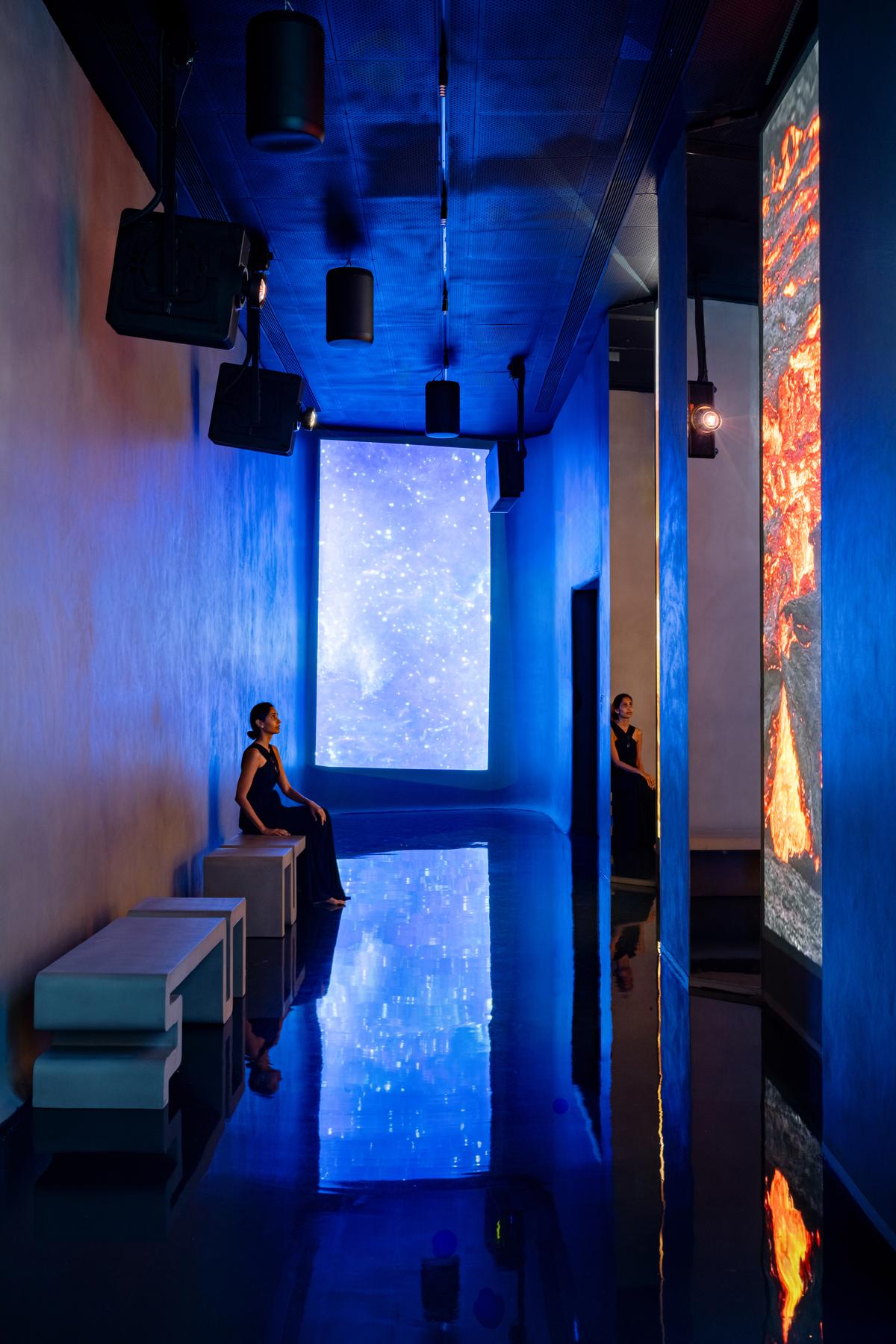
He adds, “Every audio-visual experience is carefully curated. Totally, this walk takes around 15-20 minutes, and only 10-15 visitors are allowed at a time.” The timing allows people to rest at each space, slowly building on the immersive experience. “The set number of visitors per batch is ensured for safety and occupancy limits within the spaces, the size of the rooms, and to stave off a feeling of overcrowding.”
The playlist in the museum is designed to play on a loop, with acoustics by Sonosphere Acoustic Design Consulting. Axis Three Dee Studios Pvt. created the audio-visual displays. “The experience is largely a sensory journey. Creating these kinds of public spaces is a great experience,” states Puri.
The Aatma Manthan Museum explores natural organic forms and movement while employing technology to distinguish itself from the ornamental palaces and formidable forts seen across the state of Rajasthan. The intentional absence of ‘design motifs’ allows visitors to focus on the visuals, the cool surfaces they sit on, and the soft sounds that surround them. The lighting, acoustic design, material curation and spatial structure all work in tandem, to set the museum apart from others in the space. Here, the only voice guiding your meditation, is the voice within.
The freelance writer is based in Chennai.