Business

Asian stocks climb on Fed rate cut hopes; Wall Street’s big rally loses steam amid signs of slowing US economic data


Asian stocks climb on Fed rate cut hopes; Wall Street's big rally loses steam amid signs of slowing US economic data

Asian stocks mostly rose on Thursday as weaker US economic data raised hopes that the Federal Reserve may soon cut interest rates, with attention focused on upcoming employment data.Investors are also watching closely for upcoming US jobs data and any updates on possible trade talks between President Trump and China’s Xi Jinping, which White House sources suggest could occur this week.US markets were subdued following an ADP report showing private-sector employment increased by 37,000 in the previous month, significantly below April’s 60,000 and falling short of Bloomberg survey predictions.US futures declined slightly alongside oil prices. The Japanese Nikkei 225 decreased by 0.2% to 37,658.46, while Australia’s S&P/ASX 200 recorded a marginal decline of 0.1% to 8,535.10.The South Korean Kospi surged 2.1% to 2,829.48 as newly appointed president Lee Jae-myung commenced his leadership, pledging to initiate dialogue with North Korea and strengthen trilateral cooperation with the US and Japan.The Hang Seng index in Hong Kong rose 0.9% to 23,856.54, whilst Shanghai’s Composite remained largely stable with a minimal decrease of less than 0.1% to 3,374.30.Early trading in Asia showed gains across Hong Kong, Sydney, Singapore, Taipei and Wellington. Shanghai remained stable while Tokyo declined prior to a significant Japanese government bond sale.Indonesian markets improved slightly as authorities implemented a $1.5 billion economic stimulus after the region’s largest economy recorded its weakest growth in over three years during the first quarter.Earlier on Wednesday, the S&P 500 remained essentially flat at 5,970.81, staying 2.8% below its peak. The Dow Jones Industrial Average declined 0.2% to 42,427.74, while the Nasdaq composite increased 0.3% to 19,460.49.The bond market displayed significant movement, with Treasury yields falling after disappointing economic reports.The ADP report indicated that private sector employment growth in the US fell considerably short of economists’ projections last month. This could signal potential concerns for Friday’s comprehensive employment report from the US Labour Department, a crucial economic indicator for market analysts.The US employment sector has demonstrated unexpected stability despite prolonged high inflation and potential impacts from President Donald Trump’s tariff policies. However, any deterioration in employment could adversely affect the broader economy.Weaker job data has led traders to bet that the US Federal Reserve may cut interest rates later this year to support the slowing economy. This expectation pushed down Treasury yields.The drop followed a disappointing ADP jobs report, which also triggered a reaction from Donald Trump. On his Truth Social platform, he urged Fed Chair Jerome Powell to act faster, saying, “‘Too Late’ Powell must now LOWER THE RATE.” “He is unbelievable!!!” he added.So far in 2025, the Fed hasn’t lowered rates after cutting them several times in 2024. One reason for holding off is to assess how Trump’s tariffs could impact inflation and economic growth.While lower interest rates may help boost the economy, they also risk driving inflation higher. At the same time, long-term Treasury yields have been rising because investors are concerned about the growing US debt, especially with new tax cuts being discussed in Washington.

Key Market Figures as of 02.30 GMT

  • Tokyo (Nikkei 225): Down 0.2% at 37,658.46
  • Hong Kong (Hang Seng): Up 0.9% at 23,871.21
  • Shanghai (Composite): Flat at 3,374.87
  • New York (Dow Jones): Down 0.2% at 42,427.74 (close)
  • London (FTSE 100): Up 0.2% at 8,801.29 (close)


Source link

Stock market today: Nifty50 above 24,600; BSE Sensex up 100 points


Stock market today: Nifty50 above 24,600; BSE Sensex up 100 points
Market experts anticipate continued consolidation, influenced by global trends and economic indicators. (AI image)

Stock market today: Nifty50 and BSE Sensex, the Indian equity benchmark indices, opened in green on Thursday. While Nifty50 was above 24,600, BSE Sensex was up 100 points. At 9:21 AM, Nifty50 was trading at 24,632.55, up 12 points or 0.050%. BSE Sensex was at 81,037.41, up 39 points or 0.048%.Market experts anticipate continued consolidation, influenced by global trends and economic indicators, whilst individual stocks may see movement based on sector-specific developments.VK Vijayakumar, Chief Investment Strategist, Geojit Investments Limited says, “Both geopolitical and economic news are likely to weigh on markets in the near-term. A serious concern is a potential Russian retaliation to the recent Ukraine attacks on Russian planes. How serious this will be and what will be its consequences are unknown factors now.”“The major economic news is the sharp dip in the US ISM PMI data. This indicates that the US economy is slowing down sharply. The US 10-year bond yield has declined to 4.36 % and, given the slowing US economy, is likely to trend lower. This will turn out to be good for EMs like India in the medium term, but the spike in uncertainty will keep the market within the present range for the near-term. Buy on dips continues to be the ideal strategy now. Rate sensitives will be preferred in view of the expected rate cut by the MPC on 8th June.”American markets showed mixed results on Wednesday. The S&P 500 remained flat, whilst the Nasdaq Composite increased slightly and the Dow Jones Industrial Average declined, following poor economic data highlighting the impact of Trump’s trade policies.Gold prices edged higher on Thursday following disappointing U.S. economic data that increased the appeal of safe-haven investments, whilst traders evaluated ongoing global economic and political uncertainties.Oil prices declined in early Thursday trading following increased U.S. gasoline and diesel stockpiles and Saudi Arabia’s reduction in July crude prices for Asian customers.Foreign portfolio investors sold shares worth Rs 1,076 crore net on Wednesday, whilst domestic institutional investors purchased Rs 2,567 crore net.Foreign institutional investors’ net short position in futures market decreased from Rs 1.04 lakh crore on Tuesday to Rs 1.02 lakh crore on Wednesday.(Disclaimer: Recommendations and views on the stock market and other asset classes given by experts are their own. These opinions do not represent the views of The Times of India)


Source link

Donald Trump raises steel and aluminum tariffs to 50%: Will higher levies affect US industry? What’s next


Donald Trump raises steel and aluminum tariffs to 50%: Will higher levies affect US industry? What's next

US President Donald Trump has doubled down tariffs on steel and aluminum imports to 50%, following his earlier implementation of 25% tariffs less than three months ago.The move is intended to boost the US steel industry, but many businesses warn it will lead to higher prices for consumers.According to the New York Times, key sectors like housing, automotive, oil, and canned goods are expected to be hit hardest by Trump’s increased tariffs. Homebuilders, car makers, oil producers, and packaging companies are expected to face rising costs, which many may pass on to consumers.1. US steelmakers to create more jobs: Domestic steel industry representatives have welcomed the higher tariffs, saying they could boost investment and create more jobs in the US. Kevin Dempsey, president and chief executive at the American Iron and Steel Institute, stated that the increased tariffs would enhance US steel producers’ competitiveness against China and other nations flooding the global market.He noted that many in the industry felt the earlier 25% tariff on steel imports wasn’t enough to offer adequate protection.“The increase to 50% is well justified and will help prevent a new surge in imports of steel,” Dempsey said. He further continued that higher tariffs would eventually help create new jobs. “Over time, increased production will lead to increased employment,” Dempsey added.2. Foreign steel and aluminum producers: British steel and aluminum exporters will continue facing a 25% tariff when selling to the US, thanks to a temporary deal with the Trump administration. However, other countries like Canada are expected to face steeper challenges under the new tariff rules. As the primary foreign supplier of steel and aluminum to the United States, Canada’s response has been strong. The Canadian Steel Producers Association criticised the increase, stating it “essentially closes the US market to our domestic industry.”The European Steel Association has expressed concerns that this increase might redirect cheap foreign steel towards European markets.3. Impact on Aluminum industry: Aluminum industry groups back the US government’s move to boost the domestic sector, but they stress the need for continued aluminum imports from Canada. These imports are essential for making specialised products that support American jobs and investments.“We urge the administration to take a tailored approach that reserves high tariffs for bad actors — such as China that floods the market and includes carve outs for proven partners — such as Canada,” according to Matt Meenan, a spokesperson for the Aluminum Association.They also cautioned that higher tariffs alone won’t boost domestic production unless trade policies become “consistent, predictable trade and tariff policy to plan for current and future investment.”4. US Automakers at a disadvantage: Increased steel tariffs are expected to drive up the cost of cars and trucks. This spells trouble for both consumers, who are already dealing with high vehicle prices, and carmakers, who are already burdened by rising costs due to earlier tariffs on imported parts and engines.“These tariff increases will further raise the cost of both imported and domestic steel and aluminum, thereby increasing the cost of assembling a car in the United States,” said Matt Blunt, president of the American Automotive Policy Council, which lobbies on behalf of General Motors, Ford Motor and Stellantis.“This action places US industry and US workers at a disadvantage in the global marketplace,” he added. The precise impact of increased metal tariffs on vehicle prices remains uncertain. Analysts suggest price increases could range from several hundred dollars to over $1,000 per vehicle. The timing of these price effects is also uncertain.5. Homebuilders: The steel and aluminium tariffs are expected to increase construction costs and potentially limit new housing developments.Buddy Hughes, chair of the National Association of Home Builders, indicated that prior to the latest increase, builders had calculated tariffs would add $10,900 to new home costs.President Trump’s move to double steel and aluminum tariffs will have a negative impact on housing affordability by further disrupting building material supply chains and fueling business uncertainty,” Hughes said in a statement.6. Can manufacturers: The increased metal tariffs will likely result in higher prices for canned goods at supermarkets.The Can Manufacturers Institute reports that domestic tin mill steel production has decreased by 75% over eight years due to significant production cuts.This reduction has led domestic can manufacturers and food producers to import approximately 80% of tin mill steel from international allies.7. Oil and Gas producers: The steel tariff increase will affect US oil companies’ operations, as steel is essential for pipeline construction and resource extraction. Steel comprises 10% to 20% of new well costs.Rising metal costs coinciding with falling oil prices create difficulties for producers. Smaller operations, which typically cannot order materials far in advance, are particularly affected.


Source link

Trump-related crypto projects prompt user confusion, warnings from Trump’s son


Magic Eden used an image of Trump holding up his fist that Trump himself has used to promote his $TRUMP crypto on January 18 [File]

Magic Eden used an image of Trump holding up his fist that Trump himself has used to promote his $TRUMP crypto on January 18 [File]
| Photo Credit: REUTERS

As U.S. President Donald Trump leans more heavily into the crypto sector, his name is being used to promote several crypto projects that have nothing to do with his own ventures, prompting confusion among users and making them more vulnerable to being scammed.

Trump’s son Eric Trump on Wednesday (June 4, 2025) used his X account to call out a project that was not affiliated with the official World Liberty Financial crypto project that Trump had previously endorsed.

The project in question, Magic Eden, was using images of Trump and the $TRUMP crypto ticker in order to rally up hype around an upcoming crypto wallet that it claimed was “official.”

Magic Eden used an image of Trump holding up his fist that Trump himself has used to promote his $TRUMP crypto on January 18, which led to user confusion.

Trump’s son stated, “This project is not authorized by @Trump. @MagicEden I would be extremely careful using our name in a project that has not been approved and is unknown to anyone in our organization.”

Many X users in the comments expressed their confusion as they tried to differentiate between the $TRUMP crypto endorsed by the president and the version that Eric Trump had cautioned against. Others were not clear as to the links between World Liberty Financial, a Trump-linked crypto project working on a stablecoin, and the $TRUMP meme token.

Magic Eden is a trading platform with more than 800,000 followers on X. The account bio noted that its posts were “not intended for US or UK audiences.”

Trump’s promotion of crypto, and especially his own meme token, has made him the subject of criticism and concern as legal experts point out potential conflicts of interest. However, the U.S. crypto community has largely welcomed Trump’s stance, hoping that his return to the White House will signal looser crypto regulations for businesses.


Source link

Impact of Trump’s new tariffs on steel, aluminium on U.S. economy


While addressing steel workers in the U.S. state of Pennsylvania, Mr. Trump threatened to increase the import tariffs on steel and aluminium from the current 25% to 50% from June 4, upset by the slow progress of a trade deal between the U.S. and the EU.

Steel and aluminium are used as basic inputs in a host of industries and sectors ranging from transportation (rail, road, sea and air), defence and aerospace, household appliances, engineering machinery of all kinds, agricultural tools and implements, civil engineering and construction, power generation and transmission and a whole lot of others.

Now that the tariffs have come into effect, they would further increase the domestic prices of goods and services in the U.S. where steel and aluminium are used, either as intermediate products and inputs or as fully finished products, lower the consumer and industrial demand for such products and slow down the overall growth of the economy, as steel and aluminium happen to be key basic inputs used in a wide variety of industries and economic activities. The U.S. economy had contracted by 0.2% in the first quarter of 2025 as compared to the previous quarter, while inflation had declined to 2.31% at the end of April 2025, still higher than the threshold level of 2% for the Federal Reserve to start cutting interest rates again.

Impact on GDP

With the economic and trade disruption caused by uncertain trade policies and the widening U.S. Budget deficit, there is a fear that U.S. inflation may go up again, forcing the Federal Reserve to postpone its interest rate cuts to September, and in a worst-case scenario, towards the end of the year.

The Paris-based Organization for Economic Cooperation and Development (OECD) has forecast a slowing down of the U.S. GDP growth rate to 1.6% in 2025 from 2.8% in 2024 and a fall in World GDP growth rate to 2.9% for 2025 as compared to 3.3% in the previous year. In April 2025, the U.S. economy added 1,77,000 new jobs, exceeding previous expectations, though falling short of the 2,56,000 new jobs generated in December 2024, the last month of the Biden administration, before Mr. Trump assumed office. The unemployment rate, however, remained steady at 4.2% April 2025.

Loss of consumer’s surplus

Economic theory tells us that when an import tariff is imposed on a commodity in a free-market economy following free international trade, the higher tariff-inclusive price will become the new domestic price. It reduces the consumer’s surplus, which is calculated as the notional difference between what consumers are prepared to pay for a product or service and what they actually end up paying – the lower the actual price the higher the consumer’s surplus and vice versa. It transfers some of this lost consumer’s surplus to the domestic producers of the import competing industry as producer’s surplus, while the rest (of the lost consumer’s surplus) is treated as a deadweight loss to society as a whole.

Still, Governments all over the world use import tariffs as measures to increase Government revenue (ultimately paid for by the domestic consumers) and to support domestic manufacturers of the import competing products for generating local employment, incomes and economic growth. Rarely are tariffs used as measures to promote national security which Mr. Trump is signalling in justification of his new 50% levies on steel and aluminium imports.

Nominal vs. effective rate

The rate of effective protection provided by an import tariff to domestic producers of an import competing product is perceived to be high, if the tariff on the imported input used in the manufacture of that product is lower than the tariff on the imported finished product. Otherwise, the domestic producers suffer the consequences of negative protection and the anomalies of an inverted duty structure, which arises when the tax rate on inputs used to produce goods or services is greater than the tax rate on the finished output.

Impact on U.S. auto units

Let us consider the impact of Mr. Trump’s new tariff levies on steel and aluminium imports on the American automobile producers. Currently automobile imports into the U.S. from the EU attract an import tariff of 25%. With the new 50% import tariffs on steel and aluminium imports from the EU and other countries (excepting U.K.), American producers of automobiles who use steel and aluminium as inputs in their manufacturing process, will not only see a sharp rise in their manufacturing costs, but will also see the 25% import tariff on automobiles not providing the protection that it is intended to provide. Far from providing a positive rate of effective protection, the proposed higher tariffs of 50% on steel and aluminium imports, will end up as disincentives to ramping up domestic production of automobiles in the US.

Domestic firms

Let us illustrate this with a hypothetical example. Assume the basic starting price of a Ford Mustang car in the U.S. is $30,000. The cost of steel and aluminium parts used in the Mustang car is $20,000. The U.S. is taxing a comparable car model of the EU imported into the U.S. (Volkswagen Jetta), an import tariff of 25%, but the imported steel and aluminium metals and components, an import tariff of 50%. The rate of effective protection provided to Ford to ramp up the domestic production of Mustang car can be estimated using the following formula:

g = {(t-a¡t¡) / (1-a¡)}

where,

g= rate of effective protection to domestic producers of the final product,

t= nominal tariff rate on consumers of the final product,

a¡= ratio of the cost of the imported input to the price of the final product in the absence of tariffs,

t¡= the nominal tariff rate on the imported input.

In the above example:

t= 25%

t¡= 50%

price of final product = $30,000

cost of steel input = $20,000

Negative vs. positive rate

Using the above formula for estimating the rate of effective protection, g can be calculated as -0.25 or -25%, which is a negative rate and acts as a disincentive for ramping up the domestic production of Ford Mustang cars. On the other hand, if the import tariff on steel and aluminium metals and parts is fixed at 10%, like the basic import tariff on all other imports announced by Mr. Trump, then the rate of effective protection, g, will be 0.55 or 55%, which will be a sufficient incentive for Ford to ramp up the domestic production of its Mustang cars.

(The writer is former associate professor of economics, Loyola College, Chennai)


Source link

Desi AI founders risk falling behind overseas peers: Accel


Desi AI founders risk falling behind overseas peers: Accel

BENGALURU: Venture capital firm Accel partners Shekhar Kirani and Prayank Swaroop highlighted concerns about Indian AI startups lagging behind global competitors, despite having comparable technical abilities. They cited insufficient urgency and limited global vision as key issues.During a media roundtable on Wednesday, they observed that while India is experiencing an emergence of technically proficient, AI-focused founders, many maintain a cautious, risk-averse approach that could prove detrimental in this fast-moving sector. “In the Valley, it’s a warzone. Engineers are building, iterating, raising money, and chasing scale aggressively,” Kirani said. “In India, many still operate in peacetime mode, trying to optimise for capital efficiency, fixing bugs, and selling to five customers. That’s not how you win this AI cycle.” The disparity is evident in valuations. Kirani noted that US-based AI-first startups demonstrating revenue growth can achieve valuations over $500 million at $15 million ARR, while traditional SaaS firms with similar figures typically receive valuations around $100 million. “The market rewards velocity. If you’re an AI-native company growing fast, the delta in pull and valuation is unprecedented,” he said.Swaroop indicated a shift in investor perspectives. “Everyone’s looking for that breakout moment. Earlier, a company showing $1-2 million ARR might be considered early stage. Now, if it’s AI-first and compounding fast, the expectation is that it hits $50-100 million in revenue within 12-18 months,” he said. “The bar is higher, but so is the upside, if the founder is thinking globally.”


Source link

India wants WTO’s dispute settlement mechanism back


India wants WTO's dispute settlement mechanism back

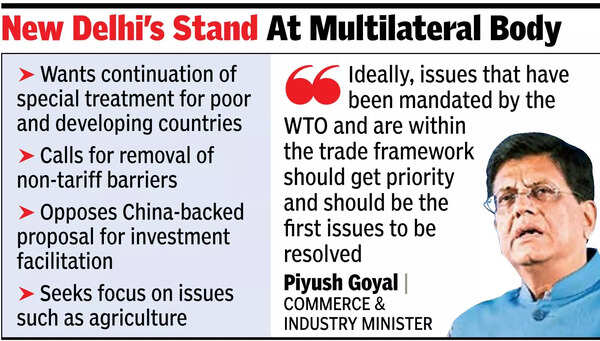
PARIS: India has identified the restoration of the dispute settlement mechanism as the first priority for WTO members and called for maintaining special treatment for poor and developing countries.After a meeting of trade ministers here, commerce & industry minister Piyush Goyal also reiterated India’s opposition to bringing plurilateral initiatives such as investment facilitation under the ambit of the multilateral body. India has argued that the China-backed proposal for investment facilitation will reduce policy space for govt and is meant to pursue Beijing’s investment agenda.

India wants WTO’s dispute settlement mechanism back

“Ideally, issues that have been mandated by the WTO and are within the trade framework should get priority and should be the first issues to be resolved,” the minister told reporters after the meeting.At the mini-ministerial meet of trade ministers, Goyal urged other ministers to bring back the focus on issues such as agriculture, which have been agreed to by the membership in the past but a decision has been pending for more than a decade. He also called for removal of non-tariff barriers.“We have all resolved to collectively work to strengthen the working of the WTO, to ensure the core principles are respected and work towards global good and global growth in trade,” he said, while dismissing concerns of WTO facing an “existential crisis”.Putting in place the dispute settlement mechanism is seen to be at the heart of reinvigorating WTO amid a series of blows by the US during successive presidential tenures, starting with Barack Obama. The US has blocked appointments to the appellate body for resolving disputes, rendering it useless.


Source link

Adani Airports raises $750mn from international banks


Adani Airports raises $750mn from international banks

NEW DELHI: Adani Airports Holdings (AAHL) Wednesday said it has raised $750 million via external commercial borrowings from a consortium of international banks. The transaction was led by First Abu Dhabi Bank, Barclays, and Standard Chartered Bank. The company says it will “use the proceeds to refinance existing debt, invest in infrastructure upgrades, and capacity expansion across six airports -Ahmedabad, Lucknow, Mangaluru, Jaipur, Guwahati, and Thiruvananthapuram, scale non-aeronautical businesses, including retail, F&B, duty free and services across airport network”AAHL is India’s largest private airport operator (in terms of number of airports it operates) and a subsidiary of Adani Enterprises. The company saw 9.4 crore passengers in 2024-25, with an overall capacity of 11 crore passengers.


Source link

Birla to acquire US chemical facility from agri giant Cargill


Birla to acquire US chemical facility from agri giant Cargill

MUMBAI: Aditya Birla Chemicals, a privately held company owned by Kumar Mangalam Birla and his family, is set to acquire a chemical manufacturing facility in the US from agribusiness major Cargill. The facility, spanning 17 acres, is located in Dalton, Georgia. The deal signifies Birla’s continuous expansion in the American manufacturing sector, with investments exceeding $15 billion over the past 17 years, and cementing his position as the biggest Indian investor in the country.“This acquisition represents Aditya Birla’s strategic entry into the US chemicals industry, extending the business model of our other successful manufacturing businesses in the United States, including Novelis and Birla Carbon,” said Aditya Birla Group chairman Kumar Mangalam Birla. The Cargill facility currently employs 50 people and has an annual capacity of 16,000 tons, which will be boosted to 40,000 tons within the next two years. The acquisition is being carried out through Aditya Birla Chemicals (USA), a wholly owned subsidiary of Aditya Birla Chemicals (Thailand).


Source link

Asset freeze: NCLAT denies relief to Gensol


Asset freeze: NCLAT denies relief to Gensol

NEW DELHI: National Company Law Appellate Tribunal (NCLAT) on Wednesday declined to stay NCLT order directing to freeze assets of Gensol, its promoters, and related entities. It has directed two Gensol Group entities – BluSmart Premium Feet and Matrix Gas and Renewable – to approach Ahmedabad bench of the National Company Law Tribunal NCLT with their plea, where the matter has been listed for hearing on June 12.Passing an order on plea filed by the ministry of corporate affairs, a vacation bench of NCLT had on May 28 directed to freeze assets of Gensol, its promoters, and related entities. agencies


Source link