


Business

2 BPO staffers access Coinbase user data


2 BPO staffers access Coinbase user data

BANGALURU: Two India-based employees of US BPO TaskUs illegally accessed sensitive information belonging to their client, Coinbase. These staff members were allegedly part of a larger criminal operation targeting Coinbase, which also affected other service providers working with the cryptocurrency exchange. TNN


Source link

Carlyle offloads 2.6% stake in Yes Bank


Carlyle offloads 2.6% stake in Yes Bank

MUMBAI: Private equity fund Carlyle has sold 2.6% stake in Yes Bank which has left it with a holding of 4.22%. At closing share price the stake is worth Rs 1,737 crore. Meanwhile senior executives Akshay Sapru, country head, private banking and liabilities products and Sanjiv Roy, country head fee based products resigned from the bank. TNN


Source link

Services growth in May stays robust on global demand


Services growth in May stays robust on global demand

NEW DELHI: Activity in service sector remained robust in May as demand from overseas was the strongest in nearly two decades of data collection. There was also a record rise in employment in sector, a survey showed. Registering 58.8 in May, the HSBC India Services PMI Business Activity Index was largely in line with April’s reading of 58.7 and signalled another sharp rate of expansion. The 50-point mark separates expansion from contraction in the survey, which is compiled from responses to a question sent to 400 service sector firms.


Source link

Nvidia’s Blackwell chips double AI training speed, MLCommons benchmark shows


Nvidia’s Blackwell chips double AI training speed, MLCommons benchmark shows

Nvidia’s newest Blackwell chips have significantly advanced the training of large artificial intelligence systems, dramatically reducing the number of chips needed to train massive language models, new data released Wednesday shows.The results, published by MLCommons, a nonprofit that issues benchmark performance results for AI systems, detail improvements across chips from Nvidia and Advanced Micro Devices (AMD), among others, Reuters reported. The benchmarks focus on AI training — the phase where systems learn from vast datasets — which remains a key competitive frontier despite the market’s growing focus on AI inference, or responding to user queries.One major finding was that Nvidia and its partners were the only ones to submit data for training a large-scale model like Llama 3.1 405B, an open-source AI system from Meta Platforms with trillions of parameters. This model is complex enough to stress test modern chips and expose their true training capabilities.According to the data, Nvidia’s new Blackwell chips are more than twice as fast per chip as the previous-generation Hopper chips. In the fastest result, a cluster of 2,496 Blackwell chips completed the training task in just 27 minutes. By contrast, more than three times that number of Hopper chips was needed to match or better that performance.At a press conference, Chetan Kapoor, chief product officer at CoreWeave — which collaborated with Nvidia on the benchmark tests — highlighted a broader industry trend.“Using a methodology like that, they’re able to continue to accelerate or reduce the time to train some of these crazy, multi-trillion parameter model sizes,” Kapoor said, referring to a shift from massive monolithic systems to modular training infrastructures made up of smaller chip groups.The benchmark results underline Nvidia’s dominance in the AI training space, even as rivals like China’s DeepSeek claim competitive performance with fewer chips. As the race to power ever-larger AI systems intensifies, chip efficiency in training tasks remains a critical metric.


Source link

UP among best fiscally managed states despite low per capita income: Finance Commission chief


UP among best fiscally managed states despite low per capita income: Finance Commission chief
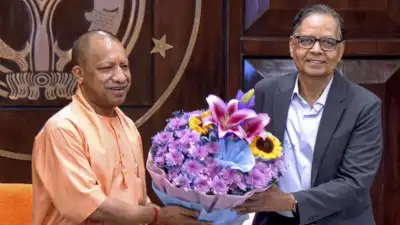
Finance Commission chief Arvind Panagariya & UP cm Yogi Adityanath (PTI)

Uttar Pradesh, despite having the second-lowest per capita income in the country, has emerged as one of the best-managed states financially, Chairman of the 16th Finance Commission Arvind Panagariya said on Wednesday.Speaking at a press conference at Lok Bhawan during the Commission’s visit to the state capital, Panagariya said the panel was briefed on UP’s economic reforms, demographic shifts, fiscal performance, and development achievements, as reported PTI.“All in all, Uttar Pradesh is a well-run state. Its tax collection as a proportion of GSDP is among the highest in the country,” he said, following meetings with Chief Minister Yogi Adityanath, Chief Secretary Manoj Kumar Singh, and senior state officials.“Indeed, one would like to see other states be able to do the tax collection as the proportional GSDP to the tune of what UP can do, which will go a long way towards solving the revenue problems of the other states as well,” Panagariya added.He praised the state’s financial discipline, stating that its expenditures are well-planned and within budget limits, while fiscal deficits are also maintained within the prescribed norms.“Its expenditures are also well designed and well within its budgets,” he noted. “Its fiscal deficits are well within the usual limits.”According to Panagariya, Uttar Pradesh benefits from two major fiscal advantages – strong own-tax revenue collections and favourable treatment under the Finance Commission’s horizontal devolution formula, which tends to favour states with lower per capita income.“On finances, UP has a double advantage. One, its own tax collections (SGST, excise, etc) are good. The second is, finance commissions are traditionally also, in horizontal devolution, give more weight to poorer states which have lower per capita income. UP has the second-lowest per capita income after Bihar, which has the lowest. That also works to UP’s advantage,” he explained.Acknowledging the state’s prudent financial strategy, he said, “Good finances can also be squandered, but that’s not the case with UP. It has prudently managed its finances.”He added that the state’s debt-to-GDP ratio remains well within manageable levels, enabling more room for development spending rather than debt servicing.“Its debt-to-GDP ratio is also very much within manageable levels. That, of course, makes its finances a little more comfortable because if you have very large debt, then a substantial part of your expenditures ends up being devoted to the interest payment of that debt,” he said.Panagariya also issued a caution regarding high public debt, noting that while current governments may not face immediate consequences, the burden often falls on future administrations.“If you have very high debt, then the government which runs that high debt may not suffer, but future governments end up suffering when you end up creating liabilities for the future,” he said.During the press interaction, he reiterated that Uttar Pradesh, like more than 22 other states, has called for an increase in the states’ share of tax revenue from the current 41 per cent to 50 per cent. The state has also sought special funds for targeted development initiatives.The 16th Finance Commission, constituted on December 31, 2023, under Article 280 of the Constitution, is tasked with recommending the distribution of tax revenues between the Centre and the states for the five-year period beginning April 1, 2026. The Commission is scheduled to submit its report by October 31, 2025, with its recommendations applicable from 2026-27 to 2030-31.


Source link

Majority of states seek 50% share in tax revenue from Centre: Finance Commission chief Arvind Panagariya


Majority of states seek 50% share in tax revenue from Centre: Finance Commission chief Arvind Panagariya

A majority of states have recommended that the Centre increase their share in tax revenue distribution to 50 per cent, Arvind Panagariya, Chairman of the 16th Finance Commission, said on Wednesday.Currently, states receive 41 per cent of the divisible tax pool, while the remaining 59 per cent is retained by the Centre. Addressing a press conference in Lucknow, Panagariya said, “The previous finance commission had set the (tax revenue) share at 41 per cent for states and 59 per cent for Centre. That’s how it is now.”He noted that more than 22 out of the 28 states have recommended raising the states’ share to 50 per cent. “Like most other state governments, UP has also asked for the share to be raised to 50 per cent from the present 41 per cent,” Panagariya said.The Finance Commission is currently conducting state-wise consultations as part of its mandate. The visit to Uttar Pradesh marked the conclusion of its consultations with states, although meetings with some central ministries are expected to continue.When asked whether the Commission would recommend a 50 per cent share for states in its final report, Panagariya declined to commit. “Practically speaking, I can’t tell you (the press) what the commission will do because I also don’t know it yet as it’s a decision of full membership of the commission. What I can speculate though is it is not going to be 50 per cent because that would be too large a jump and such a large jump upsets too many cards,” he said, quoted PTI.Panagariya also observed that, historically, the recommendations made by Finance Commissions have been accepted in full by the government.The 16th Finance Commission was constituted on December 31, 2023, under Article 280 of the Constitution. It is tasked with recommending the distribution of tax revenues between the Centre and the states for the five-year period from April 1, 2026, to March 31, 2031. The Commission is expected to submit its report by October 31, 2025.


Source link

Trump’s tax bill to widen deficit by $2.4 trillion, increase uninsured by nearly 11 million, says CBO


Trump’s tax bill to widen deficit by $2.4 trillion, increase uninsured by nearly 11 million, says CBO

US President Donald Trump’s sweeping tax and spending legislation, now advancing through Congress, will cut taxes by $3.75 trillion but add $2.4 trillion to federal deficits over the next decade, according to a new analysis from the nonpartisan Congressional Budget Office (CBO) released Wednesday.The CBO also projects the bill would lead to 10.9 million more people without health insurance by 2034, including 1.4 million undocumented immigrants currently covered by state-funded programs.The package would also reduce federal outlays by nearly Rs 1.3 trillion during that same period, the report noted, as reported AP.“Republicans cry crocodile tears over the debt when Democrats are in charge — but explode it when they’re in power,” said Rep. Brendan Boyle of Pennsylvania, the top Democrat on the House Budget Committee. “In the words of Elon Musk,” Boyle added, referencing the billionaire and former Trump aide’s criticism of the plan, “this bill is a ‘disgusting abomination.’”The findings land at a critical juncture in the legislative process, as Trump urges Congress to finalize the package by the Fourth of July. The CBO’s assessment, considered a key benchmark for evaluating the fiscal impact of federal legislation, will be closely scrutinized by lawmakers and stakeholders seeking to understand the consequences of the more than 1,000-page proposal.In anticipation of the report, the White House and GOP leaders mounted a pre-emptive critique of the CBO, seeking to cast doubt on its findings. White House Press Secretary Karoline Leavitt said the CBO has been “historically wrong,” and Senate Majority Leader John Thune argued the agency was “flat wrong” in its projections for Trump’s 2017 tax cuts. The CBO last year said government revenue was 5.6% higher than initially estimated, in part due to pandemic-era inflation spikes.Leavitt also suggested bias among CBO staff, despite the agency’s strict ethics rules that prohibit political activities and campaign contributions to ensure objectivity.Along with the projected costs, the CBO previously estimated that 8.6 million people would lose health coverage and 4 million fewer would receive monthly food stamps due to proposed cuts to Medicaid and the Supplemental Nutrition Assistance Program (SNAP).The bill — dubbed the “One Big Beautiful Bill Act,” echoing one of Trump’s signature catchphrases — is the GOP’s top legislative priority and faces unified Democratic opposition. Democrats, in turn, have labelled it Trump’s “big, ugly bill.”The legislation seeks to extend individual tax breaks from Trump’s 2017 tax overhaul that are set to expire in December unless Congress intervenes. It also introduces new tax measures, including an exemption on taxes for tips. The plan includes a $350 billion increase in funding for border security, deportations, and national defence.To offset some of the lost revenue, Republicans propose phasing out green energy tax credits implemented under President Joe Biden and introducing stricter work requirements for Medicaid and SNAP recipients up to age 65, starting in December 2026.The proposal also includes a Rs 4 trillion increase to the US debt ceiling, currently at Rs 36 trillion, allowing for continued government borrowing. The Treasury has warned that the ceiling must be raised this summer to avoid defaulting on existing obligations.Established in 1974 to serve as Congress’s independent fiscal referee, the CBO is now in its 50th year and employs about 275 economists, analysts, and staff. It was created to provide lawmakers with nonpartisan insights and serve as a counterweight to the White House’s Office of Management and Budget.The CBO’s current director, Phillip Swagel, who previously served under Republican President George W. Bush at the Treasury Department, was reappointed in 2023 to a second four-year term.


Source link

TPG trims stake in Tata Technologies with Rs 638 crore share sale; BNP Paribas exits part of Choice International holding


TPG trims stake in Tata Technologies with Rs 638 crore share sale; BNP Paribas exits part of Choice International holding

Private equity major TPG on Wednesday pared its stake in Tata Technologies by 2.1 per cent, selling shares worth Rs 638 crore through an open market transaction.According to bulk deal data on the BSE, TPG Rise Climate SF, an affiliate of the U.S.-based investment firm, sold 85.16 lakh shares in Tata Technologies at an average price of Rs 749.10 apiece. The transaction amounts to Rs 637.97 crore, PTI reported.Following this sale, TPG Rise Climate SF’s stake in Tata Technologies decreased from 6.01 per cent to 3.91 per cent. The identity of the buyers could not be immediately confirmed.Shares of Tata Technologies, which offers engineering and product development digital services, declined 1.02 per cent to close at Rs 759.65 on the BSE.This marks TPG’s third divestment in Tata Technologies in the past year. In April, the firm sold a 3.9 per cent stake for Rs 1,068 crore, and in August last year, it offloaded 3 per cent for Rs 1,230 crore.In a separate BSE block deal on Wednesday, Societe Generale, based in Paris, acquired 11 lakh shares (0.55 per cent) of Choice International for approximately Rs 77 crore, at an average price of Rs 705.2 per share.The seller in this transaction was BNP Paribas’ investment arm, which offloaded the exact number of shares at the same price. BNP Paribas’ holding in Choice International declined from 2 per cent to 1.45 per cent post-sale.Shares of Choice International ended 0.07 per cent higher at Rs 705.85 apiece.


Source link

ZF Group commissions new plant in Coimbatore


ZF Group, an automotive supply and technology company, has commissioned a plant in Coimbatore to cater to the construction and railways segments in the domestic and export markets.

The 10,000 sq.mt manufacturing facility, which is set up with 20 million euro investment (approximately Rs.192 crores), will initially have 85% of production for export market.

Andreas Moser, Executive Vice President of Industrial Technology, ZF Group, told the media on Wednesday that the plant has capacity to produce 22,000 transmissions and 35,000 axles annually. While majority of the production will be exported initially, supply to the domestic market will increase in the coming years.

“The new plant in Coimbatore together with the main hub in Germany will support the production capacity needed for the future market growth in the global construction equipment market.

“The Off-Highway plant will support ZF’s growth in India, supplying world class technology to domestic and global OEMs,” he said in a press release.

According to Peter Laier, Member of the ZF Group Board of Management and Head – Commercial Vehicle Solutions and Industrial Technology, with presence in 19 locations in the country, the ZF Group looks at India as an engineering hub.

Akash Passey, president, ZF Group India, said the wind power plant has 12 GW capacity in Coimbatore  with scope for expansion.


Source link

NCLAT refuses to grant relief on asset freeze order on Gensol entities


The National Company Law Appellate Tribunal (NCLAT), Delhi, on Wednesday refused to grant any relief to entities related to Gensol Engineering Ltd. with regard to the freezing of its assets ordered by the vacation bench of National Company Law Tribunal (NCLT), Ahmedabad, and reverted the matter to the NCLT.

On May 28, the vacation bench of NCLT, Ahmedabad  had said that the investigation reports and regulatory findings prima facie supported the Union Ministry of Corporate Affairs’ (MCA) claims of systemic fraud  by promoters of Gensol Engineering Ltd. and related entities, and granted the interim relief sought by the Ministry, including freezing of accounts.

 Matrix Gas and Renewable Ltd. and Blu Smart Fleet Private Ltd., the entities linked to Gensol, had moved separate appeals before NCLAT seeking vacation of the order and pointed out that it was passed without affording an opportunity of being heard.

They also cited hardships since the payment of salaries and other running expenses of the companies shall be due.

“We dispose of these two appeals by requesting the NCLT to treat these two appeals as applications  for vacation of stay granted vide order dated 28.05.2025 and its consequent orders, while keeping open all the submissions which may be made before the  NCLT by either parties,” NCLAT said in its order, while also disposing of other pending applications. The NCLT is set to hear the cases on June 12.


Source link