Business

Rupee declines 10 paise to 85.49 against U.S. dollar in early trade


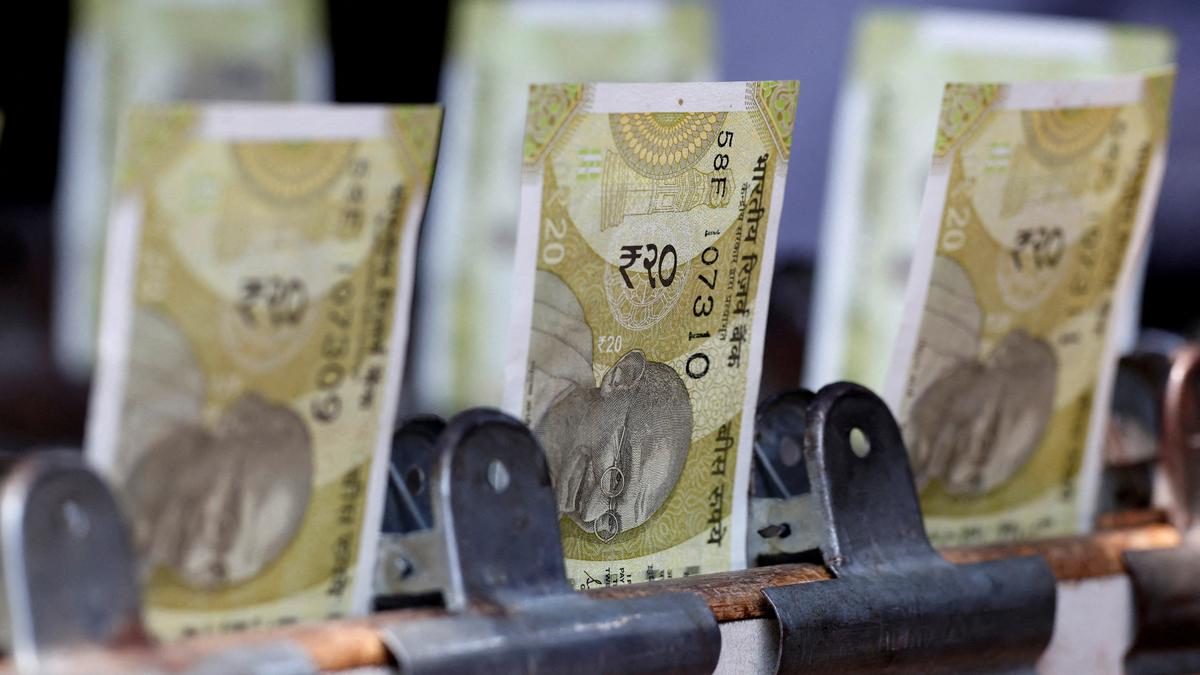
Indian rupee weakens against the dollar amid volatile equity markets and RBI policy deliberations, while GDP growth exceeds expectations. File

Indian rupee weakens against the dollar amid volatile equity markets and RBI policy deliberations, while GDP growth exceeds expectations. File
| Photo Credit: Reuters

The rupee depreciated 10 paise to 85.49 against the U.S. dollar in early trade on Tuesday (June 2, 2025) amid a slight recovery in the American currency against major rivals, higher crude oil prices and outflow of foreign funds.

Volatile domestic equity markets ahead of the Reserve Bank’s monetary policy announcements also weighed on the Indian currency, forex traders said.

RBI’s Monetary Policy Committee (MPC) will begin the deliberations on its next bi-monthly policy on June 4 and the outcome is scheduled to be announced on June 6.

At the interbank foreign exchange, the domestic unit opened weak and stayed in a narrow range, trading 10 paise lower at 85.49 against the greenback in initial deals.

On Monday (June 2, 2025), the rupee appreciated 16 paise to settle at 85.39 against the dollar.

Meanwhile, the dollar index, which gauges the greenback’s strength against a basket of six currencies, was trading higher by 0.23% at 98.86.

Brent crude, the global oil benchmark, rose 0.51% to $64.96 per barrel in futures trade.

In the domestic equity market, the 30-share BSE Sensex fell 36.42 points, or 0.04%, to 81,337.33, while the Nifty slipped 43.25 points or 0.17% to 24,673.35.

Foreign institutional investors (FIIs) sold equities worth ₹2,589.47 crore on a net basis on Monday (June 2, 2025), according to exchange data.

A monthly survey released on Monday (June 2, 2025) showed India’s manufacturing sector growth fell to a three-month low in May, restricted by inflationary pressures, softer demand and heightened geopolitical conditions. The seasonally adjusted HSBC India Manufacturing Purchasing Managers’ Index (PMI) fell from 58.2 in April to 57.6 in May, highlighting the weakest improvement in operating conditions since February.

The latest government data released on Friday (May 30, 2025) showed the Indian economy expanded at a faster pace than expected in the last quarter of the 2024-25 fiscal. The GDP growth rate of 7.4% in the January-March period of FY25 reflected a strong cyclical rebound that was helped by a rise in private consumption and robust growth in construction and manufacturing.

The government also managed to meet its fiscal deficit target of 4.8% of the GDP for 2024-25, according to the provisional data released by the Controller General of Accounts on Friday (May 30, 2025).

Moreover, the country’s gross GST collection remained above the ₹2 lakh crore mark for the second month in a row, rising 16.4% in May to over ₹2.01 lakh crore. Goods and Services Tax (GST) collection had touched a record high of ₹2.37 lakh crore in April.


Source link

Markets decline in early trade on foreign fund outflows, global trade concerns


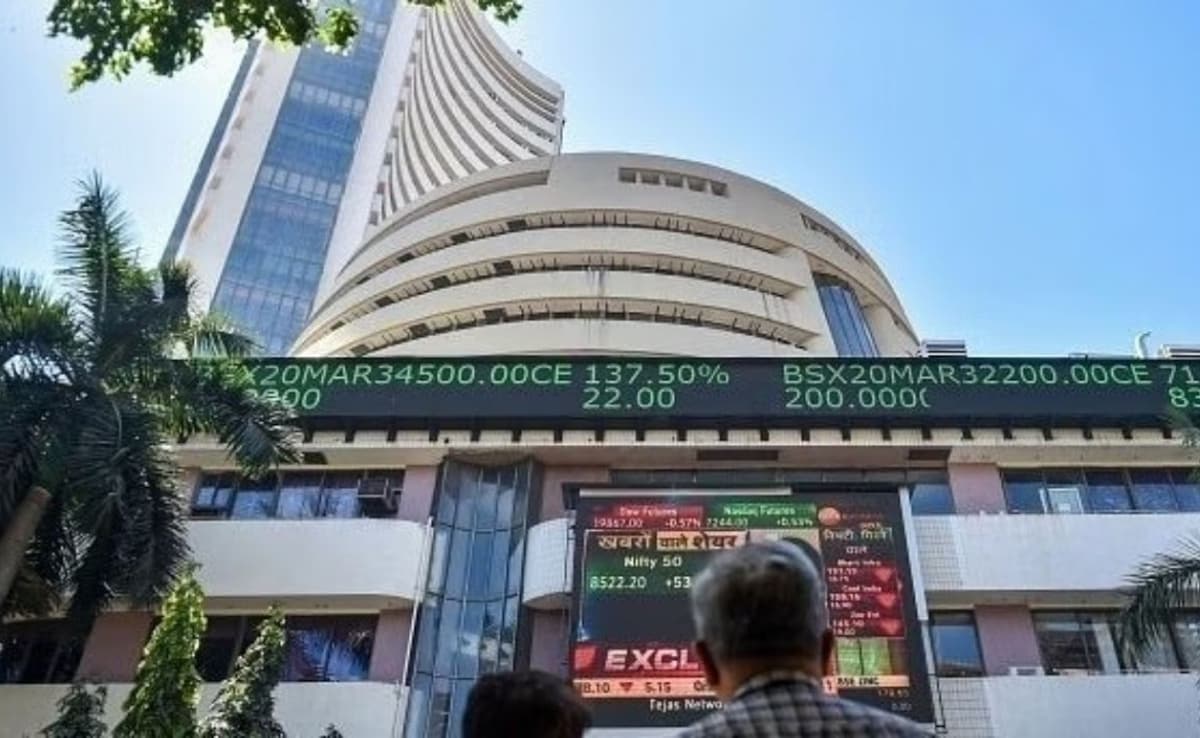
A screen displaying the Sensex is pictured at the Bombay Stock Exchange (BSE) building in Mumbai. Image for representational purposes only.

A screen displaying the Sensex is pictured at the Bombay Stock Exchange (BSE) building in Mumbai. Image for representational purposes only.
| Photo Credit: Reuters

Equity benchmark indices Sensex and Nifty declined in early trade on Tuesday (June 3, 2025) amid uncertainty on the geopolitical and global trade front.

Foreign fund outflows also weighed on investors’ sentiments.

The 30-share BSE Sensex declined 194.65 points to 81,179.10 in early trade. The NSE Nifty dipped 62.35 points to 24,654.25.

From the Sensex firms, Adani Ports, Larsen & Toubro, Bajaj Finance, ICICI Bank, Bharti Airtel and Hindustan Unilever were among the biggest laggards.

Eternal, Tata Steel, Mahindra & Mahindra and IndusInd Bank were among the gainers.

Foreign Institutional Investors (FIIs) offloaded equities worth ₹2,589.47 crore on Monday (June 2, 2025), according to exchange data.

“With a lot of uncertainty in geopolitics, tariffs and trade, the market will continue to remain volatile. Therefore, investors may persist with the strategy of buying on dips,” V.K. Vijayakumar, Chief Investment Strategist, Geojit Investments Limited, said.

In Asian markets, South Korea’s Kospi, Japan’s Nikkei 225 index, Shanghai’s SSE Composite index and Hong Kong’s Hang Seng were trading in the positive territory.

U.S. markets ended higher on Monday.

Global oil benchmark Brent crude climbed 0.57% to $65 a barrel.

After tumbling 796.75 points or 0.97% to 80,654.26 in intra-day trade on Monday, the 30-share BSE Sensex witnessed volatile trends and later ended 77.26 points or 0.09% lower at 81,373.75. The Nifty dipped 34.10 points or 0.14% to settle at 24,716.60.


Source link

Access Denied


Access Denied

You don’t have permission to access “http://www.ndtv.com/business-news/sensex-falls-194-points-nifty-down-62-points-amid-global-trade-concerns-8574184” on this server.

Reference #18.4cfdd417.1748930121.1fdfc6b

https://errors.edgesuite.net/18.4cfdd417.1748930121.1fdfc6b


Source link

Disney to lay off several hundred employees in film, TV, finance globally


File picture of the Disney logo on a store

File picture of the Disney logo on a store
| Photo Credit: Reuters

Media company Walt Disney is laying off several hundred employees in film, television and corporate finance, a source familiar with the matter said on Monday (June 2, 2025).

The layoffs affect multiple teams around the world, including film and TV marketing, TV publicity, and casting and development, the source said.

Disney and other companies are reshaping their business strategies in response to the migration of cable TV audiences to streaming platforms. In 2023, Disney cut 7,000 jobs as part of an effort to save $5.5 billion in costs.

In May, Disney reported earnings that exceeded expectations with an unexpected boost from the Disney+ streaming service and strong results from theme parks.

Disney shares, which have risen 21% since the earnings report, were down 0.5% at $112.43 on Monday.


Source link

Gold price prediction today: Where are gold rates headed on June 3, 2025 and in the near-term?


Gold price prediction today: Where are gold rates headed on June 3, 2025 and in the near-term?
Considering the ongoing US-China tension and weakness in the US Dollar Index, it is advisable to buy the dips with stoploss below $3,325/$3300. (AI image)

Gold price prediction today: Gold rates have shown considerable volatility recently, without establishing a definitive trend in either direction. International developments, particularly the trade tariff decisions by Donald Trump and ongoing geopolitical tensions, continue to influence daily gold prices. Given these unpredictable circumstances, investors face uncertainty about their investment strategies. What’s the outlook on gold prices in the near term? Praveen Singh, Senior Fundamental Research Analyst- Currencies and Commodities at Mirae Asset Sharekhan shares his views:Gold Performance:Following a weekly loss of 2.02% in the week ending May 30, spot gold prices are sharply higher this week due to renewed safe haven demand as US-China and other geopolitical concerns come to the fore. On Monday, China accused the US of violating the US-China trade truce as the US imposed further chip technology curbs. Last week, the US said that it will revoke visas for Chinese students who relate to the Chinese Communist Party or are studying in critical fields. The US Administration also barred the export of critical US jet engine parts and technology to China. It plans to broaden restrictions on China’s tech sector with new regulations to capture subsidiaries of companies under US curbs as well.China’s slow approval for rare earth exports is being cited as the cause behind US’s actions against China.Gold Data roundup:US data released Monday were slightly weaker than expected. ISM manufacturing came in at 48.50 Vs the forecast of 49.50 as the manufacturing sector contracted for the third straight month on tariff uncertainties. ISM’s Import component slumped to a 16-year low, while the export gauge fell to the lowest level in five years. Contraction spending in April contracted by 0.4% as against the forecast of a 0.2% expansion.The Eurozone’s manufacturing PMI (May) at 49.40 matched the estimate in its final reading, while the UK’s manufacturing PMI at 46.40 beat the estimate of 45.10.Gold ETF:Total known global gold ETF holdings stood at 88.508Moz as of May 30. Holdings recorded first weekly inflow after five straight weeks of outflows as holdings are up 6.82% YTD.Upcoming data and events:The European Central Bank will deliver its monetary policy on June 5 wherein the Central Bank is expected to cut the key rates by 25 bps– its eighth rate cut since the Bank embarked on its rate cutting spree in June 2024.Major US data to be released ahead in this week include JOLTs job openings (April), ADP employment change (May), ISM Services (May), trade balance (April) and nonfarm payroll (May). Investors will also monitor China’s manufacturing and services PMIs (May) and Europe’s services PMIs (May).Geopolitical watch:The Security Service of Ukraine (SBU) carried out a massive drone attack deep inside Russia on June 1, which reportedly hit 41 Russian aircrafts. Both the countries concluded their latest peace talks in Istanbul on June 2; however, peace prospects remain dim.US Dollar Index and yields:At the time of writing, the US Dollar Index was at 98.71, down nearly 0.60% on the day, lowest since April 2022 barring April 2024 –reciprocal tariff sell-off period. Big investments cutting their Dollar Index forecasts is also weighing on the Greenback.Ten-year US yields and 30-year US yields respectively at 4.44% and 4.9781% were up by 0.90% on the day.Gold price Outlook:A close above $3,372 will be quite positive for the metal. Considering the ongoing US-China tension and weakness in the US Dollar Index, it is advisable to buy the dips with stop loss below $3,325/$3300.Worsening geopolitical situation and further weakness in the US Dollar Index may help the yellow metal test the psychological resistance at $3400, followed by possible tests of next resistance levels at $3414/$3435. Traders need to monitor the evolving China-US trade situation to minimize their risks.(Disclaimer: Recommendations and views on the stock market and other asset classes given by experts are their own. These opinions do not represent the views of The Times of India)


Source link

Apple challenges ‘unreasonable’ EU order to open up to rivals


Apple said the EU’s interoperability requirements create “a process that is unreasonable, costly, and stifles innovation” [File]

Apple said the EU’s interoperability requirements create “a process that is unreasonable, costly, and stifles innovation” [File]
| Photo Credit: REUTERS

Apple has submitted a legal challenge to an EU order to open up its closed ecosystem to rivals such as Meta and Alphabet’s Google, saying the demands are unreasonable and hamper innovation.

The European Commission had in March detailed how Apple must comply with the Digital Markets Act, which aims to rein in the power of Big Tech.

Apple said the EU’s interoperability requirements create “a process that is unreasonable, costly, and stifles innovation”.

“These requirements will also hand data-hungry companies sensitive information, which poses massive privacy and security risks to our EU users,” it said in a statement.

“These deeply flawed rules that only target Apple – and no other company – will severely limit our ability to deliver innovative products and features to Europe, leading to an inferior user experience for our European customers.”

Meta, Google, Spotify and Garmin are among companies that have requested access to Apple users’ data.

The legal fight will likely take years to play out in court. Until then, Apple will have to comply with the EU order.

The Commission ordered Apple to give rival makers of smartphones, headphones and virtual reality headsets access to its technology and mobile operating system so they can connect with Apple’s iPhones and iPad tablets.

It also set out a detailed process and timeline for Apple to respond to interoperability requests from app developers.


Source link

Stock market today: Nifty50 gives up early gains; BSE Sensex down over 300 points


Stock market today: Nifty50 gives up early gains; BSE Sensex down over 300 points
Market experts anticipate continued consolidation amidst unfavourable global indicators. (AI image)

Stock market today: Nifty50 and BSE Sensex, the Indian equity benchmark indices, were volatile in opening trade on Tuesday. While Nifty50 went below 24,650, BSE Sensex was near 81,000. At 9:35 AM, Nifty50 was trading at 24,644.90, down 72 points or 0.29%. BSE Sensex was at 81,045.85, down 328 points or 0.40%.Market experts anticipate continued consolidation amidst unfavourable global indicators, though robust domestic economic factors and possible RBI interest rate reductions might provide support.VK Vijayakumar, Chief Investment Strategist, Geojit Investments Limited says, “During a consolidation phase, where the market moves within a range, buy on dips is the ideal strategy. And this strategy is working well now. With a lot of uncertainty in geopolitics, tariffs and trade the market will continue to remain volatile. Therefore, investors may persist with the strategy of buying on dips.“The concern in the market now is the high valuation, particularly in the broader market. But the trends in money flows into the market and the healthy trend of retail investors persisting with their investment for longer periods, indicate that Indian equities will remain at higher valuations for an extended period of time. Since the MPC is expected to cut policy rate by 25 bp in the policy meet on 8th, rate sensitives are likely to be favoured in the coming days.The S&P 500 finished positively on Monday, with investors remaining hopeful about trade negotiations between the US and its partners, despite President Donald Trump’s announcement to increase tariffs on steel and aluminium imports.Asian markets displayed a mixed opening on Tuesday, following US gains driven by technology sector recovery.Oil prices increased during early Asian trading on Tuesday, influenced by supply concerns as Iran prepares to decline US nuclear agreement proposals, whilst Canadian production faces disruption from wildfires.Gold prices reached a near four-week peak on Tuesday, benefiting from dollar weakness and increased uncertainty surrounding US-China trade relations.Foreign portfolio investors recorded net sales of Rs 2,589 crore on Monday, whilst domestic institutional investors showed net purchases of Rs 5314 crore.FII net short positions in futures trading increased from Rs 83,684 crore on Friday to Rs 89,066 crore on Monday.(Disclaimer: Recommendations and views on the stock market and other asset classes given by experts are their own. These opinions do not represent the views of The Times of India)


Source link

China says U.S. moves on computer chips and student visas ’seriously violate’ tariffs truce


China has blasted the U.S. for issuing AI chip export control guidelines [File]

China has blasted the U.S. for issuing AI chip export control guidelines [File]
| Photo Credit: REUTERS

China criticised the U.S. on Monday over moves it alleged harmed Chinese interests, including issuing AI chip export control guidelines, stopping the sale of chip design software to China, and planning to revoke Chinese student visas.

“These practices seriously violate the consensus,” the Commerce Ministry said in a statement, referring to a China-U.S. joint statement in which the United States and China agreed to slash their massive recent tariffs, restarting stalled trade between the world’s two biggest economies.

But last month’s de-escalation in President Donald Trump’s trade wars did nothing to resolve underlying differences between Beijing and Washington and Monday’s statement showed how easily such agreements can lead to further turbulence.

The deal lasts 90 days, creating time for U.S. and Chinese negotiators to reach a more substantive agreement. But the pause also leaves tariffs higher than before Trump started ramping them up last month. And businesses and investors must contend with uncertainty about whether the truce will last.

U.S. Trade Representative Jamieson Greer said the U.S. agreed to drop the 145% tax Trump imposed last month to 30%. China agreed to lower its tariff rate on U.S. goods to 10% from 125%.

The Commerce Ministry said China held up its end of the deal, cancelling or suspending tariffs and non-tariff measures taken against the U.S. “reciprocal tariffs” following the agreement.

“The United States has unilaterally provoked new economic and trade frictions, exacerbating the uncertainty and instability of bilateral economic and trade relations,” while China has stood by its commitments, the statement said.

It also threatened unspecified retaliation, saying China will “continue to take resolute and forceful measures to safeguard its legitimate rights and interests.”

Trump stirred further controversy Friday, saying he will no longer be nice with China on trade, declaring in a social media post that the country had broken an agreement with the United States.

Hours later, Trump said in the Oval Office that he will speak with Chinese President Xi Jinping and “hopefully we’ll work that out,” while still insisting China had violated the agreement.

“The bad news is that China, perhaps not surprisingly to some, HAS TOTALLY VIOLATED ITS AGREEMENT WITH US,” Trump posted. “So much for being Mr. NICE GUY!”

In response to recent comments by Trump, the Commerce Ministry said of the U.S.: “Instead of reflecting on itself, it has turned the tables and unreasonably accused China of violating the consensus, which is seriously contrary to the facts.”

U.S. Commerce Secretary Howard Lutnick said that the Chinese were “just slow rolling the deal” from Geneva.

Appearing on Fox News on Sunday, Lutnick said the U.S. was “taking certain actions to show them what it feels like on the other side of that equation,” adding that Trump would “work it out” with Xi.

The Trump administration also stepped up the clash with China in other ways last week, announcing that it would start revoking visas for Chinese students studying in the U.S.

U.S. campuses host more than 275,000 students from China.

Both countries are in a race to develop advanced technologies such as artificial intelligence, with Washington seeking to curb China’s access to the most advanced computer chips. China is also seeking to displace the U.S. as the leading power in the Asia-Pacific, including through gaining control over close U.S. partner and leading tech giant Taiwan.


Source link

Disney to lay off hundreds across entertainment divisions amid shift to streaming


Disney to lay off hundreds across entertainment divisions amid shift to streaming

The Walt Disney Company is cutting several hundred jobs across its film and television divisions, a Disney spokesperson confirmed to USA TODAY. The layoffs, which formally took effect on Monday, June 2, impact departments involved in marketing, publicity, casting, development, and parts of corporate finance. No entire teams are being dissolved, the company said.A Disney representative attributed the decision to the “rapid pace” of industry transformation and the company’s push to “operate more efficiently.”This move is the latest in a series of cost-cutting measures implemented since CEO Bob Iger returned to helm the company in 2022. In early 2023, Iger announced that Disney would lay off 7,000 employees to reduce spending by billions of dollars. That plan has since unfolded through multiple rounds of layoffs.In September 2024, Disney cut around 300 positions in corporate functions such as legal, HR, and communications. Earlier layoffs affected Disney-owned brands including National Geographic, Pixar, and Freeform. In March 2025, the company trimmed another 200 jobs—nearly 6% of its workforce in ABC News and Disney Entertainment Networks.Despite the cuts, Disney reported strong financial results. According to its Q2 2025 earnings report, revenue rose to $23.6 billion, a 7% year-on-year increase. Subscriber numbers for Disney+ also climbed by 126 million in the first quarter, reflecting the accelerating shift in consumer preferences toward streaming platforms.As of its latest fiscal year ending September 2024, Disney employed approximately 233,000 people worldwide.Meanwhile, Disney’s theme parks are also facing challenges. At Walt Disney World in Florida, employees under Temporary Protected Status (TPS) were recently informed they must provide updated work authorization documents or risk being placed on leave. The notification followed a U.S. Supreme Court ruling upholding the Trump-era decision to end TPS protections for about 350,000 Venezuelans.


Source link

Infosys CEO among highest paid in Indian IT as compensation rose 22% to $9.4 million last fiscal


Infosys CEO and Managing Director Salil Parekh [File]

Infosys CEO and Managing Director Salil Parekh [File]
| Photo Credit: REUTERS

Infosys CEO Salil Parekh’s compensation rose 21.7% to 806.2 million rupees ($9.44 million), the company said in its annual report on Monday, making him one of the highest-paid Indian IT chiefs currently in office.

Parekh, the longest-serving non-founder CEO at the IT company, earned a fixed salary of 79.4 million rupees and bonuses of 231.8 million rupees.

The largest portion, 495 million rupees, resulted from the chief executive of India’s No. 2 IT services firm exercising his stock options.

In comparison, Parekh earned $7.9 million in 2024 and $6.76 million in 2023, with the rise in pay, mainly due to a greater number of stock options exercised during the year.

For the financial year 2025, Infosys reported a revenue growth of 4.2% in constant currency terms, falling short of its forecast of 4.5%-5%. For the current fiscal year, it forecast a flat to 3% growth in revenue, signalling a weaker business environment.

India’s $283-billion IT sector is facing another year of slowing growth, partly due to the U.S. tariff policies, which complicate forecasting market conditions in key markets and client segments.

“Majority of Infosys revenue is from the U.S. and other global markets. The compensation is in line and consistent with what companies of this scale and size pay globally. Boards of Indian tech companies are indeed aware and need their leaders to be retained and paid appropriately in this challenging environment,” said K Sudarshan, managing director at executive search firm EMA Partners.

K Krithivasan, CEO of Infosys’ larger rival Tata Consultancy Services earned $3.11 million, and smaller rival Wipro’s CEO Srinivas Pallia earned $6.28 million, according to their latest annual report.

Infosys is one of the two among India’s top five IT companies that have retained their CEO at the helm over the last 18–24 months, with HCLTech being the other.


Source link