Business

US, global markets plunge as Trump’s tariff hike escalate trade war fears


US, global markets plunge as Trump's tariff hike escalate trade war fears

Wall Street and global markets took a sharp downturn Thursday following US President Donald Trump’s announcement of new tariffs on imports from around the world, stoking fears of an escalating trade war and rising recession risks, news agency AP reported.
Futures for the S&P 500 plunged 3.4%, while Dow Jones Industrial Average futures dropped 2.8%, signalling steep losses when US markets open. Nasdaq futures fell 3.8%. Oil prices also took a hit, dropping more than 4%, and the US dollar sank to its lowest level against the Japanese yen since early October.
This marked the fourth consecutive day of early declines for US markets, with little hope for a recovery by day’s end.
After the US market closed on Wednesday, Trump unveiled a 10% baseline tariff on imports from all countries, along with higher tariffs on nations with trade surpluses with the US Notably, China will face a 34% tax on imports, while the European Union will be charged 20%, and Taiwan will face 32%. The move has sent shockwaves through global markets, with China particularly affected by the tariff hike, which now brings its total tariff burden to 64% when factoring in previous measures.
Asian markets, though somewhat shielded by the anticipation of further stimulus from Beijing, still felt the brunt of the news. Hong Kong’s Hang Seng index dropped 1.7%, while the Shanghai Composite slid by 0.2%.
Trump has argued that the tariffs aim to level the playing field and bring manufacturing jobs back to the US However, economists warn that these measures could dampen growth for the US and the global economy, while increasing inflation, which is already hovering stubbornly above the Federal Reserve’s 2% target.
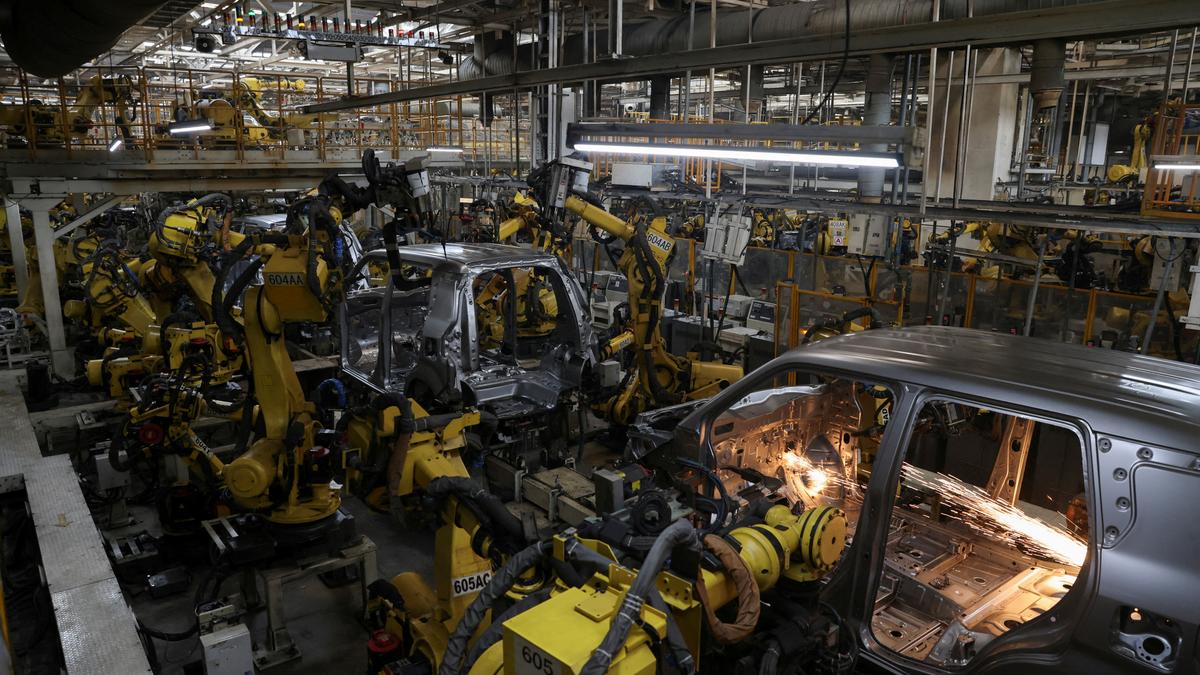
The tariff announcements follow earlier actions, including a 25% tariff on auto imports, levies on steel and aluminium, and expanded tariffs on countries such as China, Canada, and Mexico. Trump’s trade policies also target oil imports from Venezuela, and he has proposed additional tariffs on pharmaceuticals, lumber, copper, and computer chips.
Treasury yields swung dramatically, reflecting the uncertainty in the markets. The 10-year Treasury yield dropped as low as 4.04% before settling at 4.11%, down from 4.23% late Wednesday and nearly 4.80% earlier this year.
The commodity market also saw significant losses, with US benchmark crude oil shedding $3.36, or 4.7%, to $68.35 per barrel, and Brent crude falling $3.29, or 4.4%, to $71.66 per barrel. Declining oil prices typically signal economic pessimism, as oil is seen as a key indicator of global economic health.
In Europe, markets also slumped, though not as severely as in the US Germany’s DAX dropped 2.4%, the CAC 40 in Paris lost 2.7%, and the FTSE 100 in Britain shed 1.5%.
Asian markets saw a variety of losses. Tokyo’s Nikkei 225 index briefly dipped 4% before closing 2.8% down. South Korea, impacted by a 25% tariff, saw its Kospi index fall 1.1%. Australia’s S&P/ASX 200 index decreased by 0.9%, and Thailand’s SET index shed 1.1% after being hit with a 36% tariff on exports to the US
Economists like Sal Guatieri and Jennifer Lee from BMO Capital Markets Economics noted that most commodity prices were lower, including gold, as the trade war escalates, creating widespread economic uncertainty.


Source link

EAM Jaishankar: Global order under churn, every region needs to look out for itself


External Affairs Minister S. Jaishankar with Minister of Foreign Affairs of Thailand Maris Sangiampongsa during the 20th BIMSTEC Ministerial Meeting in Bangkok, Thailand.

External Affairs Minister S. Jaishankar with Minister of Foreign Affairs of Thailand Maris Sangiampongsa during the 20th BIMSTEC Ministerial Meeting in Bangkok, Thailand.
| Photo Credit: X/@DrSJaishanka

Amid reciprocal tariffs announced by U.S. President Donald Trump, External Affairs Minister S Jaishankar on Thursday (April 3, 2025) said the world is moving to an era of self-help and every region needs to look out for itself.

Addressing the 20th BIMSTEC Ministerial, Mr. Jaishankar said shorter supply chains and immediate neighbours have a salience much more than before.

“The reality is that the world is moving to an era of self-help. Every region needs to look out for itself, whether it is in food, fuel and fertilizer supply, vaccines or speedy disaster response,” the Minister said.

“We are seeing that unfold before our very eyes. Times have indeed changed. Shorter supply chains and immediate neighbours have a salience much more than before,” Mr. Jaishankar said.

Also Read | Trump’s tariffs target tiny Australian islands, including some with no people

While Mr. Jaishankar is here to attend the BIMSTEC (Bay of Bengal Initiative for Multi-Sectoral Technical and Economic Cooperation) Ministerial, Prime Minister Narendra Modi will join the leaders from Thailand, Bangladesh, Sri Lanka, Nepal, Myanmar and Bhutan to oversee the signing of the Agreement on Maritime Cooperation at the 6th BIMSTEC summit.

The Minister said the BIMSTEC Summit was taking place in “very uncertain and volatile times, when the global order itself is under visible churn.”

“This should encourage us to approach BIMSTEC from a more ambitious perspective. The new order, whose outlines have only now started to become visible, is intrinsically more regional and agenda-specific,” Mr. Jaishankar said.

“The era when a few powers underwrote the international system is now behind us. What we make of our prospects is very much dependent on ourselves. As developing nations who face a multitude of challenges, that is better done in concert with each other than individually,” the Minister said.

Highlighting that India’s north-eastern region in particular is emerging as a connectivity hub for the BIMSTEC, with a myriad network of roads, railways, waterways, grids and pipelines, Mr. Jaishankar said, “The completion of the Trilateral Highway will connect India’s North East all the way to the Pacific Ocean, a veritable game-changer.”

Mr. Jaishankar also said that the nations around the Bay of Bengal have both common interests and shared concerns which emanates from history, where other priorities overrode the well-being of this region.

“Whether it is connectivity, trade, investment or services between the BIMSTEC members, we are performing below our real potential. Now, if we are to change that, both the past and the future are our friends,” he said.

Mr. Jaishankar said that, from India’s perspective, BIMSTEC represented the trifecta of three crucial initiatives – the Act East Policy, the Neighbourhood First approach and the MAHA-SAGAR outlook.

“It is also on the pathway to our Indo-Pacific commitment. In order to promote BIMSTEC, what India is doing is to draw the best from all of them and then synergise that with our collective efforts,” the Minister said.

On March 12, Modi had announced India’s new vision for the Global South and named it ‘MAHASAGAR’ or Mutual and Holistic Advancement for Security and Growth Across Regions, a policy approach that came against the backdrop of China’s relentless attempts to expand its influence in the Indian Ocean.

The MAHASAGAR vision builds on the SAGAR (Security and Growth for All in the Region) policy that PM Modi first announced during his visit to Mauritius in 2015.


Source link

Fab 5: The five countries missing from Trump’s list of reciprocal tariffs | International Business News


Fab 5: The five countries missing from Trump's list of reciprocal tariffs
President Donald Trump speaks during an event to announce new tariffs in the Rose Garden at the White House, in Washington. AP/PTI

US President Donald Trump’s latest wave of reciprocal tariffs has dealt a significant blow to numerous countries, with rates ranging from 10% to as high as 50%. However, five countries—Russia, Canada, Mexico, North Korea, and Cuba—were notably absent from the list.
Their exemption has raised questions, especially given that major trading partners such as India (27%), the European Union (20%), and Vietnam (46%) were subjected to steep duties.
Russia, North Korea, Cuba, and Belarus were not included in this latest round. US Treasury Secretary Scott Bessent explained that Russia had been left out because existing sanctions had already reduced trade between the two countries to minimal levels.
Although Canada and Mexico were not named in Trump’s 2 April tariff announcement, they have not been entirely spared from trade penalties. Earlier in the year, the US imposed a 25% tariff on imports from both countries, along with a 10% rate specifically targeting Canadian energy and potash.
Goods covered by the US-Mexico-Canada Agreement (USMCA) continue to be exempt from the new duties. However, new tariffs on auto parts and other products are set to come into force on Thursday.
Canadian Prime Minister Mark Carney, speaking to Bloomberg, said that his government would respond with countermeasures to protect Canadian workers.
Mexico is preparing its own response, with President Claudia Sheinbaum expected to address the matter at a press conference on Thursday.
A US official noted that the excluded countries already faced high tariffs and that prior sanctions had rendered meaningful trade with them virtually impossible.
Saurav Ghosh, co-founder of the bond investment platform Jiraaf, suggested another possible reason for Russia’s exclusion: the ongoing negotiations between Trump and Russian President Vladimir Putin. He noted that due to existing sanctions, US-Russia trade had already decreased significantly, and added that if Trump was still in talks with Putin over ending the war in Ukraine, a cooperative Russia would likely be necessary.
It also remains unclear whether Trump plans to revise his approach to countries that continue purchasing Russian oil and gas.
The new tariff strategy appears focused on countries with substantial trade surpluses with the US. China, for example, which had a $295 billion surplus with the US in 2024, has been hit with a 34% tariff.
Ghosh remarked that countries in Asia, along with the EU, tend to have higher trade deficits with the US, which may explain their position at the top of the tariff list. He added that Trump has cited non-tariff barriers, such as domestic VAT systems and currency manipulation, as contributing factors in determining tariff levels—suggesting that restoring trade balance has been the administration’s primary concern.
Among the more unexpected moves in this latest round were the heavy tariffs on Japan (24%) and Vietnam (46%). Ghosh described these as particularly striking developments.
As global trade adjusts to these new measures, several countries are preparing retaliatory actions. Canada and Mexico are weighing their next steps, while both Asian and European nations brace for the broader impact.
For now, Russia and North Korea remain outside Trump’s line of fire—though that could easily change, depending on how diplomatic relations evolve in the coming months.


Source link

Why is Russia missing from Trump’s ‘Liberation Day’ tariffs list?


Why is Russia missing from Trump's 'Liberation Day' tariffs list?
Russia President Vladimir Putin and US President Donald Trump

US President Donald Trump has announced sweeping tariffs, imposing a minimum 10% levy on nearly all nations worldwide, with additional higher rates targeting approximately 60 countries. Notably, Russia was missing from the list of countries.
During his announcement, Trump held up a board listing around 50 countries, detailing the tariffs each imposed on the United States and the reciprocal duties the US would slap. Notably, while many nations were included, Russia’s name was absent from the list.
When questioned, press secretary Karoline Leavitt explained to Axios that Russia’s omission was due to existing US sanctions that “preclude any meaningful trade.”
Follow Live blog for more updates
Yet, America’s trade volume with Russia surpasses that of several included nations, such as Mauritius and Brunei.
The tariff list was remarkably comprehensive, including tiny territories like Tokelau (pop. 1,500) in the South Pacific and Svalbard (pop. 2,500) in the Arctic Circle, which belong to New Zealand and Norway respectively. Leavitt clarified that Cuba, Belarus and North Korea were also excluded due to pre-existing high tariffs and sanctions.
US-Russia trade statistics show a dramatic decline from approximately $35 billion in 2021 to $3.5 billion last year, following sanctions imposed after Russia’s Ukraine invasion.

US and Russia improving ties

Recently US was seen siding with Russia in the international organisation. To everyone’s surprise, US supported Russia in UNGA. US voted against the European-drafted resolution condemning Moscow’s actions and supporting Ukraine’s territorial integrity.
And then again in the UN Security Council (UNSC) Russia and US approved a US-backed resolution calling for a swift end to the conflict that avoided labelling Russia as the aggressor or acknowledging Ukraine’s territorial integrity.

Trump seeks more trade with Russia: Report

According to a report by Forbes, Trump is seeking an enhanced trade relations with Russia while implementing tariffs to limit trade with other nations.
Economic experts highlight that Canada, Mexico and Europe present significantly more commercial prospects than Russia. They challenge the rationale behind Trump’s tariff strategy aimed at reducing trade deficits.
Notably, the United States has historically maintained a substantial trade deficit with Russia, Trump’s preferred trading partner.
Following a telephone discussion between Donald Trump and Vladimir Putin on March 18, 2025, the White House announced, “The two leaders agreed that a future with an improved bilateral relationship between the United States and Russia has huge upside. This includes enormous economic deals and geopolitical stability when peace has been achieved.”
Trump frequently discusses potential trade arrangements with Russia and contemplates easing sanctions, despite Russia’s continuing Ukrainian invasion and UN-documented human rights violations, including civilian targeting and the kidnapping of approximately 20,000 Ukrainian children.
Analysis of US-Russia trade statistics reveals two significant points. Firstly, bilateral trade volumes are relatively modest, totalling roughly $3.5 billion in 2024 and $36 billion in 2021. By comparison, US-Canada trade reached $762 billion in 2024.
The United States maintains a considerable trade deficit with Russia, contradicting Trump’s stance on trade imbalances with other nations. Before sanctions following Russia’s Ukraine invasion, 2021 figures show US exports to Russia at $6.4 billion against imports of $29.6 billion, creating a $23 billion deficit. Similar patterns appear in other years, with US exports primarily comprising chemicals, machinery and transport equipment, whilst importing oils, chemicals and metals.
Specialists indicate Russia presents an unfavourable and potentially dangerous environment for international businesses.
During U.S.-mediated ceasefire discussions, which have now largely halted, Russia requested Trump to reduce some sanctions. Trump recently threatened Russia with secondary oil tariffs and expressed anger towards Vladimir Putin regarding his Ukraine statements.
Leavitt indicated possible “additional strong sanctions” against Russia.
Notably, Canada and Mexico were also absent from Trump’s extensive tariff list. Leavitt confirmed this was because of existing 25% tariffs on both nations.


Source link

Tata Motors stock falls nearly 3%


Tata Motors’ shares fell 3% on April 3, 2025, after the tariff hike on foreign-made automobiles announced by the Trump administration came into effect.

Tata Motors’ shares fell 3% on April 3, 2025, after the tariff hike on foreign-made automobiles announced by the Trump administration came into effect.
| Photo Credit: REUTERS

i Shares of Tata Motors declined nearly 3% on Thursday (April 3, 2025) with coming into effect of the tariff hike on foreign-made automobiles announced by the Trump administration on March 26.

These U.S. tariff hikes have come to effect from midnight of April 3.

During the day, the scrip of Mumbai-based Tata Motors fell 2.58% to ₹654.50 per piece on the BSE.

According to a release by the White House, “… steel/aluminium articles and autos/auto parts already subject to Section 232 tariffs” and hence exempted from the Liberation Day announcements made by U.S. President Donald Trump.

However, the auto parts tariff will be imposed no later than May 3, 2025.

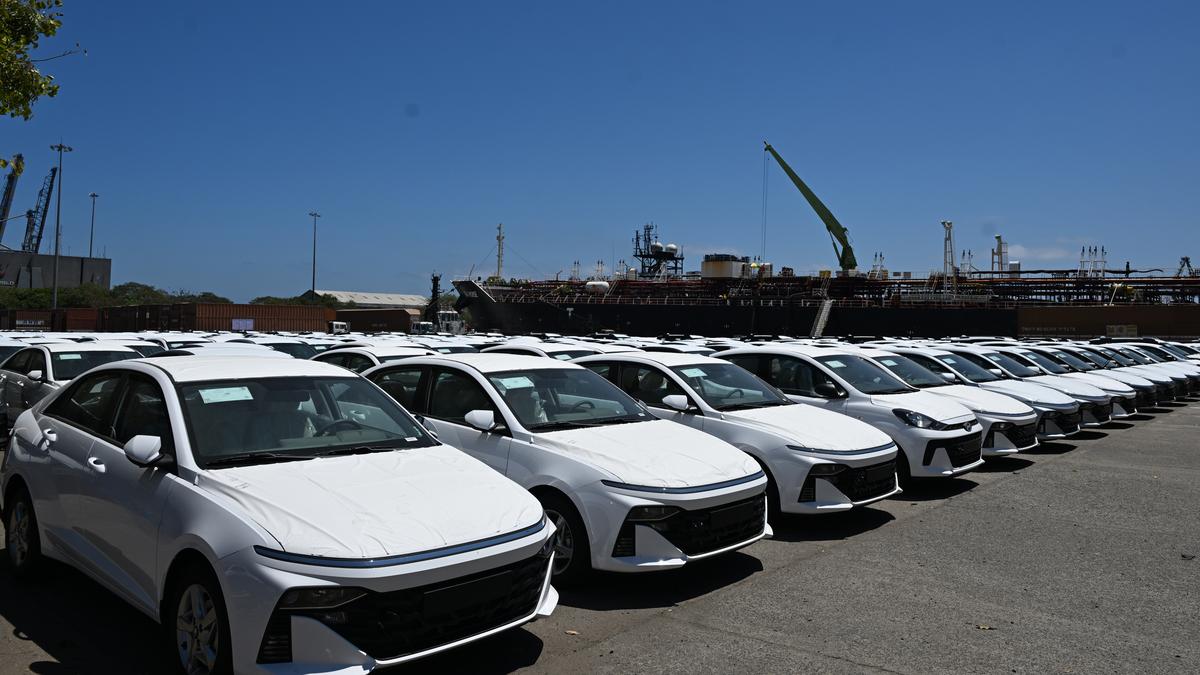
The tariff will apply to imported passenger vehicles— sedans, SUVs, crossovers, minivans, cargo vans— and light trucks, as well as critical auto parts, engines, transmissions, powertrain components, and key electrical parts.

Tata Motors Ltd is the parent company of British passenger vehicle maker Jaguar Land Rover (JLR). The United States is a key market for JLR as nearly one-third of its sales in 2024 came from the U.S. markets.

While India is not a big exporter of cars to the U.S., Tata Motors’ luxury car subsidiary, JLR, is deeply entrenched in the American market. About 23% of JLR’s over 4,00,000 units sold in FY24 were in the U.S. These were all exported from its U.K. plants.

“The U.S. has imposed 25% tariffs on imported cars, light trucks and select auto parts sourced from outside of North America. Further, almost 150 auto parts will face tariffs at a similar rate,” Arun Agarwal, VP, Fundamental Research, Automobiles at Kotak Securities, said.

Meanwhile, the tariff hikes have also affected shares of Bharat Forge by declining 4.6% to ₹1,099.40 apiece, Balkrishna Industries by 4.3% to ₹2,453.90, Sona BLW Precision Forgings by 3.60% to ₹449.60, Samvardhana Motherson International by 3.3% to ₹127.85 on the BSE.

On the other hand, shares of Bajaj Auto slipped by 2.87% to ₹7,840, TVS Motor Co fell by 2.08% to ₹2,442.85, Ashok Leyland by 1.9% to ₹204.60, Mahindra & Mahindra by 1.4% to ₹2,600.55 and Hero MotoCorp went lower by 1.15% to ₹3,738.55 a piece on the exchange.

The BSE Sensex benchmark declined 300.98 points or 0.39% to 76,316.46.

India’s auto components export to the U.S. stood at $6.79 billion in FY24, while it imported $1.4 billion from the U.S. at 15% import duty. India’s largest export items to the U.S. are engine components, powertrains and transmissions.

Further, Mr. Agarwal said margins of suppliers may come under pressure as they may need to partly absorb cost pressures. We believe there will be some impact, which the suppliers will have to bear, leading to negative implications on margins.

The extent of impact for Indian players will also depend on the U.S.-India bilateral agreement over the next few months, he added.


Source link

Stock markets settle lower on selling in IT & Teck stocks, global sell-off as Trump hikes tariffs


The U.S. has announced additional 27% import duties on India saying New Delhi imposes high tariffs on American goods, as Trump administration aims to reduce the trade deficit and boost manufacturing. File

The U.S. has announced additional 27% import duties on India saying New Delhi imposes high tariffs on American goods, as Trump administration aims to reduce the trade deficit and boost manufacturing. File
| Photo Credit: Reuters

Benchmark indices Sensex and Nifty settled lower on Thursday (April 3, 2025) due to selling in IT and Teck shares and a global sell-off as U.S. President Donald Trump unveiled reciprocal tariffs on 60 countries, including India.

The 30-share BSE Sensex declined by 322.08 points or 0.42% to close at 76,295.36. During the session, it plunged 809.89 points or 1.05% to hit an intraday low of 75,807.55 but recovered some of the losses as pharma shares advanced.

The broader NSE Nifty fell 82.25 points or 0.35% to settle at 23,250.10. The index declined by 186.55 points or 0.79% to a low 23,145.80 in early trade but later pared some losses.

“The Nifty index opened lower in response to the U.S. tariff announcements but saw some recovery due to resilience in select heavyweight stocks. This helped trim losses in early trades, leading to a range-bound session,” Ajit Mishra – SVP, Research, Religare Broking Limited, said.

From the Sensex pack, Tata Consultancy Services, HCL Technologies, Tech Mahindra, Infosys, Tata Motors, Bajaj Finance, Kotak Mahindra Bank, Mahindra & Mahindra, Bharti Airtel and Maruti Suzuki India, Tata Steel were the major laggards.

Also read: Trump tariff announcement highlights

PowerGrid, Sun Pharmaceuticals, UltraTech Cement, NTPC, Asian Paints, Nestle India, Titan, IndusInd Bank and Axis Bank were among the gainers.

In broader markets, the BSE smallcap gauge rose by 0.76% and the midcap index went up 0.31%.

Market breadth was positive as 2,809 stocks advanced while 1,175 declined and 139 remained unchanged on the BSE.

The U.S. has announced additional 27% import duties on India saying New Delhi imposes high tariffs on American goods, as the Donald Trump administration aims to reduce the trade deficit and boost manufacturing.

President Trump, in a historic measure to counter higher duties on American products imposed globally, announced reciprocal tariffs on about 60 countries.

“This is Liberation Day, a long-awaited moment. April 2, 2025, will forever be remembered as the day American industry was reborn, the day America’s destiny was reclaimed, and the day that we began to make America wealthy again. We are going to make it wealthy, good, and wealthy,” Mr. Trump said in his remarks from the Rose Garden at the White House on Wednesday (April 2, 2025).

In Asian markets, Tokyo’s Nikkei plunged the most by nearly 3%, followed by Hong Kong (1.52%), Seoul’s KOSPI (0.76%) and Shanghai (0.24%).

European markets were trading lower in the mid-session deals. Wall Street ended higher on Wednesday (April 2, 2025).

Global oil benchmark Brent crude declined 3.68% to $72.19 a barrel.

Meanwhile, foreign Institutional Investors (FIIs) offloaded equities worth ₹1,538.88 crore on Wednesday (April 2, 2025), while Domestic Institutional Investors (DIIs) purchased shares worth ₹2,808.83 crore on a net basis.

On Wednesday (April 2, 2025), the 30-share BSE Sensex rebounded 592.93 points to settle at 76,617.44, and the NSE Nifty climbed 166.65 points to settle at 23,332.35.


Source link

Rupee pares initial losses, settles 22 paise up at 85.30 against U.S. dollar


The rupee pared its initial losses and settled for the day higher by 22 paise at 85.30 (provisional) against the U.S. dollar on Thursday (April 3, 2025).

The rupee pared its initial losses and settled for the day higher by 22 paise at 85.30 (provisional) against the U.S. dollar on Thursday (April 3, 2025).
| Photo Credit: REUTERS

The rupee pared its initial losses and settled for the day higher by 22 paise at 85.30 (provisional) against the U.S. dollar on Thursday (April 3, 2025) as the greenback weakened against its major peers after President Donald Trump unleashed reciprocal tariffs on about 60 countries.

The domestic unit had witnessed a knee jerk reaction in early trade but soon gained the lost ground and ended the day on a positive note, after the U.S. announced 27% reciprocal tariffs on India, saying New Delhi imposes high import duties on American goods.

Experts, however, said that India is better-placed than its competitors, who also face increased levies.

At the interbank foreign exchange, the rupee opened at 85.77 then touched an intraday high of 85.30 and a low of 85.78 against the greenback. The unit ended the session at 85.30 (provisional) against the dollar, registering a gain of 22 paisa from its previous closing level.

On Wednesday (April 2, 2025), the rupee had settled at 85.52 against the U.S. dollar.

The U.S. reciprocal tariffs are expected to impact India’s exports of certain sectors to the U.S., experts said, adding that India is better-placed than its competitors, including Bangladesh (37%), China (54 per cent%), Vietnam (46%) and Thailand (36%) who face increased levies.

Meanwhile, according to an official statement on Thursday, the Department of Commerce is carefully examining the implications of the U.S. reciprocal tariffs on India and is engaged with all stakeholders, including domestic industry and exporters to seek their feedback on the issue.

The Commerce Ministry said that it is also studying the opportunities that may arise due to this new development in the U.S. trade policy.

It also said that discussions are ongoing between Indian and US trade teams for the expeditious conclusion of a mutually beneficial, multi-sectoral Bilateral Trade Agreement (BTA).

The BTA will cover a wide range of issues of mutual interest, including deepening of supply chain integration.

Meanwhile, the dollar index, which gauges the greenback’s strength against a basket of six currencies, was trading 1.65% lower at 102.09.

Brent crude, the global oil benchmark, fell 4.10% to $71.88 per barrel in futures trade.

In the domestic equity market, the 30-share BSE Sensex fell 322.08 points, or 0.42%, to settle at 76,295.36, while the Nifty declined 82.25 points, or 0.35%, to close at 23,250.10 points.

Foreign institutional investors (FIIs) offloaded equities worth ₹1,538.88 crore on a net basis on Wednesday, according to exchange data.


Source link

No fee to be charged for update of nominees for PPF accounts: Finance Minister Nirmala Sitharaman


Union Finance Minister Nirmala Sitharaman. File

Union Finance Minister Nirmala Sitharaman. File
| Photo Credit: PTI

Finance Minister Nirmala Sitharaman on Thursday (April 3,. 2025) said no fee will be charged for the update or addition of nominees for Public Provident Fund (PPF) accounts as the government has done necessary changes through notification.

“Recently, it was informed that a fee was being levied by financial institutions for updating/modifying nominee details in PPF accounts,” the Finance Minister said in a social media post on X.

“Necessary changes are now made in the Government Savings Promotion General Rules 2018 via Gazette Notification dated April 2, 2025, to remove any charges on the update of nominees for PPF accounts,” she said.

The gazette notification has done away with the fee of ₹50 for cancellation or change of nomination for small savings schemes run by the government.

“The Banking Amendment Bill 2025, passed recently, allows nomination up to four persons for payment of depositors’ money, articles kept in safe custody and safety lockers,” she said.

Another change in the Bill relates to redefining of term ‘substantial interest’ of a person in a bank. The limit is sought to be enhanced to ₹2 crore from the current ₹5 lakh, which was fixed almost six decades ago.

The law also seeks to increase the tenure of directors (excluding the chairman and whole-time director) in cooperative banks from eight to 10 years, so as to align with the Constitution (Ninety-Seventh Amendment) Act, 2011.


Source link

India carefully examining implications of U.S. reciprocal tariffs, says Commerce Ministry


Union Commerce and Industry Minister Piyush Goyal. File.

Union Commerce and Industry Minister Piyush Goyal. File.
| Photo Credit: ANI

We are “carefully examining” the implications of U,S. President Donald Trump’s tariff announcements, said the Department of Commerce on Thursday (April 3, 2025).

The U.S. President Donald Trump issued an Executive Order on reciprocal tariffs imposing additional ad-valorem duties ranging from 10% to 50% on imports from all trading partners. The baseline duty of 10% will be effective from April 05, 2025 and the remaining country specific additional ad-valorem duty will be effective from April 09, 2025. The additional duty on India as per the Annex I of the Executive Order is 27%, the Ministry explained in a press statement.

It is also engaging with all stakeholders, including Indian industry and exporters, taking feedback of their assessment of the tariffs and assessing the situation.

The Department is also studying the opportunities that may arise due to this new development in the U.S. trade policy.

It also said that discussions are ongoing between Indian and U.S. trade teams for the expeditious conclusion of a mutually beneficial, multi-sectoral Bilateral Trade Agreement (BTA).

The talks are focused on enabling both nations to grow trade, investments and technology transfers.

“We remain in touch with the Trump Administration on these issues and expect to take them forward in the coming days,” it said.


Source link

This is how US President Donald Trump’s ‘Liberation Day’ tariffs will unfold in India | India News


This is how US President Donald Trump's 'Liberation Day' tariffs will unfold in India
US President Donald Trump

Hours after US President Donald Trump‘s announcement of reciprocal tariffs, India on Thursday said it is studying the opportunities that may arise in light of the drastic change in US trade policy.
On Wednesday, US slapped a 27% tariff on imports from India. Trump said that the tariffs charged by India to the US are 52%.
The Executive Order establishes additional ad-valorem duties between 10% and 50% on imports from trading partners.
Starting April 05, 2025, a 10% baseline duty will be implemented, whilst country-specific additional duties commence from April 09, 2025.
The department of commerce said that they are carefully examining the implications of the US President’s various measures and announcements. In alignment with Viksit Bharat’s objectives, the department maintains active engagement with stakeholders, including industry representatives and exporters, to gather feedback on tariff impacts and evaluate the situation. Additionally, they are investigating potential opportunities arising from these US trade policy changes.

In a statement, the ministry of commerce said that Prime Minister Narendra Modi, and the US President Donald Trump on February 13, 2025, unveiled ‘Mission 500’, targeting to increase bilateral trade to US $500 Billion by 2030.
Both nations’ trade teams are currently negotiating a comprehensive bilateral trade agreement, addressing mutual interests including supply chain integration. The discussions aim to enhance trade growth, investments and technology transfers. Regular communication continues with the Trump Administration to advance these objectives.
“India values its Comprehensive Global Strategic Partnership with the United States and is committed to working closely with the US to implement the India-US ‘Catalysing Opportunities for Military Partnership, Accelerated Commerce & Technology’ (COMPACT) for the 21st century to ensure that our trade ties remain a pillar of mutual prosperity and drive transformative change for the benefit of the people of India and the US.” the statement read.


Source link