
Business

RBI eyes bank-like rate norms for NBFCs to plug policy gaps


RBI eyes bank-like rate norms for NBFCs to plug policy gaps

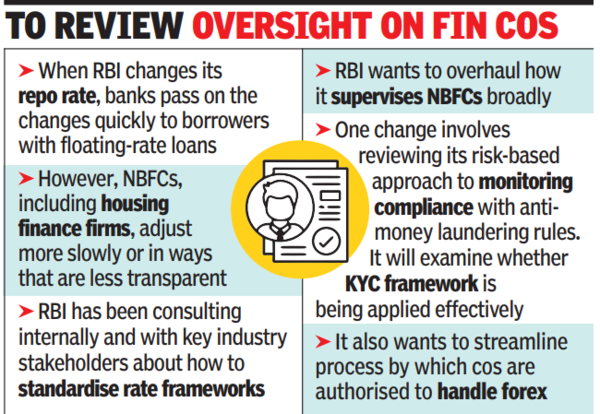
MUMBAI: RBI is looking to introduce interest rate rules for non-banking finance companies similar to those that govern banks. The goal is to improve how changes in monetary policy pass through to borrowers and to make loan pricing more transparent.As of now, when RBI changes its benchmark repo rate, banks pass on the changes quickly to borrowers with floating-rate loans. However, NBFCs, including housing finance firms, adjust more slowly or in ways that are less transparent. “The extant regulations on interest rates on advances vary across all regulated entities,” said RBI. “In order to harmonise the same, a comprehensive review of the extant regulatory instructions is underway.RBI has been consulting internally and with key industry stakeholders about how to standardise interest rate frameworks. “In order to solicit wider public feedback, it is proposed to issue a discussion paper delineating the various imperatives of moving to a harmonised regime for interest rates on loans and advances across all regulated entities,” the central bank said in its annual report.

-

Analysts say the current system creates gaps in oversight. “Banks have repo rate-linked loans, MCLR (marginal cost of lending rate) loans, etc, which are all well defined and RBI can track how transmission happens,” said Suresh Ganapathy of Macquarie. “NBFCs don’t have these repo-linked or MCLR loans and they price their loans off some antiquated PLR (prime lending rate) concept. Of course, eventual end-pricing will be determined by competitive forces. Having said that, this entire process is super opaque and hence it is essential a proper alignment is sought,” Ganapathy added.RBI also wants to overhaul how it supervises NBFCs broadly. One change involves reviewing its risk-based approach to monitoring compliance with anti-money laundering rules. It will examine whether KYC framework is being applied effectively, especially for higher-risk firms.The regulator also plans a thematic review to ensure NBFCs follow interest rate guidelines, particularly to prevent customers from being charged excessive rates. At the same time, it is studying how to bring more NBFCs under a risk-based supervision model, where regulatory attention depends on the complexity and risk profile of each firm. RBI also plans to simplify rules for borrowing and lending in rupees, and to streamline the process by which companies are authorised to handle foreign currency under India’s foreign exchange law.


Source link

Additional instalment of tax devolution to be released to States on June 2: Finance Ministry


Representational image

Representational image
| Photo Credit: Getty Images/iStockphoto

The government on Friday (May 30, 2025) approved an additional instalment of ₹81,735 crore as tax devolution to States, which will be released on June 2.

This release is in addition to the regular monthly instalment of tax devolution of ₹81,735 crore, which will be released on June 10, 2025.

“The Union Government has approved an additional instalment of ₹81,735 crore as Tax Devolution to the State Governments, which will be released on June 2, 2025,” the Finance Ministry said in a statement.

The additional instalment of devolution to States is in line with the principle of cooperative federalism and the aim of becoming ‘Viksit Bharat’ by 2047, it added.

“The additional instalment of devolution will enable the States to speed up their Capital spending, finance their development and welfare-related expenditure and also make available resources for priority projects/schemes of the States,” the Ministry said.

Currently, 41% of taxes collected by the Centre is devolved in instalments among States during a fiscal year.


Source link

IVCA directs VCs to migrate to AIF framework before SEBI deadline


According to the SEBI circular dated August 2024, a migrated venture capital fund will be considered an Type 1 AIF. 

According to the SEBI circular dated August 2024, a migrated venture capital fund will be considered an Type 1 AIF. 

Indian Venture Capitalist Association (IVCA) directed venture capitalists who have not migrated to AIF framework, to do so before the SEBI deadline of July 19, 2025, according to a statement. 

“Despite the regulatory clarity and incentives provided under this framework—including a simplified re-registration process, fee waivers, and tailored compliance requirements— the response to the said scheme is understood to be tepid. This low uptake is a cause for concern,” IVCA said in its statement. According to the SEBI circular dated August 2024, a migrated venture capital fund will be considered an Type 1 AIF. 

“The old VCF (Venture Capital Fund) guidelines were existing even in the late 1990s, and in 2012, the AIF regulations were introduced. Every fund has a limited life of generally 8-10 years. There are a lot of VC funds registered with SEBI. And as of date, many of the VCs while their tenure has got over, have not completed their winding up and termination process via-a-vis erstwhile VCF regulation of SEBI,” said Rahul Shah, Executive Vice President of IVCA. ”

He further added that the members of IVCA felt that the July 19 deadline was too quick for them to comply and that they’d prefer liquidating the VC funds first before migrating.” He further added that the VC fund managers were of the view that they rather than make efforts liquidating the current investments in the fund by the given deadline and then apply for migration, the IVCA was pushing them to complete the migration process before the deadline.


Source link

Debashis Chatterjee exits LTIMindtree; Venu Lambu to take over as new CEO & MD on May 31


LTIMindtree, IT arm of L&T Group, has said Debashis Chatterjee has opted to retire due to personal reasons as the Chief Executive Officer & Managing Director of the company with effect from today (May 30, 2025).

 Venu Lambu

Venu Lambu
| Photo Credit:
Visveswaran V@Chennai

Following which, the Board of Directors of LTIMindtree at its meeting held on Tuesday, has appointed Venu Lambu, currently the CEO Designate, as the Chief Executive Officer & Managing Director of LTIMindtree with effect from May 31, 2025.

Mr. Lambu, who was named CEO Designate by the company a couple of months ago, has over three decades of experience in the technology. Earlier, he worked with LTIMindtree and serviced global markets between October 2020 and January 2023, leading a profitable growth. Prior to coming back to the company recently,, he served as CEO of Randstad Digital, the digital business of Randstad.

Mr. Chatterjee, served as CEO and MD of Mindtree from 2019 until its merger with L&T Infotech in November 2022, after which he led the newly formed LTIMindtree.


Source link

Ashok Leyland supplies 25 of 250 ordered trucks to Patanjali Group firm


Ashok Leyland Ltd. has announced that it has started delivery of the first batch of 250 ordered trucks to Patanjali Parivahan Private Ltd., a logistics player of the Patanjali Group.

Sanjeev Kumar, President, MHCV, Ashok Leyland said the first batch of 25 units of 1916 haulage trucks were delivered on Friday.

“This partnership reflects their trust in our brand and products, reinforcing our commitment to meeting the evolving needs of customers in the dynamic commercial vehicle sector,” he said.

Patanjali Parivahan, with a fleet of about 1,000 trucks has placed a substantial order to Ashok Leyland.


Source link

India’s forex reserves rise $6.992 billion to $692.721 billion in week ended May 23


India’s forex reserves rise $6.992 billion to $692.721 billion in week ended May 23
Forex Reserves (AI image)

India’s foreign exchange reserves increased by $6.992 billion, reaching $692.721 billion for the week ended May 23, according to the RBI’s Friday announcement. The overall reserves had previously declined by $4.888 billion to $685.729 billion in the week ended May 16. The reserves had achieved their highest level of $704.885 billion at the end of September 2024.The data released on Friday indicated that foreign currency assets, which constitute a significant portion of the reserves, rose by $4.516 million to $586.167 billion during the week ended May 23.The foreign currency assets, when expressed in dollar terms, reflect the changes in value of non-US currencies such as the euro, pound and yen that are part of the foreign exchange reserves.The country’s gold holdings saw an uptick of $2.366 billion, reaching $83.582 billion for the week, according to the RBI.The SDRs (Special Drawing Rights) witnessed an increase of $81 million, totalling $18.571 billion, as reported by the central bank.According to the RBI data, India’s position with the International Monetary Fund also strengthened by $30 million, standing at $4.401 billion during the reporting week.India ranks among the top 10 countries with the highest foreign exchange reserves in the world.


Source link

Bengaluru witnesses 11.2% YoY growth in premium residential realty market: Report


Premium residential category emerged as the growth driver of Bengaluru’s residential real estate sector in 2024, says a report by real estate consultancy NKlusive.

According to the report, while the affordable segment (<₹7,000 per square foot (psf)) showed a modest fall in sales and signs of saturation, the premium category (₹7,000 to 15,000 psf) accounted for more than 52.8% of the total market supply in 2024. Premium home launches increased by 16.3% year-on-year to 94,126 units, with strong end-user demand maintaining absorption at 53%.

Rising aspirations

“The findings point to a thriving market environment characterised by robust premium sector performance, rising aspirational demand, and a shift in buyer preferences toward lifestyle-driven housing,” said a statement from the company.

The report pointed out that the luxury and uber luxury sectors continued to see high-price increases, backed by increased affluence and the appeal of lifestyle-driven homes.

“These categories have also seen a move toward compact luxury formats, particularly in East and Central Bengaluru, making high-end living more accessible to a wider range of upwardly mobile customers,” it said.

Demand for 3 BHK

As per the report, the premium segment recorded a 4% YoY price appreciation, with Weighted Average Price rising from ₹13,284 to ₹14,000 per sq. ft. Increased preference for 3 and 3.5 BHK configurations, driven by work-from-home lifestyles and nuclear family needs was observed during the year. The report also suggested balanced demand-supply dynamics, particularly in micro-markets like Whitefield and North Bengaluru.

“Overall, a more varied, stable, and opportunity-rich housing ecosystem is being fostered by Bengaluru’s changing buyer tastes, steady infrastructure development, and growing disposable incomes. The year 2024 has confirmed Bengaluru’s standing as one of India’s most vibrant and resilient residential markets, which is good news for developers, investors, and homeowners,” it said.


Source link

Infosys BPM introduces AI Agents to ensure better efficiency, accuracy in invoice processing


Infosys BPM, the business process management arm of Infosys, has on Friday announced the launch of AI agents for invoice processing within its flagship Infosys Accounts Payable on Cloud solution.

Powered by Infosys Topaz, the innovation would redefine invoice processing by moving from a human-driven, AI-supported model to an autonomous AI-first approach, said the company.

According to Infosys BPO, designed to operate autonomously, the solution leverages AI agents equipped with advanced decision-making capabilities to handle complex business scenarios with precision and speed.

Autonomous AI-first approach enables end-to-end workflow management, allowing AI agents to handle dynamic processes, adapt to changing business logic, and perform intricate tasks with minimal human oversight, claimed the company.

This solution was developed in close collaboration with Americana Restaurants, the largest out-of-home dining and quick service restaurant operator across the Middle East, North Africa, and Kazakhstan, with more than 2,600 restaurants. Building on the successful deployment of Accounts Payable on Cloud solution for Americana, Infosys BPM was now integrating Agentic AI to make their invoice processing largely autonomous, further enhancing its efficiency and accuracy, it further said.

Anantha Radhakrishnan, CEO & Managing Director, Infosys BPM, said, “With the introduction of Agentic AI into Infosys Accounts Payable on Cloud solution, we are redefining what is possible in the finance and accounting functional domain. By integrating Infosys Topaz with a purpose-built multi-agent framework, along with Microsoft’s AI stack, we’ve developed a solution that is autonomous by design, responsive to change, and built to evolve.’‘


Source link

‘Went COLD TURKEY, it was devastating for them…’: Donald Trump slams China for ‘violating’ trade agreement with US – what went wrong this time?


‘Went COLD TURKEY, it was devastating for them…’: Donald Trump slams China for ‘violating’ trade agreement with US - what went wrong this time?
Donald Trump has always called China the ‘biggest abuser’ on tariffs. (AI image)

US President Donald Trump claims he was a ‘Nice Guy’ with China – that he helped China out of a ‘devastating’ situation when the world’s second largest economy was in ‘grave economic danger’. But, China ‘violated’ its agreement with the US, Trump has said in his latest social media post on the Truth Social. Trump’s latest salvo against China comes as no surprise for experts, who have come to accept Trump’s ‘flip-flops’ as a reality.Two weeks ago, the US and China announced reaching an agreement for a temporary 90-day reduction in their tariffs, following discussions between senior officials in Geneva. The United States decided to temporarily decrease its additional tariffs on Chinese goods from 145 percent to 30 percent. In response, Beijing implemented a corresponding reduction, bringing down its additional tariffs from 125 percent to 10 percent.US tariffs continue to be elevated, incorporating a 20 percent duty that the Trump administration recently applied to Chinese products, citing concerns about Beijing’s supposed involvement in illegal drug trafficking – an allegation that China has firmly disputed.But things seem to have gone down hill again since then. Trump’s social post reads, “Two weeks ago China was in grave economic danger! The very high Tariffs I set made it virtually impossible for China to TRADE into the United States marketplace which is, by far, number one in the World. We went, in effect, COLD TURKEY with China, and it was devastating for them. Many factories closed and there was, to put it mildly, “civil unrest.” I saw what was happening and didn’t like it, for them, not for us. I made a FAST DEAL with China in order to save them from what I thought was going to be a very bad situation, and I didn’t want to see that happen. Because of this deal, everything quickly stabilized and China got back to business as usual. Everybody was happy! That is the good news!!! The bad news is that China, perhaps not surprisingly to some, HAS TOTALLY VIOLATED ITS AGREEMENT WITH US. So much for being Mr. NICE GUY!”Tit-for-tat tariffs: It’s been a bumpy roadTrump has always called China the ‘biggest abuser’ on tariffs. On April 2, also called the ‘Liberation Day’ by Trump, the US President announced sweeping tariffs on most major economies, with China getting hit with 34% tariffs (plus 20% existing tariff). China had retaliated strongly by raising its own tariffs and the situation had quickly escalated to a level where Trump eventually imposed 245% reciprocal tariffs on China.Also Read | Big embarrassment! Pakistan’s crypto attempt to ‘please’ Donald Trump in a soupTrump levied huge tariffs on Chinese imports, responding to Beijing’s stringent restrictions on exports of critical minerals, which are vital components in various products from smartphones and electric vehicles to aircraft engines and nuclear submarines.China controls an overwhelming 92% of the world’s rare earth processing capabilities and the United States depends on Chinese supplies for approximately 70% of its rare earth compounds and metals. In the past Trump administration officials have said that China is wielding its market supremacy as a strategic tool, necessitating immediate US action.Global markets went into a tailspin following the trade war between the US and China and the 90-day truce between the world’s two largest economies had brought a sense of relief – albeit fragile!So, what went wrong between the US & China this time?Trump’s statement lacks details regarding China’s specific violations of the Geneva, Switzerland agreement and does not outline his intended response towards Beijing.A US official informed Reuters that China appeared to be delaying the issuance of export licences for rare earth minerals.US Trade Representative Jamieson Greer told CNBC that China had not fulfilled its Geneva commitments. He said, “The Chinese are slow-rolling their compliance, which is completely unacceptable and it has to be addressed.”Greer indicated that China’s supply of critical minerals, previously stopped due to Chinese trade countermeasures, had not resumed as stipulated in the Geneva agreement.Earlier, in a Fox News interview, US Treasury Secretary Scott Bessen had t indicated that negotiations with China regarding trade matters were “a bit stalled.”Also Read | ‘Overstepped his authority…’: What are the scathing observations made by US trade court in ruling against Donald Trump’s tariffs?Bessent mentioned the possibility of direct involvement from President Trump and Chinese President Xi Jinping. He also noted that a telephone conversation between the two leaders might take place in the future.Meanwhile, legal hurdles are mounting against Trump’s proposed tariff measures. A recent US trade court verdict said that the president exceeded his authority by invoking emergency economic powers to warrant comprehensive tariffs.The court’s decision halted the most extensive duties since Trump’s return to office, though the ruling remains suspended pending an appeal process.Nevertheless, the verdict maintains the existing tariffs that the Trump administration had established on specific industry imports, including steel and automotive sectors.Also Read | ‘Even if we lose…’: Donald Trump administration readying two-part strategy to impose reciprocal tariffs, says ‘we will do it another way’


Source link

United India Insurance back in black, posts ₹154 crore net in FY25 


United India Insurance Company returned to profitability reporting ₹154 crore net profit for 2024-25.

Compared to the ₹804 crore loss in previous fiscal, it is an impressive turnaround. It has made profit after several years, the State-owned general insurer said.

Gross direct premium income stood at ₹20,072 crore, combined ratio improved 4% to 121.67% and customer base raced past 2 crore mark, the country’s 4th largest general insurer said.

“Our relentless focus on technological innovation, customer satisfaction and risk management enabled us to adapt to evolving industry dynamics and emerge stronger,” CMD Bhupesh Sushil Rahul said.

Through prudent underwriting and strategic loss control measures, it has reclaimed its position as a profitable force in the industry, UIICL said. In alignment with IRDAI’s vision of ‘Insurance for All by 2047’ it has unveiled a range of cutting-edge insurance solutions designed to meet changing needs of customers while enhancing market competitiveness. The list includes comprehensive personal accident policy Sampurna Suraksha Bima; parametric insurance product Param Mitra Suraksha Policy; usage-based motor insurance cover tailored for customers with limited vehicle usage; United Cyber Kavach Policy; and home protection plan securing both property and belongings United Value Griha Raksha Policy.

By prioritizing customer-centric strategies, seamless claims processing and enhanced service standards, the company continues to reinforce its commitment to delivering financial security, strengthening customer trust and redefining industry leadership in the ever-evolving insurance landscape. UIICL has presence across India and offers a portfolio of insurance solutions, including health, motor, property, and marine coverage.


Source link