Business

Rupee falls 8 paise to settle at 85.56 against U.S. dollar


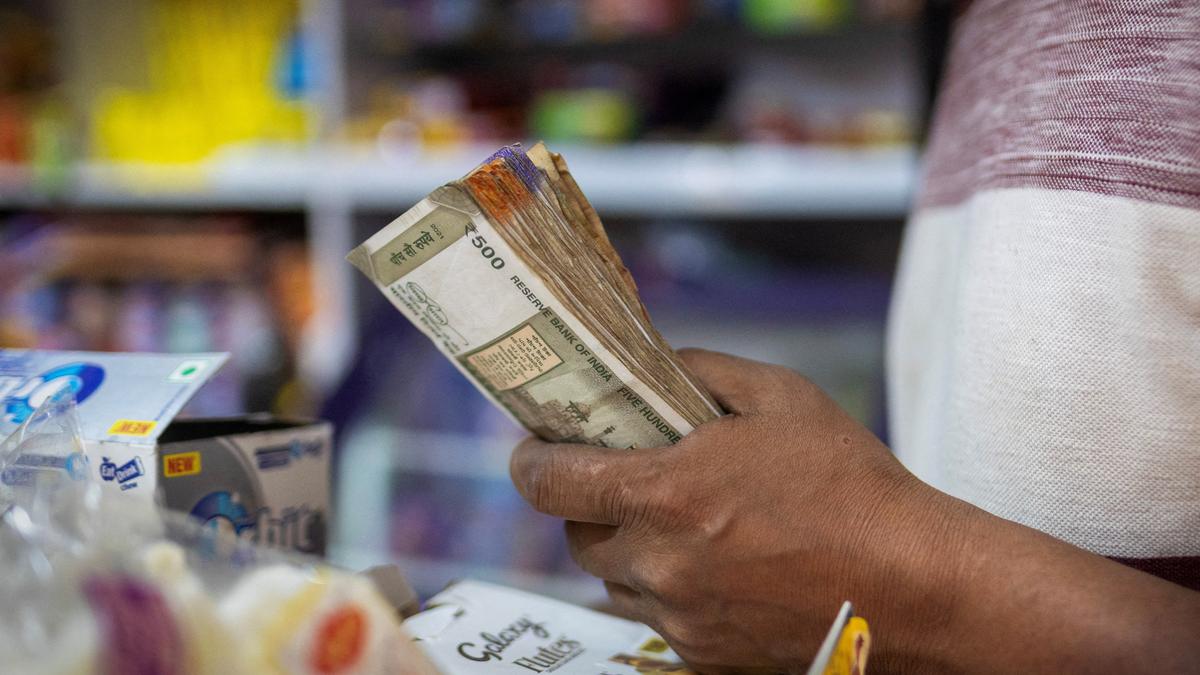
Forex traders said that a steady inflow of foreign funds supported the domestic unit even as investors stayed cautious, awaiting domestic GDP data to be released later in the day. Representational file image.

Forex traders said that a steady inflow of foreign funds supported the domestic unit even as investors stayed cautious, awaiting domestic GDP data to be released later in the day. Representational file image.
| Photo Credit: Reuters

The rupee pared its initial gains to settle 8 paise lower at 85.56 (provisional) against the U.S. dollar on Friday (May 30, 2025), as volatility in domestic equities and recovering global crude prices pressured the local currency.

However, a steady inflow of foreign funds supported the domestic unit even as investors stayed cautious, awaiting domestic GDP data to be released later in the day, forex traders said.

At the interbank foreign exchange, the domestic unit opened at 85.35 and moved between the intraday high of 85.25 and the low of 85.64 against the greenback. The unit settled the day at 85.56 (provisional), registering a loss of 8 paise from its previous close.

The rupee ended 10 paise lower at 85.48 against the dollar on Thursday (May 29, 2025).

Anuj Choudhary, a research analyst at Mirae Asset Sharekhan, said the rupee fell on weak domestic markets and a recovery in crude oil prices. Month-end dollar demand from importers also pressurised the rupee. However, the weak US dollar index and FII inflows cushioned the downside.

“Traders may take cues from the core PCE price index and personal income data from the U.S. The USD-INR spot price is expected to trade in a range of ₹85.30 to ₹86,” he added.

Meanwhile, the dollar index, which gauges the greenback’s strength against a basket of six currencies, was trading higher by 0.28 per cent at 99.49.

Analysts said the dollar showed signs of recovery after the U.S. federal court’s ruling against President Donald Trump’s sweeping reciprocal tariffs proved short-lived as a federal appeals court put a temporary stay on the ruling.

Brent crude, the global oil benchmark, rose 0.41 per cent to $64.41 per barrel in futures trade.

In the domestic equity market, the 30-share BSE Sensex fell 182.01 points, or 0.22 per cent, to close at 81,451.01, while the Nifty declined 82.90 points, or 0.33 per cent, to 24,750.70.

Foreign institutional investors (FIIs) purchased equities worth ₹884.03 crore on a net basis on Thursday (May 29, 2025), according to exchange data. The Reserve Bank, in its latest annual report on Thursday (May 29, 2025), said the country is poised to remain the fastest-growing major economy in the world even in FY26.


Source link

Sensex declines 182 points on losses in IT, metal shares, sluggish Asian peers


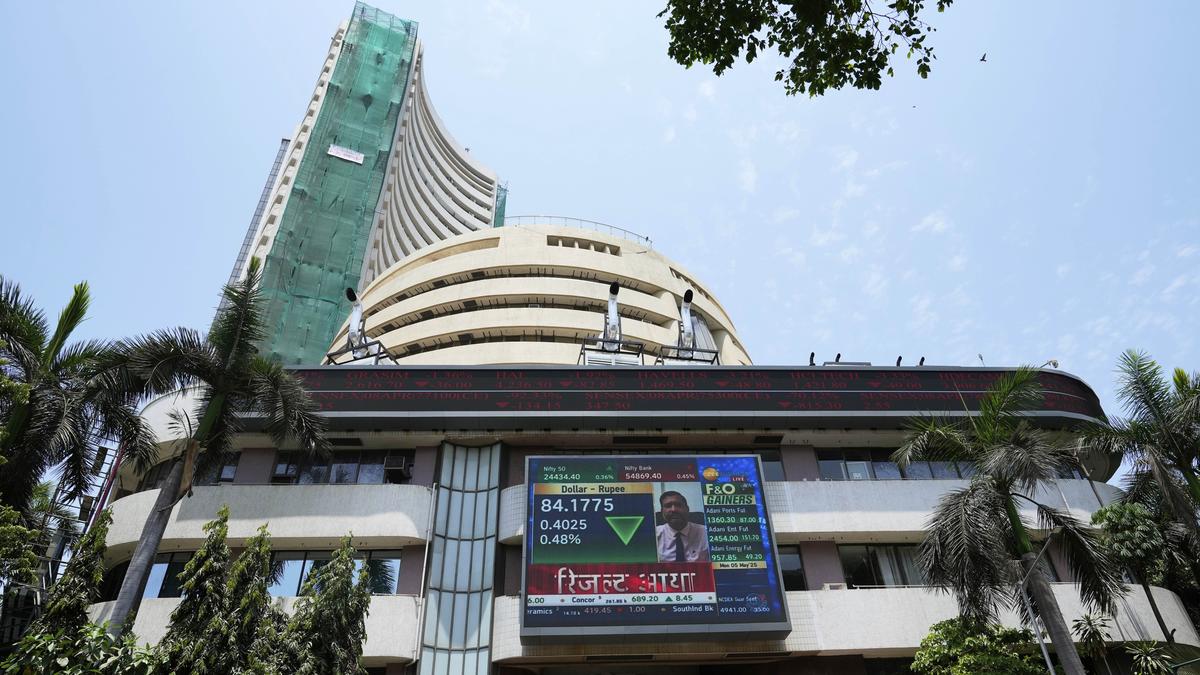
The 30-share BSE Sensex declined by 182.01 points or 0.22% to settle at 81,451.01 as 24 of its constituents retreated and six advanced. During the day, it dropped 346.57 points or 0.42%, to 81,286.45. File

The 30-share BSE Sensex declined by 182.01 points or 0.22% to settle at 81,451.01 as 24 of its constituents retreated and six advanced. During the day, it dropped 346.57 points or 0.42%, to 81,286.45. File
| Photo Credit: AP

Stock markets closed lower in a range-bound trade on Friday (May 30, 2025) following losses in IT shares and sluggish trends in Asian markets due to trade uncertainty after a U.S. appeals court temporarily reinstated reciprocal tariffs.

The 30-share BSE Sensex declined by 182.01 points or 0.22% to settle at 81,451.01 as 24 of its constituents retreated and six advanced. During the day, it dropped 346.57 points or 0.42%, to 81,286.45.

The NSE Nifty dipped 82.90 points or 0.33%, to 24,750.70.

Metals, IT, and auto sector shares declined while banking shares gained. Investors were cautious ahead of the release of domestic GDP data post-market hours, analysts said.

Among Sensex firms, Tech Mahindra fell the most by 1.73%. HCL Tech, Asian Paints, NTPC, Infosys, Nestle, Sun Pharma, and Tata Steel also closed lower.

Eternal, State Bank of India, HDFC Bank, Larsen & Toubro, Reliance Industries and Bajaj Finserv were the gainers.

“A range-bound movement continued in the market, with the temporary reinstatement of U.S. tariffs by the appeal court influencing investors to stay on the sideline. The global market may contend with macroeconomic concerns as the global trade landscape has yet to see stability, which may navigate a short-term consolidation.

“Meanwhile, FII inflows continued due to the volatility in the U.S. 10-year yield and an expectation of solid domestic Q4 GDP data later today and a rate cut by RBI,” Vinod Nair, Head of Research, Geojit Investments Limited, said.

“Markets languished in negative territory to end lower amid weak Asian cues as investors cut their positions in IT, metal, oil & gas and auto shares,” Prashanth Tapse, Senior VP (Research), Mehta Equities Limited, said.

The BSE midcap gauge declined 0.39% while smallcap index went up by 0.17%.

Among sectoral indices, metal dropped the most by 1.68%, followed by BSE Focused IT (1.14%), commodities (1.14%), utilities (1.09 per cent), tech (0.99%), auto (0.91%) and telecommunication (0.79%).

Financial Services, bankex and capital goods were the gainers.

On the weekly front, the BSE benchmark declined 270.07 points or 0.33% and the Nifty dipped 102.45 points or 0.41%.

In Asian markets, South Korea’s Kospi, Japan’s Nikkei 225 index, Shanghai’s SSE Composite index and Hong Kong’s Hang Seng settled in the negative territory.

Markets in Europe were trading higher. U.S. markets ended higher on Thursday (May 29, 2025).

Foreign Institutional Investors (FIIs) bought equities worth Rs 884.03 crore on Thursday (May 29, 2025), while Domestic Institutional Investors (DIIs) bought equities worth Rs 4,286.50 crore, according to exchange data.

Global oil benchmark Brent crude climbed 0.44% to $64.43 a barrel.

The BSE Sensex climbed 320.70 points or 0.39%, to settle at 81,633.02 on Thursday (May 29, 2025). The 50-share Nifty went up by 81.15 points or 0.33% to 24,833.60.


Source link

IndiGo will comply with any government regulations, says CEO Elbers on wet leasing of Turkish Airlines planes


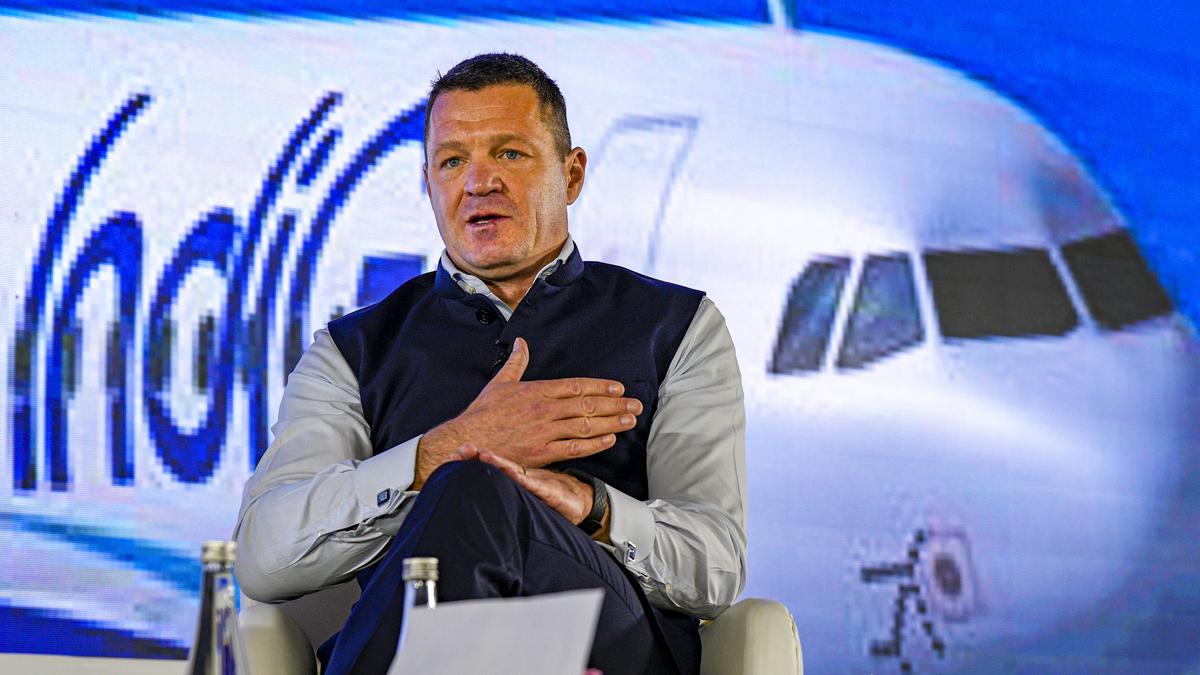
IndiGo CEO Pieter Elbers said, “Flights between India and Türkiye are governed within the bilateral air service agreement.” File

IndiGo CEO Pieter Elbers said, “Flights between India and Türkiye are governed within the bilateral air service agreement.” File
| Photo Credit: PTI

IndiGo CEO Pieter Elbers on Friday (May 30, 2025) said it will comply with any government regulations amid the airline operating wet-leased planes of Turkish Airlines coming into focus.

Last week, Civil Aviation Minister K. Rammohan Naidu said the Civil Aviation Ministry was taking inputs from IndiGo and security agencies on the airline’s use of planes leased from Turkish Airlines and then will decide on the way forward.

“Flights between India and Türkiye are governed within the bilateral air service agreement. We are compliant today and we will continue to comply with any government regulations on those lines,” Mr. Elbers told PTI

On May 15, aviation security watchdog Bureau of Civil Aviation Security (BCAS) revoked the security clearance for Turkish company Celebi Airport Services India Pvt Ltd in the “interest of national security”, days after Türkiye backed Pakistan and condemned India’s strikes on terror camps in the neighbouring country.

Some online travel portals and associations have also issued advisories asking people not to visit Turkiye.

IndiGo is operating direct flights to Istanbul with two leased Boeing 777 aircraft from Turkish Airlines, having over 500 seats each. It also offers codeshare seats to more than 40 points in Europe and the U.S. through the codeshare partnership with the Turkish carrier.


Source link

India exempts Saudi Arabia’s wealth fund from investment cap rules to boost capital inflows


India exempts Saudi Arabia's wealth fund from investment cap rules to boost capital inflows

India has agreed to exempt Saudi Arabia’s Public Investment Fund (PIF) from certain foreign portfolio investment (FPI) rules in a move aimed at attracting long-term capital and deepening financial engagement with the Gulf nation, two sources familiar with the matter said.The exemption comes amid ongoing efforts by both countries to strengthen economic ties, following Prime Minister Narendra Modi’s visit to Saudi Arabia in April. During the visit, both sides committed to promoting investment in sectors such as energy, infrastructure, and pharmaceuticals.The rules in question limit foreign ownership by clubbing investments from various sovereign entities under a single 10% cap in a listed Indian company. This had constrained the PIF and its subsidiaries from making independent investments in India.“The requirement to club investment from different sovereign entities together limits the ability of the Saudi fund and its subsidiaries to invest independently,” said one of the sources, who declined to be named, reported Reuters.The exemption granted to the Saudi fund will allow its different arms to invest separately, giving them greater flexibility in deploying capital in Indian equity markets without breaching regulatory thresholds, the source added.The PIF, which manages assets worth approximately $925 billion globally, currently has a limited exposure to Indian markets. According to its website, its India investments include $1.5 billion in Jio Platforms and $1.3 billion in Reliance Retail.India, the world’s third-largest oil importer, is seeking long-term capital from energy-rich Gulf nations, while Saudi Arabia is looking to broaden its global footprint through investments in high-growth markets as part of its Vision 2030 economic diversification strategy.To accelerate these goals, a high-level task force was set up in 2024 to fast-track Saudi Arabia’s plans to invest $100 billion in India.“The progress made by this Task Force in areas such as taxation was also a major breakthrough for greater cooperation in the future,” a joint statement issued in April said.“The two sides affirmed their desire to complete negotiations on the BIT at the earliest.”Recent reports also indicated that the Indian government is exploring additional tax relief measures for the PIF to encourage greater investment in infrastructure and energy sectors.


Source link

Net financial savings may touch ₹22 lakh crore in FY25: SBI research report


The report said the growing capital pool is crucial for funding government and corporate deficits and supporting macroeconomic stability. File

The report said the growing capital pool is crucial for funding government and corporate deficits and supporting macroeconomic stability. File
| Photo Credit: Reuters

State Bank of India (SBI) in its latest economic research report said that based on the current trends, net financial savings of the household sector may touch ₹22 lakh crore, or 6.5% of Gross National Disposable Income (GNDI), in the financial year 2024-25. The net financial savings during 2023-24 stood at 5.1% of GNDI, an increase from 4.9% in the previous fiscal.

The report said the growing capital pool is crucial for funding government and corporate deficits and supporting macroeconomic stability.

Referring to the dynamics of Reserve Bank of India (RBI) surplus, the report said the Central bank’s efforts to contain the volatility of the Rupee was a major factor in determining its quantum. During fiscal 2024-25, the balance sheet of RBI expanded by 8.19%, which is less than the nominal GDP growth of 9.9%. “An amount of ₹2.69 lakh crore surplus amount of RBI has been transferred to the government, which would enhance the fiscal space,” the report said.

According to the report, the incidence of fraud cases had declined, but defraud amounts tripled to ₹36,014 crore. On the other hand, card and internet fraud volume decreased significantly from 29,802 in 2023-24 to 13,516 in 2024-25. “In summary, India’s financial system stands at a crossroads, resilient and transformative,” the report said.


Source link

IndiGo, BIAL sign MoU for 31-acre MRO hub at Kempegowda International Airport


IndiGo, BIAL sign MoU for 31-acre MRO hub at Kempegowda International Airport

IndiGo has signed a Memorandum of Understanding (MoU) with Bangalore International Airport Ltd. (BIAL) to establish a dedicated Maintenance, Repair, and Operations (MRO) facility at Kempegowda International Airport, Bengaluru.Under the agreement, BIAL will allocate approximately 31 acres of land to IndiGo for the development of MRO infrastructure, which will support the airline’s growing fleet, ANI reported.“Partnering with BIAL underlines our shared commitment to drive long-term growth of the aviation ecosystem in Bengaluru and cement its status as one of the best and world-class international hubs in India,” said Pieter Elbers, Chief Executive Officer, IndiGo. “We see this collaboration as a pivotal step towards building a significant global presence for IndiGo, as well as for India.”Hari Marar, MD & CEO of BIAL, welcomed the partnership, saying: “We have had a very successful, long-term relationship with IndiGo, and this collaboration further strengthens our association with the airline. This is a strong validation of the growth potential of BLR Airport and the City of Bengaluru as a premier aviation hub.”He added that the initiative reinforces BIAL’s commitment to developing world-class aviation infrastructure and positioning Bengaluru as a leading aerospace and MRO hub in India.In addition to the MRO facility, IndiGo and BIAL will explore collaboration in areas such as network expansion, infrastructure development, and joint marketing initiatives.The airline, which is preparing for rapid fleet growth, expects to have over 600 aircraft by 2030. IndiGo has also partnered with Norse Atlantic Airways for the dry lease of six Boeing 787-9 Dreamliner aircraft, with deliveries scheduled to complete by early 2026, ahead of the planned arrival of Airbus A350s in 2027.IndiGo recently announced the launch of long-haul operations with non-stop flights from Mumbai to Manchester and Amsterdam starting July 2025. The airline also plans to expand its long-haul network to London and Copenhagen as its fleet of damp-leased B787s grows later this year.Domestically, the airline will add four new destinations, expanding its network from 91 to 95 locations. IndiGo is also set to become the first carrier to operate from the upcoming Navi Mumbai International Airport and Noida International Airport in Jewar.At a press briefing, Elbers noted that the airline’s loyalty program, BlueChip, has already enrolled three million members within six months of its launch.“The financial year 2025 has been a pivotal year in our journey as we took significant steps in our evolution into a truly global airline,” Elbers said. “This includes the introduction of IndiGoStretch, our tailor-made business offering, and BlueChip, our loyalty program, besides sizeable network expansion in the domestic as well as international market.”


Source link

Government keen on increasing credit availability to MSMEs: Official


Chairman of Lumax Auto Technologies Deepak Jain. File

Chairman of Lumax Auto Technologies Deepak Jain. File
| Photo Credit: Ramesh Sharma

“The government wants to increase credit availability to micro, small and medium enterprises (MSMEs) and also improve them by enhancing technology,” an official said on Friday (May 30, 2025).

Addressing the Confederation of Indian Industry’s (CII) Annual General Meeting, Rajneesh, Additional Secretary and Development Commissioner, Ministry of MSME said, “India is the fourth largest economy today and would be the third-largest soon.” Mr. Rajneesh highlighted how MSMEs took a hit during COVID-19 but turned around very fast.

He said that “MSMEs provide employment to 27 crore people and that is why the Ministry keeps them in mind while making policies.”

“We want to increase credit availability to MSMEs. This year’s Budget provided for providing credit cards to micro enterprises,” he said adding “MSME NPAs (bad loans) were less than 5% in last five years as per RBI data.”

He also highlighted the role of technology to improve MSMEs, suggesting that through the use of technology, issues between environment concerns and growth aspirations can be resolved.

Sunil Mathur, Managing Director and CEO of Siemens Limited, said, “today average productivity level is 75% in India, whereas it is more than 90% in Europe, and use of technology can help bridge this gap (productivity).” He pointed out that Indian MSMEs are dealing with challenges including access to market and finance.

Shreekant Somany, CMD Somany Ceramics, said, “digitisation helps MSMEs reduce cost and improve operational efficiency and suggested that MSMEs find new ways for rating them properly so that they get required financial facilities.”

“We must support MSME innovation hubs for improving quality of products to meet global standards,” he said, opining that regulatory compliance burden is heavy on MSMEs. Deepak Jain, chairman Lumax Group, said, “MSMEs represent the true entrepreneurship spirit of India.”

“We need to have very collaborative ecosystem… today ecosystems compete with each other,” he said citing example of China competing with other ecosystems globally. He stressed on the need to support MSMEs saying that supporting MSMEs should be a national competitive strategy.


Source link

Spain inflation falls below target in May | World News


Spain inflation falls below target in May
Spain inflation falls below target in May (Photo: AP)

Spanish inflation dipped below the European Central Bank’s two percent target in May, preliminary data showed Friday, boosting the case for more interest rate cuts in the eurozone.Consumer price rises in the European Union’s fourth-largest economy slowed to 1.9 percent on an annual basis, down from 2.2 percent in April, the National Statistics Institute said.The decline was mainly driven by a decrease in leisure and cultural prices, which had spiked in May 2024 and a slight decrease in transportation costs, the agency said in a statement.The drop reinforces a trend of slowing inflation in Spain and the rest of the eurozone in recent months.Spanish Prime Minister Pedro Sanchez welcomed the figures, writing on social network X that his “government is delivering”.“We are achieving growth while easing price pressures, despite global uncertainty,” he added.His government has gradually scaled back inflation relief measures introduced after Russia’s invasion of Ukraine, though some programmes — such as free public transportation for commuters, remain in place.With inflation close to the two-percent target, the ECB shifted last year to cutting interest rates to boost the eurozone’s sluggish economy.


Source link

Ola Electric shares crash nearly 10% after Rs 870 crore Q4 loss; revenue slips 62%


Ola Electric shares crash nearly 10% after Rs 870 crore Q4 loss; revenue slips 62%

Shares of Ola Electric saw a steep fall on Friday, tumbling close to 10% after the company announced poor quarterly results. On the Bombay Stock Exchange (BSE), the stock dropped 9.71% to Rs 48.07, while on the National Stock Exchange (NSE), it fell 9.72% to Rs 48.06. The electric vehicle company had reported a consolidated net loss of Rs 870 crore in the fourth quarter ending March 31, 2025. This is a significant jump from the Rs 416 crore loss in the same quarter of the previous financial year. Ola Electric’s revenue from operations also declined 62 percent to Rs 611 crore in Q4 FY25, compared to Rs 1,598 crore a year earlier. For the full financial year (FY25), the company recorded a net loss of Rs 2,276 crore, widening from Rs 1,584 crore in FY24. Its annual revenue also slipped to Rs 4,514 crore, down from Rs 5,010 crore in the previous year. Despite the numbers, Ola Electric remains optimistic. In a regulatory filing, the company said that it is aiming for profitability in FY26. It highlighted an improvement in gross margins, which rose by 38% year-on-year in FY25. Additionally, margins in the first quarter of FY26 have already shown a 10-percentage-point improvement over the previous quarter.


Source link

HUL MD Rohit Jawa’s salary rises to 23.23 crore in FY25; permanent workforce down 8.4%


HUL MD Rohit Jawa's salary rises to 23.23 crore in FY25; permanent workforce down 8.4%

Hindustan Unilever Ltd (HUL) Managing Director Rohit Jawa’s total remuneration rose by 3.75 per cent in FY25 to 23.23 crore, according to the company’s latest annual report.Jawa’s annual pay package included a salary of 3.65 crore, allowances of 11.45 crore, a bonus of 3.78 crore, and long-term incentive perquisites amounting to 2.76 crore, PTI reported.The report stated that Jawa’s remuneration was 146.47 times more than the median remuneration of employees. In FY24, the ratio was higher at 153.03 times.Meanwhile, the number of permanent employees at the FMCG major fell by 8.46 per cent. HUL had 6,604 permanent employees on its rolls as of March 31, 2025, compared to 7,215 the previous year.The median remuneration of employees increased by 8.39 per cent in FY25.“Average increase made in the salaries of employees other than the managerial personnel in the financial year was 4.62 per cent and does not include increase on account of promotions. Increase every year is an outcome of the company’s market competitiveness as against its peer group companies as well as financial performance,” the annual report noted.Addressing shareholders, Jawa said FY25 saw a moderation in urban demand and a gradual recovery in rural consumption.“Against this backdrop, we remained focussed on driving volume growth and strengthening competitiveness for the business,” he said.HUL Chairman Nitin Paranjpe said the company navigated a challenging operating environment, marked by uneven weather patterns, volatile commodity prices, and muted consumer demand.He added that India is “well-poised to deliver strong and consistent growth with rising affluence, a burgeoning middle class, a vibrant young working population empowered by a strong public digital backbone and growth-oriented policies.”“Economic development, technological advancements and a better quality of life have fuelled the aspirations of our consumers. These new dynamics present a significant opportunity for the FMCG sector,” he said.Paranjpe said HUL is witnessing a rapid evolution of the Indian consumer due to greater digital access and information.“We are building a robust portfolio for future growth, by sharpening our ‘where to play’ choices. In line with this, we announced the acquisition of premium science-backed beauty brand, Minimalist. This acquisition is in line with our vision to become the beauty shapers of India,” he said.In FY25, HUL also divested its water business, Pureit, and announced the decision to demerge its ice cream division, which includes brands such as Kwality Wall’s, Cornetto and Magnum.The company, which owns brands like Lux, Rin, Surf Excel, Pond’s, Dove, Horlicks, Bru, and Lipton, reported a turnover of 60,680 crore and a profit after tax of 10,644 crore in FY25.


Source link