Business

‘Even if we lose…’: Donald Trump administration readying two-part strategy to impose reciprocal tariffs, says ‘we will do it another way’


‘Even if we lose…’: Donald Trump administration readying two-part strategy to impose reciprocal tariffs, says ‘we will do it another way’
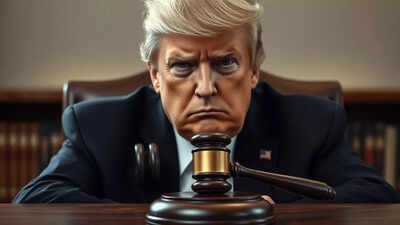
For now, Donald Trump retains his negotiating power with trading partners. (AI image)

The Donald Trump administration is evaluating a two-part strategy to deal with the US trade court ruling that blocked the American President’s sweeping reciprocal tariffs on several countries. The court ruling said that Trump overstepped his authority in imposing the tariffs. Currently, the Court of International Trade’s judgement against Trump’s tariffs under the International Emergency Economic Powers Act remains suspended due to an emergency stay. For now, this will help Donald Trump retain his negotiating power with trading partners.However, if subsequent court rulings also uphold the strike down of tariffs, US government officials have indicated that they have other measures up their sleeve.Trump Administration Message: ‘We will do it another way’In the first part of the twofold response, officials are exploring the implementation of broad-based tariffs across international markets using an unprecedented section of the Trade Act of 1974, according to a Wall Street Journal report.This provision permits levies up to 15% for 150 days to address trade deficits with international partners, according to the sources quoted in the report.Also Read | ‘Overstepped his authority…’: What are the scathing observations made by US trade court in ruling against Donald Trump’s tariffs?Under Section 122, Trump has the authority to implement a 15% tariff for a duration of 150 days to control imports. This provision aims to tackle balance-of-payments issues or prevent substantial devaluation of the dollar. However, any extension beyond the initial 150-day period would necessitate Congressional approval.This interim measure would provide Trump sufficient time to develop country-specific tariffs for major trading nations under a separate clause of the identical legislation, which addresses unfair international trade conduct.The second approach involves a detailed notification and consultation process, which administration officials believe provides stronger legal standing compared to the recently invalidated tariff policy. This alternative method has precedent, having been employed multiple times previously, including during Trump’s initial China tariffs.In a Bloomberg TV interview, Peter Navarro, senior counselor for trade and manufacturing, acknowledged the administration’s consideration of a dual-pronged tariff strategy. This would initially implement Section 122 of the 1974 trade law, followed by Section 301.When questioned about these specific provisions, Navarro confirmed, “Those are the kinds of thoughts” being evaluated by the economic team. He spoke of the potential application of the Smoot-Hawley Tariff Act of 1930, which enables tariffs against nations engaging in discriminatory practices against the US. He also mentioned the possibility of expanding tariffs based on national security considerations.“So you can assume that even if we lose, we will do it another way,” Navarro said.Navarro expressed confidence in their robust IEEPA position. “I think the big picture here is we’ve got a very strong case with IEEPA, but the court basically tells us, if we lose that, we just do some other things. So nothing’s really changed,” Navarro said.Also Read | Donald Trump’s trade policy thrown into turmoil! Will countries like India, China be tempted to hold off tariff talks?What does it mean for other countries?Globally, the implications are significant. Legal experts and trade analysts suggest that while court decisions might temporarily hinder Trump’s worldwide tariff strategy, they are unlikely to completely halt his efforts to secure trade advantages through pressure tactics. These rulings could simply lead to a shift in legal frameworks rather than a complete cessation.Specialists are advising their international stakeholders, businesses and other interested parties to anticipate that Trump will persist with his tariff agenda, albeit potentially through different mechanisms.“This is just the opening salvo,” said Dan Ujczo, a lawyer and U.S.-Canada trade expert at Thompson Hine in Columbus, Ohio. “The Trump administration has a number of options including reframing the executive orders to include some of the boundaries used in the CIT opinion,” Ujczo was quoted as saying by Reuters.“For folks celebrating this opinion, this may be a case of be careful what you ask for,” he added.Also Read | ‘Blatantly wrong’: Donald Trump administration blasts US court ruling blocking tariffs; says trade policy will continue


Source link

Top stocks to buy today: Stock recommendations for May 30, 2025


Top stocks to buy today: Stock recommendations for May 30, 2025
Top stocks to buy today (AI image)

Stock market recommendations: According to Bajaj Broking Research, Aurobindo Pharma, and Gokaldas Exports are the top stock picks for today. Here’s its view on Nifty, Bank Nifty and the top stock picks for May 30, 2025:Index View: NIFTYBenchmark indices extended consolidation for the second week in a row amid stock specific action. Nifty is seen consolidating in the range of 24,400-25,200. Despite facing multiple global macroeconomic and geopolitical headwinds — including heightened geopolitical tensions, persistent global trade tariff uncertainties, and elevated U.S. bond yields — the Indian equity market continues to exhibit a resilient upward bias. The benchmark Nifty 50 index has sustained its positive trajectory and is now placed around the 24,800 level.From a short-term technical perspective, the market sentiment remains constructive. The index is expected to find strong demand in the support zone of 24,400–24,500. As long as this key support range is held, we anticipate the Nifty 50 to continue its bullish momentum towards the resistance at 25,200-25,300 levels in the short term. Short-term support for Nifty is placed at 24,400–24,500 levels being confluence of 20 days EMA, previous breakout area and the last 2 weeks lows. While on the higher side 25,200-25,300 remains a key hurdle area being the previous major high and 80% retracement of the entire decline (26.277-21,744).Factors that support the positive momentum in the market 1) Rate cut expectations in the monetary policy outcome (2) Above normal Monsoon Forecast by the Indian Meteorological Department (IMD) (3) Brent crude prices have remained in a downward trajectory, offering a major tailwind to the Indian economy, which is a net importer of crude.NIFTY BANK

  • Bank Nifty continues to consolidate in the broad range of 56,000-53,500 in the last 5 weeks.
  • A key technical observation on the daily chart is that the index has already taken 26 sessions; it has retraced just 38.2% of the prior 9-session rally (49,157–56,098), indicating a shallow pullback that suggests underlying strength and potential higher bottom formation.
  • We expect the index to extend the last 5 weeks’ consolidation in the range of 53,500-56,000. Only a move above 56,000 levels will signal acceleration of the up move towards 56,700 levels in the coming sessions.
  • Within consolidation we believe dips should be used as a buying opportunity. Key support placed at 54,000-53,500 as it is the confluence of the lower band of the last 5 weeks range, key retracement and 50 days EMA.

Stock Recommendations:Aurobindo PharmaBuy in the range of Rs 1155-1175

Target SL Return Time Period
Rs 1278 1109 10% 3 Months

The stock is rebounding taking support at the rising trendline support joining lows of the last 3 months signaling buying demand at lower levels.The daily stochastic is rebounding from the oversold territory and has generated a buy signal moving above its three periods average thus validates positive bias. We expect the stock to head towards 1278 levels in the coming months being the 80% retracement of the previous decline (1356-1010) and the high of April 2025.Gokaldas ExportsBuy in the range of Rs 960-980

Target SL Return Time Period
Rs 1090 905 12% 3 Months

The stock is witnessing buying demand from the previous major breakout area and the confluence of 20- & 50-days EMA signaling strength and offers fresh entry opportunity. It is currently trading above the short- and long-term moving averages signaling strength and overall positive bias.The daily stochastic is rebounding from the oversold territory and has generated a buy signal moving above its three periods average thus validates positive bias. We expect the stock to head towards 1090 levels in the coming months being the 123.6% external retracement of the previous decline (1060-925). Disclaimer: The opinions, analyses and recommendations expressed herein are those of brokerage and do not reflect the views of The Times of India. Always consult with a qualified investment advisor or financial planner before making any investment decisions.


Source link

Higher loans, credit cards coming street vendors’ way


Higher loans, credit cards coming street vendors' way
Higher loans, credit cards coming street vendors’ way

NEW DELHI: With the contours of the revamped PM SVANidhi scheme having been finalised, street vendors will be getting higher subsidised loans, as well as credit cards with a limit of Rs 30,000, on account of banks coming on board. The credit cards will be issued by banks to street vendors who have repaid the earlier three tranches of subsidised loans, of Rs 10,000, Rs 20,000 and Rs 50,000.TOI has learnt that the revamped scheme will soon be placed before Cabinet for approval. Sources said the subsidised loans will now also be granted to street vendors from rural areas who migrate to cities to make a living. Though the housing and urban affairs ministry did not respond to queries, sources said an additional Rs 10,000 would be provided as part of the enhanced loan amount.Sources said the credit card facility will allow street vendors with a better credit rating to have access to more rolling capital for business, with the repayment norms being decided by banks.In her Budget speech, FM Nirmala Sitharaman had said the scheme launched in 2020, during the Covid-19 pandemic, has provided more than 68 lakh street vendors with respite from high-interest informal sector loans. “Building on this success, the scheme will be revamped with enhanced loans from banks, UPI-linked credit cards with Rs 30,000 limit and capacity building support,” she added.


Source link

ICAI to review fin statements of IndusInd


ICAI to review fin statements of IndusInd

NEW DELHI: The Institute of Chartered Accountants of India (ICAI) will review fraud-hit IndusInd Bank’s financial statements for 2023-24 and 2024-25. ICAI’s Financial Reporting Review Board (FRRB) will carry out the review. FRRB conducts the review of financial statements of companies to assess compliance with accounting standards, standards on auditing, among others. Starting with a March 10 disclosure about a potential hit to the net worth because of incorrect recognition of derivative trades over the last two years, the last two months have been tumultuous for IndusInd Bank.


Source link

Bajaj Auto Q4 profit falls 10% to Rs 1,802cr


Bajaj Auto Q4 profit falls 10% to Rs 1,802cr

NEW DELHI: Bajaj Auto on Thursday said its consolidated net profit declined 10 per cent year-on-year to Rs 1,802 crore in Q4 on account of lower sales in the domestic market. The Pune-based company reported a net profit of Rs 2,011 crore for the Jan-March period of 2023-24. Total revenue from operations rose to Rs 12,646 crore in Q4.


Source link

Wipro unveils global innovation network


Wipro Limited announced the launch of its global Wipro Innovation Network designed to accelerate strategic partnership with global clients and academia. The network would leverage frontier technologies ranging from Artificial Intelligence (AI) to Quantum Computing to solve some of the most challenging problems for its clients across industries, the company said.

The Wipro Innovation Network would focus on five strategic frontier technology themes: Agentic AI, robotics with embodied AI, quantum computing, digital ledger technology and quantum-safe cyber resilience. It would also bring together Wipro’s extensive innovation ecosystem, including the Innovation Labs, the Partner Labs, Wipro Ventures, its crowdsourcing platform Topcoder, alliances with leading academic and research institutions, and its deep technology talent to create an ongoing loop of ideation, research and innovation.

Srini Pallia, CEO and Managing Director, Wipro Limited, said: “The Wipro Innovation Network is a catalyst for AI-powered co-innovation. By bringing together our global clients, partners, academia, and tech communities, we aim to accelerate innovation that solves real-world challenges, unlocks bold new possibilities, and drives competitive edge for our clients.” The company also opened a new 60,000 sq. ft. Innovation Lab in Bengaluru to advance its AI-powered vision.


Source link

False disclosures give false sense of information which distorts reality: SEBI chief


To protect investors from cyber frauds and market manipulators, the Securities and Exchange Board of India (SEBI) is planning to put in place robust system in coordination with investigative agencies which will go live soon. The regulator is also working to put in place a specific system wherein when investors are putting money through UPI, it will only go to the registered bank accounts thereby preventing fraud, SEBI Chairman Tuhin Kanta Pandey said in an exclusive interview with The Hindu. Edited excerpts: 

Lokpal has given a clean chit to the former SEBI chairperson in a case, and SEBI had also come under the cloud. How do you view this? 

At least from the compliance point of view there was a closure for my predecessor, because these were personal allegations. But you are right in saying that the chairperson represents an institution, so I would always feel that everyone in the institution right from the chairperson down to a single officer who is working with SEBI is above board. From the institutional perspective our effort should be always there.

What is the message you want to send by taking suo moto cognisance and issuing the order in the IndusInd Bank case? 

We want to make it very clear that being a market regulator we are responsible for market integrity. We want people to work with integrity. All investors should be rightly be placed to the extent possible, on an equal footing and no body must be trading based on unpublished price sensitive information.  

When one can make more money than others [through the price sensitive information] it would spoil the integrity of the market and that was the a very fundamental principle. We have people who are trying to do the pump and dump kind of operations. That’s an impious behavior. Recently we had passed an order on spoofing and we found that the people are spoofing, giving a dodge, so there are different kinds of market manipulations, some are standardised. People are quite creative and innovative also to keep on creating some of the other manipulations which I think it would be our effort to curb it by investing both in terms of human resources and technology. Combined with our intent, we intend to really see that the surveillance and enforcement continues to be on our radar always.

SEBI came out with the order on Gensol.  But it has impacted the company. The drivers are jobless and the company is in a bad shape. Could this have been handled better?  

Yes, I think our efforts should always be to do that. Sometimes it may be possible, sometimes it may not be. I think there are many players including board of directors, independent directors, and auditors. All of these things are there to see that that things do not come to that level because after all, we cannot be in every boardroom. Disclosures are there. So false disclosures have to be caught. Auditors have to see what’s going on. Independent directors also see the going on but still some egregious behavior comes and then it ends up in that situation.

I would say it is not a general phenomena. After all, you build businesses and the businesses might go wrong also sometimes, risk that equity holders shareholders always take and is the nature of the market but you have to have an honest intention. The intent is very important. But fraud and falsification are unacceptable. Particularly in a market situation where we have many rules and regulations, many more players. There I think, sometimes you have to come in very hard. In case of IndusInd, we came out with an interim order.

Normally we would have gone for a show cause. But there are certain things which need to be prevented because  time is of essence, market is always playing and the investigations do take time. We are able to at least prevent the things. In many cases, we would like to give an opportunity to the person and then come to a final conclusion like in the case of Gensol. That had to be done because it was discovered that there was so much of lenders’ money was getting diverted. In fact, the lenders should have been more circumspect. This is a role that the company should play. So I think when they fail we have to do that. It is something that we don’t feel happy about but we have to do it.  

Despite all regulation, wrongdoings are happening. Is there a way out to further strengthen the regulations and evoke fear in the mind of offenders? 

 Regulation is only the first part of dealing with wrongdoings. The second part is prevention, third is corrective action when finally someone doesn’t listen. That’s the nature of human behavior. You can deter a large number of people through regulations, but there will be some people who would be careless enough not to bother about the regulation.  You can just make things more complicated for the good people. Regulation is there and if people violate we punish them. 

When a market becomes bigger, the probability of wrongdoing only increases. In that context, why are you deliberating on deregulation? 

I never said deregulate. I said optimum regulation. To say that you put more regulation then you can do better is not the way to do that. Effectiveness of regulation is important. If you want to hit where the high risk is, you do not have to get into micro-regulation. We are not able to have effective regulation or effective compliance because if you have too much of it, you can’t focus on the riskier part of it. We can simplify but still be very stringent on something where it actually matters a lot. 

When you were in the finance ministry, the Chief Economic Adviser Ananthanageswaran warned of financialisation in the economy. Now you are in the chair of a financial regulator. What is your stand?

 I think my take is that context is important. Financial capital market development is the essence of growth. If the companies are not able to raise money, then how are they able to invest ? So intermediation is important. Suppose the real economy is faltering and you are simply talking. Then that means there may be a bubble, but real economy fundamentally must carry on in order for that to give a credible fundamental based on which the growth should come and fully agree with him. 

You maintain that short-term volatility does not matter. Is there something SEBI is doing to protect retail investors who have now come to the forefront?

 A lot of it is the temporary sentiment and the moment the sentiment is corrected, it just picks up again. So there is no way we can intervene in those situations and secondly, regulators’ job is to provide the market infrastructure. We will develop the capital market and we develop through instruments which are properly regulated.  

Is there any move to further regulate companies listed in SME exchanges and ensure that they go to the main board at a certain stage? 

 The point is that we have got literally millions of small enterprises. They are family owned, mostly private, limited or proprietorships, and others. Some have got potential, some are big, but they’re still unlisted, so it is an opportunity. So they should come to the capital market and  raise money and they can graduate. We will not like to just stereotype and make a sweeping statement at the same time. But we don’t have tolerance for false disclosures. We have relatively done a little bit of a tightening  to weed out  completely loss making firms. It’s not that every investor should put money just because somebody is offering IPO. We take a lot of effort keeping the investor aware of responsible investing.

However, there could be some egregious cases as well. We are watching and analyzing to determine the extent of deviant behavior. People should be able to disclose; good or bad.  This false disclosures give a false sense of information to the people, which actually distorts the reality. Therefore, we are also working out a system to verify the claims of a listed company through the exchanges. In that case, that information can very quickly come in loud and we can catch them at that place. So this is the system which we are bringing. We have already told the exchanges and they are working how to make it happen. 

Are there any improvements you are looking at in the exchanges? 

We have to constantly watch it. I would say that complacency is not the place for the regulators. Because you never know what is a new risk. So we have to constantly see how upgrade ourselves and fortunately we also have a lot of young force joining. We are inducting technically savvy, engineers and chartered accountants. And so we really want to encourage them to develop tools and effectively use technology to analyze large data. If you are able to do data analytics of a larger scale, you are able to get alerts from a larger data sets and then from alerts you can do further research. So it’s a painstaking job, but then it’s worth doing that way because the more the data the more we have to have tools to handle it. 

A regulator needs to create fear in the minds of rule breakers and should not be a cheer leader….

 It is not a question of a personality. SEBI is a Parliamentary institution and Parliament has given us three types of mandates; investor protection, development of markets and regulation of markets. Therefore, it is not bad to know that we are able to maintain market integrity. People will trust a market when you say that we are able to give a fair regulation. So if my job is to only create fear, then do I suppress the economic activity? That is not the kind of an approach that we should have.  We  write fair regulations and we get them implemented. We see that these are implemented and that is dynamic process.  

Are there any concerns that you think you should be looking at?

 There are no concerns. I would say that India is quite a resilient market and our market system is fairly robust. World recognises that.  So instead of becoming complacent, we have to constantly evolve. We have got a nice moment in history with demographic dividend, democracy, demand and talent. 

We are not really saying that we are overly dependent on foreigners. We have our own domestic money coming in as people have faith in the market. But at the same time we should understand the cyber risks. That is one of our very big focus; awareness building.  We are working with platforms to see that only whitelisted apps will be there, others will be pulled down from the play stores. We are working to see that there is a system whereby when you are putting money through UPI, we will have a specific UPI system in built  which will only go to the registered bank accounts. We will just try and create all those things to ensure people do not lose the money.

We are also trying to squeeze business plan of finfluencers out. We have taken down 70,000 finfluencers and we are taking down an average of 5,000 of them every month. We are also squeezing their business model as no regulated entity of SEBI can give advertisement to someone who is not registered in this debate.  I would say that we will do much more, much wider thinking of awareness building through everyone coming together and also bringing other agencies, the state police and, the cyber crime police, the ED and CBI. We are trying to build much more for the investment side and stock side on these crimes. 

We really want to have a massive kind of a plan which will actually penetrate to everyone which includes some simple messages where it can reach down and we are able to say that at least come to the market safely. It is tougher to bring awareness on allocation of portfolio. People are just losing money in F&O.  They can save and invest. That’s how people used to. It’s not a grow rich kind of a thing overnight. It never works. It’s a gambling behavior. In a gambling [the] den house always wins. 

Are you contemplating using artificial intelligence and sniffing out social media accounts? 

 We are using it. In fact, without artificial intelligence it would not be possible to exactly pinpoint which are the influencers that need to be taken down.


A year back there was a protest among the employees. Will the High Level Committee looking to prevent such activities in the updated employee service norms? 

 First of all, the protests happened during my predecessor’s time. I would not like to comment. Now the conflict of interest issue is a very important. In our case, the conflict of interest issue for employees was emanating from the ESR and I mean ESR will have to deal with it and for board members and the chairperson it was from a code of conduct which was came in 2008. They were in different times. They are appointed by the government through the appointment committee so therefore, these were two different things and they are looking at both.  They’re free to interact with anyone. They’re an independent committee formed by SEBI but not reporting to SEBI. 

RBI has taken initiatives like roping in celebrities for awareness campaigns like RBI Kehta Hay. Is SEBI planning something like that ? 

 I would say that we are trying to bring it together in a more cohesive manner to a SEBI driven strategy but ownership has been taken by other organisations too. The brokers, the market infrastructure institution, the market intermediaries, SEBI and NISM should be able to really work out a more comprehensive awareness campaign together. We are still at concept stage. We have actually done an investor survey which will be out by July and this will help assess the deficiencies and help us formulate the campaign. 


Is there coordination between different regulators to further strengthen the surveillance mechanism? 

 Yeah, it’s very important.  We are doing it already, but I think we have to further upgrade in terms of sharing of information. Even in cyber crimes affecting investing, we are going to plan in a big way along with various state agencies. So today we have the I4C and the national level and 1930 as a as a single line national line in order to report that the people will do it. But I still think lot of guidance is needed with respect to the cyber crime police as  to how to really go about things quickly in matters which are relating to investment crimes. We also want to give clear alternatives that are safe pipelines. So if we are able to make the people adopt to that, then there will be a very little chance of putting money in wrong account. 

Organisations are definitely more important than individuals, but leaders leave a mark. As the new leader of SEBI, what are the new directions you want to give as far as transparency and corporate governance are concerned?

I think it is for you to judge my leadership, I can’t judge my own leadership. 


Source link

‘Blatantly wrong’: Donald Trump administration blasts US court ruling blocking tariffs; says trade policy will continue


‘Blatantly wrong’: Donald Trump administration blasts US court ruling blocking tariffs; says trade policy will continue
Donald Trump has sought to restructure America’s international trade relationships. (AI image)

The Donald Trump administration has lashed out at a US trade court ruling striking down the President’s reciprocal tariffs. The White House has said that the US trade policy will continue and the government is reviewing other avenues as well.The Trump administration sharply criticised a federal court’s ruling on Thursday that blocked numerous broad-ranging tariffs, dealing a significant blow to the presidential trade agenda.Since his return to office in January, Donald Trump has sought to restructure America’s international trade relationships, employing tariffs as a diplomatic tool to bring other governments into negotiations.However, the inconsistent implementation of these reciprocal tariffs, affecting both allies and adversaries alike, has created instability in markets and disrupted supply chains.Also Read | Donald Trump’s trade policy thrown into turmoil! Will countries like India, China be tempted to hold off tariff talks?On Wednesday, the Court of International Trade’s three-judge panel determined that Donald Trump had exceeded his legal authority and prohibited most of the tariff measures implemented during his second term.The Trump administration has denounced the court ruling as ‘blatantly wrong’ through social media channels, stating their belief that the ruling would not survive an appeal.Legal representatives of the Trump administration have initiated an appeal process, responding to the court’s mandate giving them 10 days to cease the affected tariff collections.“Nothing’s really changed,” said Peter Navarro, the President’s trade adviser, in conversation with Bloomberg Television.“If anybody thinks this caught the administration by surprise, think again,” he further remarked.Senior officials from the Trump administration expressed confidence on Thursday regarding the appeal of a US trade court decision that halted President Donald Trump’s most comprehensive tariff measures. They maintained that alternative legal options remain available for implementation during this period.Also Read | ‘Overstepped his authority…’: What are the scathing observations made by US trade court in ruling against Donald Trump’s tariffs?


Source link

Coca-Cola eyes next billion-dollar brand from India amid resilient demand, says COO Braun


Coca-Cola eyes next billion-dollar brand from India amid resilient demand, says COO Braun

The Coca-Cola Company is optimistic about expanding its portfolio of billion-dollar brands, with India playing a key role in this growth trajectory, said Henrique Braun, Executive Vice President and Chief Operating Officer, on Thursday.Speaking during his visit to Mumbai, Braun highlighted the significance of India in the company’s global growth strategy. He noted that Coca-Cola currently has three billion-dollar brands originating from India — ThumsUp, Maaza, and Sprite — which reflects the strength and vibrancy of the Indian beverages market, PTI reported.“We have today 30 billion-dollar brands (globally) of which 15 were built organically and 15 we acquired and built into billion-dollar brands over the years,” Braun said, expressing confidence that more Indian brands would join this elite club in the future.Industry sources indicate that Coca-Cola’s flagship cola drink in India may soon enter the billion-dollar revenue club as well.“I have no doubt that we will have another one coming in the future because we believe in the vibrance of the country and the industry,” Braun added.India is currently Coca-Cola’s fifth-largest market by volume growth, and the company is continuing to build what Braun described as the “right foundations” for long-term sustainable expansion. He also acknowledged India’s evolving status in global rankings, influenced by various market conditions and geopolitical factors.On the broader demand landscape, Braun observed: “We continue to see resilience in the demand. It’s never a straight line, but if you compare year on year, in a bigger time frame, it continues to be resilient. There might be variations, but it’s a market with growing demand.”Coca-Cola already has seven of the top ten beverage brands in the Indian market and plans to continue building and localizing its portfolio. However, Braun noted that the decision to introduce more global brands will depend on the timing and maturity of the Indian market.India remains one of the highest-taxed markets globally for carbonated beverages, attracting a GST of 28 per cent along with an additional cess of 12 per cent. On the issue of whether a reduction in tax rates could spur growth, Braun was measured: “We have learned in 139 years that we have to deal with the local framework. We focus more on what we can control.”


Source link