Business

Markets welcome court ruling against Trump’s tariffs as shares, U.S. dollar, oil gain


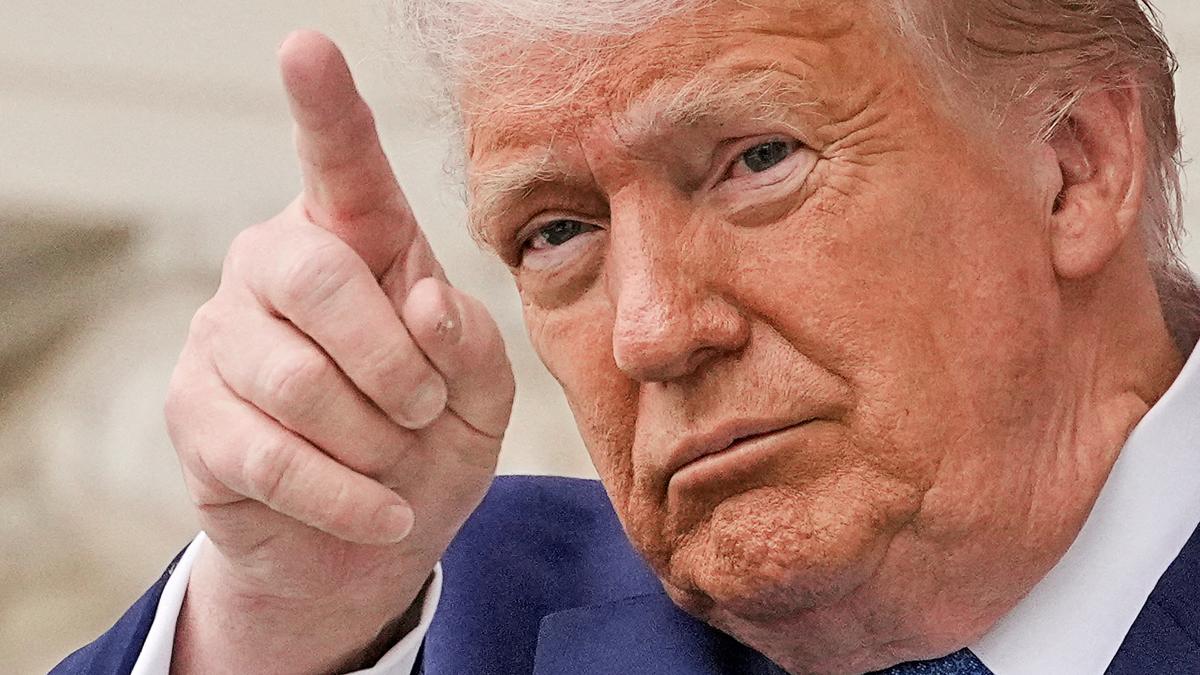
U.S. President Donald Trump. File

U.S. President Donald Trump. File
| Photo Credit: Reuters

Financial markets welcomed a U.S. Court ruling that blocks President Donald Trump from imposing sweeping tariffs on imports under an emergency-powers law.

U.S. futures jumped on Thursday (May 29, 2025), and oil prices rose more than $1. The U.S. dollar rose against the yen and euro.

The Court found the 1977 International Emergency Economic Powers Act, which Mr. Trump has cited as his basis for ordering massive increases in import duties, does not authorise the use of tariffs.

The White House immediately appealed and it was unclear if Mr. Trump would abide by the ruling in the interim. The long-term outcome of legal disputes over tariffs remains uncertain. But investors appeared to take heart after the months of turmoil brought on by Mr. Trump’s trade war.

The future for the S&P 500 was up 1.7% while that for the Dow Jones Industrial Average gained 1.4%.

Japan’s Nikkei 225 index jumped 1.9% to 38,442.10. America’s largest ally in Asia has been appealing to Mr. Trump to cancel the tariffs he has imposed on imports from Japan and to also halt the 25% tariffs on steel, aluminum, and autos.

The ruling also pushed the dollar sharply higher against the Japanese yen. It was trading at 145.98 yen on Thursday, up from 144.87 yen late Wednesday (May 28, 2025).

A three-judge Panel ruled on several lawsuits arguing Mr. Trump exceeded his authority, casting doubt on trade policies that have jolted global financial markets, frustrated trade partners, and raised uncertainty over the outlook for inflation and the global economy.

Many of Mr. Trump’s double-digit tariff hikes are paused for up to 90 days to allow time for trade negotiations, but the uncertainty they cast over global commerce has stymied businesses and left consumers wary about what lies ahead.

“Just when traders thought they’d seen every twist in the tariff saga, the gavel dropped like a lightning bolt over the Pacific,” Stephen Innes of SPI Asset Management said in a commentary. The ruling was, at the least, “a brief respite before the next thunderclap,” he said.

Elsewhere in Asia, Hong Kong’s Hang Seng added 1% to 23,482.81, while the Shanghai Composite index gained 0.8% to 3,365.40. Australia’s S&P/ASX 200 gained 0.1% to 8,409.70.

In South Korea, which like Japan relies heavily on exports to the U.S., the Kospi surged 1.8% to 2,709.42. Shares also were helped by the Bank of Korea’s decision to cut its key interest rate to 2.5% from 2.75%, to ease pressure on the economy.

Taiwan’s Taiex edged 0.1% lower, and India’s Sensex was also down 0.1%. On Wednesday (May 28, 2025), the U.S. stocks cooled, with the S&P 500 down 0.6% but still within 4.2% of its record after charging higher amid hopes that the worst of the turmoil caused by Mr. Trump’s trade war may have passed. It had been roughly 20% below the mark last month. The Dow industrials lost 0.6% and the Nasdaq composite fell 0.5%.

Trading was relatively quiet ahead of a quarterly earnings release for Nvidia, which came after markets closed.

The bellwether for artificial intelligence overcame a wave of tariff-driven turbulence to deliver another quarter of robust growth thanks to feverish demand for its high-powered chips that are making computers seem more human. Nvidia’s shares jumped 6.6% in afterhours trading.

Like Nvidia, Macy’s stock also swung up and down through much of the day, even though it reported milder drops in revenue and profit for the latest quarter than analysts expected. Its stock ended the day down 0.3%.

The bond market showed relatively little reaction after the Federal Reserve released the minutes from its latest meeting earlier this month, when it left its benchmark lending rate alone for the third straight time. The central bank has been holding off on cuts to interest rates, which would give the economy a boost, amid worries about inflation staying higher than hoped because of President Trump’s sweeping tariffs.

In other dealings on Thursday (May 29, 2025), the yield on the 10-year Treasury rose to 4.52% from 4.47% late Wednesday (May 28, 2025). The U.S. benchmark crude oil gained $1.06 to $62.90 per barrel. Brent crude, the international standard, added $1.01 to $65.33 per barrel. The euro slipped to $1.1242 from $1.1292.


Source link

Access Denied


Access Denied

You don’t have permission to access “http://www.ndtv.com/business-news/rbi-says-india-poised-to-remain-fastest-growing-major-economy-in-fy26-8535531” on this server.

Reference #18.4cfdd417.1748505162.1ddcb563

https://errors.edgesuite.net/18.4cfdd417.1748505162.1ddcb563


Source link

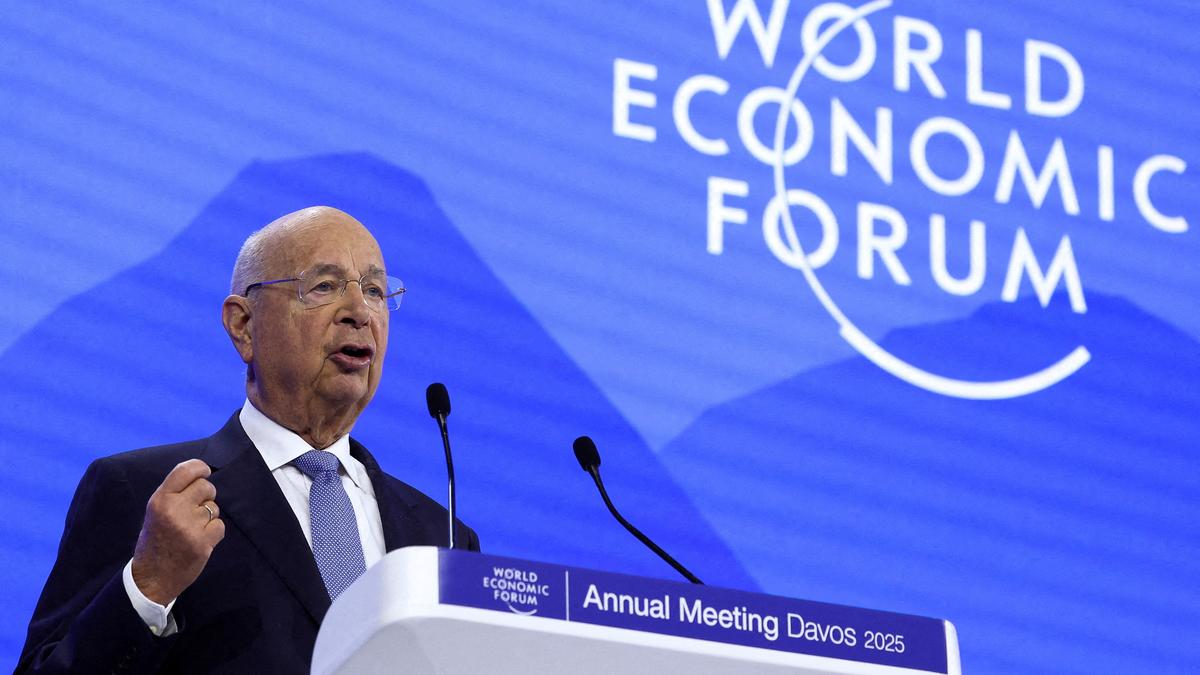
WEF founder Klaus Schwab files criminal complaint against whistleblowers, FT reports


World Economic Forum founder Klaus Schwab. File

World Economic Forum founder Klaus Schwab. File
| Photo Credit: Reuters

World Economic Forum (WEF) founder Klaus Schwab has filed a criminal complaint against the whistleblowers who had anonymously alleged misconduct by him, the Financial Times reported on Thursday (May 29, 2025), citing an interview with Mr. Schwab.

The Forum had launched an investigation in April into Mr. Schwab following a whistleblower letter alleging misconduct by him, only a day after the 87-year-old Mr. Schwab said he was resigning as chairman without stating a reason. Mr. Schwab told the FT that he would fight the “stupid and constructed” allegations, adding that his lawyers had filed a complaint for defamation and coercion with the public prosecutor in Geneva.

WEF, whose annual gathering of business and political leaders in the Swiss mountain resort of Davos has become a symbol of globalisation, did not immediately respond to a Reuters request for comment. Mr. Schwab could not be immediately reached. There was no immediate response from the Geneva prosecutor’s office.

The FT report said the WEF had declined to comment on Mr. Schwab’s legal action, saying it was “a matter apparently directed privately against unknown whistleblowers”.

“We will have this public prosecutor investigation now, we don’t know how aggressive they will be,” Mr. Schwab said. “If they find a systemic attempt to undermine my reputation, this won’t be comfortable for the board.”

The Wall Street Journal, which first reported the probe in April, had said the anonymous letter raised concerns about WEF’s governance and workplace culture, including allegations that the Schwab family mixed their personal affairs with the Forum’s resources without proper oversight. The Schwab family denied all the allegations in the whistleblower complaint to the Journal. Mr. Schwab also denied all allegations against him to the Financial Times. The Forum has previously stated that it would wait for the outcome of the investigation to comment further.


Source link

Indian Railways to achieve net zero targets in 2025 itself – 5 years ahead of 2030 goal


Indian Railways to achieve net zero targets in 2025 itself - 5 years ahead of 2030 goal
By the end of December, Indian Railways will achieve ‘Scope 1 net zero’, successfully offsetting 2.2 million tonne CO2.

In a big boost to Indian Railways‘ green plans, the national transporter is set to reach its net zero objectives in the current year, significantly earlier than its 2030 target, primarily due to comprehensive electrification efforts.By the end of December, Indian Railways will achieve ‘Scope 1 net zero’, successfully offsetting 2.2 million tonne CO2, which exceeds its emissions by 200,000 tonnes, according to Indian Railways officials.By 2030, the Indian Railways anticipates requiring approximately 10 gigawatt (GW) of electricity for train operations. The distribution plan includes 3 GW from renewable sources including hydropower, whilst another 3 GW will come from thermal and nuclear sources. The remaining 4 GW requirement shall be fulfilled through arrangements with power distribution companies.

On Track for net zero plans

On Track for net zero plans

A senior official informed ET, “Over 90% of the traction (energy used to power trains) is on electric. This will rise to 95% by 2029-30.”The government-operated railway network is currently focusing on decreasing indirect emissions, particularly from electricity generated by thermal power stations.Official data indicates that the Indian Railways’ carbon emissions reduced from 3.32 million tonnes per annum (mtpa) in 2023-24. The official stated, “At 90% electric traction (in 2024-25), Scope 1 carbon emissions stood at 2.02 mtpa. This will come down to 1.37 mtpa with 95% electric traction from 2025-26 onwards.”Also Read | Indian Railways bets on nuclear power – details hereIndian Railways is actively pursuing renewable energy sources, including solar and wind power, while also exploring nuclear energy options. “This will address indirect emissions (Scope II and III),” the official added.According to officials, requests have been submitted to the power ministry to allocate roughly 2 GW of nuclear power for Indian Railways. Plans include sourcing 2 GW thermal power through new joint ventures and power purchase agreements. Additionally, negotiations are ongoing for 500 megawatt round-the-clock renewable energy procurement.The transition to electric power brings both environmental benefits and financial advantages for the Indian Railways. The expenditure on diesel for traction is projected to decrease to Rs 9,528.53 crore in 2025-26, marking the lowest projected diesel spending by the railways in over ten years.Also Read | Indian Railways’ first 9,000 HP electric locomotive engine inaugurated by PM Modi; unveils Dahod’s loco workshop – Top facts


Source link

Nvidia first-quarter earnings results: Nvidia beats estimates as revenues rise 69% from a year ago | Business


Nvidia first-quarter earnings results: Nvidia beats estimates as revenues rise 69% from a year ago
Nvidia first-quarter earnings results (AP)

Nvidia announced impressive first-quarter results on Wednesday, reporting a 69% year-over-year increase in revenue, reaching $44.1 billion, surpassing Wall Street’s forecast of $43.28 billion. However, the company’s net profit of $18.78 billion was slightly below the anticipated $19.49 billion.Earnings per share came in at 73 cents, an increase from 61 cents a year prior. Shares of the California-based chip manufacturer rose more than 4% in after-hours trading. Nvidia finished the regular trading session as the second-most valuable company in the world, trailing only Microsoft, with a market capitalization of $3.3 trillion.Nvidia’s stock climbed over 3% to $135.36 a day before the company was due to release its earnings report on Wednesday.Last year, the Biden administration’s export controls limited Nvidia’s ability to sell its advanced H20 AI chip in China, a market that accounted for 13% of the company’s revenue in 2024. Nvidia has warned that these restrictions could lead to $5.5 billion in charges, with CEO Jensen Huang estimating a $15 billion loss in potential sales. Analysts at Susquehanna estimated the curbs cost Nvidia about $1 billion in sales in the final three weeks of the April quarter. Wedbush analysts projected a quarterly hit between $3 billion and $4 billion. Gross margins were also expected to take a hit, forecasting an 11 percentage point drop to 67.7 per cent, partly due to write-downs related to H20 shipments, which could reduce margins by as much as 12.5 per cent.Now that Nvidia has released its financial results for the first quarter of 2026, all eyes will be on how the company navigates the twin challenges of regulatory restrictions in China and rising AI infrastructure costs. Analysts are watching closely to see whether Nvidia can extend its streak of beating Wall Street expectations for an eighth consecutive quarter.Despite Nvidia’s strong positioning, 2025 has been volatile for chipmakers. Nvidia’s share price has largely stalled after doubling in 2023.NVIDIA is set to distribute its upcoming quarterly cash dividend of $0.01 per share on July 3, 2025, to all shareholders registered as of June 11, 2025.


Source link

Once weighed down by bad loans, public sector banks drive India’s banking profits to highest ever in history


Once weighed down by bad loans, public sector banks drive India’s banking profits to highest ever in history
Government-owned banks demonstrated remarkable growth with a 26% increase in profits to Rs 1.83 lakh crore. (AI image)

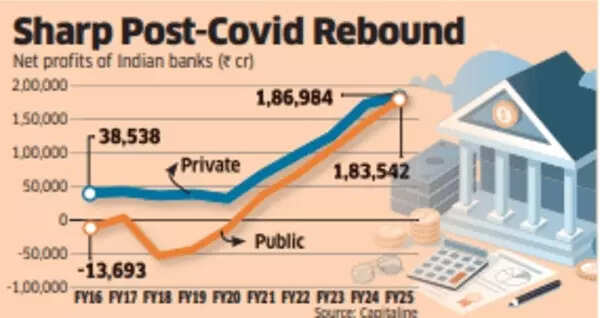
Big turnaround story! Public sector banks led India’s banking sector to record-breaking profits in FY25, with industry earnings rising nearly 14-fold over a decade to Rs 3.71 lakh crore, driven by lending income, treasury gains and reduced provisions for non-performing assets.Government-owned banks demonstrated remarkable growth with a 26% increase in profits to Rs 1.83 lakh crore, closing in on private banks, which recorded a modest 7% growth to Rs 1.87 lakh crore, according to an ET analysis.State Bank of India emerged as the most profitable bank with net earnings of Rs 70,900 crore, with HDFC Bank following at Rs 67,347 crore, and ICICI Bank achieving Rs 47,227 crore in FY25. The overall private sector bank profits were affected by significant declines in earnings at IndusInd Bank and IDFC First Bank.The remarkable financial performance follows the cleanup initiative that began in 2015 with the asset quality review (AQR) under former central bank governor Raghuram Rajan. This led PSU banks to record substantial losses over three successive years, with bad loans exceeding 8% of advances in FY16.

Sharp Post-Covid Rebound

Sharp Post-Covid Rebound

To support PSU banks’ growth, the government provided capital injection of Rs 3.15 lakh crore since the 2015 AQR, according to the recently published Economic Capital Framework report.Motilal Oswal Finance Services’ banking report has said: “Banks are prioritising asset quality over growth, with stricter credit filters, higher CIBIL score thresholds, and conservative underwriting—especially in retail segments… PSU banks’ disbursements remain modest while private players have gained share.”In fiscal year 2016, commercial banks collectively posted a net profit of Rs 24,854 crore, primarily attributed to the strong performance of private sector banks. Lenders then initiated a comprehensive balance sheet restructuring, prompted by regulatory guidance and supported by updated insolvency legislation designed to swiftly recover substantial funds locked in debt-laden assets.“The key driver of the impressive rise in profits is the stable credit growth in FY25 on top of the good growth in FY24,” said VK Vijayakumar, chief investment strategist, Geojit Investments. The aggregate net profit of all commercial banks stood at Rs 3.19 lakh crore in the previous year. “A major concern at the beginning of the year was deposits lagging credit growth. But as the year progressed, the deposit growth converged with credit growth,” he added.The AQR implementation resulted in enhanced recognition of non-performing loans and increased provisions. The subsequent introduction of the Insolvency and Bankruptcy Code strengthened banks’ recovery mechanisms and negotiating position with defaulters. According to IBBI statistics, creditors have recovered approximately Rs 3.9 lakh crore across 1,194 cases through March 2025.Regarding stressed assets, Subha Sri Narayanan, director, Crisil Ratings, says, “Gross non-performing assets (NPAs) have bottomed at 2.4% as of March 31, 2025, and are seen rangebound at 2.4-2.6% by March 2026. While corporate NPAs would remain low on strengthened risk management of banks, and robust balance sheets of corporates.”Discussing FY26 net interest margin (NIM) prospects, Vishal Narnolia, analyst, ICICI Direct, noted, “In the first half, NIMs are expected to decline around 15 bps as there is a strong probability of policy rate cut which the banks will have pass to EBLR-linked borrowers.” He indicated that deposit repricing in the second half should support margin recovery, with overall margins likely decreasing by approximately 10 bps in FY26.Most banks maintain NIMs—the gap between interest income and expense—between 3% and 4%. Vijayakumar of Geojit confirms the banking sector’s positive outlook.He cautioned that “However, there are some concerns arising out of rising delinquencies in unsecured loans, credit cards and stress in the microfinance segment which can moderate profit growth in FY26.”


Source link

Access Denied


Access Denied

You don’t have permission to access “http://www.ndtv.com/business-news/sensex-opens-above-81-500-market-opens-in-green-lead-it-metal-stocks-8534763” on this server.

Reference #18.4cfdd417.1748499877.1dbde58c

https://errors.edgesuite.net/18.4cfdd417.1748499877.1dbde58c


Source link

Sensex jumps over 500 points in early trade


Equity benchmark indices Sensex and Nifty surged in early trade on Thursday (May 29, 2025) after two days of decline, mirroring a rally in Asian markets amid positive developments on the US tariffs front.

Also, foreign fund inflows drove equity markets higher.

The 30-share BSE benchmark gauge Sensex jumped 504.57 points to 81,816.89 in early trade. The NSE Nifty climbed 137.25 points to 24,889.70.

From the Sensex firms, Infosys, Tata Steel, Tech Mahindra, HCL Tech, Tata Consultancy Services, Sun Pharma, Tata Motors and HDFC Bank were among the biggest gainers.

UltraTech Cement, Bajaj Finance, Bajaj Finserv and Nestle were among the laggards.

A U.S. federal court has blocked President Donald Trump from imposing sweeping tariffs on imports under an emergency-powers law.

“The US federal court striking down the reciprocal tariffs is a clear message that the President cannot ride roughshod over markets and economy with his questionable decisions.

“This court ruling is the second big blow to President Trump after the blow delivered by the bond market which forced the Trump administration to pause the tariffs for 90 days. From the market perspective, this is a positive development,” V K Vijayakumar, Chief Investment Strategist, Geojit Investments Limited, said.

In Asian markets, South Korea’s Kospi, Japan’s Nikkei 225 index, Shanghai’s SSE Composite index and Hong Kong’s Hang Seng were trading in the positive territory.

US markets ended lower on Wednesday.

Foreign Institutional Investors (FIIs) bought equities worth ₹4,662.92 crore on Wednesday (May 28), according to exchange data.

India’s industrial production growth slowed to 2.7 per cent in April 2025 due to poor performance of manufacturing, mining and power sectors, according to official data released on Wednesday.

Global oil benchmark Brent crude jumped 1.11 per cent to USD 65.62 a barrel.

The 30-share BSE barometer declined 239.31 points or 0.29 per cent to settle at 81,312.32 on Wednesday. The Nifty dropped 73.75 points or 0.30 per cent to 24,752.45.


Source link

Rupee declines 7 paise to 85.45 against U.S. dollar in early trade


The rupee depreciated 7 paise to 85.45 against the U.S. dollar in early trade on Thursday (May 29, 2025).

The rupee depreciated 7 paise to 85.45 against the U.S. dollar in early trade on Thursday (May 29, 2025).
| Photo Credit: Reuters

The rupee depreciated 7 paise to 85.45 against the U.S. dollar in early trade on Thursday (May 29, 2025) as the American currency strengthened after the U.S. federal court blocked President Donald Trump’s sweeping reciprocal tariff order, fuelling hope of ending global trade uncertainties.

The local unit was weighed down by higher crude oil prices overseas and disappointing domestic data on industrial output for April. However, inflow of foreign funds and buying trend in domestic equities capped the rupee’s fall, forex traders said.

At the interbank foreign exchange, the domestic unit opened at 85.56 and gained some ground to trade at 85.45 against the greenback in initial deals, 7 paise lower from its previous close.

The local unit ended Wednesday’s session 2 paise higher at 85.38 against the dollar.

Meanwhile, the dollar index, which gauges the greenback’s strength against a basket of six currencies, was trading higher by 0.40% at 100.18.

Brent crude, the global oil benchmark, climbed 1.11% to $65.62 per barrel in futures trade.

In the domestic equity market, the 30-share BSE Sensex rose by 350.27 points, or 0.43%, to 81,662.59, while the Nifty went up 94.05 points, or 0.38%, to 24,846.50.

Foreign institutional investors (FIIs) purchased equities worth ₹4,662.92 crore on a net basis on Wednesday, according to exchange data.

On the domestic macroeconomic front, India’s industrial production growth slowed to 2.7% in April 2025 due to poor performance of manufacturing, mining and power sectors, according to official data released on Wednesday.


Source link

Gold & silver price prediction today: What’s the gold rate outlook for May 29, 2025 – should you buy or sell?


Gold & silver price prediction today: What's the gold rate outlook for May 29, 2025 - should you buy or sell?
Gold prices have resumed their primary upward trend after a brief consolidation phase. (AI image)

Gold and silver price prediction: MCX Gold and MCX Silver have shown considerable fluctuations recently, influenced by global political events and the impact of Donald Trump’s decisions regarding tariffs on market confidence. Despite gold’s conventional status as a secure investment option, gold rate has declined from recent highs over the past few trading sessions. Abhilash Koikkara, Head – Forex & Commodities, Nuvama Professional Clients Group shares his views:MCX GOLD OutlookGold prices have resumed their primary upward trend after a brief consolidation phase within the 96,000–94,500 range. This consolidation acted as a healthy pause, allowing the market to absorb previous gains before continuing its bullish momentum. The breakout from this range signals renewed buying interest and reinforces the underlying positive sentiment in the precious metals market.Currently, prices are showing strong upward momentum and are poised to test the 98,000 level in the near term. This move is supported by favorable macroeconomic conditions, including ongoing geopolitical tensions, a weak currency, and persistent inflationary concerns, all of which typically enhance gold’s appeal as a safe-haven asset. Additionally, the technical setup also suggests continued strength, with price action forming higher highs and higher lows, indicating sustained buying pressure.The overall bias remains positive as long as gold sustains above the key support level of 94,500. Any dips toward this zone may attract fresh buying interest from investors and traders looking to capitalize on the broader bullish trend. In summary, with momentum building and fundamentals supporting the move, gold prices are likely to maintain their upward trajectory, with 98,000 emerging as the next potential resistance zone.MCX GOLD StrategyCMP: 95600TARGET: 98000STOP LOSS: 94350MCX SILVER OutlookMCX Silver prices continue to exhibit strong bullish momentum, maintaining their upward trajectory with a series of higher highs and higher lows. This consistent price action reflects strong investor confidence and sustained buying interest, suggesting that the current rally has more room to run. The overall market sentiment remains positive, supported by both technical and fundamental factors.Silver prices have broken past key resistance levels in recent sessions, reinforcing the bullish trend. With this momentum, prices are expected to move towards the next significant level at 1,01,800. This target is well within reach if the current momentum persists, backed by robust demand from industrial and investment sectors. Moreover, ongoing macroeconomic uncertainties, including inflationary pressures and currency volatility, continue to drive safe-haven buying in precious metals, especially silver.Technically, the structure of higher highs and higher lows is a clear indication of an ongoing uptrend. As long as this formation remains intact, we will maintain a bullish outlook. Any short-term corrections or pullbacks are likely to be viewed as buying opportunities, rather than a change in trend. In conclusion, the outlook for MCX Silver remains firmly positive, with the 1,01,800 level as the next potential target in the current upward move.MCX SILVER StrategyCMP: 98000TARGET: 101800STOP LOSS: 95800(Disclaimer: Recommendations and views on the stock market and other asset classes given by experts are their own. These opinions do not represent the views of The Times of India)


Source link