Business

Once weighed down by bad loans, public sector banks drive India’s banking profits to highest ever in history


Once weighed down by bad loans, public sector banks drive India’s banking profits to highest ever in history
Government-owned banks demonstrated remarkable growth with a 26% increase in profits to Rs 1.83 lakh crore. (AI image)

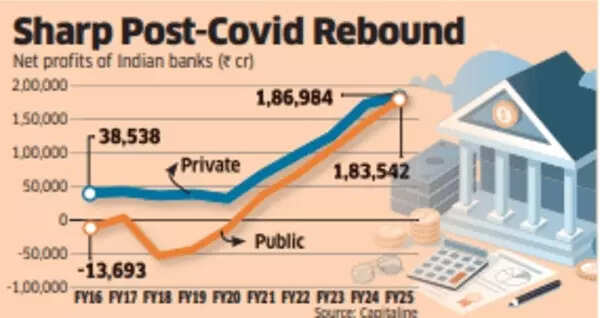
Big turnaround story! Public sector banks led India’s banking sector to record-breaking profits in FY25, with industry earnings rising nearly 14-fold over a decade to Rs 3.71 lakh crore, driven by lending income, treasury gains and reduced provisions for non-performing assets.Government-owned banks demonstrated remarkable growth with a 26% increase in profits to Rs 1.83 lakh crore, closing in on private banks, which recorded a modest 7% growth to Rs 1.87 lakh crore, according to an ET analysis.State Bank of India emerged as the most profitable bank with net earnings of Rs 70,900 crore, with HDFC Bank following at Rs 67,347 crore, and ICICI Bank achieving Rs 47,227 crore in FY25. The overall private sector bank profits were affected by significant declines in earnings at IndusInd Bank and IDFC First Bank.The remarkable financial performance follows the cleanup initiative that began in 2015 with the asset quality review (AQR) under former central bank governor Raghuram Rajan. This led PSU banks to record substantial losses over three successive years, with bad loans exceeding 8% of advances in FY16.

Sharp Post-Covid Rebound

Sharp Post-Covid Rebound

To support PSU banks’ growth, the government provided capital injection of Rs 3.15 lakh crore since the 2015 AQR, according to the recently published Economic Capital Framework report.Motilal Oswal Finance Services’ banking report has said: “Banks are prioritising asset quality over growth, with stricter credit filters, higher CIBIL score thresholds, and conservative underwriting—especially in retail segments… PSU banks’ disbursements remain modest while private players have gained share.”In fiscal year 2016, commercial banks collectively posted a net profit of Rs 24,854 crore, primarily attributed to the strong performance of private sector banks. Lenders then initiated a comprehensive balance sheet restructuring, prompted by regulatory guidance and supported by updated insolvency legislation designed to swiftly recover substantial funds locked in debt-laden assets.“The key driver of the impressive rise in profits is the stable credit growth in FY25 on top of the good growth in FY24,” said VK Vijayakumar, chief investment strategist, Geojit Investments. The aggregate net profit of all commercial banks stood at Rs 3.19 lakh crore in the previous year. “A major concern at the beginning of the year was deposits lagging credit growth. But as the year progressed, the deposit growth converged with credit growth,” he added.The AQR implementation resulted in enhanced recognition of non-performing loans and increased provisions. The subsequent introduction of the Insolvency and Bankruptcy Code strengthened banks’ recovery mechanisms and negotiating position with defaulters. According to IBBI statistics, creditors have recovered approximately Rs 3.9 lakh crore across 1,194 cases through March 2025.Regarding stressed assets, Subha Sri Narayanan, director, Crisil Ratings, says, “Gross non-performing assets (NPAs) have bottomed at 2.4% as of March 31, 2025, and are seen rangebound at 2.4-2.6% by March 2026. While corporate NPAs would remain low on strengthened risk management of banks, and robust balance sheets of corporates.”Discussing FY26 net interest margin (NIM) prospects, Vishal Narnolia, analyst, ICICI Direct, noted, “In the first half, NIMs are expected to decline around 15 bps as there is a strong probability of policy rate cut which the banks will have pass to EBLR-linked borrowers.” He indicated that deposit repricing in the second half should support margin recovery, with overall margins likely decreasing by approximately 10 bps in FY26.Most banks maintain NIMs—the gap between interest income and expense—between 3% and 4%. Vijayakumar of Geojit confirms the banking sector’s positive outlook.He cautioned that “However, there are some concerns arising out of rising delinquencies in unsecured loans, credit cards and stress in the microfinance segment which can moderate profit growth in FY26.”


Source link

Access Denied


Access Denied

You don’t have permission to access “http://www.ndtv.com/business-news/sensex-opens-above-81-500-market-opens-in-green-lead-it-metal-stocks-8534763” on this server.

Reference #18.4cfdd417.1748499877.1dbde58c

https://errors.edgesuite.net/18.4cfdd417.1748499877.1dbde58c


Source link

Sensex jumps over 500 points in early trade


Equity benchmark indices Sensex and Nifty surged in early trade on Thursday (May 29, 2025) after two days of decline, mirroring a rally in Asian markets amid positive developments on the US tariffs front.

Also, foreign fund inflows drove equity markets higher.

The 30-share BSE benchmark gauge Sensex jumped 504.57 points to 81,816.89 in early trade. The NSE Nifty climbed 137.25 points to 24,889.70.

From the Sensex firms, Infosys, Tata Steel, Tech Mahindra, HCL Tech, Tata Consultancy Services, Sun Pharma, Tata Motors and HDFC Bank were among the biggest gainers.

UltraTech Cement, Bajaj Finance, Bajaj Finserv and Nestle were among the laggards.

A U.S. federal court has blocked President Donald Trump from imposing sweeping tariffs on imports under an emergency-powers law.

“The US federal court striking down the reciprocal tariffs is a clear message that the President cannot ride roughshod over markets and economy with his questionable decisions.

“This court ruling is the second big blow to President Trump after the blow delivered by the bond market which forced the Trump administration to pause the tariffs for 90 days. From the market perspective, this is a positive development,” V K Vijayakumar, Chief Investment Strategist, Geojit Investments Limited, said.

In Asian markets, South Korea’s Kospi, Japan’s Nikkei 225 index, Shanghai’s SSE Composite index and Hong Kong’s Hang Seng were trading in the positive territory.

US markets ended lower on Wednesday.

Foreign Institutional Investors (FIIs) bought equities worth ₹4,662.92 crore on Wednesday (May 28), according to exchange data.

India’s industrial production growth slowed to 2.7 per cent in April 2025 due to poor performance of manufacturing, mining and power sectors, according to official data released on Wednesday.

Global oil benchmark Brent crude jumped 1.11 per cent to USD 65.62 a barrel.

The 30-share BSE barometer declined 239.31 points or 0.29 per cent to settle at 81,312.32 on Wednesday. The Nifty dropped 73.75 points or 0.30 per cent to 24,752.45.


Source link

Rupee declines 7 paise to 85.45 against U.S. dollar in early trade


The rupee depreciated 7 paise to 85.45 against the U.S. dollar in early trade on Thursday (May 29, 2025).

The rupee depreciated 7 paise to 85.45 against the U.S. dollar in early trade on Thursday (May 29, 2025).
| Photo Credit: Reuters

The rupee depreciated 7 paise to 85.45 against the U.S. dollar in early trade on Thursday (May 29, 2025) as the American currency strengthened after the U.S. federal court blocked President Donald Trump’s sweeping reciprocal tariff order, fuelling hope of ending global trade uncertainties.

The local unit was weighed down by higher crude oil prices overseas and disappointing domestic data on industrial output for April. However, inflow of foreign funds and buying trend in domestic equities capped the rupee’s fall, forex traders said.

At the interbank foreign exchange, the domestic unit opened at 85.56 and gained some ground to trade at 85.45 against the greenback in initial deals, 7 paise lower from its previous close.

The local unit ended Wednesday’s session 2 paise higher at 85.38 against the dollar.

Meanwhile, the dollar index, which gauges the greenback’s strength against a basket of six currencies, was trading higher by 0.40% at 100.18.

Brent crude, the global oil benchmark, climbed 1.11% to $65.62 per barrel in futures trade.

In the domestic equity market, the 30-share BSE Sensex rose by 350.27 points, or 0.43%, to 81,662.59, while the Nifty went up 94.05 points, or 0.38%, to 24,846.50.

Foreign institutional investors (FIIs) purchased equities worth ₹4,662.92 crore on a net basis on Wednesday, according to exchange data.

On the domestic macroeconomic front, India’s industrial production growth slowed to 2.7% in April 2025 due to poor performance of manufacturing, mining and power sectors, according to official data released on Wednesday.


Source link

Gold & silver price prediction today: What’s the gold rate outlook for May 29, 2025 – should you buy or sell?


Gold & silver price prediction today: What's the gold rate outlook for May 29, 2025 - should you buy or sell?
Gold prices have resumed their primary upward trend after a brief consolidation phase. (AI image)

Gold and silver price prediction: MCX Gold and MCX Silver have shown considerable fluctuations recently, influenced by global political events and the impact of Donald Trump’s decisions regarding tariffs on market confidence. Despite gold’s conventional status as a secure investment option, gold rate has declined from recent highs over the past few trading sessions. Abhilash Koikkara, Head – Forex & Commodities, Nuvama Professional Clients Group shares his views:MCX GOLD OutlookGold prices have resumed their primary upward trend after a brief consolidation phase within the 96,000–94,500 range. This consolidation acted as a healthy pause, allowing the market to absorb previous gains before continuing its bullish momentum. The breakout from this range signals renewed buying interest and reinforces the underlying positive sentiment in the precious metals market.Currently, prices are showing strong upward momentum and are poised to test the 98,000 level in the near term. This move is supported by favorable macroeconomic conditions, including ongoing geopolitical tensions, a weak currency, and persistent inflationary concerns, all of which typically enhance gold’s appeal as a safe-haven asset. Additionally, the technical setup also suggests continued strength, with price action forming higher highs and higher lows, indicating sustained buying pressure.The overall bias remains positive as long as gold sustains above the key support level of 94,500. Any dips toward this zone may attract fresh buying interest from investors and traders looking to capitalize on the broader bullish trend. In summary, with momentum building and fundamentals supporting the move, gold prices are likely to maintain their upward trajectory, with 98,000 emerging as the next potential resistance zone.MCX GOLD StrategyCMP: 95600TARGET: 98000STOP LOSS: 94350MCX SILVER OutlookMCX Silver prices continue to exhibit strong bullish momentum, maintaining their upward trajectory with a series of higher highs and higher lows. This consistent price action reflects strong investor confidence and sustained buying interest, suggesting that the current rally has more room to run. The overall market sentiment remains positive, supported by both technical and fundamental factors.Silver prices have broken past key resistance levels in recent sessions, reinforcing the bullish trend. With this momentum, prices are expected to move towards the next significant level at 1,01,800. This target is well within reach if the current momentum persists, backed by robust demand from industrial and investment sectors. Moreover, ongoing macroeconomic uncertainties, including inflationary pressures and currency volatility, continue to drive safe-haven buying in precious metals, especially silver.Technically, the structure of higher highs and higher lows is a clear indication of an ongoing uptrend. As long as this formation remains intact, we will maintain a bullish outlook. Any short-term corrections or pullbacks are likely to be viewed as buying opportunities, rather than a change in trend. In conclusion, the outlook for MCX Silver remains firmly positive, with the 1,01,800 level as the next potential target in the current upward move.MCX SILVER StrategyCMP: 98000TARGET: 101800STOP LOSS: 95800(Disclaimer: Recommendations and views on the stock market and other asset classes given by experts are their own. These opinions do not represent the views of The Times of India)


Source link

Trump tells U.S. chip design software makers to halt China sales: Report


The Bureau of Industry and Security issued the directive to the companies, according to people cited in the Financial Times report [File]

The Bureau of Industry and Security issued the directive to the companies, according to people cited in the Financial Times report [File]
| Photo Credit: REUTERS

President Donald Trump’s administration has ordered U.S. firms that offer software used to design semiconductors to stop selling their services to Chinese groups, the Financial Times reported on Wednesday, citing several people familiar with the move.

Electronic design automation software makers, which include Cadence, Synopsys and Siemens EDA, were told by the Commerce Department to stop supplying their tech, the report said.

Shares of Cadence closed down 10.7% and Synopsys ended off 9.6%.

The Trump administration has taken an aggressive approach to competition from China, threatening massive tariffs on Chinese products amid reports of more targeted restrictions aimed at hobbling its ability to make the most sophisticated AI chips.

A spokesperson for the Commerce Department said it is reviewing exports of strategic significance to China, while noting “in some cases, Commerce has suspended existing export licenses or imposed additional license requirements while the review is pending.”

Synopsys relies on China for about 16% of its annual revenue, while China accounts for about 12% of annual revenue for Cadence.

Cadence declined to comment, while Synopsys and Siemens EDA did not immediately respond to requests for comment.

The Bureau of Industry and Security issued the directive to the companies, according to people cited in the Financial Times report.

A former Commerce Department official said rules restricting the export of EDA tools to China have been under consideration since the first Trump administration, but were ruled out as too aggressive.

“They are the true choke point,” the person said.


Source link

Stock market today: Nifty50 above 24,850; BSE Sensex rises over 500 points


Stock market today: Nifty50 above 24,850; BSE Sensex rises over 500 points
Market analysts anticipate a period of consolidation with selective buying. (AI image)

Stock market today: Nifty50 and BSE Sensex, the Indian equity benchmark indices, opened in green on Thursday. While Nifty50 went above 24,850, BSE Sensex rose over 500 points. At 9:18 AM, Nifty50 was trading at 24,868.00, up 116 points or 0.47%. BSE Sensex was at 81,753.20, up 441 points or 0.54%.Market analysts anticipate a period of consolidation with selective buying whilst investors evaluate forthcoming data and global market conditions.VK Vijayakumar, Chief Investment Strategist, Geojit Investments Limited says, “Trump’s tariff-related news continues to impact markets. The US Federal court striking down the reciprocal tariffs is a clear message that the maverick president cannot ride roughshod over markets and economy with his questionable decisions. This court ruling is the second big blow to President Trump after the blow delivered by the bond market which forced the Trump administration to pause the tariffs for 90 days. From the market perspective, this is a positive development. “Nifty is consolidating in a 500 point range within 24500 – 25000. A breakout or breakdown from this range appears difficult in the near-term. All the action is in the mid and smallcap space in response to the results. Investors should not chase mid and smallcaps without any concern for valuations. Quality mid and smallcaps have the potential to outperform.”US stock markets declined on Wednesday as market participants assessed Federal Reserve meeting minutes and semiconductor design stocks weakened in late trading.Asian equities and US futures advanced on Thursday after a US federal court blocked President Donald Trump’s “Liberation Day” tariffs, leading to dollar appreciation against safe-haven currencies.The U.S. dollar experienced a significant upswing on Thursday following the court’s decision to block Trump’s tariffs, resulting in notable gains against the euro, yen and Swiss franc.Gold prices declined to their lowest point in over a week on Thursday, influenced by a strengthening dollar and improved risk sentiment after the US court order.Foreign portfolio investors purchased shares worth Rs 4,663 crore net on Wednesday, whilst domestic institutional investors acquired Rs 7,912 crore net.FIIs’ position in futures market showed an increase in net short position from Rs 67,419 crore on Tuesday to Rs 78,987 crore on Wednesday.(Disclaimer: Recommendations and views on the stock market and other asset classes given by experts are their own. These opinions do not represent the views of The Times of India)


Source link

Nvidia discloses more China risks, but CEO Jensen Huang praises Trump


Nvidia CEO Jensen Huang on a conference call with analysts praised U.S. President Donald Trump’s decision to rescind an export rule put in place by President Joe Biden [File]

Nvidia CEO Jensen Huang on a conference call with analysts praised U.S. President Donald Trump’s decision to rescind an export rule put in place by President Joe Biden [File]
| Photo Credit: REUTERS

Even as Nvidia reported another blockbuster quarter of 69% sales growth on Wednesday, the maker of artificial intelligence chips warned of more risks to its business emerging in the technology conflict between the U.S. and China.

Tucked into Nvidia’s quarterly filing with U.S. securities regulators, Nvidia for the first time said that restrictions on the use of open-source AI models from China such as DeepSeek and Qwen could hurt its business, as could U.S. rules barring connected vehicle technology from China, where Nvidia’s long-struggling car chip business has finally flourished.

While Nvidia CEO Jensen Huang on a conference call with analysts praised U.S. President Donald Trump’s decision to rescind an export rule put in place by President Joe Biden that would have regulated the flow of Nvidia’s chips around the world, the company’s quarterly filing noted that no new rule had been issued in its place and that a “replacement rule may impose new restrictions on our products or operations.”

On the other hand, Huang criticised new export curbs imposed by the Trump administration in April. The curbs stop the company from selling its H20 chip made for the Chinese market, which Huang called “a springboard to global success.”

The export limits cost Nvidia $2.5 billion in sales during its just-ended fiscal first quarter, and it expects another $8 billion sales hit during the current fiscal second quarter. Sales of the H20 in China earned Nvidia $4.6 billion in revenue as customers stockpiled the chips before the curbs set in. The China business accounted for 12.5% of overall revenue.

“The question is not whether China will have AI; it already does. The question is whether one of the world’s largest AI markets will run on American platforms,” Huang said, later adding that “AI export controls should strengthen U.S. platforms, not drive half of the world’s AI talent to rivals.”

Huang also argued that keeping Chinese open-source models such as DeepSeek and Qwen running on Nvidia chips provides U.S. firms with valuable insight on where the global AI industry is headed.

“U.S. platforms must remain the preferred platform for open-source AI,” he said. “That means supporting collaboration with top developers globally, including in China. America wins when models like DeepSeek and Qwen run best on American infrastructure.”

Despite the curbs, Nvidia forecast sales of $45 billion, plus or minus 2%, in the second quarter, only slightly below analysts’ average estimate of $45.90 billion, according to data compiled by LSEG. That would imply growth of about 50% from a year earlier.

Executives also highlighted deals worth potentially billions of dollars in the coming months and years in Saudi Arabia, the United Arab Emirates and Taiwan, sending Nvidia shares up after hours and leading analysts to conclude the impact of U.S.-China trade tensions was not as bad as feared.

“Rather than downplay the China hit, (Huang) contextualised it as a known, manageable speed bump in an otherwise hyper-accelerated growth narrative,” said Michael Ashley Schulman, chief investment officer of Running Point Capital. In his praise for Trump, Huang highlighted the President’s deal-filled tour of the Middle East.

“President Trump wants U.S. tech to lead,” Huang said. “The deals he announced are wins for America, creating jobs, advancing infrastructure, generating tax revenue and reducing the U.S. trade deficit.”

Huang also said that he agreed with a vision expressed by cabinet officials such as Commerce Secretary Howard Lutnick of bringing factories back to the United States and staffing them with robots.

“Future plants will be highly computerised in robotics. We share this vision,” Huang said.


Source link

What is TACO trade? A term that ruffled Donald Trump


What is TACO trade? A term that ruffled Donald Trump
US President Donald Trump (Pic credit: AP)

As Wall Street weathers several waves of tariff threats from US President Donald Trump, a new trading mantra is catching on among investors: TACO, short for Trump Always Chickens Out.Coined by Financial Times commentator Robert Armstrong, the term refers to a market pattern that has emerged during Trump’s volatile tariff policy swings. The idea is simple: when Trump threatens massive tariffs, don’t panic, wait for him to walk it back, then ride the relief rally. Like clockwork, the pattern has repeated itself, prompting traders to take his threats with “a grain of salt — and a bit of salsa.”The president acknowledged the term on Wednesday when asked about it by a reporter. “I chicken out? Oh, I’ve never heard that,” Trump said with a smirk during an Oval Office event, before defending his record. “You mean because I reduced China from 145% that I set down to 100 and then to another number?”Markets were roiled last month after Trump raised tariffs on Chinese imports to 145%, only to later lower them to 30% after diplomatic pressure and investor backlash. Just last week, Trump threatened 50% tariffs on goods from the European Union, only to delay the move after EU leaders reportedly requested urgent talks.“You call that chickening out?” Trump shot back. “It’s called negotiation.”According to the president, setting an “absurdly high” initial tariff rate is part of a broader strategy to force concessions. “If I get them to give in, I lower the number,” he said.Investors, however, are increasingly decoding the pattern and profiting from it. After Trump delayed the EU tariffs to July 9, citing promising talks, the USmarkets rallied sharply following the Memorial Day holiday.“The TACO trade is real,” said one trader on Wall Street who spoke on background. “Every time there’s a threat, you wait for the reversal — it’s like Trump’s tell at the poker table.”


Source link

Innovate for new risks, FM tells insurers


Innovate for new risks, FM tells insurers
Finance minister Nirmala Sitharaman

Mumbai: Finance minister Nirmala Sitharaman on Tuesday asked public sector general insurance companies to develop innovative products for emerging risks such as cyber fraud and diversify their portfolios to meet evolving consumer demands.She reviewed the performance of public sector general insurers – New India Assurance, United India Insurance, Oriental Insurance, National Insurance, Agriculture Insurance Co, and GIC Re – in a meeting that was also attended by financial services secretary M Nagaraju.The FM emphasised the need for robust underwriting, better portfolio optimisation, and aligning combined ratios with global benchmarks to ensure long-term financial sustainability. She said insurers must leverage data analytics and AI to develop precise pricing and claims models for improved risk assessment.Sitharaman also highlighted the need to increase insurance penetration and density. While penetration in India remains at 1% of GDP – compared to the global average of 4.2% – density improved from $9 in 2019 to $25 in 2023. The insurers were asked to step up adoption of digital tools.


Source link