Business

Nvidia discloses more China risks, but CEO Jensen Huang praises Trump


Nvidia CEO Jensen Huang on a conference call with analysts praised U.S. President Donald Trump’s decision to rescind an export rule put in place by President Joe Biden [File]

Nvidia CEO Jensen Huang on a conference call with analysts praised U.S. President Donald Trump’s decision to rescind an export rule put in place by President Joe Biden [File]
| Photo Credit: REUTERS

Even as Nvidia reported another blockbuster quarter of 69% sales growth on Wednesday, the maker of artificial intelligence chips warned of more risks to its business emerging in the technology conflict between the U.S. and China.

Tucked into Nvidia’s quarterly filing with U.S. securities regulators, Nvidia for the first time said that restrictions on the use of open-source AI models from China such as DeepSeek and Qwen could hurt its business, as could U.S. rules barring connected vehicle technology from China, where Nvidia’s long-struggling car chip business has finally flourished.

While Nvidia CEO Jensen Huang on a conference call with analysts praised U.S. President Donald Trump’s decision to rescind an export rule put in place by President Joe Biden that would have regulated the flow of Nvidia’s chips around the world, the company’s quarterly filing noted that no new rule had been issued in its place and that a “replacement rule may impose new restrictions on our products or operations.”

On the other hand, Huang criticised new export curbs imposed by the Trump administration in April. The curbs stop the company from selling its H20 chip made for the Chinese market, which Huang called “a springboard to global success.”

The export limits cost Nvidia $2.5 billion in sales during its just-ended fiscal first quarter, and it expects another $8 billion sales hit during the current fiscal second quarter. Sales of the H20 in China earned Nvidia $4.6 billion in revenue as customers stockpiled the chips before the curbs set in. The China business accounted for 12.5% of overall revenue.

“The question is not whether China will have AI; it already does. The question is whether one of the world’s largest AI markets will run on American platforms,” Huang said, later adding that “AI export controls should strengthen U.S. platforms, not drive half of the world’s AI talent to rivals.”

Huang also argued that keeping Chinese open-source models such as DeepSeek and Qwen running on Nvidia chips provides U.S. firms with valuable insight on where the global AI industry is headed.

“U.S. platforms must remain the preferred platform for open-source AI,” he said. “That means supporting collaboration with top developers globally, including in China. America wins when models like DeepSeek and Qwen run best on American infrastructure.”

Despite the curbs, Nvidia forecast sales of $45 billion, plus or minus 2%, in the second quarter, only slightly below analysts’ average estimate of $45.90 billion, according to data compiled by LSEG. That would imply growth of about 50% from a year earlier.

Executives also highlighted deals worth potentially billions of dollars in the coming months and years in Saudi Arabia, the United Arab Emirates and Taiwan, sending Nvidia shares up after hours and leading analysts to conclude the impact of U.S.-China trade tensions was not as bad as feared.

“Rather than downplay the China hit, (Huang) contextualised it as a known, manageable speed bump in an otherwise hyper-accelerated growth narrative,” said Michael Ashley Schulman, chief investment officer of Running Point Capital. In his praise for Trump, Huang highlighted the President’s deal-filled tour of the Middle East.

“President Trump wants U.S. tech to lead,” Huang said. “The deals he announced are wins for America, creating jobs, advancing infrastructure, generating tax revenue and reducing the U.S. trade deficit.”

Huang also said that he agreed with a vision expressed by cabinet officials such as Commerce Secretary Howard Lutnick of bringing factories back to the United States and staffing them with robots.

“Future plants will be highly computerised in robotics. We share this vision,” Huang said.


Source link

What is TACO trade? A term that ruffled Donald Trump


What is TACO trade? A term that ruffled Donald Trump
US President Donald Trump (Pic credit: AP)

As Wall Street weathers several waves of tariff threats from US President Donald Trump, a new trading mantra is catching on among investors: TACO, short for Trump Always Chickens Out.Coined by Financial Times commentator Robert Armstrong, the term refers to a market pattern that has emerged during Trump’s volatile tariff policy swings. The idea is simple: when Trump threatens massive tariffs, don’t panic, wait for him to walk it back, then ride the relief rally. Like clockwork, the pattern has repeated itself, prompting traders to take his threats with “a grain of salt — and a bit of salsa.”The president acknowledged the term on Wednesday when asked about it by a reporter. “I chicken out? Oh, I’ve never heard that,” Trump said with a smirk during an Oval Office event, before defending his record. “You mean because I reduced China from 145% that I set down to 100 and then to another number?”Markets were roiled last month after Trump raised tariffs on Chinese imports to 145%, only to later lower them to 30% after diplomatic pressure and investor backlash. Just last week, Trump threatened 50% tariffs on goods from the European Union, only to delay the move after EU leaders reportedly requested urgent talks.“You call that chickening out?” Trump shot back. “It’s called negotiation.”According to the president, setting an “absurdly high” initial tariff rate is part of a broader strategy to force concessions. “If I get them to give in, I lower the number,” he said.Investors, however, are increasingly decoding the pattern and profiting from it. After Trump delayed the EU tariffs to July 9, citing promising talks, the USmarkets rallied sharply following the Memorial Day holiday.“The TACO trade is real,” said one trader on Wall Street who spoke on background. “Every time there’s a threat, you wait for the reversal — it’s like Trump’s tell at the poker table.”


Source link

Innovate for new risks, FM tells insurers


Innovate for new risks, FM tells insurers
Finance minister Nirmala Sitharaman

Mumbai: Finance minister Nirmala Sitharaman on Tuesday asked public sector general insurance companies to develop innovative products for emerging risks such as cyber fraud and diversify their portfolios to meet evolving consumer demands.She reviewed the performance of public sector general insurers – New India Assurance, United India Insurance, Oriental Insurance, National Insurance, Agriculture Insurance Co, and GIC Re – in a meeting that was also attended by financial services secretary M Nagaraju.The FM emphasised the need for robust underwriting, better portfolio optimisation, and aligning combined ratios with global benchmarks to ensure long-term financial sustainability. She said insurers must leverage data analytics and AI to develop precise pricing and claims models for improved risk assessment.Sitharaman also highlighted the need to increase insurance penetration and density. While penetration in India remains at 1% of GDP – compared to the global average of 4.2% – density improved from $9 in 2019 to $25 in 2023. The insurers were asked to step up adoption of digital tools.


Source link

Polls, project delays hit construction equipment market


Polls, project delays hit construction equipment market

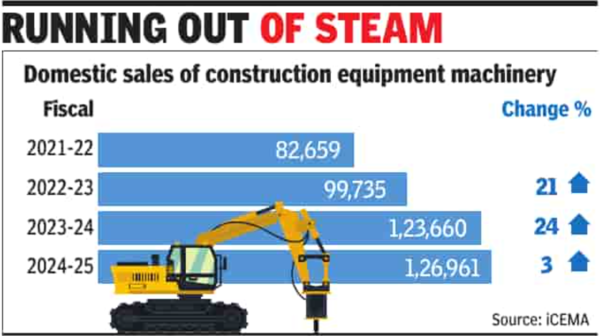
NEW DELHI: Sales of heavy construction equipment, a key barometer of growth of infrastructure projects, such as roads and highways, airports, ports, industrial parks and mining, grew at its slowest in the last financial year. Restrictions on the announcement of new projects due to election rules as well as a slowdown in ongoing central and state projects, led to a contraction in demand.Against healthy double-digit growths recorded previously, the industry saw a 3% rise in FY25, with purchases of heavy equipment slowing down uncharacteristically. The Rs 86,000 crore construction equipment industry, a key contributor to almost all the large infrastructure projects across the country, grew by 24% in FY24 and 21% in the year before that, according to data sourced from the Indian Construction Equipment Manufacturers Association (ICEMA).

-

Companies, such as Caterpillar, JCB, Tata Hitachi Construction Machinery, Cummins, and Volvo CE are major providers of machinery. ICEMA president V Vivekanand, who is also MD of the Indian subsidiary of Caterpillar, said restrictions on new project announcements due to the model code of conduct before elections saw the central govt, as well as some states (which also went to polls), delay new project announcements. .Vivekanand told TOI that even the infrastructure activities slowed down during the year. “The pace of execution is a cause of concern. The pace of construction of roads has slowed down, not just the national highways but even the rural roads. Sometimes the projects were not delivered on time, and in other cases, the projects were not awarded on time and thus got delayed. Even in mining, demand was muted for the past 15 months.Deepak Shetty, CEO & MD of Indian operations of British manufacturer JCB, said payments to contractors were believed to have been delayed in many states, which led to a slowdown in purchases of new equipment. “Work on many state highways has also slowed down. In some cases, there is a lack of availability of funds for infrastructure projects.”Sandeep Singh, MD of Tata Hitachi, said “resolution of challenges in execution” of projects is key to kickstart demand. “Govt support, in the form of incentives for both manufacturers and end-users, could accelerate this transition. Inclusion of construction equipment in the PM e-drive scheme and reduction of GST on electric machines are potential enablers,” said Dimitrov Krishnan, MD of Volvo CE India.Jaideep Shekhar, the India MD of Terex, which is an American manufacturer of materials processing machinery, waste, and recycling equipment, said the industry remains optimistic about registering better growth going forward. “The outlook remains positive, buoyed by the govt’s emphasis on infrastructure development.”


Source link

Examining the RBI’s remittances survey


Remittances have long played a quiet but crucial role in India’s external sector balance, but in terms of policy attention, they have often been overshadowed by indicators such as foreign direct investment (FDI) and trade flows. Yet the latest data from the Reserve Bank of India (RBI)’s Sixth Round of India’s Remittances Survey, released in March, makes it clear that such flows are integral to the stability and structure of India’s external accounts. Inward remittances stood at a record $118.7 billion in 2023-24, not only exceeding FDI inflows but also financing over half of India’s merchandise trade deficit. India’s persistently high remittance flows constitute a vital stabilising force in the context of global economic uncertainty and tightening financial conditions.

Structural shifts

However, the data also point to deeper structural shifts that merit closer attention. The most striking is the changing spatial composition of remittance sources. The traditional dominance of countries of the Gulf Cooperation Council (GCC) is now giving way to advanced economies (AEs). The U.S. accounts for 27.7% of India’s inward remittances, up from 23.4% reported in the Fifth Round (2020-21) Survey. The U.S., U.K., Canada, Australia, and Singapore together account for 51.2% of the flows, overtaking the cumulative share of the six GCC nations (37.9%) by a large margin. This inversion of a historical pattern reflects not only macroeconomic shifts but also a change in the profile of Indian migrants — from predominantly low-skilled workers in West Asia to high-skilled professionals and students in AEs.

This has long-term implications for both the volume and stability of remittance inflows. Migrants in AEs tend to have higher and more stable earnings, and their remittance behaviour is often less sensitive to cyclical volatility in commodity markets. At the same time, unlike temporary workers in the Gulf, high-skilled emigrants in AEs may remit less as their economic and familial integration abroad deepens.

One concern is the growing concentration of large-value transactions. In 2023-24, transfers above ₹5 lakh accounted for nearly 29% of total remittance value, even though they represented a small fraction (1.4%) of overall transactions. This skew suggests that remittances are increasingly driven by higher-earning, professionally mobile Indians rather than broad-based migrant remitters. While this may reflect the upward mobility of the diaspora, it also creates potential vulnerabilities. A slowdown in high-skilled migration due to adverse host-country immigration policy shifts could affect these large inflows disproportionately.

There is also an accelerating shift toward digital modes of remittance. In 2023-24, digital channels, on average, accounted for 73.5% of all remittance transactions. Transaction costs have correspondingly declined. The average cost of sending $200 to India now stands at 4.9%, below the global average of 6.65%, though still above the Sustainable Development Goal benchmark of 3%. This progress is impressive and attributable to the rise of fintech platforms and app-based money transfer services.

Despite this aggregate progress, the transition to digital channels has not been uniform across remittance corridors. While migrants in countries such as the UAE (76.1%) and Saudi Arabia (92.7%) have recorded a very high share of remittance transfers via digital channels, others such as those in Canada(40%), Germany (55.1%), and Italy (35%) continue to depend more heavily on conventional methods. These disparities suggest that the infrastructure and regulatory environment remain a binding constraint. For India, the policy challenge lies in deepening cross-border digital payment linkages. Doing so will not only lower costs and increase efficiency but also ensure that remittance flows remain within formal, trackable financial channels.

At the sub-national level, the remittance map shows persistent asymmetries. Bihar, Uttar Pradesh, and Rajasthan received a total share of under 6% of remittances, while Maharashtra, Kerala, and Tamil Nadu received about 51%. This is not merely a reflection of historical out-migration patterns but of unequal access to migration-enabling infrastructure: foreign language training, credentialing pathways, and employer linkages remain thin. National skilling missions must become far more State-responsive; else, India risks perpetuating remittance elite-regions and households with the social capital to migrate and the financial literacy to leverage returns, while leaving the rest behind.

Missing data

Notably, this round does not provide data on how remittances are used at the household level. This limits a fuller understanding of the developmental role of remittances beyond their macroeconomic contribution to the balance of payments. As the profile of migrants shifts towards higher-skilled occupations and as transaction sizes become more concentrated at the upper end, it is crucial to assess whether these flows are being directed towards longer-term financial goals such as savings, investment, or asset creation or continue to be primarily consumption-smoothing in nature. Incorporating this dimension would also help inform the design of complementary instruments — savings-linked remittance products, targeted financial literacy programmes, or investment incentives for remittance-receiving households — that can enhance the long-run developmental multiplier of these inflows.

Amarendu Nandy, Assistant Professor (Economics Area) at the Indian Institute of Management Ranchi. Views are personal


Source link

India’s power demand to grow 6-6.5% annually through FY2030, driven by EVs, data centres, green Hydrogen: Icra


India’s power demand to grow 6-6.5% annually through FY2030, driven by EVs, data centres, green Hydrogen: Icra

India’s power demand is projected to grow by 6.0–6.5 per cent annually over the next five years, driven by accelerating electric vehicle (EV) adoption, rapid expansion of data centres, and the development of green hydrogen projects, according to ICRA.“These three segments are expected to contribute to 20–25 per cent of the incremental demand over the next five-year period from FY2026 to FY2030,” said Vikram V, Vice President & Co-Group Head – Corporate Ratings, ICRA, quoted by ANI. However, he also claimed that this rising demand for grid capacity could be partially offset by the increasing uptake of rooftop solar and off-grid solutions, aided by initiatives like the Pradhan Mantri Surya Ghar Yojana.The report highlights that the EV sector will see broad-based growth, led by three-wheelers, followed by two-wheelers, electric buses and passenger vehicles.For FY2026, ICRA expects a strong thermal plant load factor of 70 per cent, backed by a projected power demand growth of 5.0–5.5 per cent. Total power generation capacity is forecast to rise to 44 GW in FY2026, up from 34 GW in FY2024, with contributions from both renewable and thermal sources.“The thermal segment is expected to add 9–10 GW capacity in FY2026, while the remaining capacity addition will primarily come from renewable energy,” the agency said. While renewables will continue to dominate capacity growth, ICRA noted a significant uptick in thermal projects under construction, which currently exceed 40 GW.The agency also observed that the expected FY2026 demand growth of 5.0–5.5 per cent is slightly below its GDP growth forecast of 6.5 per cent for the same period, attributing the gap to the anticipated early onset and above-average monsoon, which tends to dampen cooling and agricultural power demand.


Source link

Malabar Group earmarks ₹150 crore for CSR in FY26


Malabar Group, the parent company of Malabar Gold & Diamonds, said it has allocated ₹150 crore in 2025-26 for scaling up its CSR initiatives focused on healthcare, education, hunger & poverty alleviation, women empowerment, environment protection and housing for less privileged.

Under its ‘The Hunger Free World’ initiative, the group has committed to distribute 70,000 meals daily in India and Zambia to the under-privileged, totalling 2.50 crore meals in 2025-26. 

“This represents a significant leap from the cumulative achievement of 2.5 crore meals served over the past three years and signals a deepened commitment to the cause of food security for underserved communities,” the group said. 

The initiative is aligned with the United Nations’ Sustainable Development Goal 2 – Zero Hunger.

M.P. Ahammed, Chairman, Malabar Group said, “CSR is an integral part of our culture and we believe in giving back to society. We dedicate May 28 as our annual CSR day; we reaffirm our pledge to stand with the underserved through sustained and impactful action.”

“Our CSR initiatives are a reflection of that enduring commitment. While we are doing our utmost, a greater impact can be achieved if more organisations join this mission. With 295 million people globally facing acute hunger (as per UN data), immediate action is non-negotiable,” he said.

“This urgency drives our meal distribution efforts under the Hunger Free World initiative. Having said that, along with food distribution, the need of the hour is concerted efforts to boost production, creating jobs, and fostering economic growth to bring in sustainable change,” he added.


Source link

BASF India to demerge agri solutions business, to issue shares 1:1 ratio in new entity 


Senior executives of BASF at the launch of two products for rice crop in Hyderabad on Wednesday. 

Senior executives of BASF at the launch of two products for rice crop in Hyderabad on Wednesday. 

BASF India has begun demerging its agricultural solutions business, a process it expects to take 18-24 months after which existing shareholders will be receive shares in the ratio of 1:1 in the new entity.

The demerger will be in line with German industrial chemical parent BASF’s September 2024 announcement to separate core businesses, which have significant edge over competitors, and standalone businesses such as agricultural solutions to sharpen the latter’s focus as they compete with pure play peers. It intends to list the resultant agricultural solution entity, globally, through an Initial Public Offering.

The new company, following the demerger in India, will unlock value for the shareholders, a leadership team led by Member of the Board of Executive Directors of BASF SE Mike Heinz and comprising Senior VP – Global Strategic Marketing, Agricultural Solutions Marco Grozdanovic and BASF India Managing Director Alexander Gerding among others told media at the launch of insecticide Valexio and fungicide Mibelya for rice crop.

Mr. Heinz said for the parent entity demerger of the agricultural solutions business as well as implementation of new ERP was expected to happen by the second-half of 2027 at the earliest. The IPO thus is unlikely before first half of 2028 and the timing would still hinge on other factors such as market conditions, he said. In 2024, the agricultural division generated global sales of Euro 9.8 billion.

Last year, BASF registered sales of approximately Euro 2.4 billion to customers in India. BASF had more than 2,400 employees and 8 production sites as well as 42 offices in the country. Over the last 10 years, it has invested Euro 310 million to grow its operations in India.

To queries around plans for further investment, Mr. Heinz said, “I would very surprised if going forward for the next 10 years, the [investment] number would be lower than what we have invested in the last 10 years.”

Mr. Grozdanovic said the company is exploring all opportunities in India, including acquisitions, specifically seed companies for certain crops. In doing so, it would not be looking at large entities.

On the two new products, senior V-P-Agricultural Solutions of BASF Asia Pacific Simone Barg said rice is a priority in the region from a food security perspective. Valexio and Mibelya will help boost rice yields as they help manage rice hoppers, a key rice pest, and control diseases such as sheath blight control.

Business Director-Agricultural Solutions at BASF India Giridhar Ranuva said the company plans to launch 10-12 new products up to 2028. It had launched 10 in the last four years.


Source link

Investigation reports, regulatory findings support MCA’s claim of systemic fraud in Gensol: NCLT


Meanwhile, in separate orders, Debt Recovery Tribunal (DRT), Delhi on Wednesday restrained Gensol Engineering Ltd. and its arm Gensol EV Lease Ltd. and its promoters from selling, transferring, alienating, damaging, removing and disposing off or otherwise creating third party interest with regard to immovable & movable secured assets. 

Meanwhile, in separate orders, Debt Recovery Tribunal (DRT), Delhi on Wednesday restrained Gensol Engineering Ltd. and its arm Gensol EV Lease Ltd. and its promoters from selling, transferring, alienating, damaging, removing and disposing off or otherwise creating third party interest with regard to immovable & movable secured assets. 
| Photo Credit: carolo7

The vacation bench of National Company Law Tribunal (NCLT), Ahmedabad on Wednesday said investigation reports and regulatory findings prima facie support the Union Ministry of Corporate Affairs (MCA) claims of systemic fraud  by promoters of Gensol Engineering Ltd. and related entities and granted the interim reliefs sought by the Ministry. 

However, the NCLT’s order did not specify the reliefs. Media reports said relief included freezing of accounts held by Gensol and its promoters, among others.

Gensol Engineering Ltd. along with other respondent companies and associated individuals, have committed grave violations of corporate governance norms, the counsel for the Ministry of Corporate Affairs told NCLT.

The funds, raised for specified purposes by the companies, were illicitly transferred to various related parties, in gross violation of the provisions of the Companies Act, 2013. The pattern of illegal fund diversion, asset misstatement, and share price manipulation had caused irreparable harm to public shareholders, creditors, and other stakeholders, he noted.

Considering the emergent nature of the case, the substantial public interest involved, and the possibility of further dissipation of evidence or assets, NCLT said it finds it appropriate to grant exemption from advance service of the Company Petition on the Respondents.

The Tribunal, based on available records, noted serious allegations of fraudulent conduct, including diversion of company funds by the promoters of Gensol Engineering  and related entities, violation of corporate governance norms, manipulation of financial statements, default in loan repayments despite false declarations, and illegal alienation of company assets.

 The investigation reports and regulatory findings from the Ministry of Corporate Affairs, Securities and Exchange Board of India  (SEBI), and Serious Fraud Investigation Office prima facie support the  Ministry of Corporate Affairs claims of systemic fraud involving substantial public interest, NCLT said.

It listed the matter before regular bench on June 3.

Meanwhile in a separate orders, Debts Recovery Tribunal (DRT), Delhi on Wednesday restrained Gensol Engineering Ltd. and its arm Gensol EV Lease Ltd. and its promoters from selling, transferring, alienating, damaging, removing and disposing off or otherwise creating third party interest with regard to immovable & movable secured assets. 

It also restrained Gensol from entering into settlement with any unsecured creditor without its prior approval.

DRT had granted interim reliefs sought by state-run Indian Renewable Energy Development Agency Ltd. (IREDA), which is seeking to recover ₹510 crore from Gensol Engineering and over ₹218 crore from Gensol EV Lease Ltd.

It also granted relief sought by Power Finance Corporation, which is seeking to recover  over ₹264 crore from Gensol.


Source link

ITR deadline extended: Taxpayers may earn more interest, but government could face higher refund burden


ITR deadline extended: Taxpayers may earn more interest, but government could face higher refund burden

NEW DELHI: With the Income Tax Return (ITR) filing deadline for Assessment Year 2025–26 extended from July 31 to September 15, 2025, a key question has surfaced: will this extension increase the government’s interest liability on tax refunds?TOI reached out to multiple tax experts to understand the implications of this move on both taxpayers and the exchequer. What emerged is a detailed view of how refund-related interest works under Section 244A of the Income Tax Act, the potential financial burden on the government, and why taxpayers may still be better off filing early.

Extended ITR deadline may lead to higher refund interest

Shalini Jain, Tax Partner, EY India, explained: “The ITR filing extended deadline (for Assessment Year 2025-26, i.e., Financial Year 2024-25) may result in the government paying more interest on tax refunds in certain cases. Considering an example where excess TDS has been deducted from the taxpayer or the taxpayer has paid excess advance tax during the Financial Year (FY), Section 244A(1)(a) of the Income-tax Act, 1961 (Act) provides that the taxpayer will be eligible to receive interest on the refund amount at the rate of 0.5% per month or part of a month calculated from the 1st day of April of the Assessment Year (i.e., April 1, 2025, for AY 2025-26) up to the date on which the refund is granted.”She further noted that the interest is payable only when the refund exceeds 10% of the assessed tax liability. “Therefore, the extension of due date of filing the tax return from July 31, 2025, to September 15, 2025 may lead to higher interest being paid to taxpayers in eligible cases. Further, the taxpayers should also keep in mind that the interest received on refund is taxable in their hands as ‘income from other sources,’” Jain added.ALSO READ: ITR filing FY 2024-25 (AY 2025-26): Deadline to file income tax returns extended from July 31 – check new dateHighlighting the administrative side of the extension, Jain also pointed out a practical benefit for the Government:“While there may be additional interest liability for the Government, the extended time allows the Government to make their systems ready for additional changes brought about in the income tax returns forms and accurately capture the information from TDS/TCS statements filed by tax deductors/collectors, thereby facilitating a smooth and convenient filing experience for the taxpayers.”

Interest still payable if returns filed by extended deadline

Even with the extension, taxpayers are still entitled to receive interest on their tax refunds—provided they file their returns by the new due date of September 15, 2025.“If the Government extends the due date of filing, it would have to pay interest on refunds for the additional time of extension. The Government will need to compensate taxpayers for the extra months that their refunds are delayed,” said Ritika Nayyar, Partner at Singhania & Co., in an exclusive interaction with TOI Online.She added that interest on refunds is calculated at 0.5% per month or part thereof under Section 244A. If the return is filed on or before the due date, interest is calculated from April 1 of the assessment year until the refund is granted.

How much more interest could be paid?

To illustrate how the extended due date could impact pay-outs, Abhishek Soni, CEO and Co-founder of Tax2Win shared a breakdown of refund interest scenarios for returns filed on September 15, 2025, and processed the next day, on September 16, 2025:

Scenario Refund Amount Interest Period (5.5 months) Interest Amount Total Refund
Scene 1 Rs 1,00,000 5.5 months Rs 2,750 Rs 1,02,750
Scene 2 Rs 1,50,000 5.5 months Rs 4,125 Rs 1,54,125
Scene 3 Rs 2,00,000 5.5 months Rs 5,500 Rs 2,05,500

Source: Abhishek Soni, CEO and Co-founder of Tax2Win

Longer processing = Higher payouts

In another example, if the same return is filed on September 15, 2025, but the refund is processed on October 3, 2025, the interest period extends to 7 months. Here’s how that plays out:

Scenario
Refund Amount Interest Period (7 months) Interest Amount Total Refund
Scene 1 Rs 1,00,000 7 months Rs 3,500 Rs 1,03,500
Scene 2 Rs 1,50,000 7 months Rs 5,250 Rs 1,55,250
Scene 3 Rs 2,00,000 7 months Rs 7,000 Rs 2,07,000

Source: Ritika Nayyar, Singhania & Co. These scenarios highlight how a longer refund window directly translates into higher interest payouts—an added cost that will be borne by the Income Tax Department.

ITR Filing Deadline Extended: Why It Happened And What To Do Now? | Income Tax Return | Explained

CA Shefali Mundra, Tax Expert at ClearTax, highlighted “If the return is filed on or before the due date u/s 139(1): Interest begins from 1 April of the assessment year till the date of grant of refund.If the return is filed after the due date u/s 139(1): Interest begins from the date of return filing to the date of grant of refund.”She illustrated the interest payable on tax refunds when ITRs are filed on September 15, 2025, with the refunds processed on September 16 and October 3, 2025, respectively.

Tax refund interest amount if ITR is filed on September 15, 2025, and processed on September 16, 2025

Scenario Interest rate Months delayed Interest amount
Tax Refund Rs 1,00,000 0.5% per month 6 months Rs 1,00,000 × 0.5% × 6 = Rs 3,000
Tax Refund Rs 1,50,000 0.5% per month 6 months Rs 1,50,000 × 0.5% × 6 = Rs 4,500
Tax Refund Rs 2,00,000 0.5% per month 6 months Rs 2,00,000 × 0.5% × 6 = Rs 6,000

Source: CA Shefali Mundra, Tax Expert, ClearTax

Tax refund interest amount if ITR is filed on September 15, 2025, and processed on October 3, 2025

Scenario Interest rate Months delayed Interest amount
Tax Refund Rs 1,00,000 0.5% per month 7 months Rs 1,00,000 × 0.5% × 7 = Rs 3,500
Tax Refund Rs 1,50,000 0.5% per month 7 months Rs 1,50,000 × 0.5% × 7 = Rs 5,250
Tax Refund Rs 2,00,000 0.5% per month 7 months Rs 2,00,000 × 0.5% × 7 = Rs 7,000

Source: CA Shefali Mundra, Tax Expert, ClearTax

What triggers refund interest, and who pays?

“Interest is payable only if the refund results from excess payment of TDS, TCS or advance tax and is more than 10% of the total tax liability,” Nayyar clarified. “The extra interest due to the extended deadline will be borne by the Government of India, specifically the Income Tax Department.”

Refund interest isn’t a windfall for taxpayers

Despite longer interest accrual periods, delaying returns doesn’t provide major benefits to taxpayers. “There’s no significant benefit by delaying to file the tax return since the government pays interest upto 6% per annum, which is almost at par, if not lower, than what banks are paying these days,” said Ankit Jain, Partner at Ved Jain and Associates.Jain pointed out that while filing closer to the deadline might earn you more interest, it’s only marginal.“If one has a refund of Rs 1,00,000 and his return is filed on September 15 with the refund processed on October 3, he gets Rs 3,500 as interest. Had he filed on July 31 and refund issued on August 18, the interest would be Rs 2,000. That’s just Rs 1,500 more—hardly a compelling reason to delay,” he explained.He added that the cost to the government is not heavy because “the coupon rate of Government borrowing is almost at the same rate.”

Interest burden manageable for the government

Some tax professionals echoed the view that while the extension increases interest outflow, it’s not alarming. “The extension of the ITR filing deadline from July 31 to September 15, 2025, does not increase the interest rate; it merely increases the period for which interest is calculated,” said Ashish Karundia, Founder of Ashish Karundia & Co., Chartered Accountants.He emphasized that the Government’s liability is limited because the 6% per annum interest paid is quite conservative and aligned with the cost of government borrowings.ITR refund is not dependent on deadlineAccording to S. Sriram, Partner at Lakshmikumaran & Sridharan Attorneys, refunds are more a function of actual filing and processing than of deadlines.“Granting of a refund is not dependent upon the due date for filing of tax returns but on the actual filing of the return and its processing by the CPC. If the return is filed by July 31, the CPC can process the return earlier and grant the refund quickly,” he told TOI.He warned that filing late—even within the extended deadline—would delay refund processing and result in longer interest periods, which the Government would then have to fund.

ITR processing still faces operational challenges

Even with a push to expedite ITR processing, challenges remain. “To mitigate the potential rise in interest liability, the Government may consider accelerating processing at the CPC,” said Ashish Karundia.He noted that refund timelines also depend on various factors: the complexity of the ITR form, nature of income, taxpayer risk profile, claims made, and cross-verification with third-party data. “Processing times can vary significantly based on these elements,” he said.

What about other interest provisions?

Aarti Raote, Partner at Deloitte India, brought another dimension into the picture—interest under Sections 234A and 234B. While the extension waives 234A interest (for delayed return filing), taxpayers still remain liable under 234B if they failed to pay sufficient advance tax.“Taxpayers should note that while the tax return filing deadline is extended and hence interest under section 234A for delayed filing will not be triggered if the return is filed by September 15, interest under 234B continues till the date of actual payment if there is default in advance tax,” Raote said.She added that from a government perspective, “delayed processing means delayed scrutiny and delay in the process overall. The Government also pays interest, which starts from the date of filing of the tax return.”However, according to Abhishek Soni, CEO and Co-founder of Tax2Win, “The extension of the ITR filing deadline from July 31 to September 15, 2025, does not increase the interest paid by the government on tax refunds. Interest continues to be calculated from April 1, 2025, up to the date the refund is issued, provided the return is filed by the extended due date. However, if the return is filed after the deadline, the interest amount may be reduced.

Final takeaway

While the extension provides relief to those needing more time to file, the consensus among tax professionals is clear: taxpayers should aim to file early.“While the ITR filing deadline extension provides taxpayers with additional time to file their returns, it also results in a longer waiting period for refunds. Consequently, eligible taxpayers will accrue more interest on their refunds due to the extended processing time. Taxpayers should file their returns promptly once filing is live to expedite the refund process.” said CA Shefali Mundra, Tax Expert, ClearTax.


Source link