Life & Style

Tata Harrier & Safari Petrol: Small heart, big authority


For years, the Tata Harrier and Safari have been closely associated with diesel power. They became default choices for buyers seeking strong road presence, torque-rich performance and that unmistakable “big SUV” feel. Introducing petrol engines into this equation was always going to be a delicate move. Get it wrong, and the SUVs risk feeling underwhelming. Get it right, and Tata could open the door to an entirely new audience. With the arrival of the Hyperion petrol variants, it is clear Tata has leaned firmly towards the latter.

Harrier petrol handling city traffic effortlessly, highlighting its agile steering and composed ride quality.

Harrier petrol handling city traffic effortlessly, highlighting its agile steering and composed ride quality.
| Photo Credit:
Special Arrangement

At the core of both SUVs is the new 1.5-litre Hyperion turbo-petrol engine. It is a four-cylinder, direct-injection unit producing 170 PS at 5,000 rpm and 280 Nm of torque available across a wide 1,750–3,500 rpm band. On paper, the numbers appear respectable rather than extraordinary, particularly for SUVs of this size. But driving them tells a different story. This is a case where calibration, torque spread and real-world tuning matter far more than displacement alone — and Tata has clearly invested heavily in getting that balance right.

The first thing that stands out is refinement. The Hyperion engine feels notably smooth, aided by a stiffened engine block, advanced acoustic insulation and careful NVH management. Vibrations at idle are well suppressed, and even when pushed harder, the engine note remains controlled and mature. In urban conditions, this refinement becomes a genuine advantage. Both the Harrier and Safari feel easy to live with, masking their size well in traffic. Throttle response is progressive, not abrupt, and the initial pick-up is strong enough to make quick gaps without feeling jumpy or nervous.

Advanced safety and tech features in the Safari petrol, including Level 2+ ADAS and a 36.9 cm Harman Neo QLED infotainment system.

Advanced safety and tech features in the Safari petrol, including Level 2+ ADAS and a 36.9 cm Harman Neo QLED infotainment system.
| Photo Credit:
Special Arrangement

As speeds build, the engine’s character reveals itself more clearly. The low-end response is good, but it is the mid-range where the Hyperion truly shines. There is a strong, sustained surge of torque that makes highway driving effortless. Overtakes require little planning, and the SUVs hold cruising speeds comfortably without the engine sounding stressed. Despite being just 1.5 litres, the motor never feels out of its depth. That is largely down to the broad torque band and Tata’s decision to prioritise linear power delivery over dramatic top-end theatrics.

This linearity defines the overall driving experience. Power builds smoothly and predictably, inspiring confidence rather than excitement—and that is exactly what buyers in this segment tend to seek. There is no sudden spike, no sense of the turbo arriving too late or too aggressively. Instead, the engine works with the vehicle, not against it. Tata’s AI- and ML-based engine management systems, including smart shift and launch assist functions, subtly contribute to this seamless feel, particularly in varying driving conditions.

The 1.5-litre Hyperion turbo-petrol engine delivers smooth, linear power for urban and highway driving in the Harrier.

The 1.5-litre Hyperion turbo-petrol engine delivers smooth, linear power for urban and highway driving in the Harrier.
| Photo Credit:
Special Arrangement

An often-overlooked benefit of the petrol variants is the reduction in weight. Compared to their diesel counterparts, both the Harrier and Safari shed close to 80 kg, and the effect is noticeable from behind the wheel. Steering responses feel a touch lighter, and the front end feels less burdened, especially during quick direction changes or tight urban manoeuvres. It does not transform these SUVs into sporty machines, but it does make them feel more agile and cooperative in everyday driving.

Ride quality remains one of the Harrier and Safari’s strongest attributes, and the petrol variants do nothing to dilute that strength. Built on Tata’s OMEGARC platform, derived from Land Rover’s D8 architecture, both SUVs continue to offer a composed, planted ride. Broken roads are dispatched with ease, high-speed stability is reassuring, and body control is well judged for vehicles of this size. There are genuinely no faults to point out when it comes to overall driving dynamics — everything feels cohesive and well resolved.
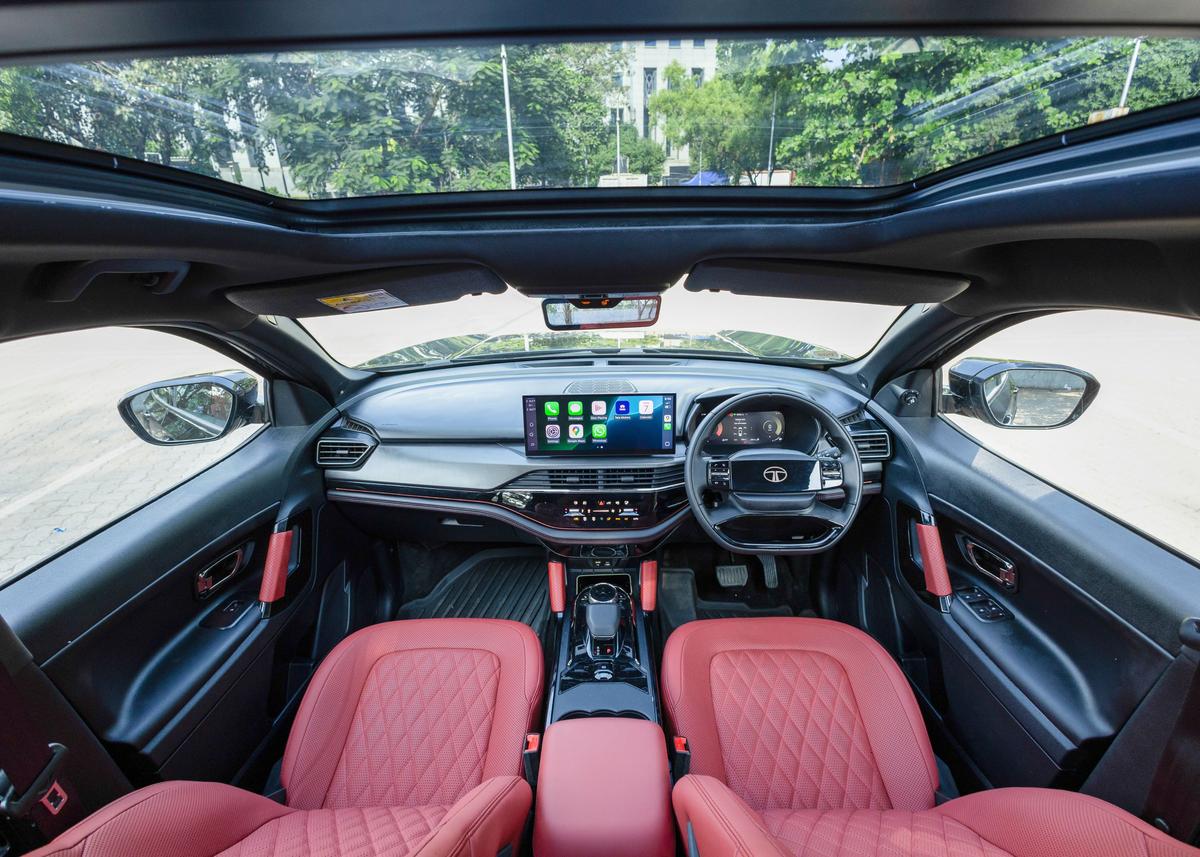
Tata Safari petrol interior with rich, dramatic cabin colours and spacious seating for families.

Tata Safari petrol interior with rich, dramatic cabin colours and spacious seating for families.
| Photo Credit:
Special Arrangement

Beyond the mechanicals, Tata has ensured that the petrol variants feel special through feature differentiation. Both SUVs get the brand’s flagship 36.9 cm Harman infotainment system with Samsung Neo QLED technology — currently unmatched in the segment for clarity and visual impact. Paired with a JBL audio system tuned for Dolby Atmos, the in-cabin experience feels genuinely premium, bordering on indulgent. Add to this connected car tech via iRA 2.0, Alexa Home-to-Car integration, built-in navigation, and a voice-operated panoramic sunroof, and it is clear Tata is targeting buyers who value technology as much as physical presence.

The interiors further underline this intent. The Harrier’s lighter, more contemporary cabin themes contrast well with the Safari’s richer, more dramatic colour palettes and larger wheels. Both feel solidly built, spacious and thoughtfully laid out. The Safari, in particular, continues to stand out as a family SUV, with excellent second-row comfort and a usable third row—something few rivals manage convincingly.

Safety remains a non-negotiable strength. Both the Harrier and Safari petrol variants carry a 5-star Bharat NCAP rating and come equipped with Level 2+ ADAS, offering features such as adaptive cruise control, lane keep assist, autonomous emergency braking and blind-spot monitoring. These systems are well integrated and reinforce the sense that these SUVs are engineered for modern Indian conditions, not just marketing brochures.

Tata Harrier petrol variant showcasing its contemporary cabin with lighter interior themes and modern technology.

Tata Harrier petrol variant showcasing its contemporary cabin with lighter interior themes and modern technology.
| Photo Credit:
Special Arrangement

That said, even well-rounded packages have room for improvement. One notable omission is the lack of one-touch up and down functionality for the driver’s window. In SUVs that otherwise feel premium and technologically advanced, this feels unnecessary and slightly out of character. It is a small detail, but one that stands out precisely because everything else feels so carefully considered.

Viewed as a whole, the petrol-powered Tata Harrier and Safari are not intended to replace their diesel siblings—they complement them. They offer a quieter, smoother and more refined alternative for buyers whose driving is largely urban or highway-focused, without sacrificing presence, comfort or confidence. The Hyperion engine, despite its modest displacement, proves to be a strong match for these SUVs, delivering a peppy yet polished driving experience that feels thoroughly engineered rather than compromised.

In the final analysis, Tata has succeeded in expanding the Harrier and Safari’s appeal without diluting their core identity. The petrol variants feel complete, competent and convincingly premium—an evolution that speaks not loudly, but with quiet authority.

Tata Harrier Petrol Expected Starting Price: INR 13.50 lakh

Tata Safari Petrol Expected Starting Price: INR 14.50 lakh

Motorscribes, in association with The Hindu, brings you the latest in cars and bikes. Follow them on Instagram on @motorscribes

Published – January 08, 2026 03:09 pm IST


Source link

Rock band Scorpions to tour India with four concerts in April


 Iconic rock band 'The Scorpions' performing live at Palace Grounds, Bengaluru as a  part of their World Humanity Tour on December 16, 2007.

Iconic rock band ‘The Scorpions’ performing live at Palace Grounds, Bengaluru as a part of their World Humanity Tour on December 16, 2007.
| Photo Credit: K MURALIKUMAR

After nearly two decades, German hard-rock legends Scorpions will take the stage in India with their iconic anthems ‘ Rock You Like A Hurricane’ and ‘Wind of Change’,  as part of their Coming Home 2026 tour in April.

Their four city tour, produced and promoted by BookMyShow Live, the live entertainment experiential division of BookMyShow, will have concerts at Shillong on April 21 at JN Stadium, Delhi-NCR on April; 24 at HUDA Grounds, Bengaluru on April 26 at NICE grounds and Mumbai on April 30 at Jio Gardens, BKC. 

“We are incredibly excited to finally be touring India again after such a long time and are looking forward to meeting our many, many fans in India. The concerts will also be a very special experience for us,” says Klaus Meine from Scorpions. 

Founded in 1965 by guitarist Rudolf Schenker, Scorpions have a legacy spanning over five decades and are considered among the most influential rock bands in history. The group has performed in over 80 countries and have sold over 120 million records worldwide, with their music continuing to transcend listeners across generations. As a hugely successful live rock act, their 2026 tour is being framed as a part of a farewell tour of sorts. 
“Scorpions’ return to India after nearly two decades is significant, not only for fans who have grown up with their songs but also as a reflection of how far India’s live entertainment ecosystem has evolved. This tour marks a watershed moment for rock culture in the country, celebrating music history, fan devotion and the enduring power of live performance,” says Naman Pugalia, Chief Business Officer – Live Events, BookMyShow. 

The Artist pre-sale for tickets begins on Wednesday, January 14 at 12 pm and will be followed by a pre-sale of tickets for Kotak Mahindra Bank credit card customers on January 15 at 12 pm. The general on-sale tickets will go live from 1 pm on January 17 on BookMyShow. 


Source link

Geeta Doctor, the sharp observer


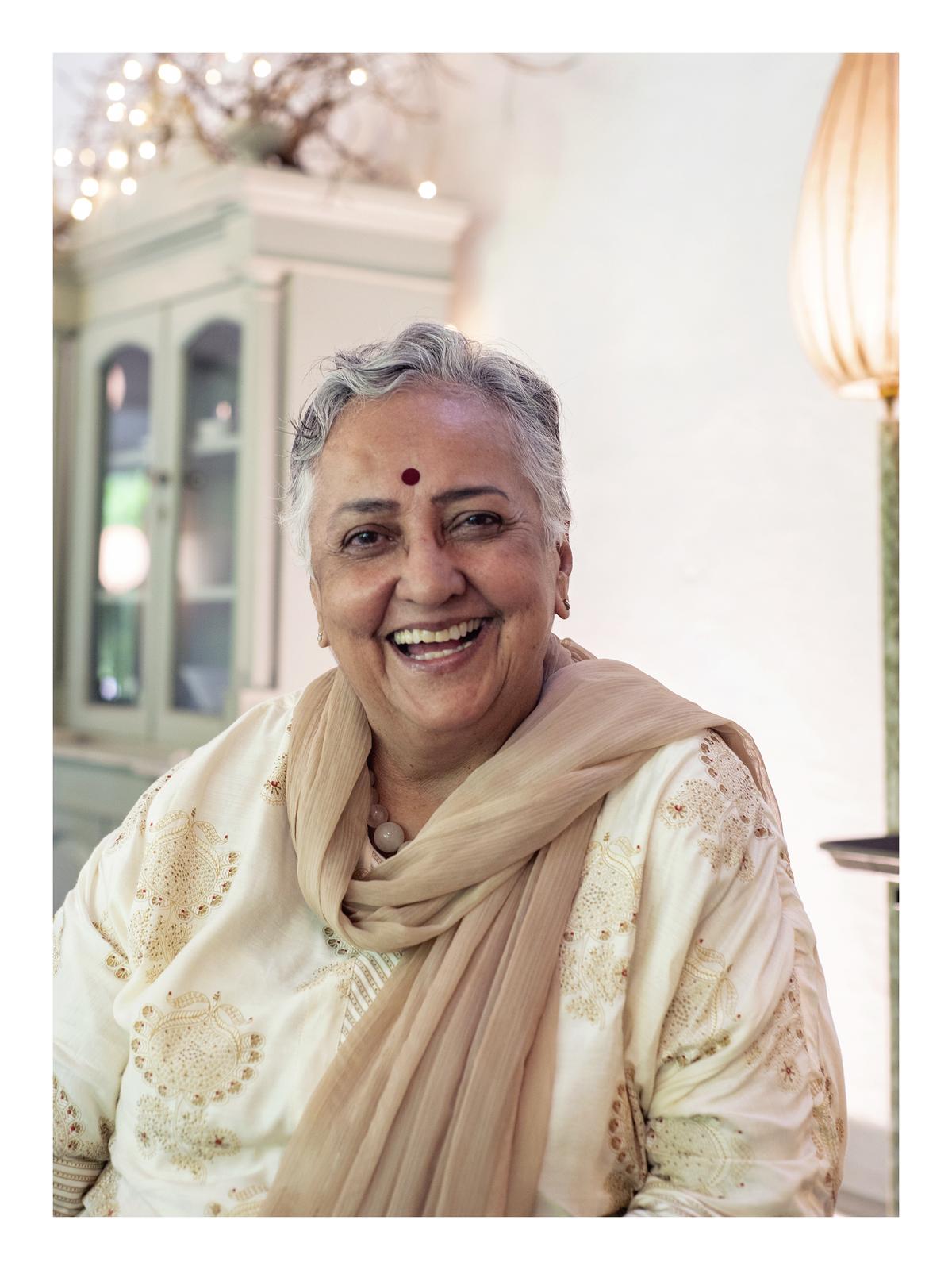
Truthfully, I was rather intimidated by Geeta Doctor. For she was not a traditional person. Geeta was, I think, a non-believer. She seemed to critique different art expressions with what you might call ‘a clean slate’. She was happy to learn, to observe, comment on all art forms — literary and performative, visual and tactile, Indian or world art, not burdened by the rules thereof. Simply as ‘the other’.

She was watchful and witty, a giggle lurking behind her smile, ready to unbalance you. I was often tongue-tied. (In fact, ever since I was asked to write this tribute, I have been picturing her laughing at the choice.) But that was till I was on the other side, as it were. Once I got to know her, I shared in the amusement as we took on the dance scene like buddies, if I may say so in her absence. I wouldn’t dare in her presence!

‘She was witty, a giggle lurking behind her smile, ready to unbalance you’

‘She was witty, a giggle lurking behind her smile, ready to unbalance you’
| Photo Credit:
Mala Mukerjee

Geeta read (and wrote) voraciously, and in the early ‘70s, she was present in her role as journalist, with a ringside seat, at a host of art movements that then emerged in Chennai. Writing a review of visual artist S.G. Vasudev’s exhibition called Vriksha in 2010, she recalled the many layered world of the ‘60s, when Vasudev and a group of artists set up the self-contained Cholamandal Artists’ Village. “It’s been described as a Village by the Sea,” she wrote. “It was in a way an epic undertaking, the old man-teacher-friend and preceptor, [founder] Paniker leading his band of faithful to make a mark for themselves in what was then a wilderness.”

Read Geeta Doctor’s words for The Hindu

This was also when I first met Geeta — when Vasudev and his now deceased wife Arnawaz, a fine artist, invited me to dance on the sands outside their new home. A performance was always followed by a discussion over a simple meal and drinks. Such a vital act, when an exchange of ideas helped in understanding our own arts and the need of the time.

A bohemian spirit

Geeta began working as a journalist in Mumbai in the 1970s, for publications such as Freedom First, a liberal monthly, and Parsiana, the Parsi magazine that shut last October. She helped start Inside Outside, India’s first design and architectural magazine. She moved to Chennai in the 1980s and wrote for many other publications, including The Hindu.

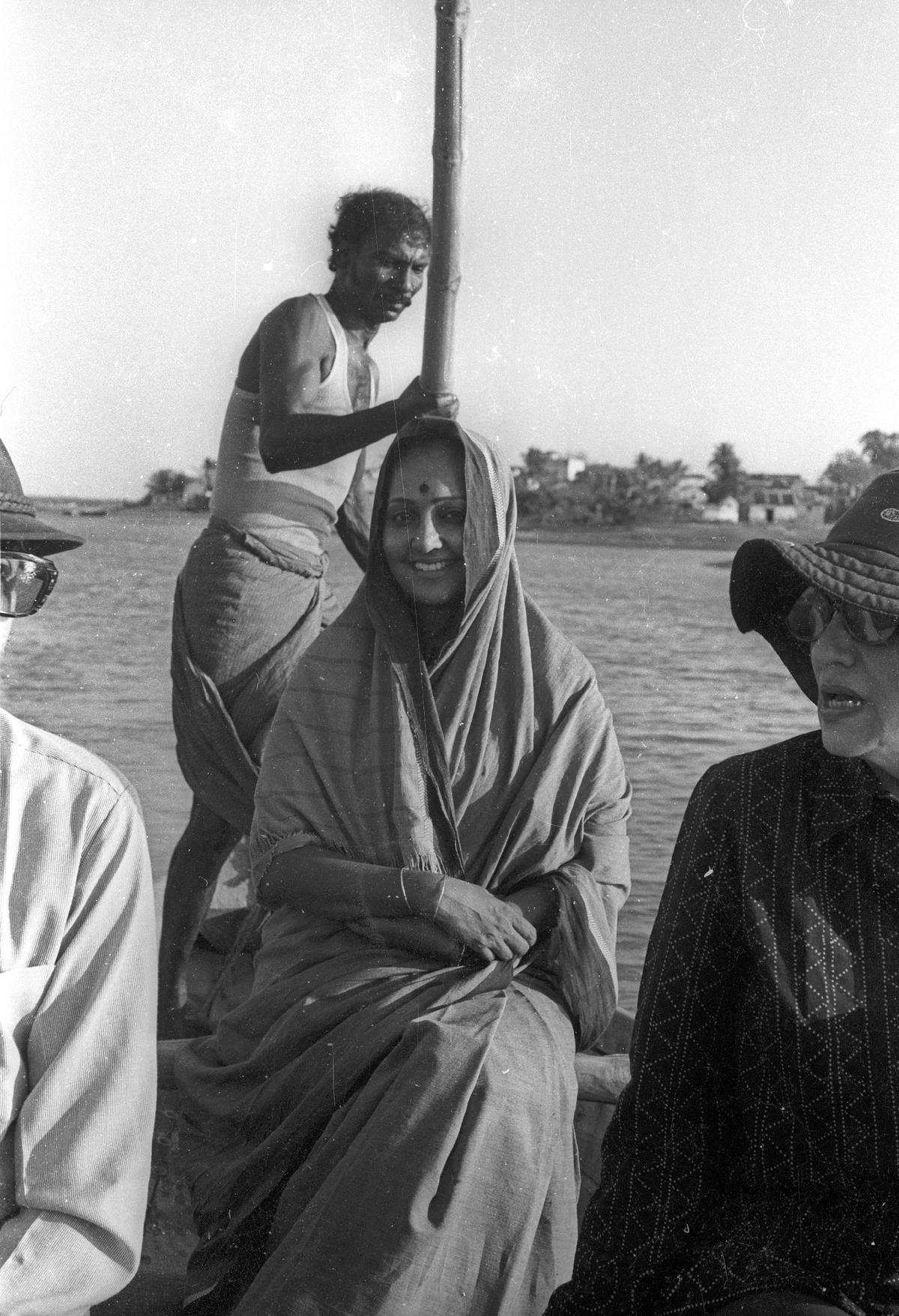
Geeta Doctor, when she had taken artist Jehangir Sabavala to Pulicat Lake

Geeta Doctor, when she had taken artist Jehangir Sabavala to Pulicat Lake
| Photo Credit:
Mala Mukerjee

A few days ago, Meenakshi, her daughter, shared some of Geeta’s writings with me that gave me an understanding of the range of subjects she reviewed. Even the headlines of the articles reflected the happy nature of one who seemed pleased to have walked with that book, that performance, that exhibition awhile.

For instance, writing about the food memoir A Bite in Time: Cooking with Memories, she remarked that it “mirrors the larger-than-life personality of Tanya Mendonsa’s invitation to take a bite of her life. Her real talent, as any bohemian spirit who has lived in Paris in the second half of the 20th century will recognise, is to be a flâneur, loosely translated it means just floating above the ground in a state of permanent enjoyment”. To me, Geeta was also a flâneur. Her own nature was reflected time and again in her reviews of others. And so we got to know her.

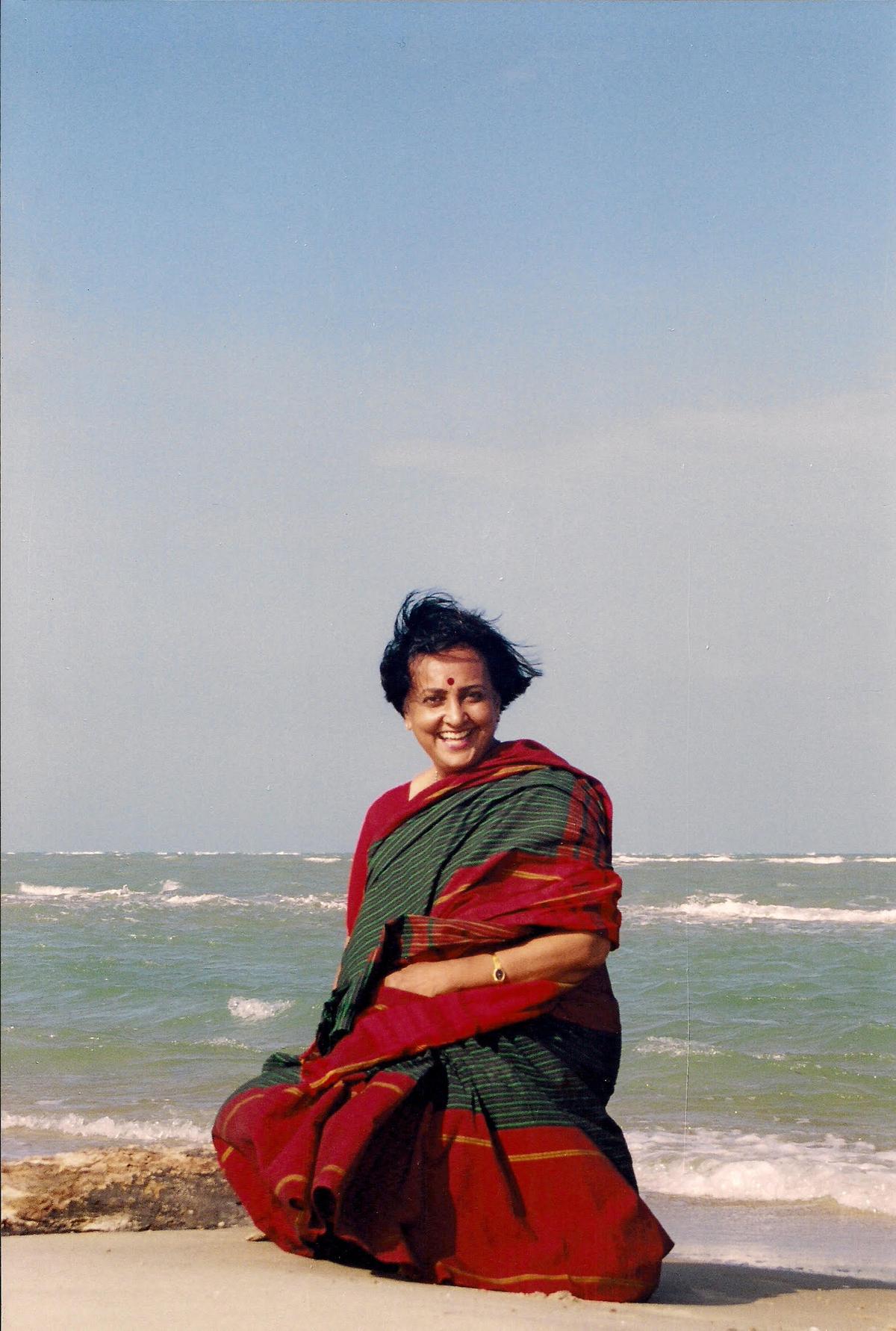
Geeta Doctor at Dhanushkodi

Geeta Doctor at Dhanushkodi
| Photo Credit:
Special arrangement

In December 2016, she wrote passionately about dancer and choreographer Astad Deboo. “Does he remember it as I do, the short series of six movements in which Astad trampled upon the canvas of contemporary dance in India and laid it wide open to different interpretations? Did he actually feel the pain when he slit his arms open with a blade and allowed the blood to drip? Or later, in what became a showstopper moment, contort his lithe body, so that his tongue became part of the performance. He licked the floor of his stage as though it were his most beloved other. The floor. The stage. The dancer. The audience. We became one with the performance. Astad Deboo became contemporary dance.”

Then she stated her non-partisan, broad outlook on society: “He could be a Parsi at home, a Christian at the school taught by Jesuit priests, and a student of Islamic traditions because of the Kathak dance teacher. The influences that he imbibed included that of the Bengali families, the Biharis and South Indians, all of whom enriched his idea not just of who he was but what being an Indian might be.”

It was pitch-perfect. Even now, I can let out a cry of joy at that line describing what it is to be truly Indian. Penned by a writer and critic who was born in India, but grew up in France, Sweden, Switzerland and Pakistan, following her father who was in the Indian Foreign Service.

One who spoke from her heart

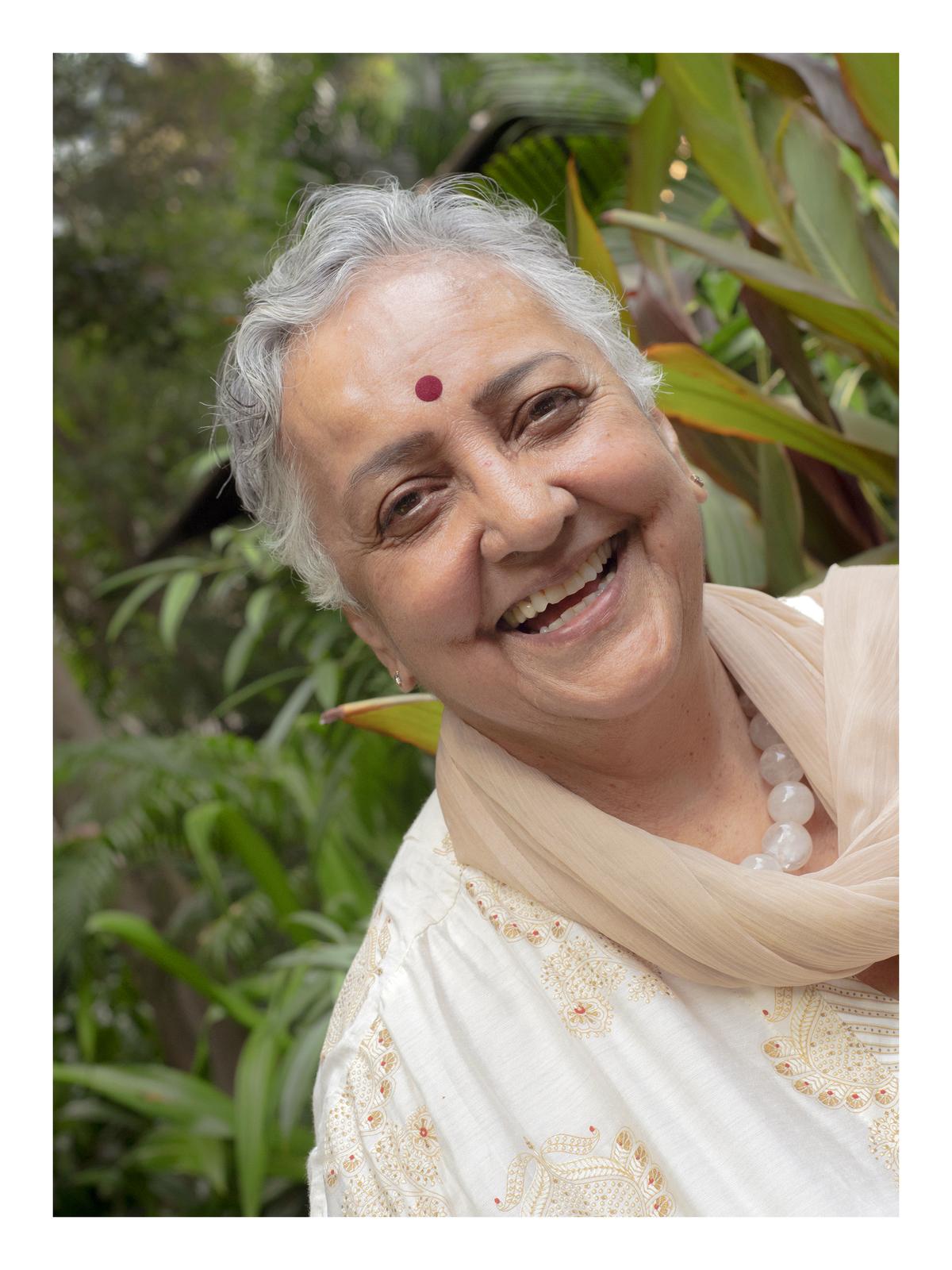
Geeta, an octogenarian who presided over a four-generation family of strong women, often talked about how she loved food, laughter, and the company of strangers she met on her travels. Glimpses could be seen in her reviews.

‘Geeta loved food, laughter, and the company of strangers she met on her travels’

‘Geeta loved food, laughter, and the company of strangers she met on her travels’
| Photo Credit:
Mala Mukerjee

In 2005, she could not contain her glee after she visited Malaysia to watch Kuala Lumpur-based choreographer and classical Bharatanatyam dancer Ramli bin Ibrahim. “Ramli follows in the tradition set by a Ram Gopal or even an Uday Shankar in taking the heroic moment by the hand and treading the path that is often so dangerous between becoming too exotic or too enchanted with his own sensuality. By insisting that it is a tribute to Odissi, perhaps, what he is also exploring is this very same appeal to the gorgeousness of Odissi that surrenders to the feminine in all its manifestations of desire.”

Months before she was diagnosed with a terminal disease, she wrote about Marghazhi and the people she lived among. Although inadvertently, I believe few have summed up the season so succinctly as Geeta did in her review of the book The Tamils: A Portrait of a Community. “It’s that time of the year when the invisible call of ‘The Season’ fills the air around Chennai inviting multitudes from distant lands. There is an almost imperceptible hum of the Tamil heartbeat written on the wind… that speak of a fabled past that finds expression in music and dance at different venues. In every generation, a scholar reaches into these storied depths and finds a way through the tangled roots… It makes Nirmala Lakshman’s extraordinarily vivid treatise on The Tamils doubly interesting.”

For me, Geeta’s was that independent outside-the-theatre- of-the-arts voice that spoke directly from the heart. It was a democratic voice. It held in it the echoes of a worldview that could see the connections and almost imperceptibly rejoice in them. She was not partisan; she did not beat about the bush. And for some of us, who recognised this, she will not be replicated. She will be missed. May she rest in peace.

The writer is a Bharatanatyam dancer and choreographer, and the former director of Kalakshetra in Chennai.

Published – January 08, 2026 01:28 pm IST


Source link

The Meher I knew: A fashion insider who changed Indian style narratives


Whenever I would think of Meher Castelino, or read or hear her name, I would imagine her at a fashion show.

That was where we met most often, in the days when fashion weeks were events that held meaning and which I attended as a journalist interested in tracking what designers were doing, and in turn sharing trends and new sartorial ideas with my readers.

Meher would be sitting at an aisle seat, often in the third or fourth row, away from the hustle and bustle and flashing phones of the front row journalists. Quietly, with no fuss, she would watch every show, taking notes as required, looking up to smile should someone address her, but otherwise totally engrossed in what she was there for.

Covering fashion weeks

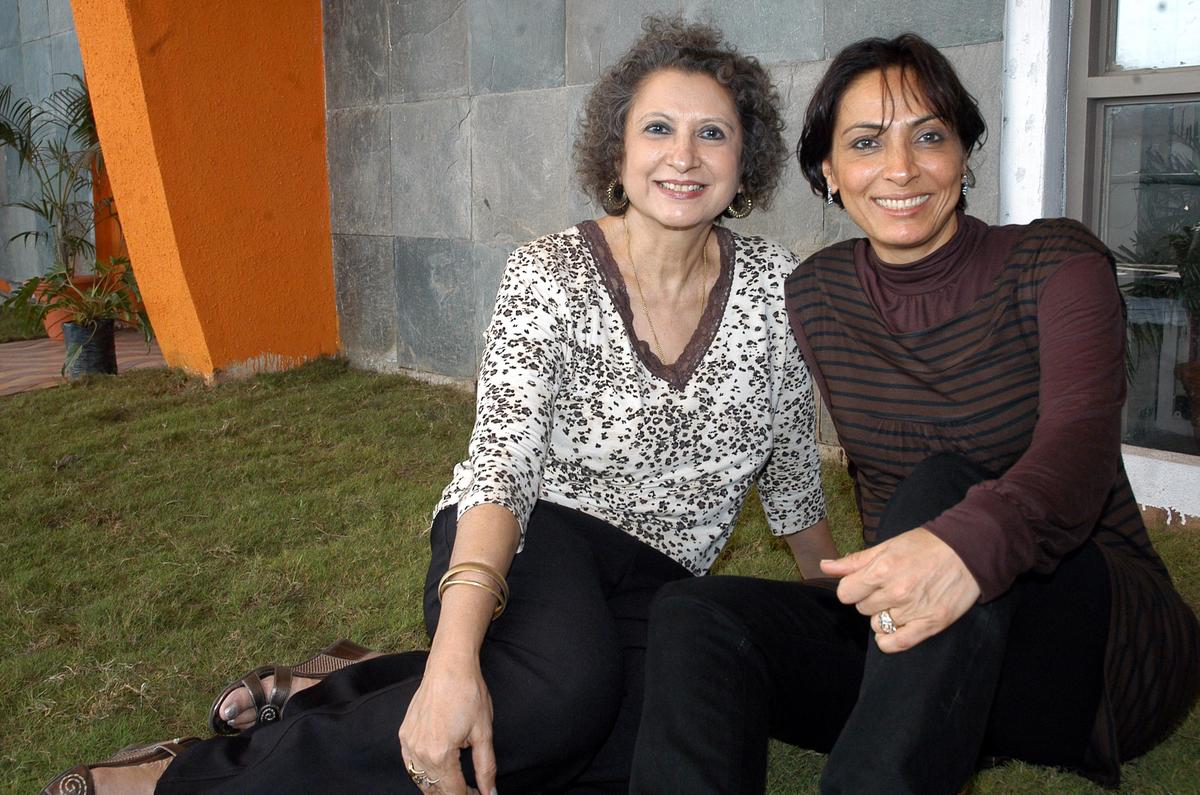
Former Miss India and fashion journalist Meher Castelino (left) and designer Krishna Mehta in Hyderabad in 2007.

Former Miss India and fashion journalist Meher Castelino (left) and designer Krishna Mehta in Hyderabad in 2007.
| Photo Credit:
Nagara Gopal

For years, through Lakmé Fashion Week and other fashion weeks later, Meher took on the role of in-house reporter, translating fashion into simple, easily understandable sentences that would go out as press notes. It was a bulwark for many a journalist newly minted as a fashion writer: thanks to Meher, she would understand fashion terminology, and trends, and more important, get the gist of what a collection was all about. It would be the first step to many a journalist’s fashion education.

As the week rolled, I would sometimes miss a show or two, as fatigue set in. But not Meher. I know there were times when she was not too well, and the walk to and from the show area to the press room eight or more times in a day was hard on her. But she never grumbled, or complained as some of the younger reporters would (me included); she just went on doing what she had taken on.

Her attitude to work was not the only inspiring thing about Meher. Her attitude to life was a lesson in quiet courage and dignity.

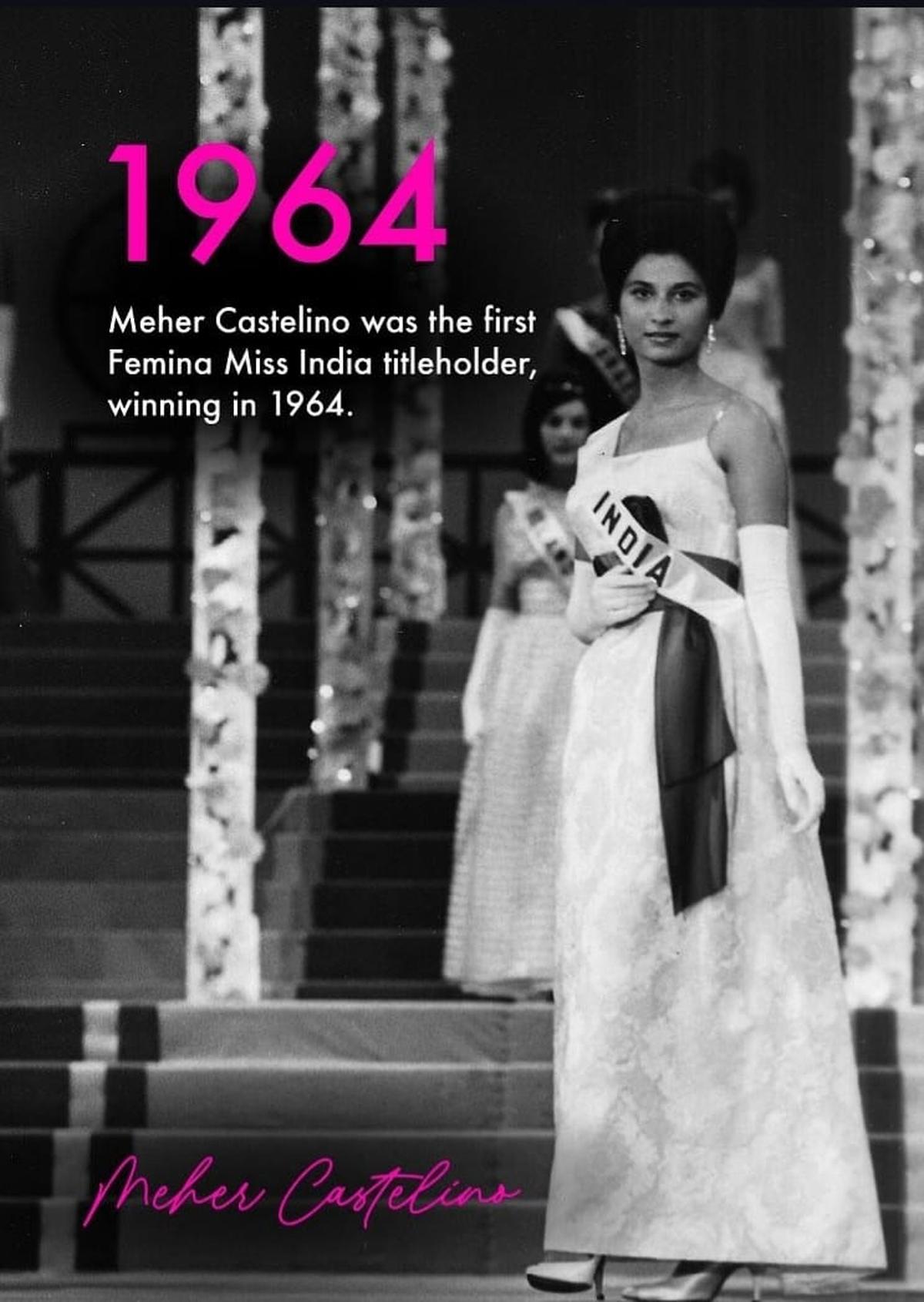
First Femina Miss India

Former Miss India Meher Castelino in Hyderabad in 2003.

Former Miss India Meher Castelino in Hyderabad in 2003.
| Photo Credit:
P.V. Sivakumar

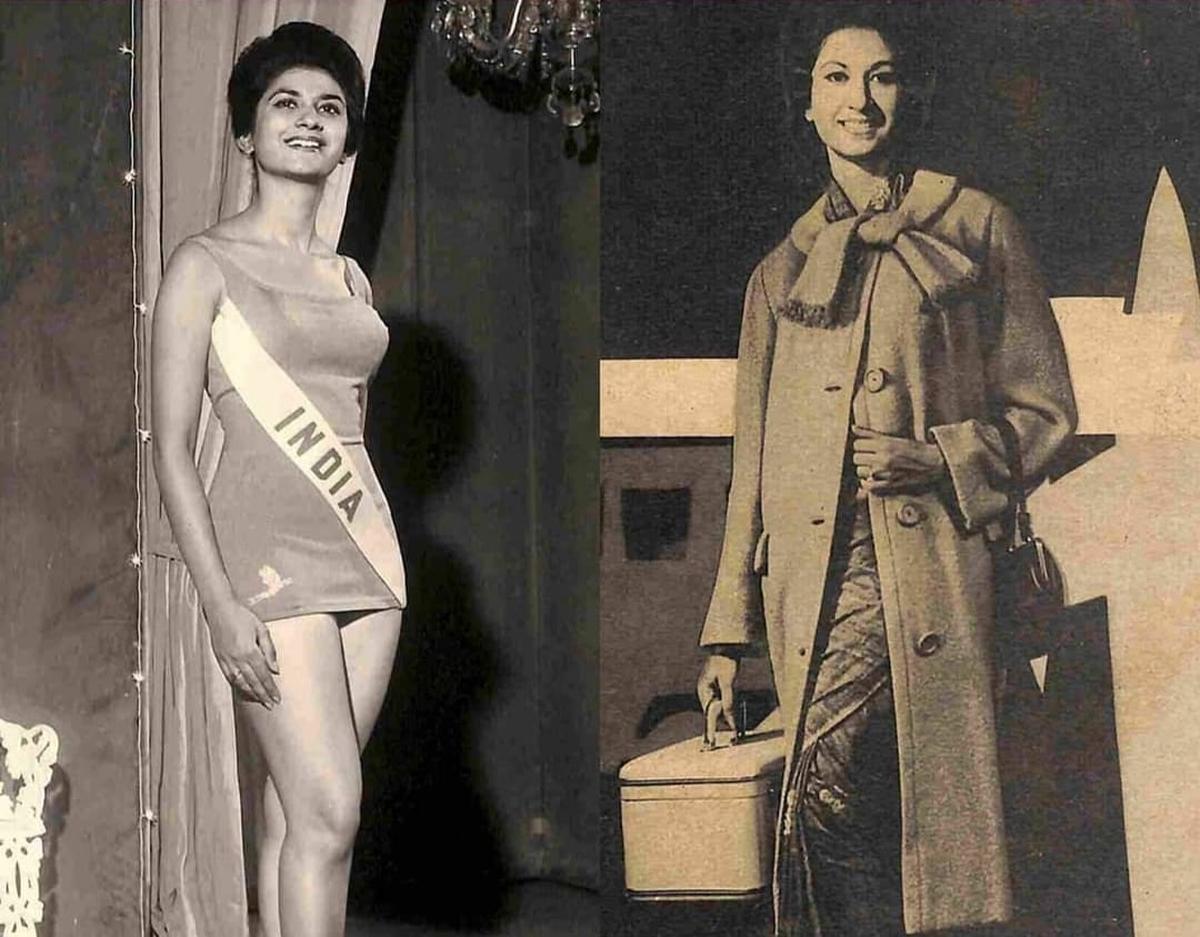
Perhaps, Meher never forgot that she had been Femina’s very first delegate to the Miss Universe Contest. She would also represent India at the Miss United Nations. It had all happened much before I came to Bombay in 1979 to join the Femina magazine. I was still a school girl in faraway Gauhati (now Guwahati), and we read books, not magazines. But I do remember, much later when discussing the Femina Miss India Contest, Meher telling me that she had been selected in a ‘contest’ — very different from the selection process that came in later. I remember asking her how she felt being sent off for an international beauty contest with no training or backend support. Remember that in 1964, there was only the telephone and the telegram as means of communication in absentia, so a crisis, should it occur, would have to be handled by the teenaged contestant alone. She smiled and said, that’s how it was, adding she wished she had been a delegate much later, when the contestants had better means of preparation at their disposal.

The aura of being a Miss India never left her, though Meher wore it lightly. She was always perfectly turned out; never flashy, always elegant, hair in place, soft jewellery at ears and throat, and more dazzling than that, her ready, happy smile.

She hid the challenges life threw her way, including her husband’s early demise, the fact that she was then a single mother supporting two young children, and who knows what else was swept away behind the smile. She was not one to let anything get her down.

Fashion first, always

(Left) Former Rathi Vinay Jha, director general of FDCI (Fashion Design Council of India) with Meher Castelino, fashion journalist at Abids Lakhotia Institute of Art and Design in Hyderabad in 2007.

(Left) Former Rathi Vinay Jha, director general of FDCI (Fashion Design Council of India) with Meher Castelino, fashion journalist at Abids Lakhotia Institute of Art and Design in Hyderabad in 2007.
| Photo Credit:
Nagara Gopal

She genuinely loved fashion. I remember her telling me, at Femina, that she was taking designers to Igedo (in Germany), for a fashion exposition. At that time, I did not know much about fashion beyond a love for clothes, but as I read her write-ups in the newspapers, I realised she had been instrumental in Indian designers showcasing their work at international expositions. I remember asking the late Wendell Rodricks, one of the designers who had travelled with her to write about his experiences. After initial hesitation, Wendell was persuaded enough to write his first article. He went on to become a fashion columnist for Femina, and I learnt valuable lessons on fashion by editing his essays. Looking back, I think if it were not for Meher, neither would have happened.

She had, I realised, set up an award for Innovative Garment Construction, given in her name at the National Institute of Fashion Technology (NIFT), Mumbai, to a promising student. It told me how deep her involvement with fashion ran.

Last month, reading the social media posts eulogising her, I realise that she was also an advisor to many fashion houses, and wrote two more books besides the one titled Fashion Musings (2020) she had gifted me.

The world we are in now, where every moment of the day is reported on Instagram, the food we eat, the dishes we cook, the clothes we wear, the events we attend and the travelling we undertake, Meher might be easily forgotten by the very fact of her absence on these websites.

But to me, she is an example of someone who did what she loved, spreading her skills quietly across the world of fashion, and contributing significantly to it.

Hers was an impeccable life, lived with grace and dignity.

The writer is a Mumbai-based editor and author.

Published – January 08, 2026 12:45 pm IST


Source link

Abstract artist Ramani Mylavarapu turns curator for the group show Golden Horizon in Hyderabad


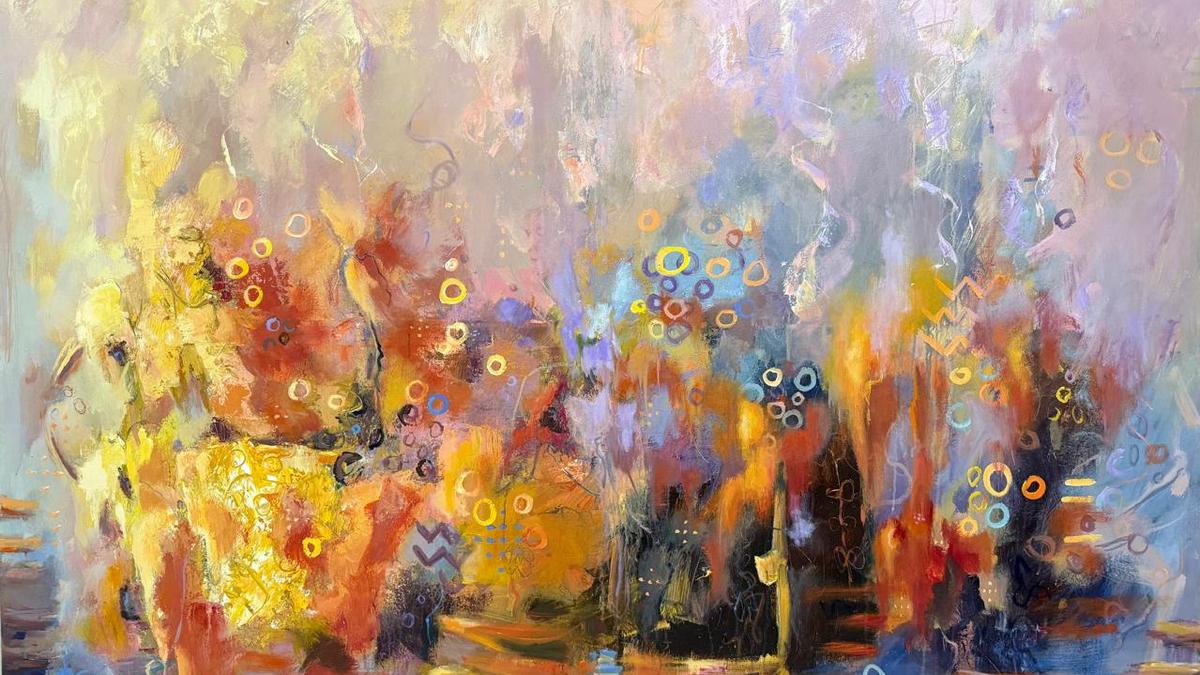
Work by Ramani Mylavarapu

Work by Ramani Mylavarapu
| Photo Credit: Special Arrangement

“Sankranti is an opportunity to welcome new beginnings,” says artist Ramani Mylavarapu, referring to her debut as an art curator for Golden Horizon. To be held from January 8 to 14, the six-day art showcase featuring 23 new artworks of 14 established and senior artists is a canvas of celebration resonating with warmth, colours and renewed perspectives. The display featuring paintings, drawing, sculpture and video art spans various genres and styles.

For Ramani, the Hyderabad-based abstract artist, the show is conceived as a celebration of renewal, abundance, and quiet optimism, as it takes place just after New Year and comes before Sankranti. “It is a festival deeply rooted in harvest, gratitude, and cyclical continuity,.” says the artist.

Different expressions

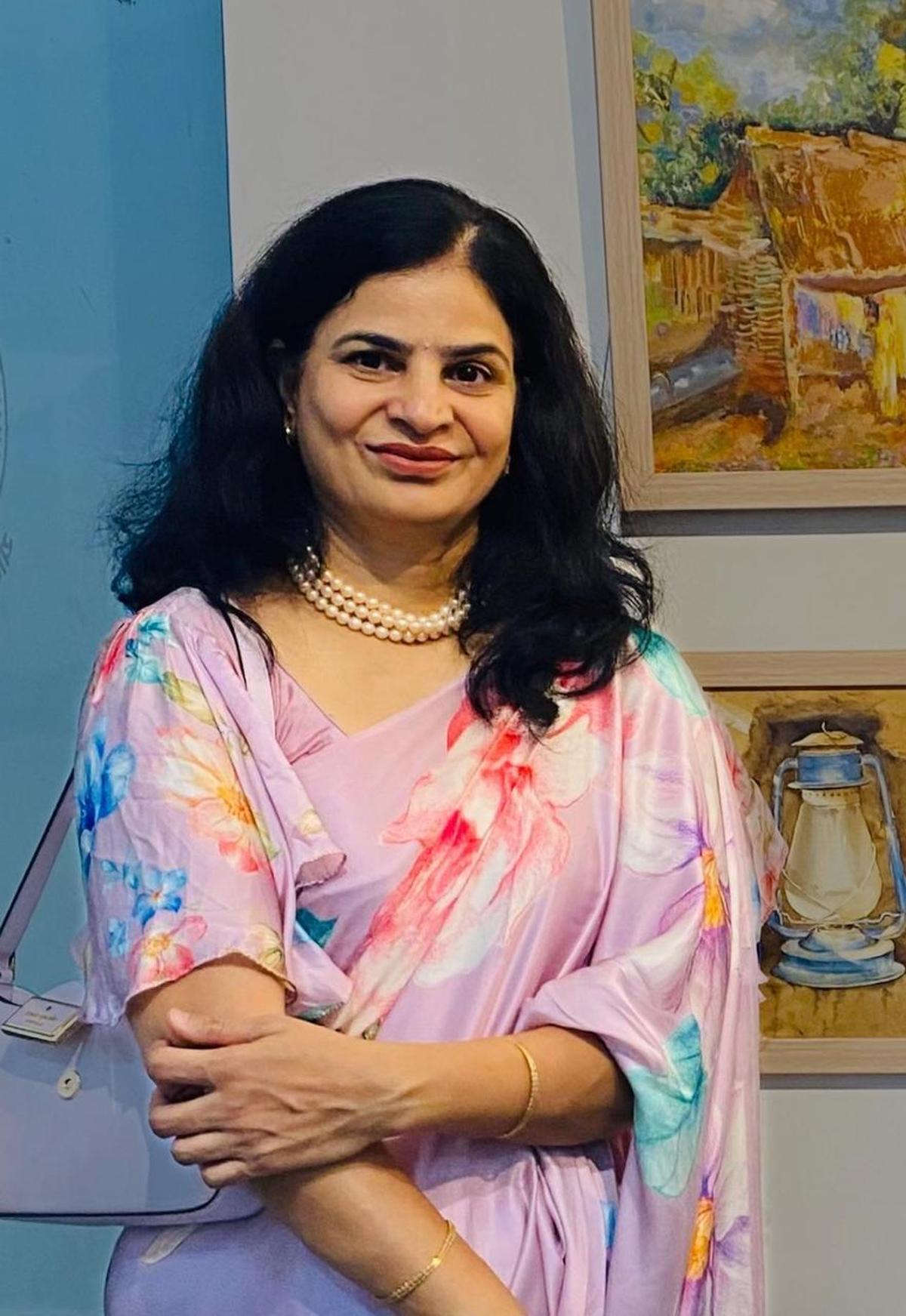
Ramani Mylavarapu 

Ramani Mylavarapu 
| Photo Credit:
Special Arrangement

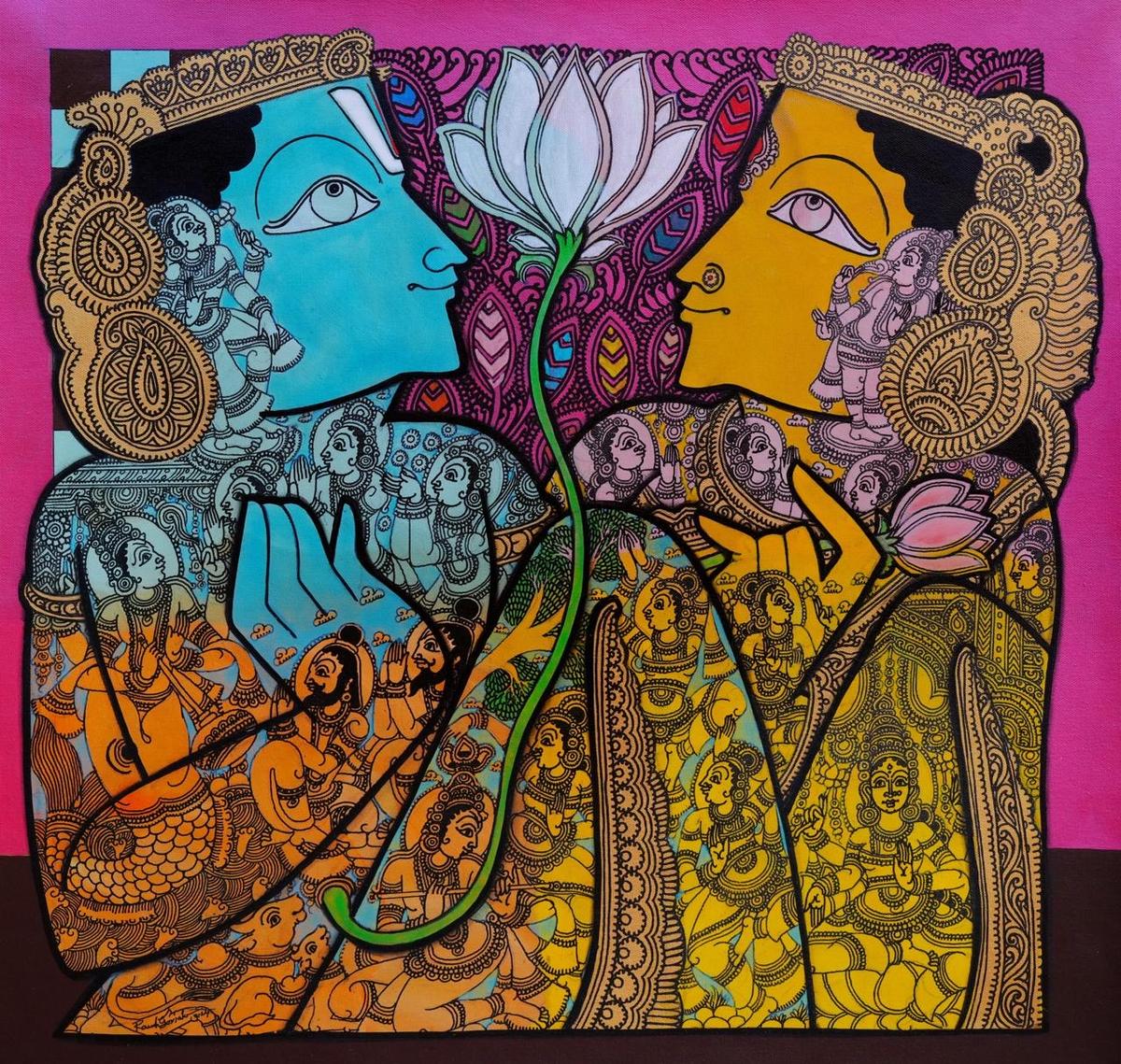
If mythology takes centrestage in artist Sachin Jaltare and Anjani Reddy’s works, Ramesh Gurjala explores a different colour scheme in his Kalamkari works on Krishna, Vishnu and Lakshmi. Known for his distinctive imagery and expression, prominent artist V Ramesh from Visakhapatnam evokes Sankranti spirit with an oil painting of an urli with hibiscus flowers.

Vishnu and Lakshmi, a Kalamkari work by Ramesh Gorjala

Vishnu and Lakshmi, a Kalamkari work by Ramesh Gorjala
| Photo Credit:
Special Arrangement

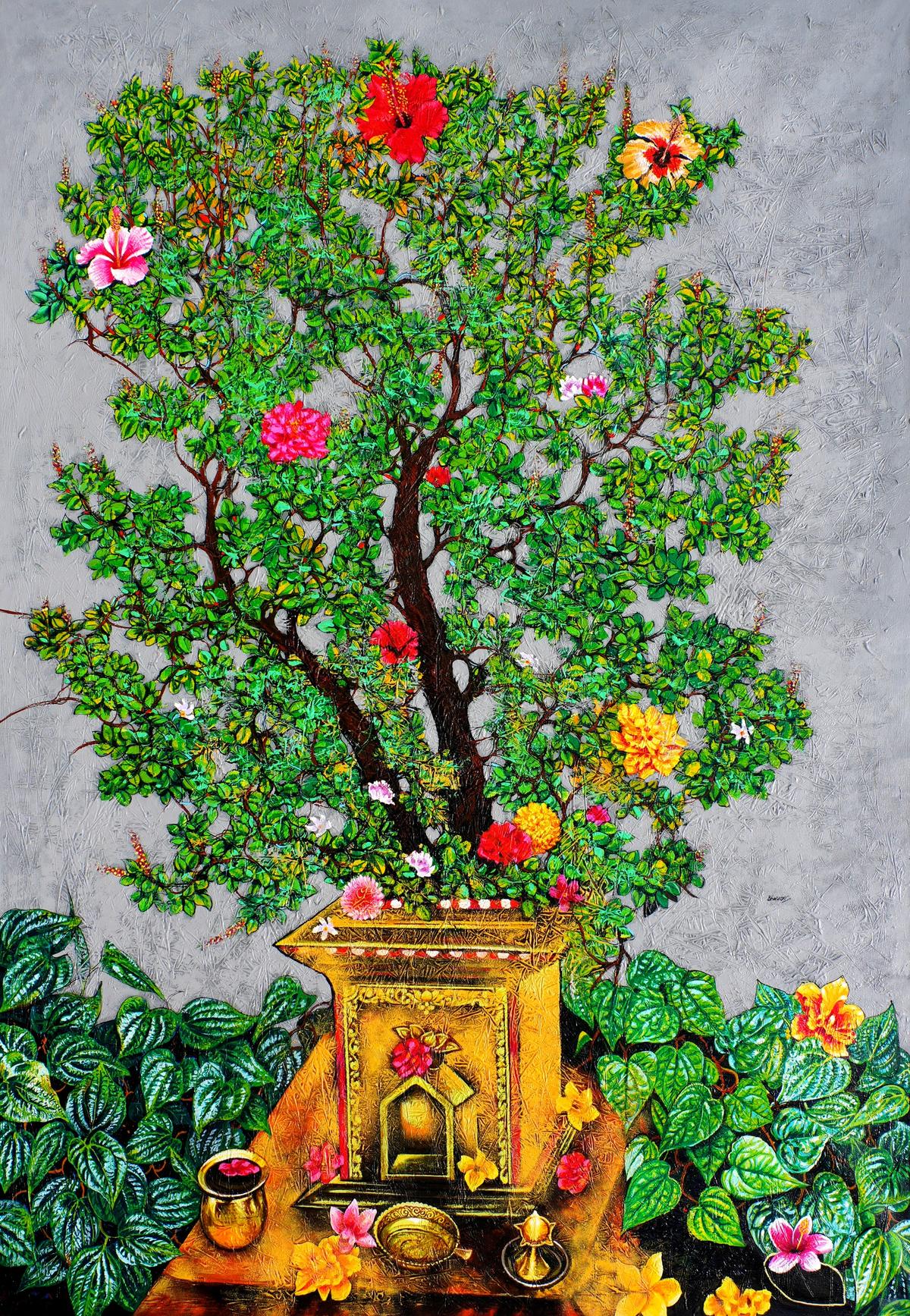
Visitors can check out octogenarian Thota Vaikuntam’s 27-year-old artwork depicting his iconic Telangana women and contemporary artist Bhaskar Rao Botcha’s Tulasi kota painting. “Bhaskar garu is in Ayyappa deeksha and has interwoven his consistent theme — the tree motif with spirituality,” says Ramani, who is also showcasing her works in acrylics. “The floral concept is intentional; Flowers symbolising life and renewal goes with the festive spirit,” says the artist. With a strong desire to create her own identity, she turned to art, studied MFA (master of fine arts) after her children grew up, and also pursued a short course in contemporary art from Slade School of Fine Art, London.

Bhaskar Rao Botcha’s Tulasi kota painting

Bhaskar Rao Botcha’s Tulasi kota painting
| Photo Credit:
Special Arrangement

Other notable works are by HR Devulpalli and Sumantha Choudhary, who is also showcasing a bronze sculpture.

(Golden Horizon is on view from January 8 to 11 at State Art Gallery, Madhapur, Hyderabad).


Source link

Designer Naushad Ali and Sundari Silks collaborate on contemporary saris with a Tamil touch


For designer Naushad Ali, inspiration for his latest collection, a collaboration with a legacy Chennai brand Sundari Silks, was all around him; in a language he loves, and in Tamil heritage that he deeply respects.

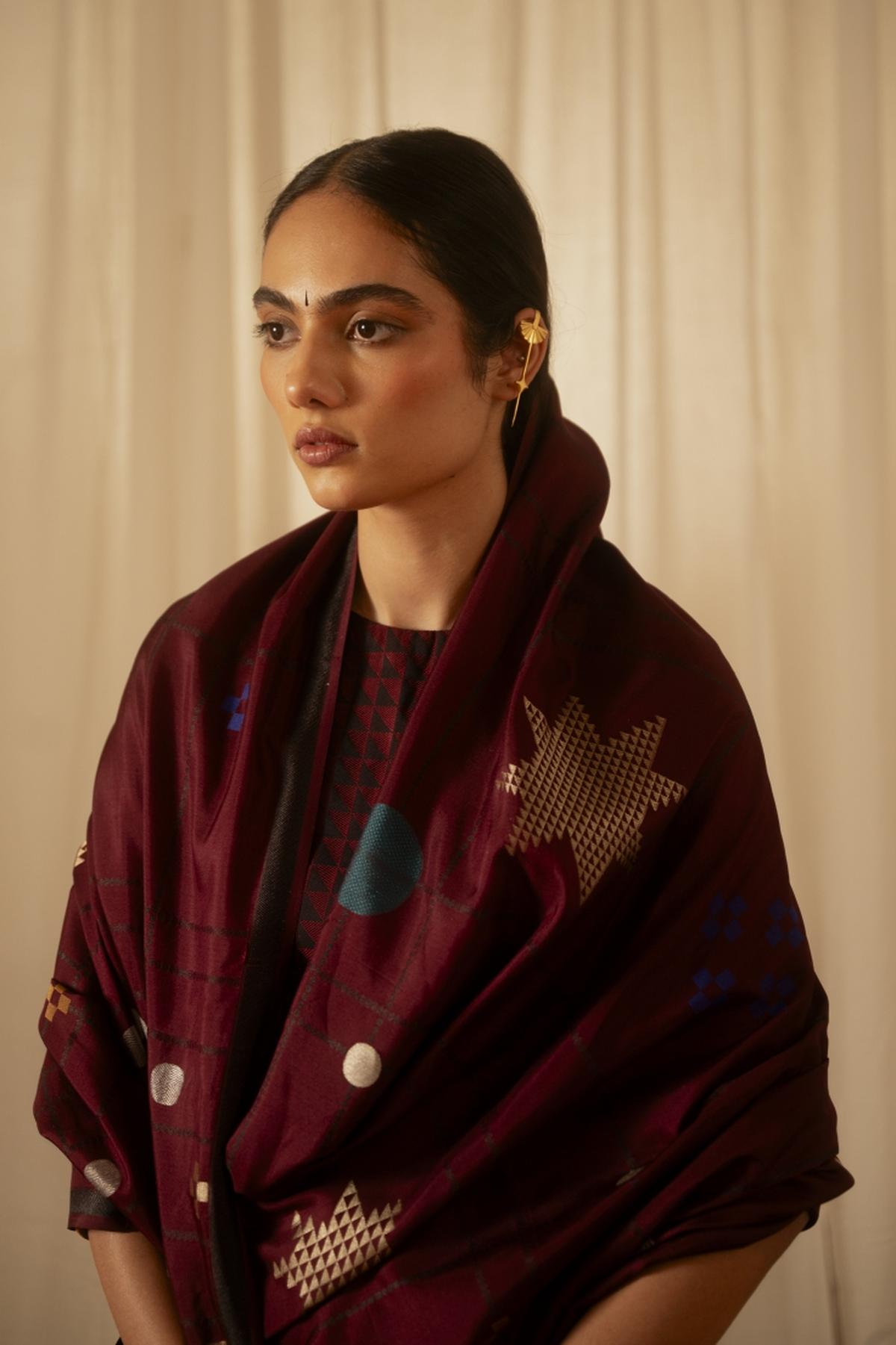
Jasmine flowers in various stages of bloom, markings from the panchangam or the traditional Tamil calendar, narrow temple borders, and motifs representing anklets, nethi chuttis, and pieces of jewellery. On saris in bright purples and blues, subtle beige, yellow, ivory, mint and a gauzy gold, these are just some elements that are woven in, each with a special significance, and a story of culture to tell.

“I was drawn to elements that have shaped Tamil visual culture for centuries. These references hold a quiet sense of ancestry and identity. My own design language has always leaned towards minimalism, restraint, and clarity, and I wanted to bring that sensibility into the sari form without disturbing its essence,” Naushad says.

Featuring 24 saris, the collection, which was unveiled in Chennai on Tuesday has been nearly two years in the making. A few years ago, Puducherry-based Naushad worked with Sundari Silks on a menswear collection. The decision to collaborate on saris is something he says has taken people by surprise.

“I have designed saris for my label’s collections in the past; but it usually is to break the monotony. One sari would probably feature in a full collection. This collaboration with Sundari however was an interesting challenge,” he says.

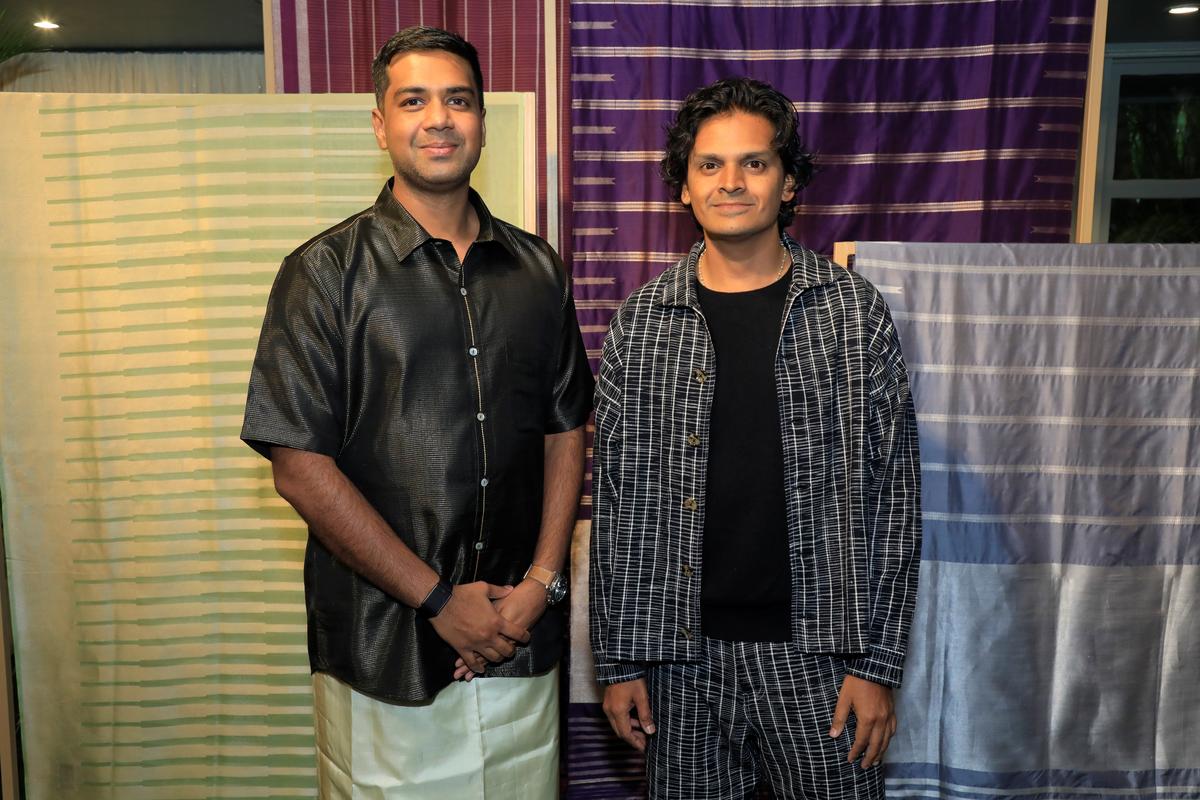
Manmohan Ram and Naushad Ali

Manmohan Ram and Naushad Ali
| Photo Credit:
Special Arrangement

To begin work on the collection, Naushad and Manmohan Ram, managing partner, Sundari Silks recall their journey to Benaras, to meet with weavers, decide on colours and ultimately, get the saris woven there. “This was a collection that was initially conceived for Kanjivarams, but we realised that we had to play around with silks given the work we wanted done on the saris. The saris had to be light, comfortable and wearable,” Naushad explains.

Given the intrinsically Tamil elements that inspire the collection, zeroing in on the colours of the saris too was a well-thought out effort. “We have colours like ‘Ramar pacchai’, a type of green for instance which is very unique to our culture. I wanted to bring these colours back but with a fresher approach, while also wanting to break what a typical sari from South India looks like. We experimented with combinations like pastel mints with reds, and a translucent beige with gold motifs for instance,” the designer says.

From gulmohar flowers, jasmine buds described in Tamil poetry and narrow temple borders, the motifs might be many, but have been used sparingly through the saris. This is deliberate, Naushad says, to let the colours and weaves take precedence, letting a minimal aesthetic shine through.

“We know many young sari wearers for instance, do not like accessorising with heavy jewellery, and were excited about having a sari that featured jewellery motifs instead,” he says.

At the T Nagar Sundar Silks showroom, Manmohan says that the collection will be made available for sale and displayed in a way that reflects the thought that has gone into its making. “The collection has just the right balance, with Naushad bringing together traditional and contemporary design elements and motifs,” he says.

“We have always been experimenting across our womenswear, menswear and even accessories, and this was an opportunity for us to work on a contemporary collection and champion creativity,” Manmohan adds.

Priced ₹28,000 onwards and available at Sundari Silks, T Nagar

Published – January 08, 2026 06:30 am IST


Source link

A festival for all Bengalureans


“Arts and culture are a great way to build a city brand, in more ways than one,” says V Ravichandar, chief facilitator of BLR Hubba, a city-wide festival, now in its third edition, which will run in Bengaluru from January 16 to 25.

The Hubba, therefore, is a stepping stone towards creating a larger Bengaluru brand that goes beyond startups, technology, traffic and garbage or even the old monikers of garden city and pensioners’ paradise, says Ravichandar, who believes that “ we should (also) be known as a happening place for art and culture.”

The Hubba, a clever play on the words “habba”, which means festival in Kannada, and “hub”, something Bengaluru is in so many ways, offers nearly 354 multidisciplinary events spread across several venues and across 10 days.

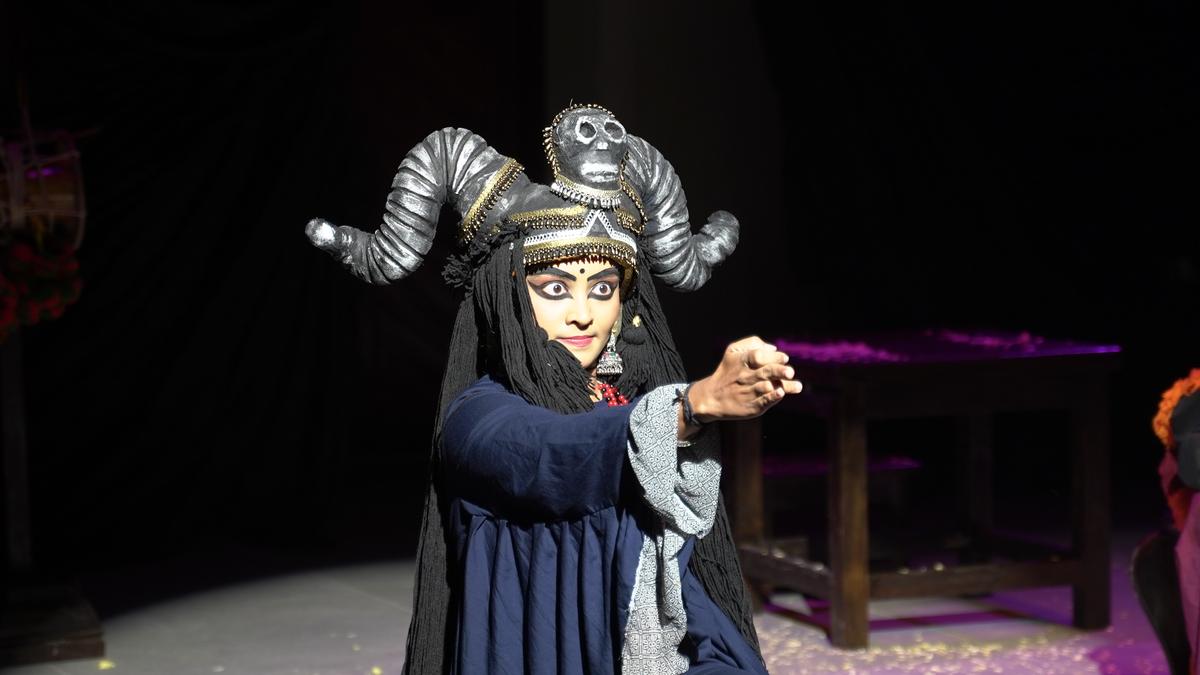
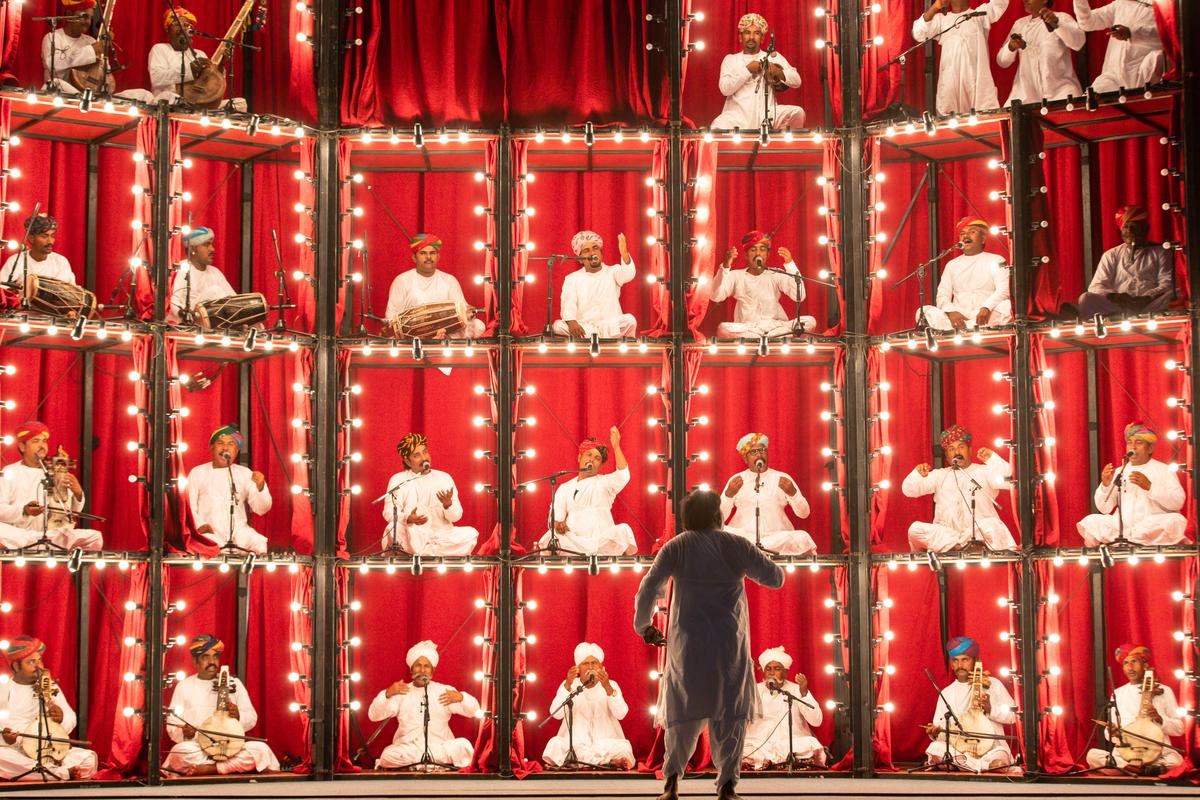
Some of these include a Kannada performance of Medea, Roysten Abel’s The Manganiyar Seduction, an art exhibition titled Holding Pattern by city-based artist Ravikumar Kashi, Tholpavakoothu (shadow puppetry) by Vipin V, Padmini Chettur’s Varnam, a concert by Marty Friedman and even an AI and mathematics session by Yang-Hui He, a Fellow at the London Institute.

The hubba is a multidisciplinary event

The hubba is a multidisciplinary event
| Photo Credit:
Special Arrangement

The festival, anchored by UnboxingBLR, is divided into 12 sub-festivals — Kala Hubba, Kantha Hubba, Nataka Hubba, Churumuri Hubba, Thindi Hubba and so on — each curated by a different person “so that there is clear ownership,” Ravichandar says. It also makes it easier to identify the events one is interested in, since the names of the subfestival indicate what it primarily focuses on, whether it is visual art, storytelling, music or theatre.

Roysten Abel’s The Manganiyar Seduction will be performed as part of the hubba

Roysten Abel’s The Manganiyar Seduction will be performed as part of the hubba
| Photo Credit:
Special Arrangement

After all, “this festival is about diversity of choices,” says Ravichandar, pointing out that taking art to public spaces automatically democratises it, bringing in people from across society’s strata. “We are a civilisation built on bazaar culture, where communities frequently meet to shop, gossip, and do things together. This collective get-together is the essential nature of what we are, and that is manifested physically in what I would call public spaces accessible to all, with no entry barriers.”

Marty Friedman

Marty Friedman
| Photo Credit:
Special Arrangement

One of the primary inspirations of the Hubba is the Edinburgh Festival Fringe, the world’s largest arts festival, which has transformed this “honestly nothing, cold, dreary Scottish city” into a “very hip and cool one.”

While, of course, this festival is much smaller than the Fringe, “in terms of unique programs, we are one-tenth of Edinburgh, the raison d’être is similar. Through these initiatives, you can build a larger city brand,” says Ravichandar, who also sees Kochi-Muziris Biennale and Goa’s Serendipity Arts Festival as having inspired the team.

The difference between the Hubba and Serendipity, Ravichandar says, is that “Serendipity is run by a set of people in Delhi who go to Goa to run the festival, and tourists from everywhere go to Goa. So, it is not a local festival.” The Hubba, on the other hand, is local, meant primarily for the Bengalurean, though, “if people from elsewhere wish to come, they are welcome to.”

V Ravichandar

V Ravichandar
| Photo Credit:
Special Arrangement

All events at the BLR Hubba are open to the public and can be accessed with either free passes offered on a first-come, first-served basis or donor passes priced between ₹250 and ₹450. The logic of having this equal split between free and paid passes, says Ravichandar, is to predict turnout. “The donor pass is a mechanism for crowd control and estimation. After the KSCA event, we wanted to make sure that there is some discipline.”

BLR Hubba will be held in the city between January 16 and 25 at multiple locations. Log in to https://blrhubba.in for more details.

Published – January 08, 2026 06:09 am IST


Source link

Raw Mango’s Kolkata test – The Hindu


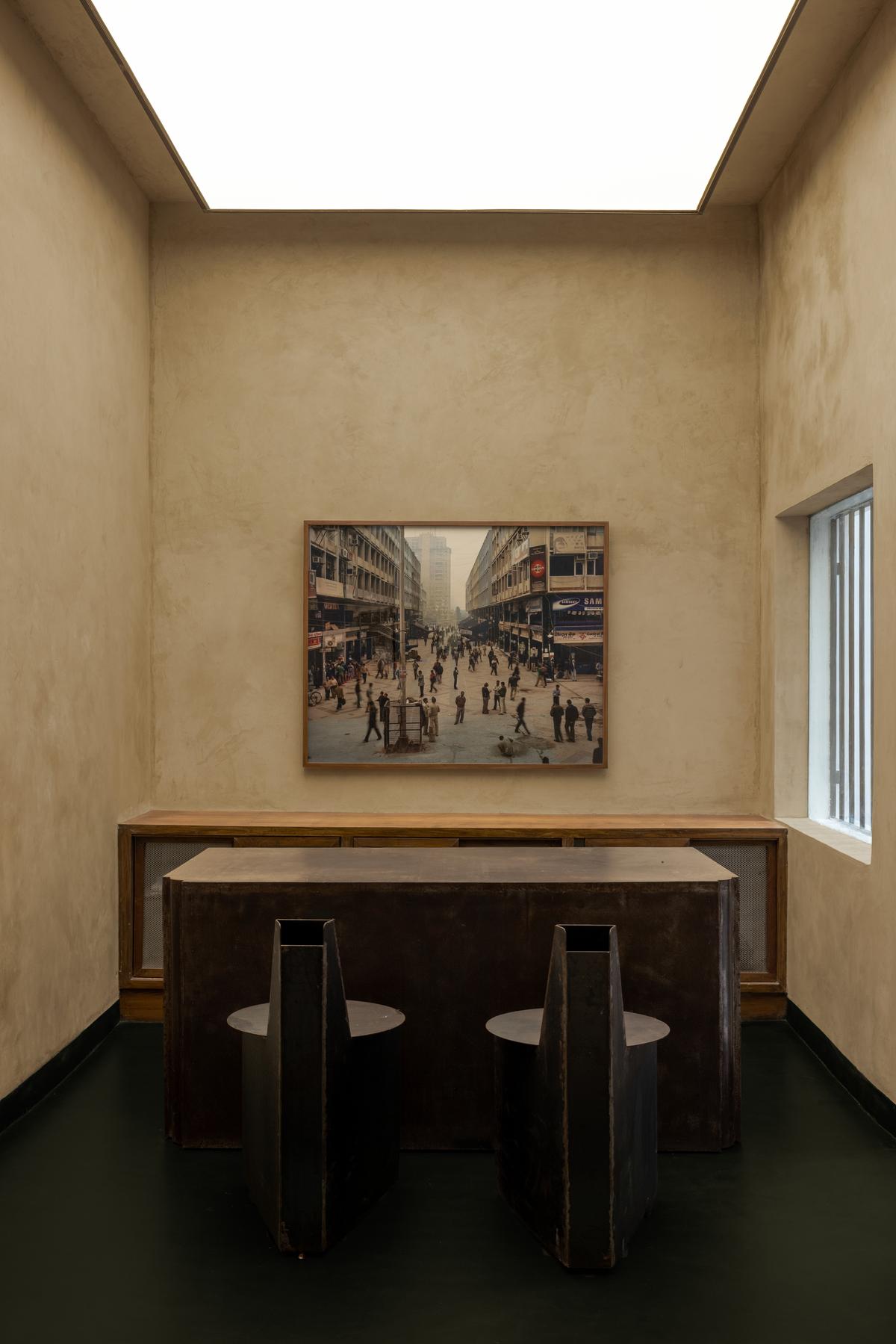
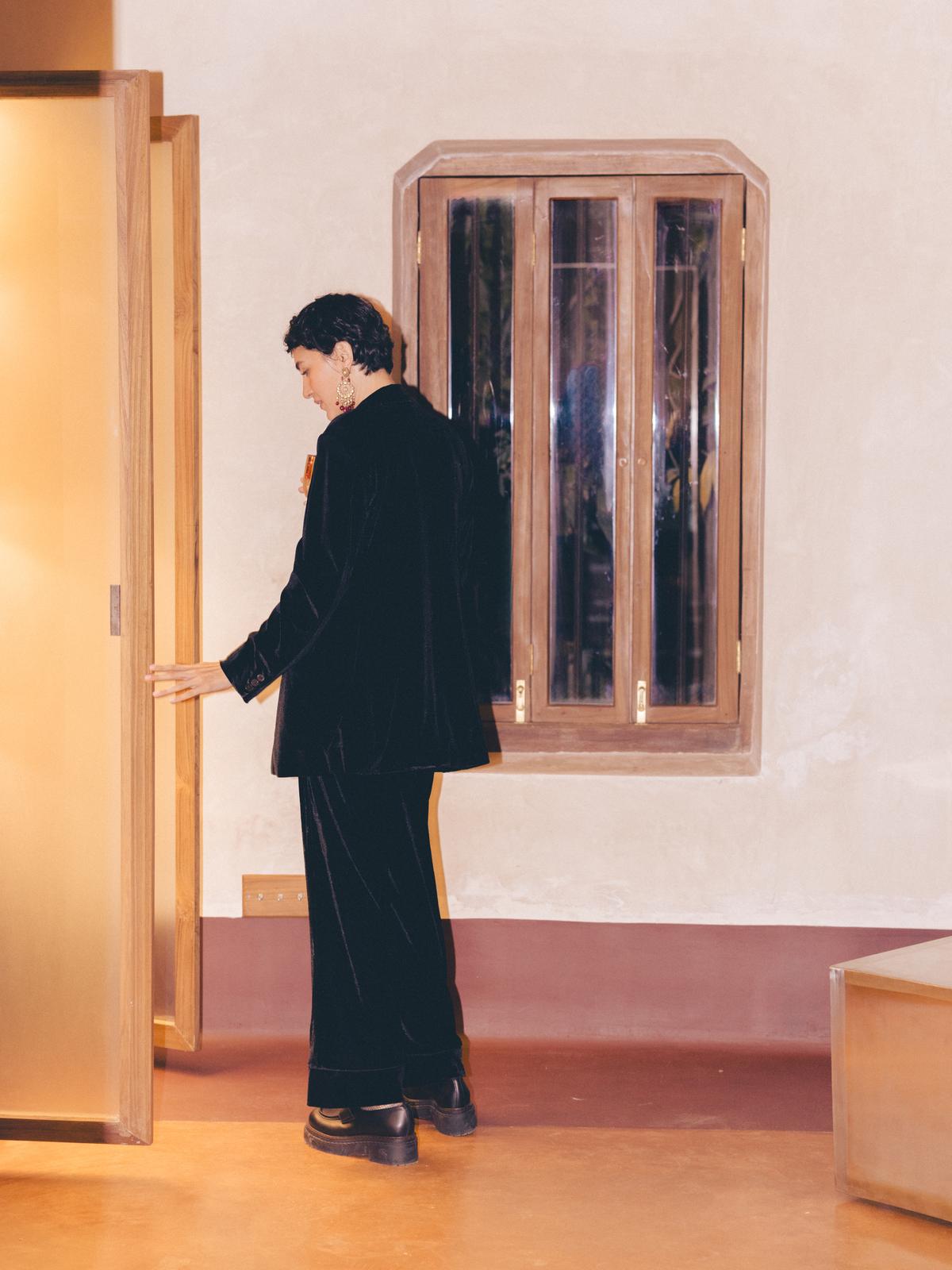
Three weeks ago, designer Sanjay Garg’s Raw Mango opened its seventh store in the country, this time in Kolkata. Many months in the making, and delayed in what some would say a quintessentially Bengali way, the milestone fashion moment was robustly celebrated across both social and traditional media, as well as by the city itself.

The launch, spread out over two days, began with a store opening party, followed by a fashion show at the Neotia Art’s Trust annual trunk show, The India Story.

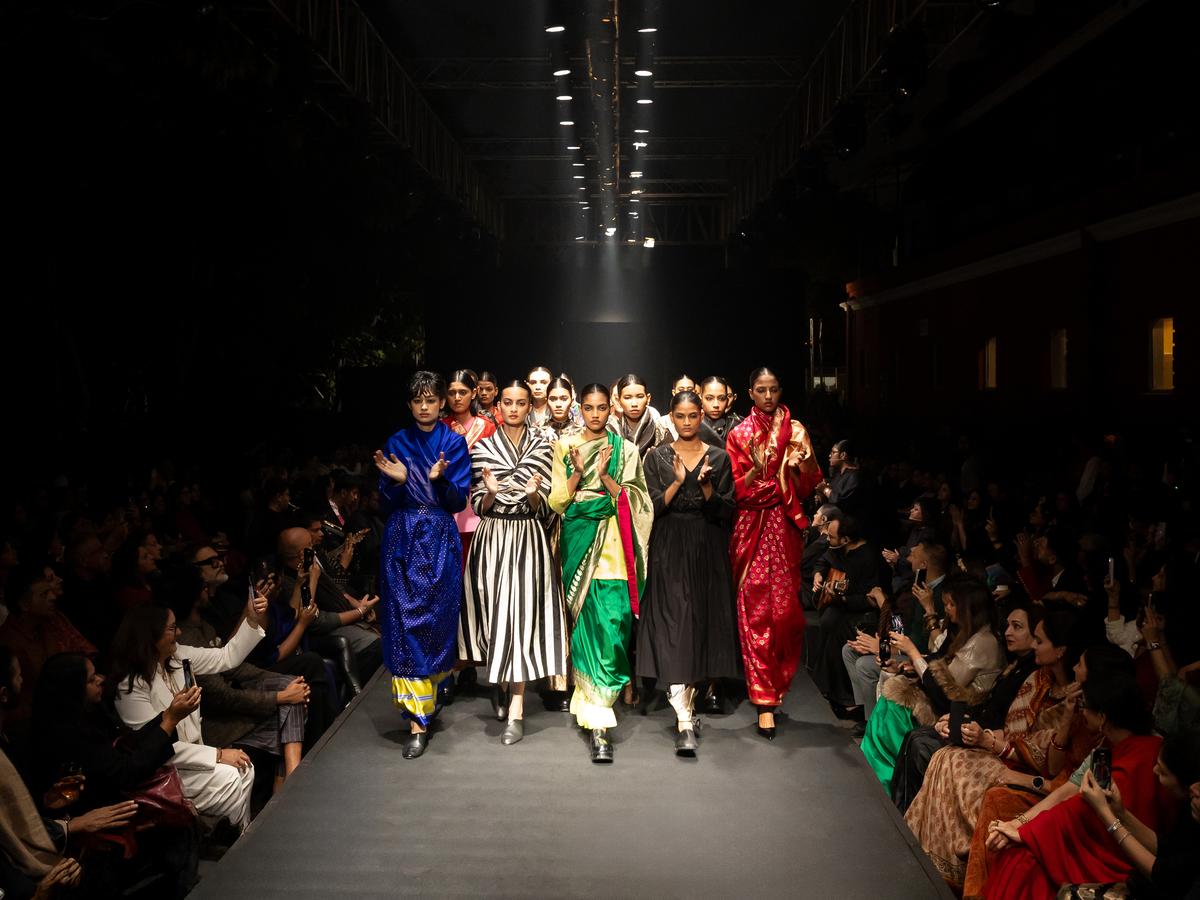
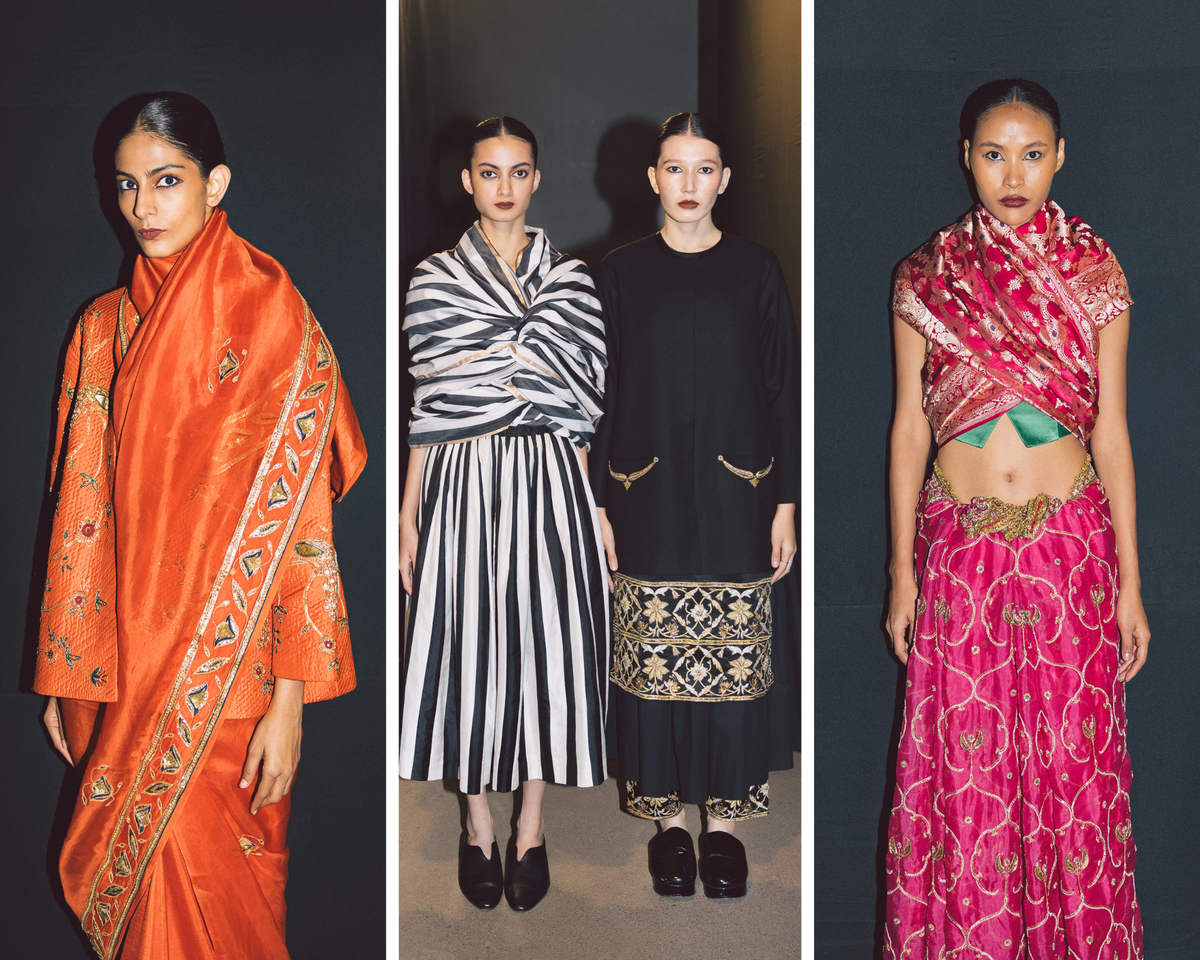
The fashion show at Neotia Art’s Trust’s ‘The India Story’

The fashion show at Neotia Art’s Trust’s ‘The India Story’

It comes at a time when Garg is also showcasing at the Serendipity Arts Festival in Goa, as well as a textile show in Paris. He calls it the “craziest time of his life.” He’s also due to show at London Fashion Week in February 2026, and all this begs the question — was now really the time?

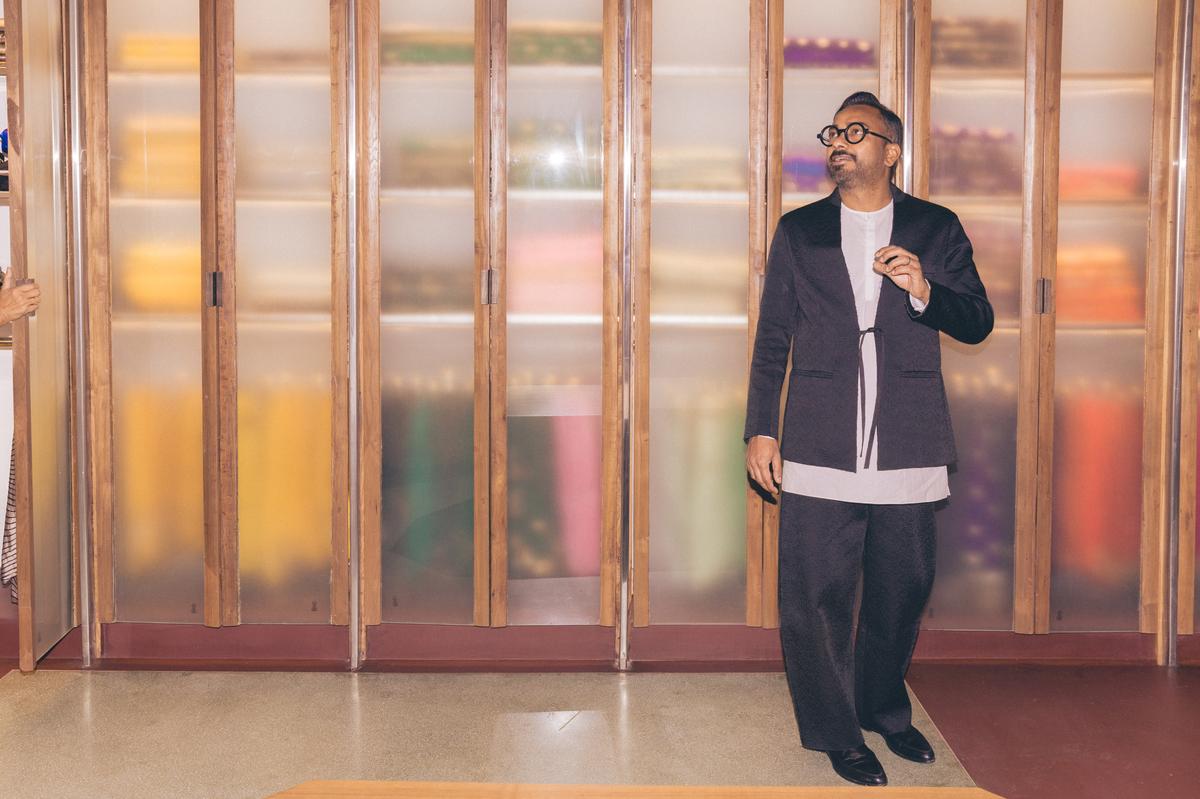
Sanjay Garg at Raw Mango Kolkata

Sanjay Garg at Raw Mango Kolkata

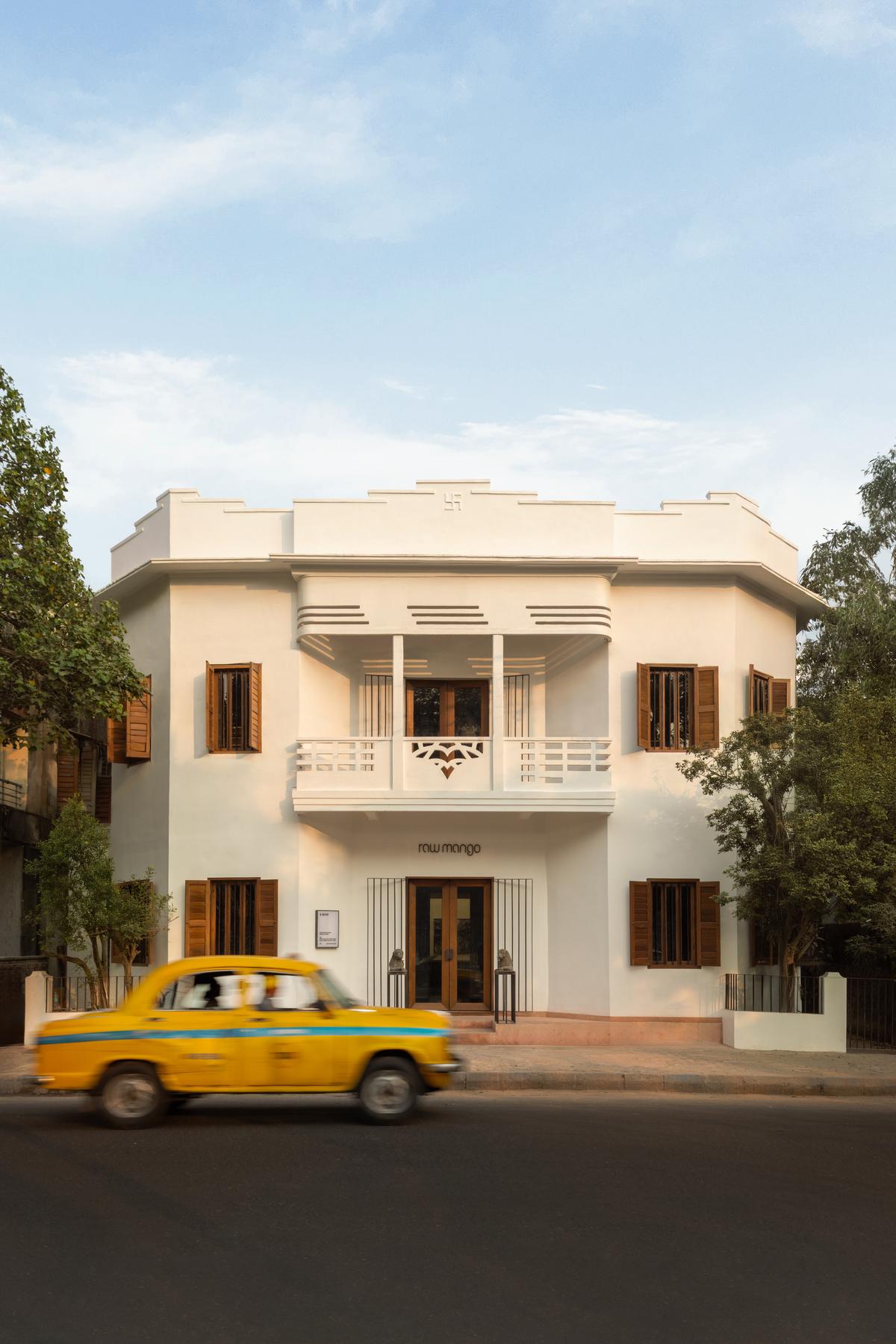
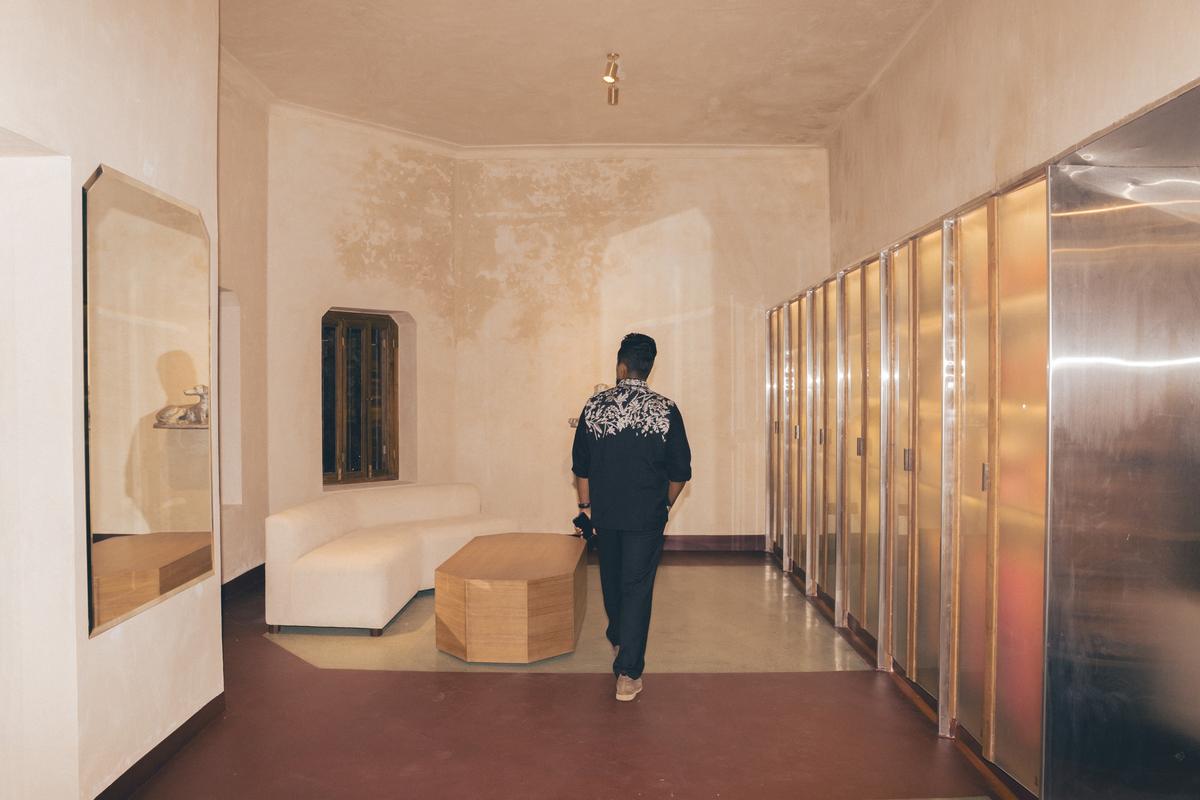
But the 4,800 sq. ft. store feels like a quiet triumph. This has much to do with how lovingly Sanjay and long-time collaborator, architect Adityan Melekalam (of design firm Squadron 14) have treated the 1930s Kolkata Art Deco building it is housed in. Something “Calcuttans”, with their abiding love of history, have taken note of. While city residents adore their architectural heritage, they’re often, save a few examples, also unwilling or perhaps unable to preserve it,. Today there are more glorious old buildings coming down than coming together. It’s not without some suspicion then, that an “outsider” attempting to dip their hands into this past is viewed. But even the naysayers have humbly admitted — the store is beautiful.

The 1930s Kolkata Art Deco building that Raw Mango is housed in

The 1930s Kolkata Art Deco building that Raw Mango is housed in

An ode to Kolkata

Entering the Raw Mango bari, I was struck by its austerity, reminiscent of my grandparents’ home in Kolkata. Almost eschewing commerce, the space initially appears to have nothing to sell, and invites you instead to take a seat, call out for a cup of cha, and cool your feet on the century-old floors. When I point this out, Garg, with a twinkle in his eye says his space is “the opposite of Sabya’s”, where every surface and corner is chock full. “I like him, I like anyone authentic, but we are opposites when it comes to this,” he says.

The Raw Mango bari is austere

The Raw Mango bari is austere

He isn’t wrong, and is also the first to admit that both aesthetics in their own way represent India, and of course luxury. For those who are familiar with his Banjara Hills, Colaba, Teynampet or other stores, the style is consistent.

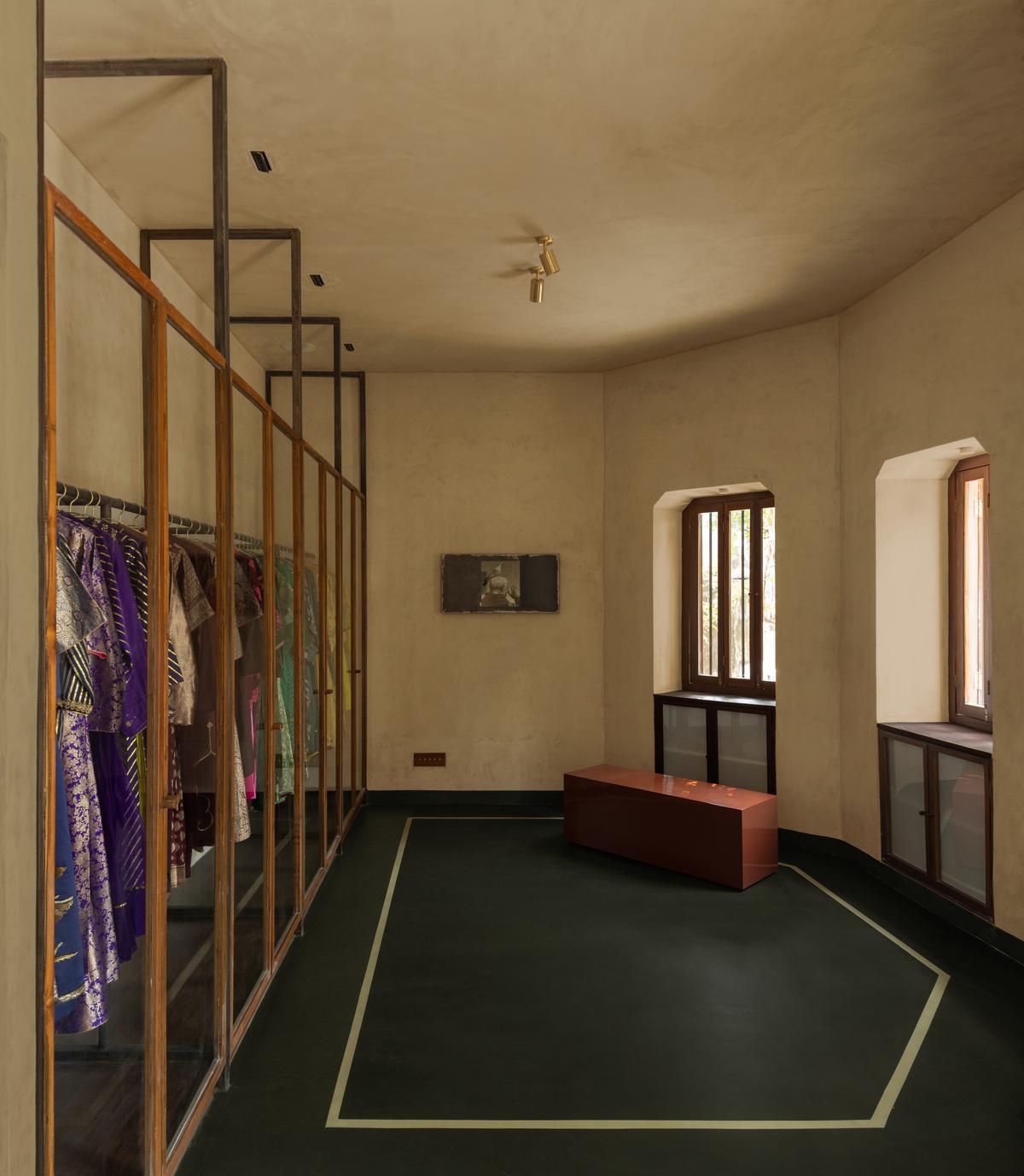
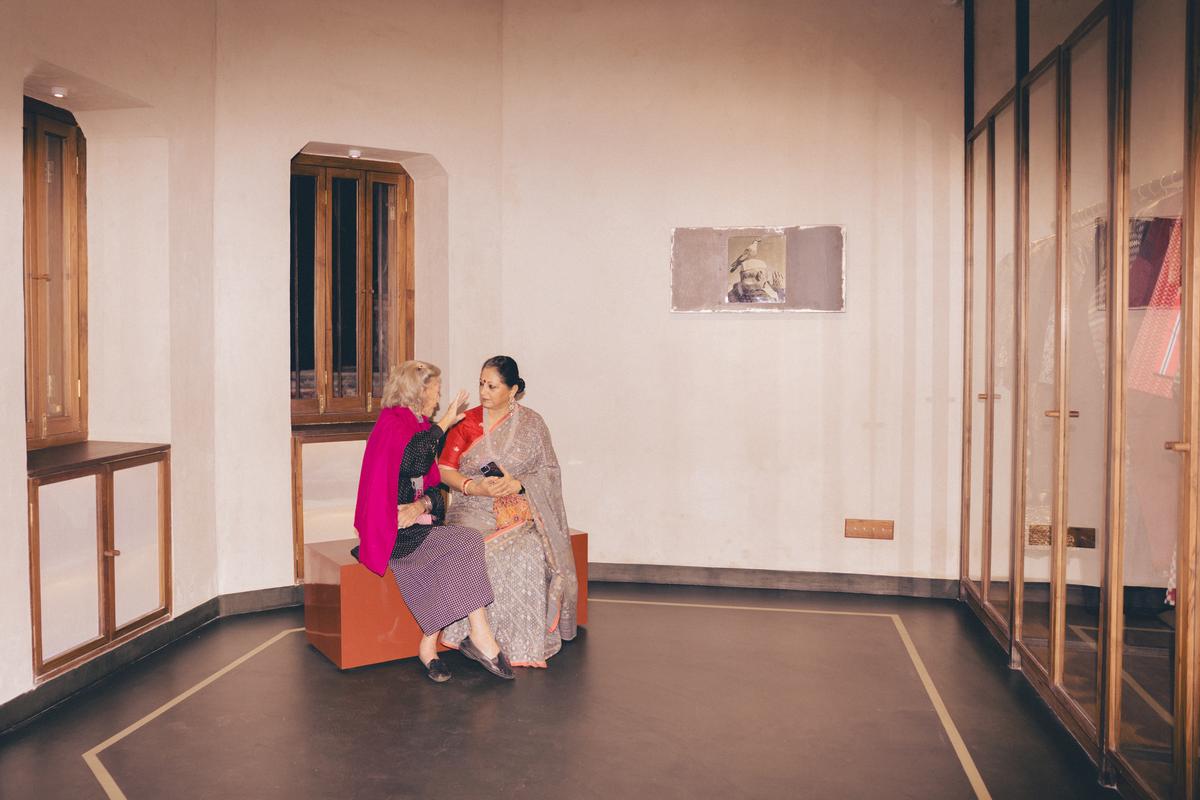
I drift upstairs, to the first floor of the house. Angular rooms that once must have slept whole families on single grand beds in their centres, now look out on to Maddox Square Park, the site for one of the city’s popular Durga Puja pandals, come Sharada season. The long lines of the grills on the front windows reflect perfectly the long lines of the grills on the park. Like this, obliquely, the bari takes from the city and gives back.

The furniture is minimal, and follows the shapes within the house, often impractical octagons and hexagons that delight Garg, who has long appreciated Art Deco, and seems to have relished transforming this house into a home. As in the rooms of a home, you rarely ever see the clothes of the inhabitants. They lie within almirahs, built into the structure’s own original alcoves for the same, and it’s only when you open them that shocks of pink and gold and emerald dance out.

The clothes lie within almirahs

The clothes lie within almirahs

Cleverly, without trying to be Bengali, or even create an “ode” to the city, Garg has crafted an echo of one. The red oxide of the classic Kolkata home is present, but in a subdued matt finish. The shine it traditionally sports has been transferred to the doors, lacquered in a diminutive oxblood.

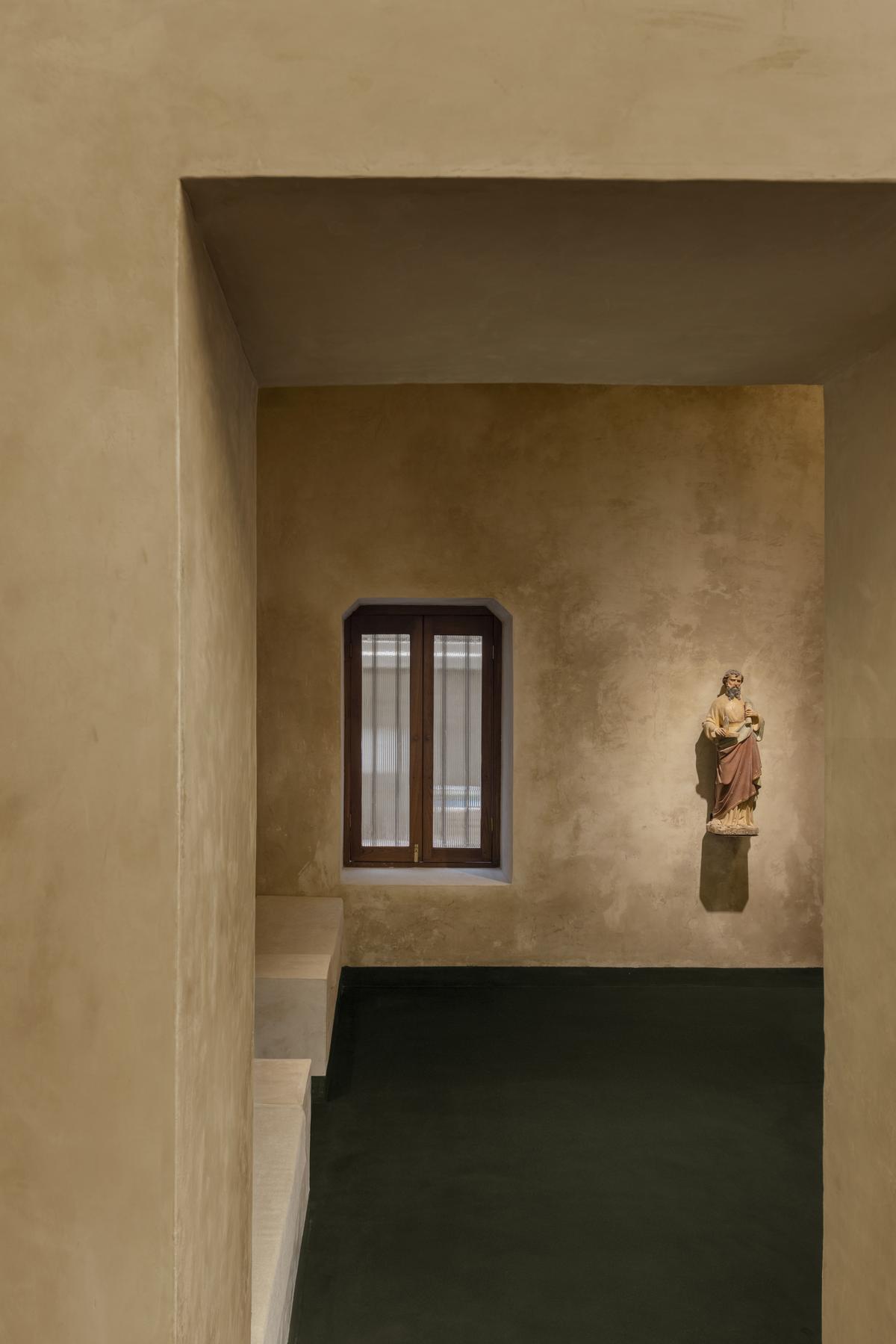
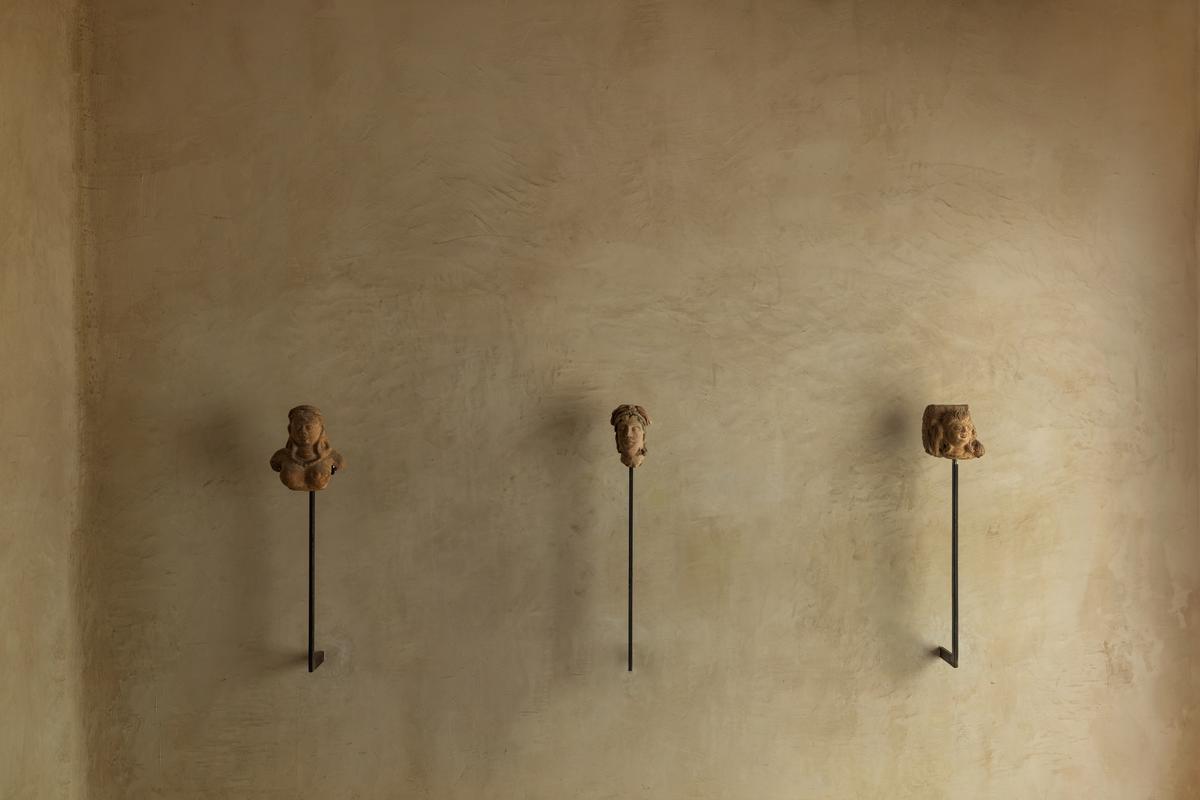
There are small Gupta period statues, photos of Jawaharlal Nehru, and photographer Bharat Sikka’s work up, all from the designer’s own collection. If you thought Garg might have a goddess somewhere in the house, think again.

Statues from Sanjay Garg’s own collection

Statues from Sanjay Garg’s own collection

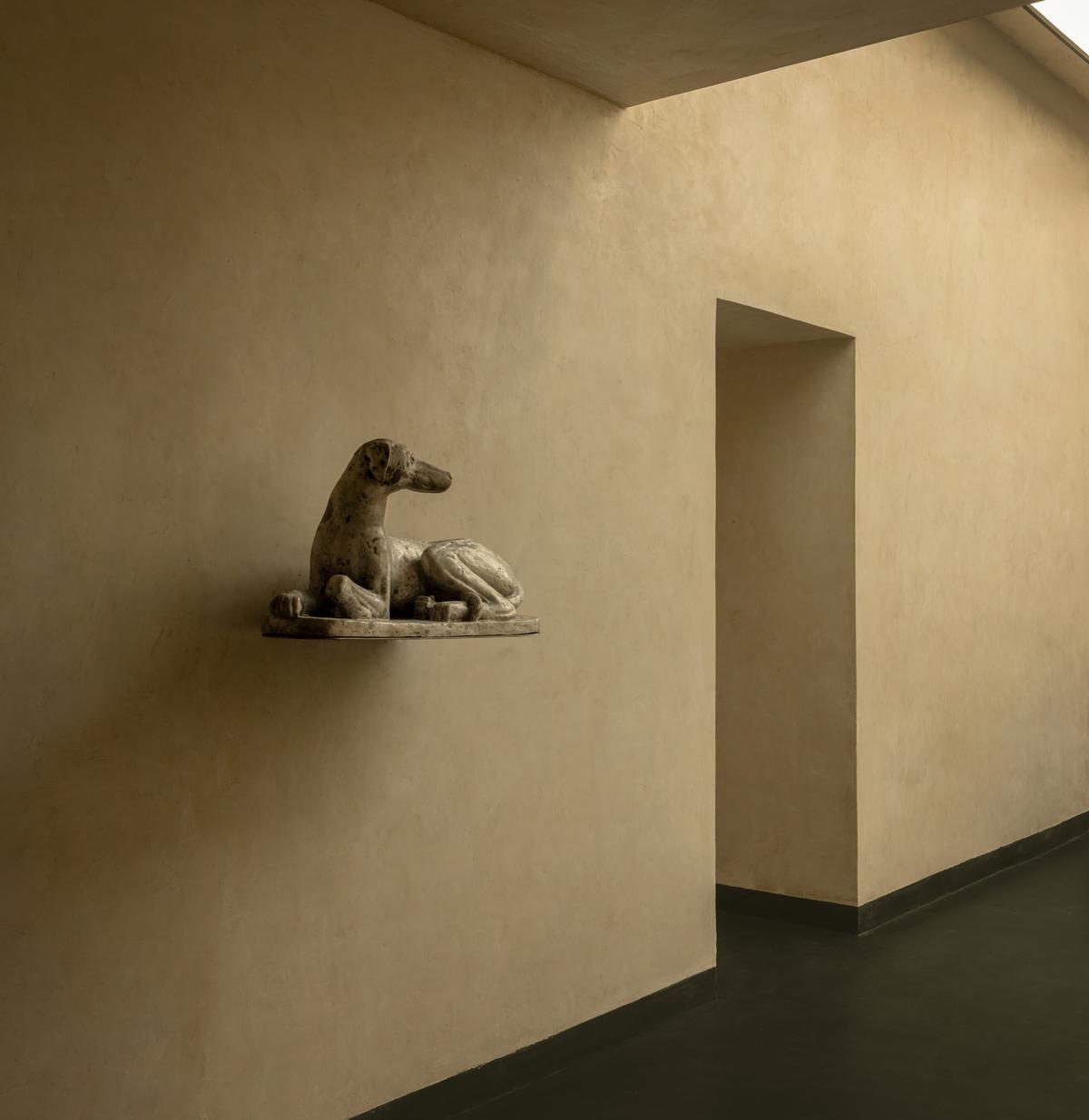
Alternatively, the statues of Kumartuli, the potters’ quarter, find form in the most Kolkata of things, two gentle figures of a resting street dog, Chunu, created by sculptor Sahasrangshu Saha, elevated to eye level. There’s also the visitors’ washroom, awash in simple yet Subodh-esque steel.

Street dog Chunu, created by sculptor Sahasrangshu Saha.

Street dog Chunu, created by sculptor Sahasrangshu Saha.

A family affair

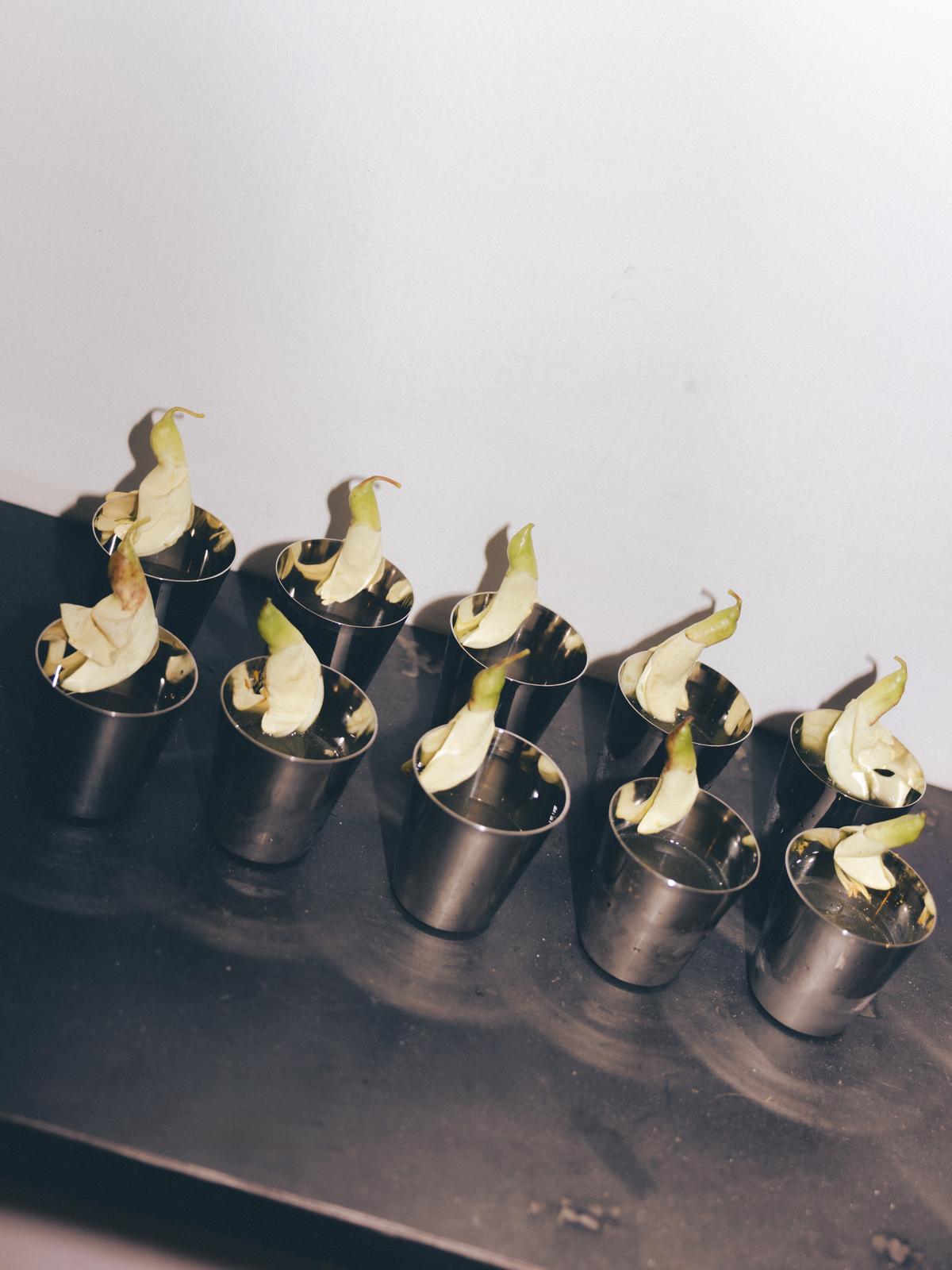
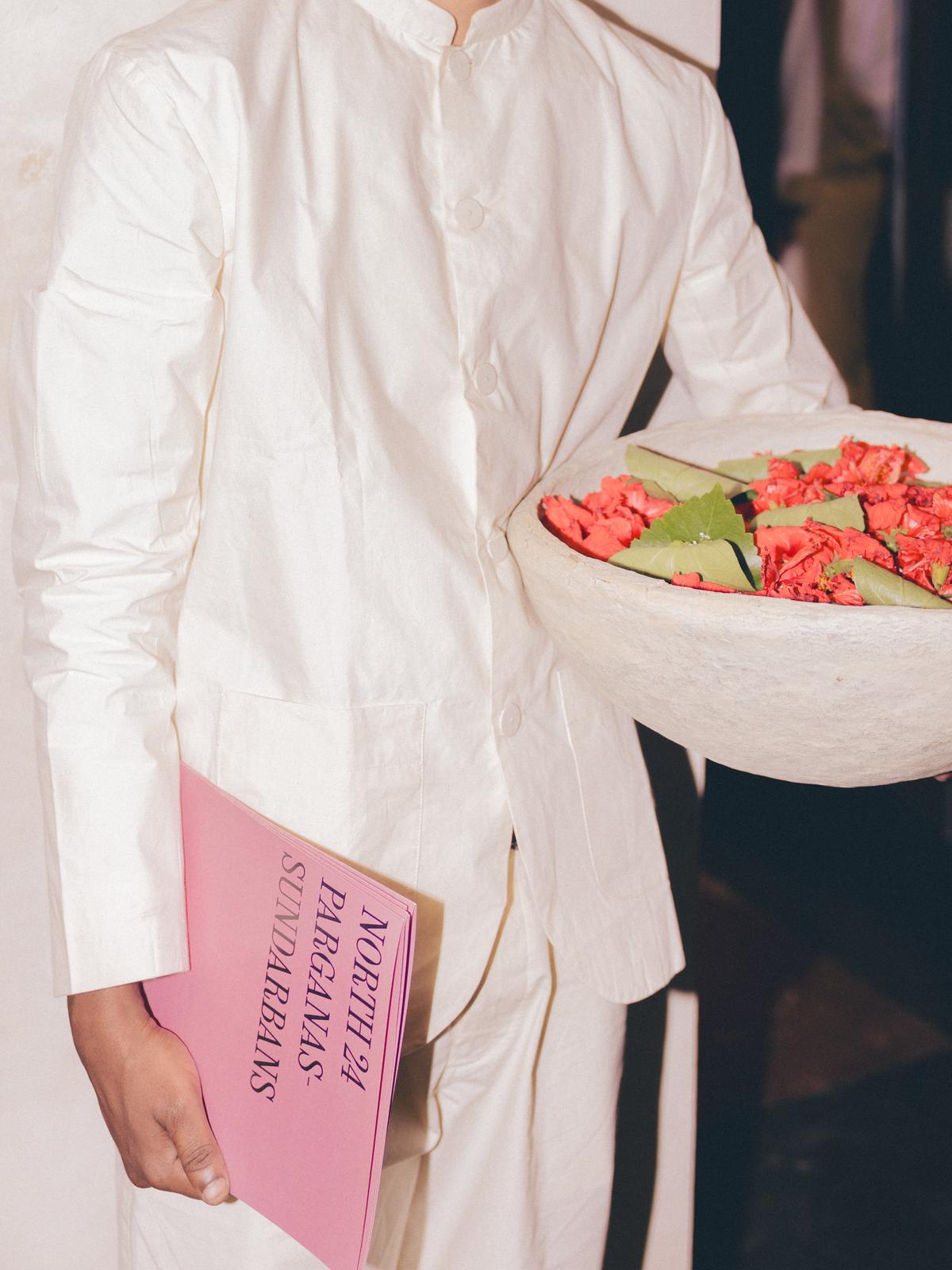
As always, with Garg, his family remains close, a circle woven around him. A day prior to the launch, I see his brother-in-law Nitin Sisodia standing in the winter sun, overseeing last minute decor. Together with Prerna, Garg’s elegant sister who has played muse to the brand in the past, they run A Dialogue, a food biodiversity conservation project that also designs culinary experiences — and did the same for the opening night. Sharbats with marigold petals are distributed in stainless steel glasses. Clover leaves, for luck, act as small spoons to mouthfuls of shorshe (mustard) cream. Gondhoraj (lime) rice bites come around in leaf cones, and sweet sandesh and mishti are laced into lotus flowers.

The food is served in an open air back courtyard that feels like an ode to Garg’s Rajasthani roots. Standing there, music wafting into the night, he looks up and suddenly says, “This is where I’ll cut my marks. This is why I can never be satisfied. There should have been a light here.” He isn’t wrong, and it reassures anyone listening that he will continue to improve on both the space, as well in his understanding of the city. And there have been misunderstandings.

As part of the launch, a team in Kolkata recorded snippets of locals speaking Bengali. Sweet nothings as well as what Garg affectionately (to his team’s shushing) calls “the bakchodi of the streets”. The recordings appear as projected typography on the store walls and some played over Raw Mango’s Instagram reels. When released on social media though, one local designer commented on how the incorrect form of a Bengali word had been used. The final consensus in the city is that she was wrong, that it was simply a less common-in-Kolkata dialect, but the flare up that ensued showed a side of Bengal that might be quick to pull down a designer who dares to bring what many feel are overpriced Banarasis to the state of the Banarasi-wearing bride. But Garg is no stranger to claims of appropriation, and has spoken out in the past about the balance between borrowing from cultures and acknowledging them with respect.

Guests at the Raw Mango Kolkata opening

Guests at the Raw Mango Kolkata opening

Hiccups and criticism

When I ask if he is at all worried about entering this market, Garg says what scares him sometimes is that Kolkata is a “sari-wearing market”, suggesting this is a test in some ways, but emphasises the love the brand has received in the city over the years. He says it isn’t just Marwari clients he has, as many assume. “Our Kolkata clientele is made up of an equal number of Bengalis as Marwaris, and of course others.”

The evening of the show though, front row seats go empty. Something that a few people whisper would simply never happen in other cities, and that left others wondering if this reflected a city-wide attitude towards the brand. Most absentees insisted it was the traffic — particularly terrible that evening. Other criticisms came up in the choice of music for the show. Curated by arts experience company Artsforward, musicians from the collective The Other Borno performed a live piece made to feel like a street protest. Inspired by singers Bhupen Hazarika and Paul Robeson, it honoured the Ganga. The story felt like the perfect tribute — a river that flows through the country, and makes its way from Banaras to Kolkata. Despite its powerful messaging though, some viewers complained of the dissonance between the audio and visual experience.

The clothing itself, as always, went beyond Banarasi, showcasing a variety of Raw Mango pieces, not all new creations but an amalgamation. An eye-catching green bandhani coat, broad striped skirts, an exquisite scalloped black sari. Different textiles shone and came together, beautifully styled by Nikhil D., who layered garments in a way that felt both chic and cosy, as the temperatures dropped.

The clothing went beyond Banarasi

The clothing went beyond Banarasi

But whether the city of complex joys will truly embrace Garg and his dreamhouse, is yet to be seen. He is hopeful though, and full of love and admiration for Bengal.

The writer, spoken word poet, and screenwriter is based in Kolkata.


Source link

Smoked pork and modern paan: Your guide to the food stalls at BLR Hubba 2026


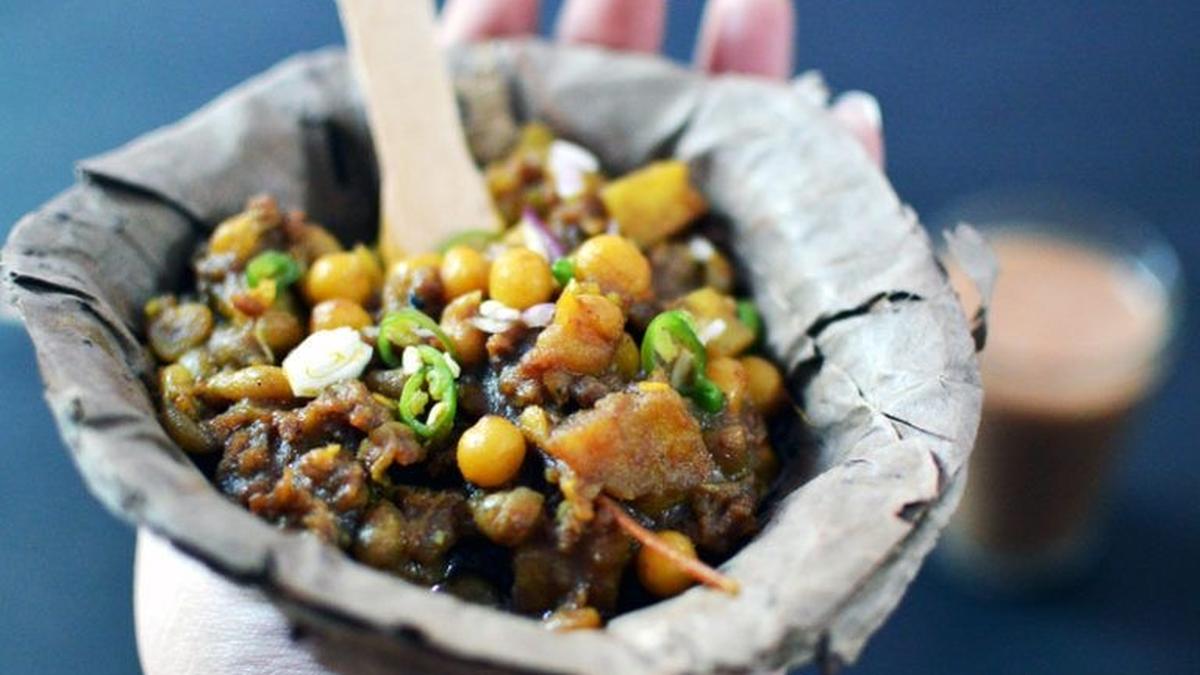
The Ghughuni Gully food stall will feature the beloved street snack from Eastern India

The Ghughuni Gully food stall will feature the beloved street snack from Eastern India
| Photo Credit: Special arrangement

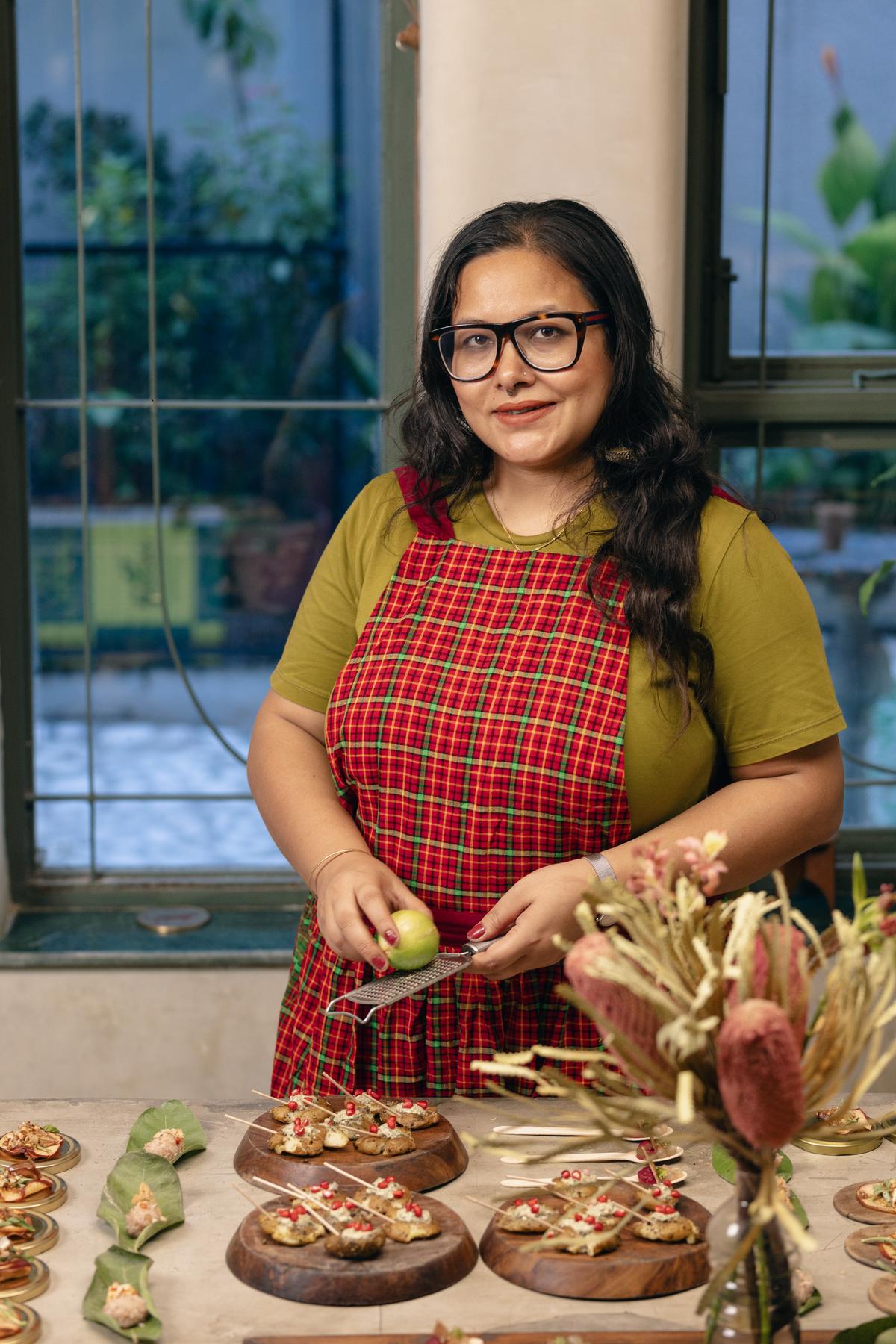
Bengaluru’s arts and crafts festival, BLR Hubba 2025, is taking over the city next week. With dance, music, theatre, visual art and many other events and performances, the 10-day festival is now in its third edition. Supporting the BLR Hubba, is a Thindi Hubba, a celebration of the rich and diverse tapestry that is Indian cuisine. “Street food, in its humble brilliance, holds so many invisible nuances,” says the curator of Thindi Hubba, Kabyashree Borgohain. “Through this event I’m seeking moments where a shared snack becomes a shared story.”

Curator of Thindi Hubba, Kabyashree Borgohain

Curator of Thindi Hubba, Kabyashree Borgohain
| Photo Credit:
Special arrangement

“With Thindi Hubba, we aim to uncover the invisible design logic behind our everyday eating, from wrapping styles to walking meals, handheld dishes bridging traditional food wisdom with contemporary food-design thinking,” adds Kabyashree, who with Dayananda Meitei, is the founder of Project Otenga, the Delhi-based organisation that looks at interdisciplinary collaboration through food and design.

Reimagining street food

The food stalls cover all four corners of the country. Here are some of the highlights:

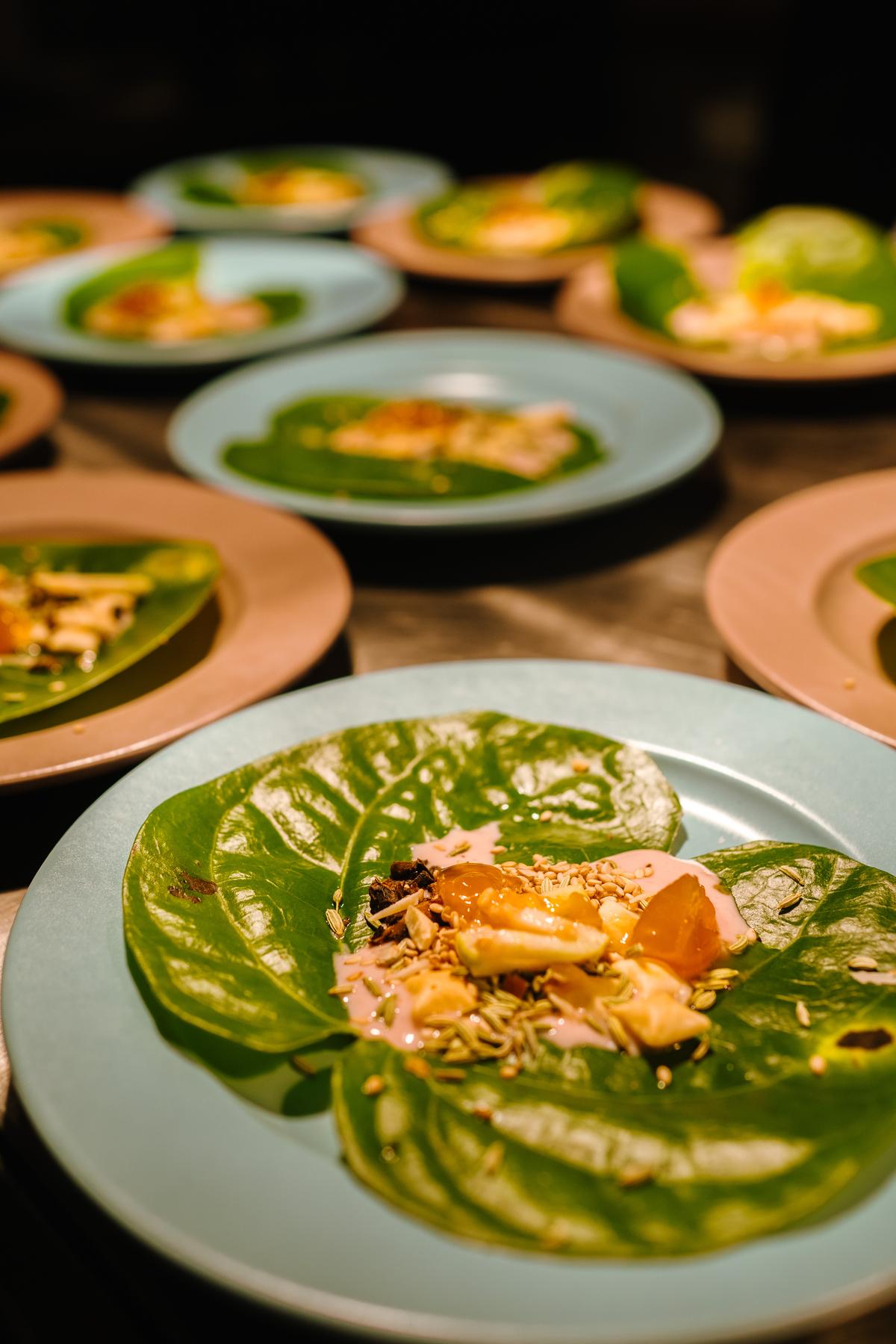
Neo paan, postmodern paan for the bold and experimental: This is a contemporary take on paan which is lighter and more botanical. Here paan is reworked with fresh ingredients and unexpected pairings. Think sweet, savoury options, inspired from popular dishes like miang kham, a Thai appetiser.

Neo paan, is a stall with modern interpretation of paan

Neo paan, is a stall with modern interpretation of paan
| Photo Credit:
Special arrangement

Just pork, smoky pork grill straight from the hills: This food stall takes inspiration from the kitchens of North east India. Traditional methods such as smoking and fermentation, and flavours including sesame, bamboo shoots and axone, are given a contemporary spin here.

Mudde pe aayein: Ragi mudde is a staple in many south Indian homes. At Thindi Hubba, they will serve hawker-style mudde bowls with chutneys, coatings, and bhutte ki kees.

Ghughuni gully: At this stall you can dine on the warm and comforting ghughni chaat from West Bengal. The ghughni is traditionally made with yellow peas or black chickpeas, which are slow-cooked with spices. At the hubba they get an innovative twist.

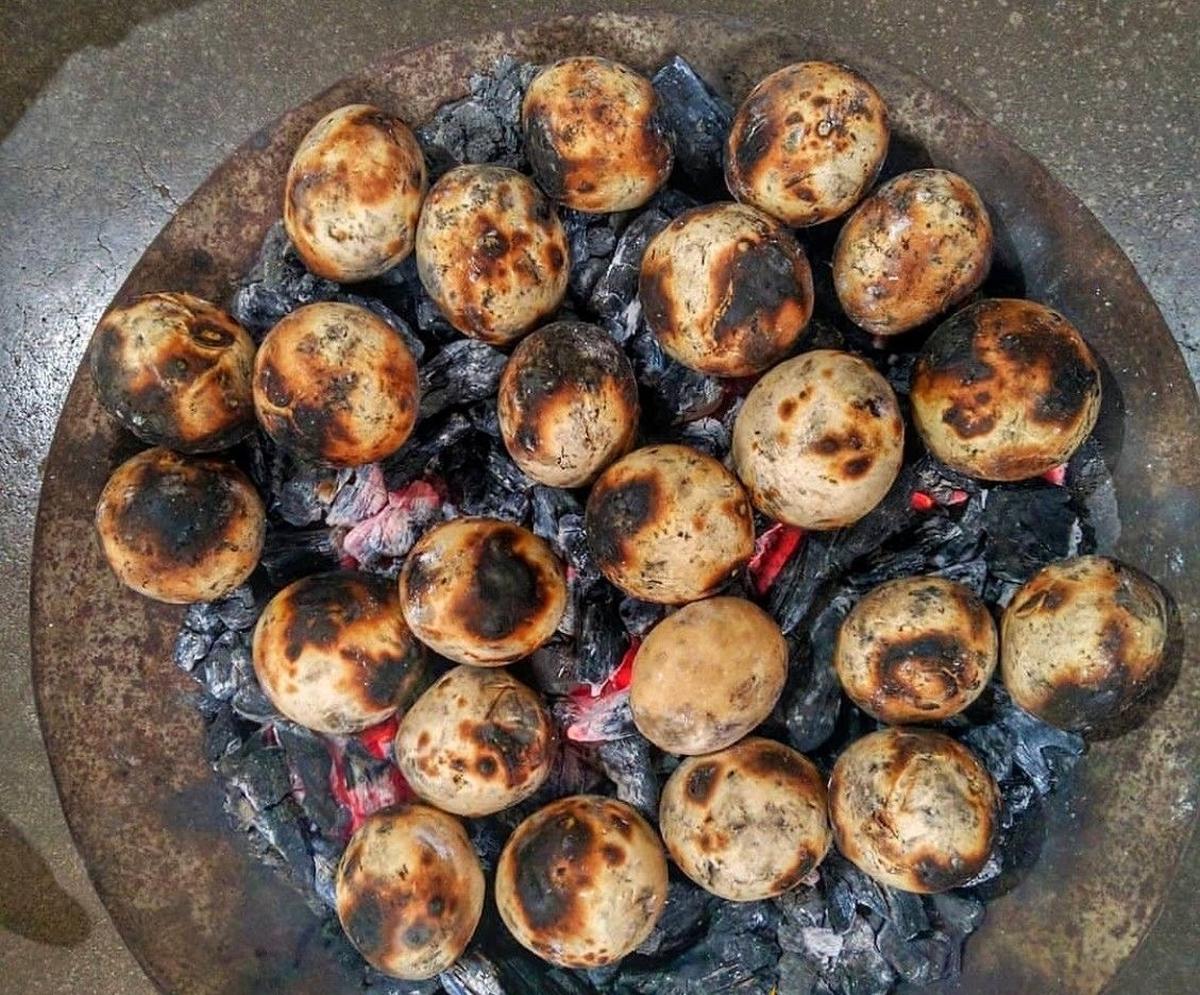
Littis being made on charcoal

Littis being made on charcoal
| Photo Credit:
Special arrangement

Hamaar Litti: These charcoal grilled sattu dumplings are a favourite from Bihar and UP. Pair it with mustard oil scented mashed potato (aloo chokha) and bright green chillies.

Other stalls include golgappes with six kinds of paanis, black rice crepes, rasam prepared with elephant apple, churmuri and bhel puri, ramen and chai. The Hubba has events with food stalls. “There will be book reading sessions on food, edible experiences on personality-based tastes, and other sessions on food memories, zero waste cooking, mithai making, and pickling.”

Entry free, registration online. January 16 -25, 2025, 11 AM – 9 PM. At Freedom Park, Seshadri Rd, Gandhi Nagar. For more details visit blrhubba.in


Source link