Life & Style

Toda tribe of The Nilgiris rethatch their sacred temple with a rare grass


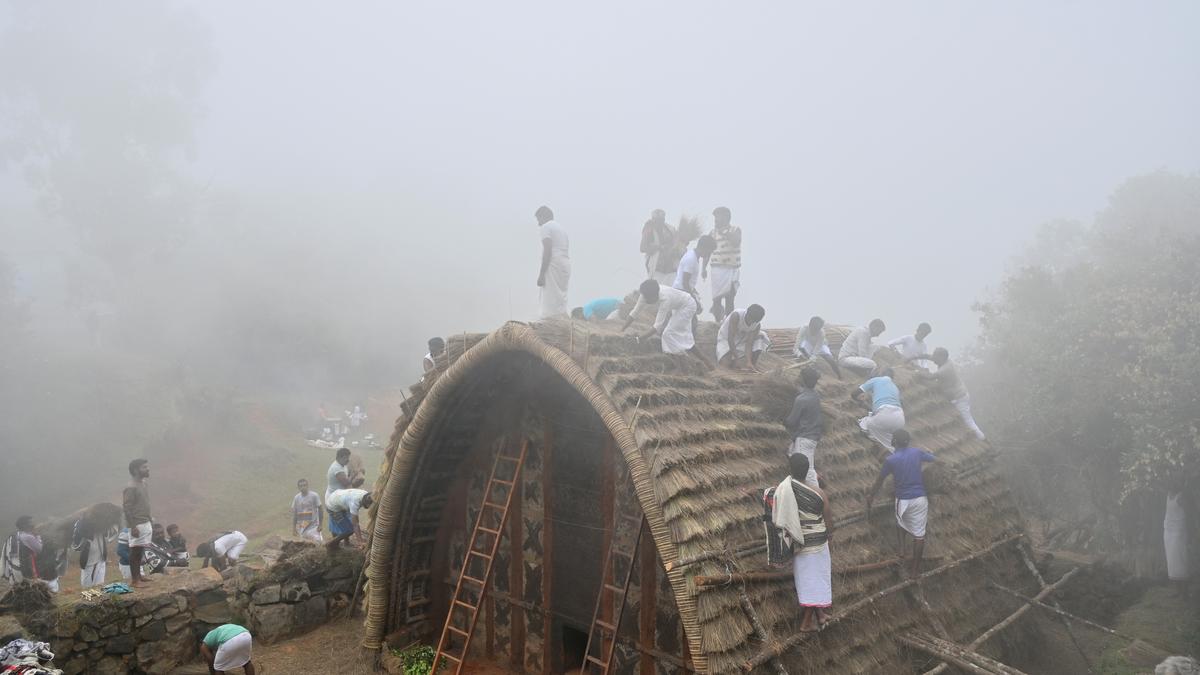
Toda men re-thatching the dairy temple

Toda men re-thatching the dairy temple
| Photo Credit: SATHYAMOORTHY M

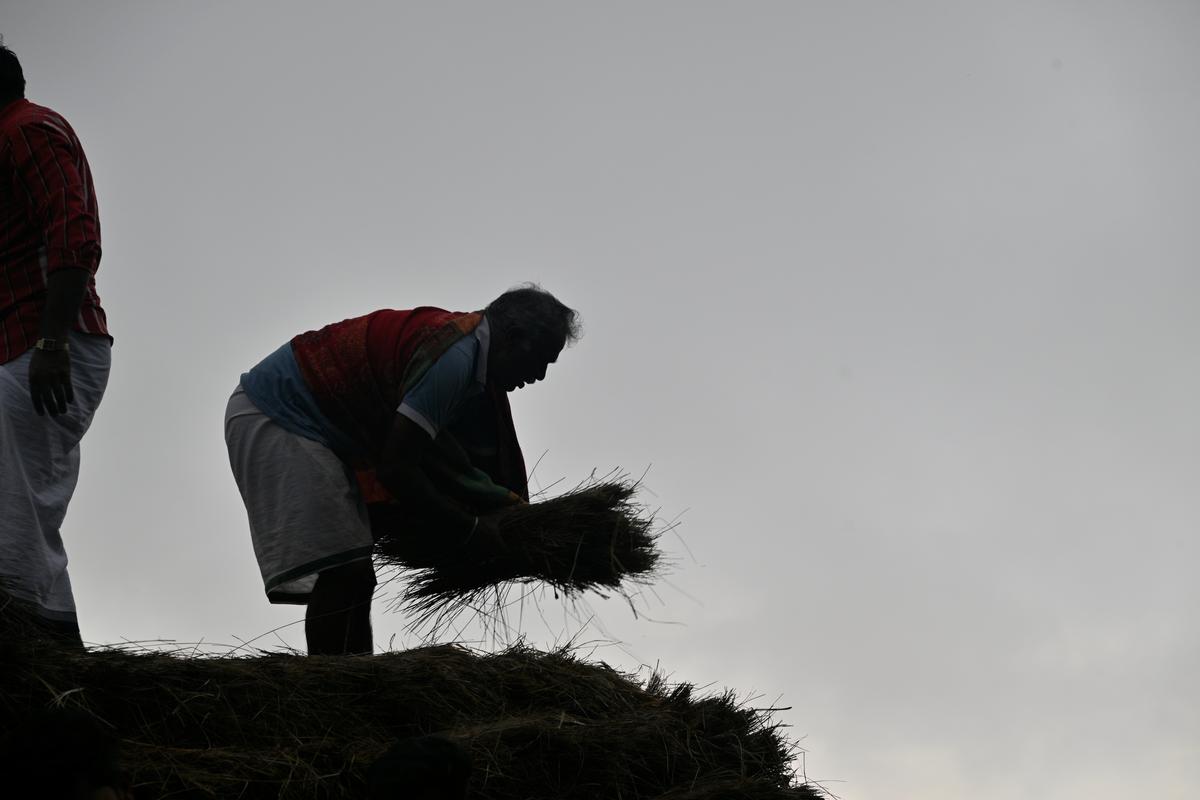
Recently, members of the Toda tribe, the oldest and indigenous tribes of The Nilgiris, gathered at Melgaa(r)sh, an ancient Toda hamlet above the Ooty Botanical Garden for a sacred ritual. The Manajakkal Mund, also called the Garden Mund in recent times, is the principal hamlet of the patriclan. The men, dressed in the ceremonial embroidered shawls, bundled swamp grass called avful, endemic to the wetlands of The Nilgiris and found nowhere else on the planet. “A re-thatching ceremony of a Toda temple which happens every 15 years is in progress,” says Tarun Chhabra, a retired dentist and an expert on the indigenous Toda culture and local ecology. He is also the author of The Toda Landscape: Explorations in Cultural Ecology. 
Toda men gather ‘Avful’ swamp grass found only in The Nilgiris

Toda men gather ‘Avful’ swamp grass found only in The Nilgiris
| Photo Credit:
SATHYAMOORTHY M

Todas live on the highest reaches in hamlets called munds made of bamboo-vaulted homes shaped like a rainbow and patched with mud and straw, believed to tackle the wind velocity at high altitudes. While the Todas  have largely shifted from these traditional homes to modern concrete buildings, the  temples are still built with cane, bamboo and avful. Once common in swamps in the main Toda heartland of the Wenlock Downs, this grass has nearly disappeared from the wet grasslands of the mountains.

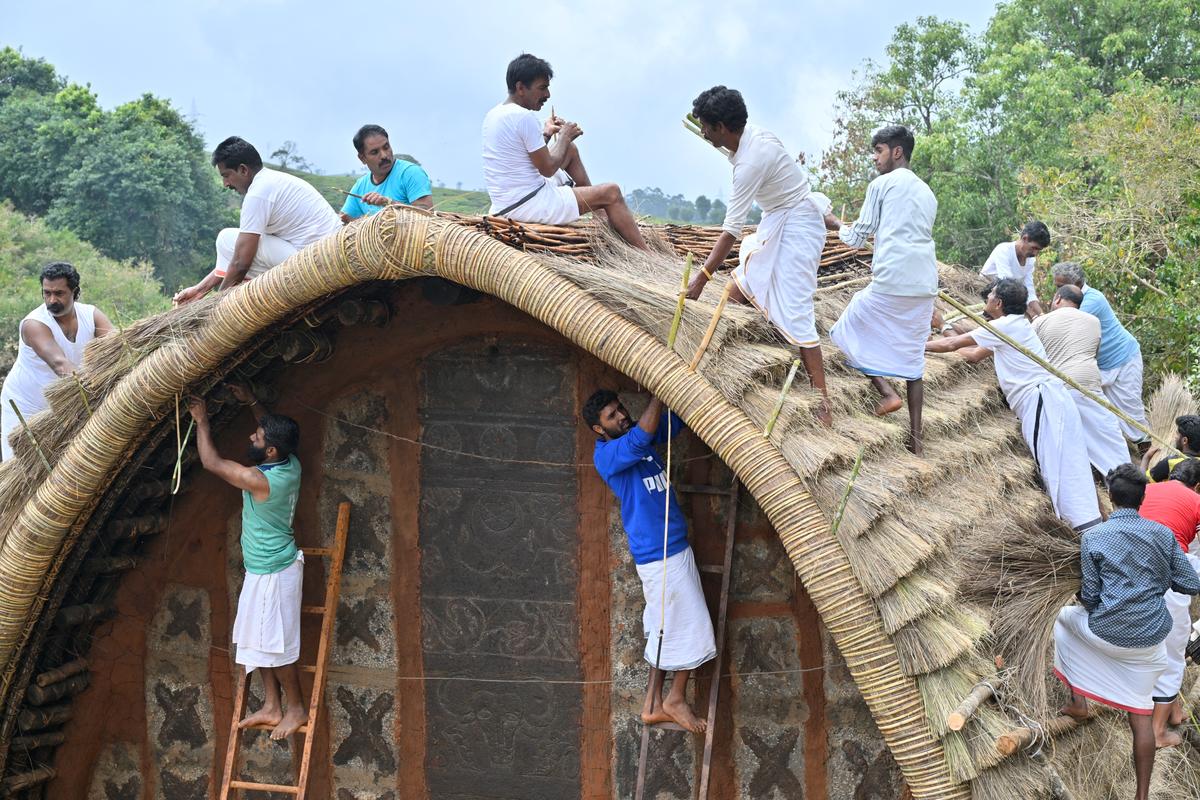
Thin bamboo reeds called theff are bent together in bunches, while still green, to give the temple the typical barrel-vaulted shape. These are fastened with peeled rattan cane. This bamboo reed, seen in many shola pockets of the Nilgiris, is now restricted to some dense jungles on the south-west slopes. Similarly, rattan cane, plentiful on the Nilgiri slopes and some sholas, has virtually disappeared. Todas go into the dense rain forests on the slopes beyond the western catchment and Mukurthi to gather rattan cane.
A re-thatching of Toda temple  happens every 15 years

A re-thatching of Toda temple happens every 15 years
| Photo Credit:
SATHYAMOORTHY M

“When they decide to rebuild a dairy-temple, there will be a minimum of three ceremonies at different stages. When they bend theff and tie it in bunches, it is known as ‘kwehll (zh) g-vheell- pattyt’ ceremony where only Toda communities take part, especially a particular clan, in this case the Melgaa(r)sh. They understood that the thin theff bamboo has high tensile strength and hence  bent it to give the structure its characteristic barrel-vaulted shape. There is also ‘waadr-ofst’ ceremony where they put horizontal bamboos. And during ‘poll(zh)y-veihhst’ thatching ceremony, they use the avful to thatch the dairy temples. These structures can last for decades provided the occupant has lit the fire within the building regularly, thus exposing it to smoke,” explains Tarun who is also the founder of Toda Nalavaazhvu Sangam that works with preserving the culture and welfare of the Todas.

The front facade of the temple is thatched in an intricate way, a job that is reserved for elderly men of the clan. Before starting this, they make ‘toott’, a ring-like structure around which they thatch the grass and braid it with stripped cane. This is called ‘podhaarr-thittyt’ and is done a few days earlier. “It’s an an important occasion, a prelude to the main ceremony,” explains Tarun.
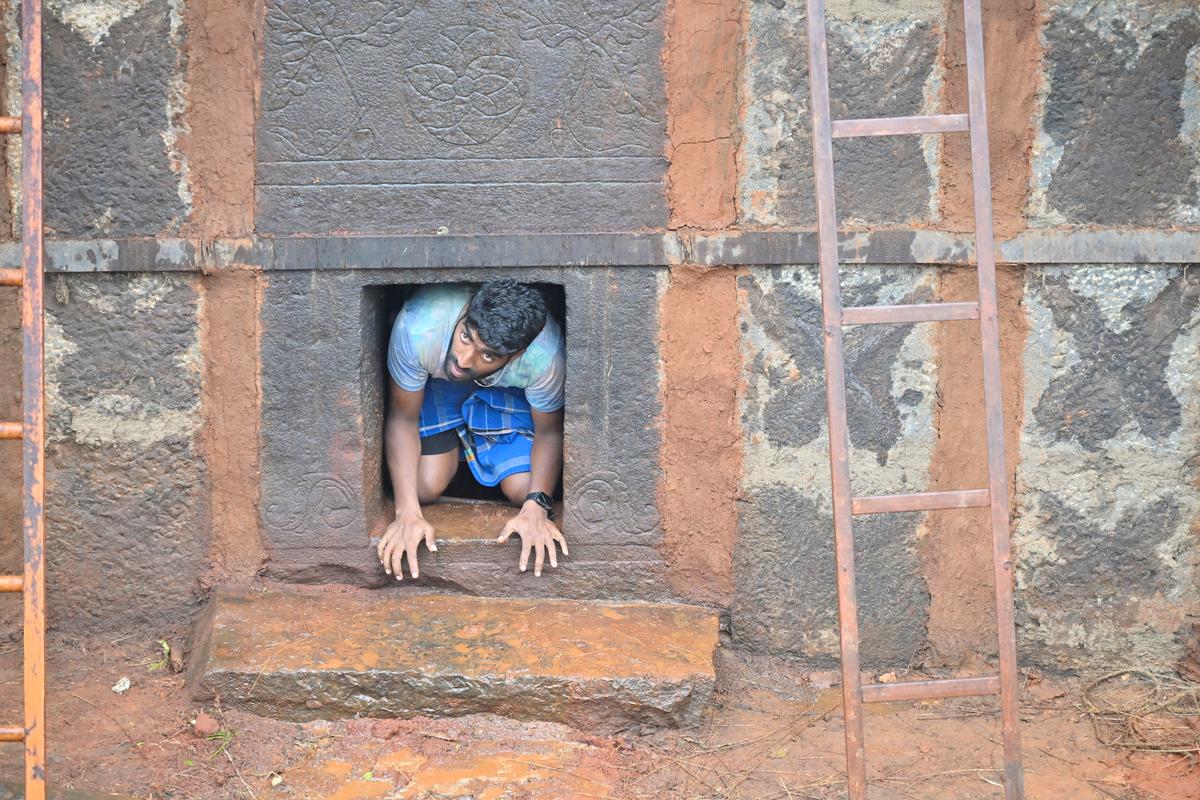

The priest brings a milk churning stick and a bamboo vessel and the prayers begin

The priest brings a milk churning stick and a bamboo vessel and the prayers begin
| Photo Credit:
SATHYAMOORTHY M

Once Toda men start thatching from either sides, they will carry on singing songs till they meet at the the top of the half moon structure. “In certain places where the focus of divinity is going to be placed, there will be special kind of cross patterns which I have hypothesised as what evolved into the embroidery and many other things,” says Tarun who, along with Ramneek Singh, has also established the Edhkwehlynawd Botanical Refuge (EBR) to further emphasise on conservation and ecological restoration, inspired by traditional Toda knowledge.
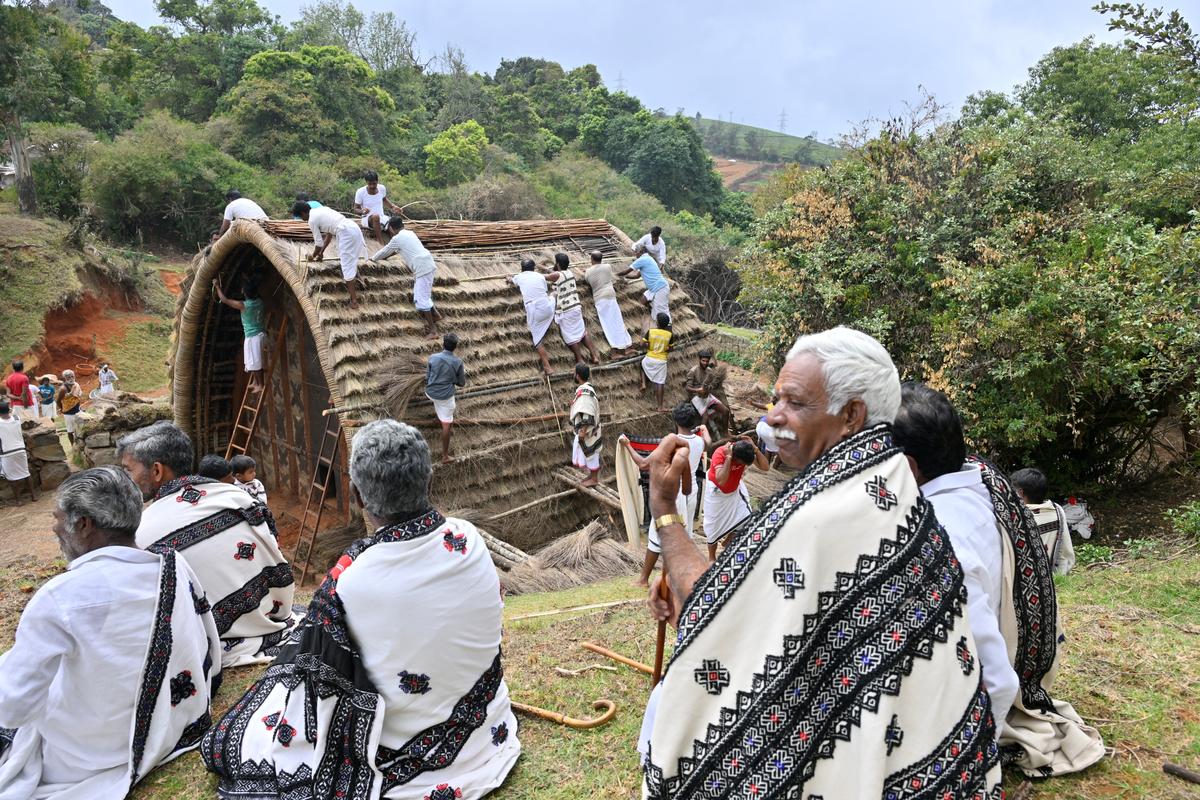
The men are dressed in ceremonial embroidered shawls

The men are dressed in ceremonial embroidered shawls
| Photo Credit:
SATHYAMOORTHY M

After thatching, they also put a pointed ‘kwakhzh-vheell (zh)’ on the ‘toott’ and clamp it. Once the priest brings a milk churning stick and a bamboo vessel, prayers begin. The shola forests and the grasslands are intertwined with the lives of Todas as they believe that several peaks, slopes, shola thickets, trees, rivers, swamps, paths, streams and caves are sacred. They sing ‘konn-ezht’, sacred couplets in an impromptu oral poetry form, assemble in a circle and have ‘pochazhky’ balls made with mashed little millet with a dollop of ghee in the middle that is served on ‘kawkwehdd’ leaf. 
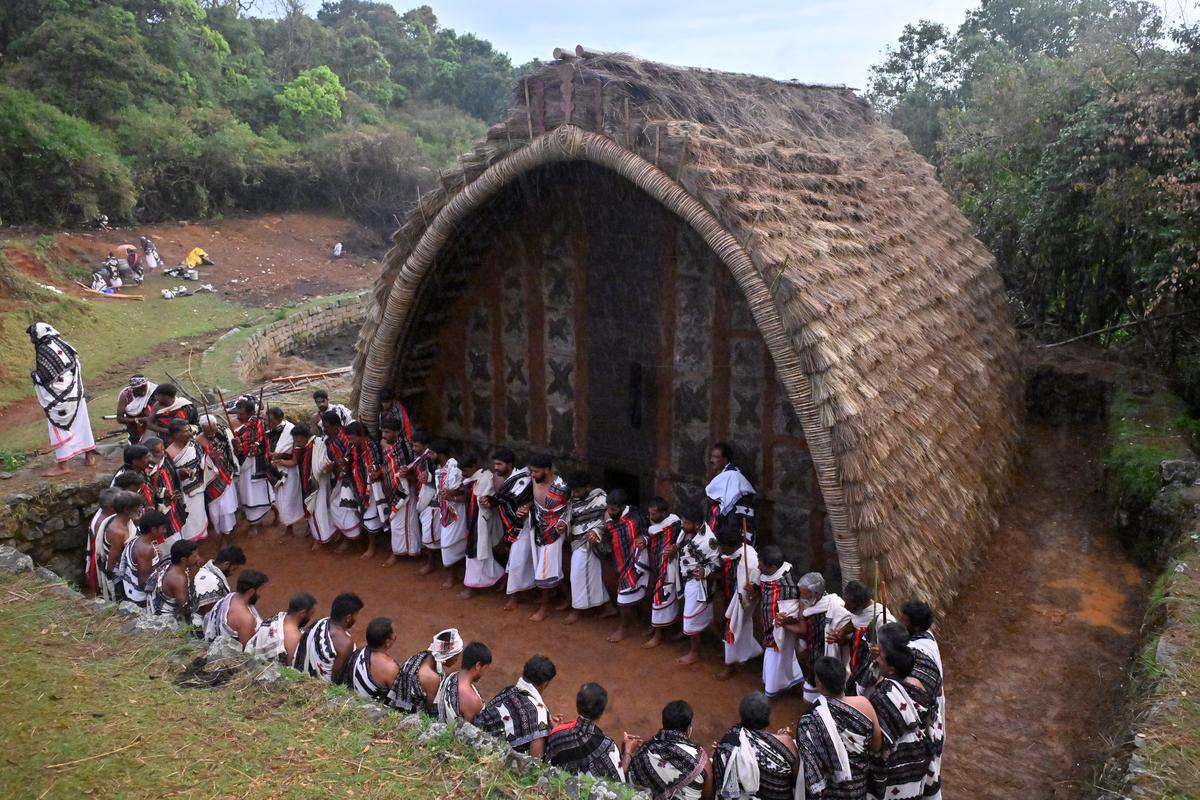
After re-thatching they stand in a circle and pray

After re-thatching they stand in a circle and pray
| Photo Credit:
SATHYAMOORTHY M

The Toda tradition easily dates back to 4000 years, says Tarun as he elaborates on Avful“When a study was initiated on this grass, flowering specimens were sent to an expert in the Royal Botanic Gardens at Kew for necessary identification. Todas, on the other hand, can readily distinguish specimens from other similar-looking species even at a distance. Elders can identify and name close to 400 floral species in the hinterland. In the olden days, where Todas lived, avful flourished on the west side of the wetlands. When the dams came in, the wetlands got flooded, and eucalyptus, pine trees, plantations, sprung up on the sides,” he says, adding, “Then everything changed.” 


Source link

Rainbow trout farm in Avalanche: Restarts a 100-year-old tradition


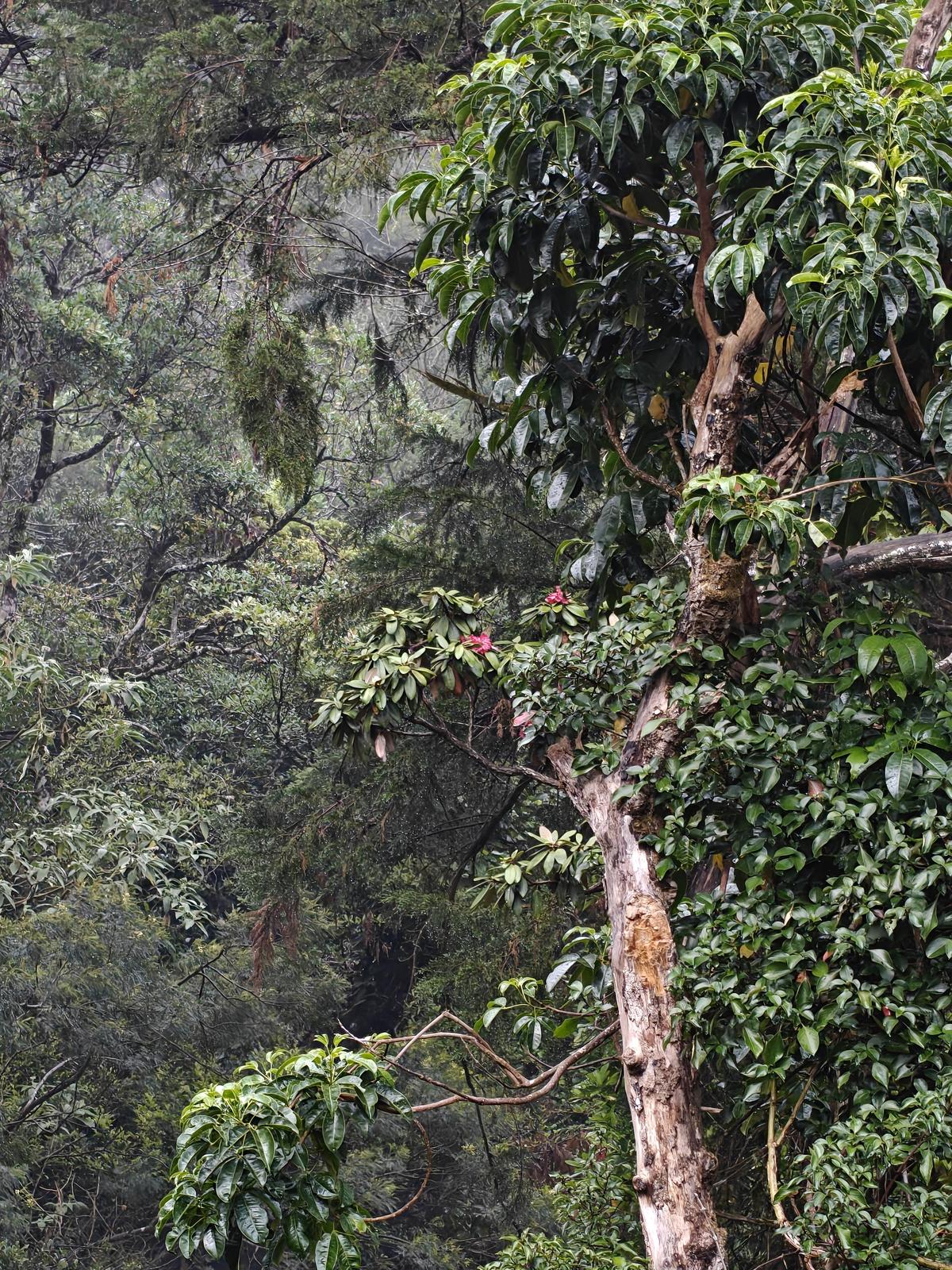
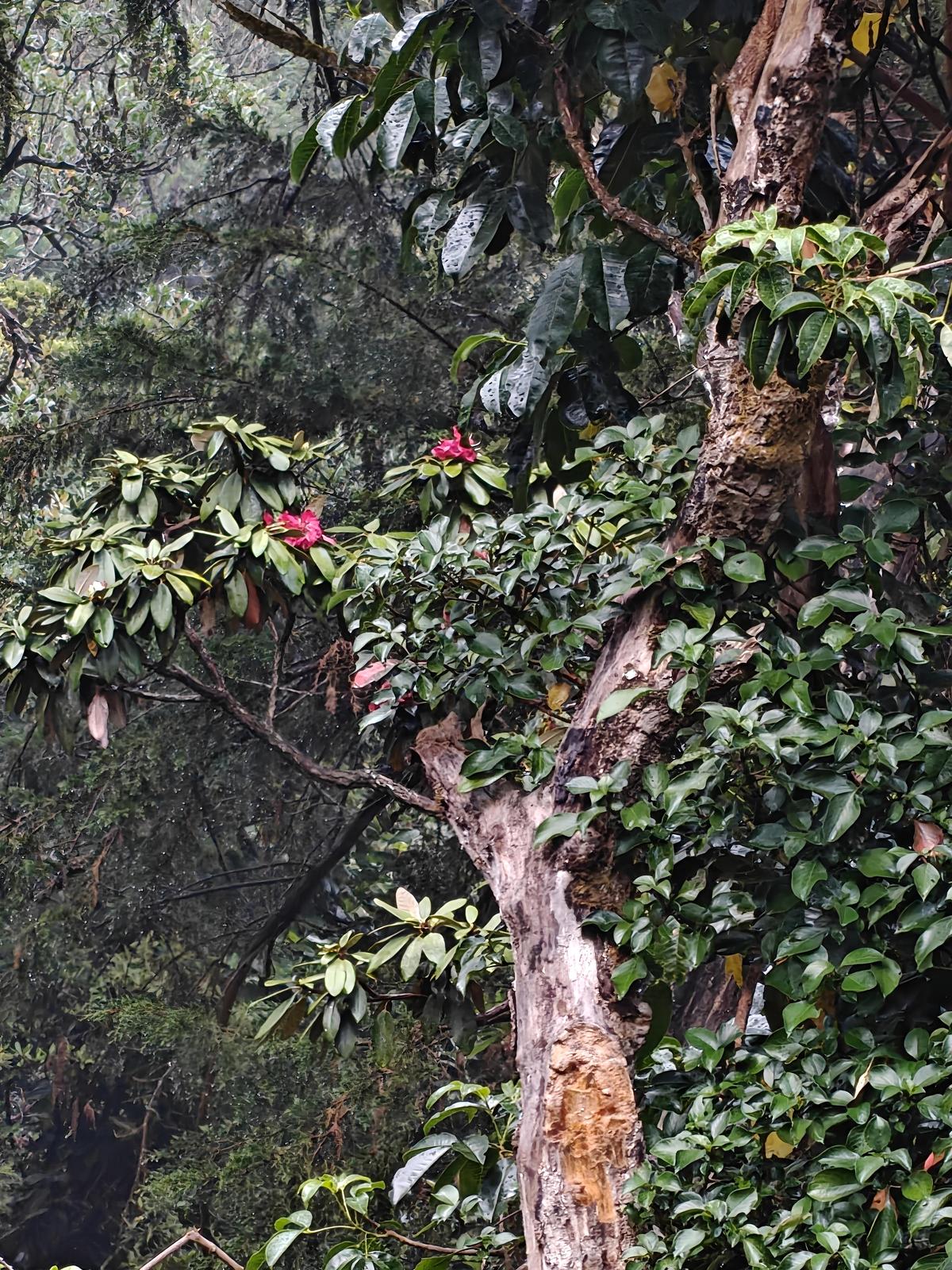
Pink rhododendron blooms at Avalanche. Shot On OnePlus #FramesofIndia

Pink rhododendron blooms at Avalanche. Shot On OnePlus #FramesofIndia
| Photo Credit: K Jeshi

Clear blue waters, rolling grasslands, and gorgeous pink rhododendron blooms abound. That’s Avalanche, a beautiful blue lake located 28 kilometres from Udhagamandalam in The Nilgiris. After a 45-minute drive along rain-washed valleys, and sprawling tea estates, we are at the Avalanche Trout Hatchery & Farm, thrilled to catch a glimpse of the exotic rainbow trout, a cold water fish that thrives in clear, healthy mountain streams and lakes in North America, but now farmed globally.

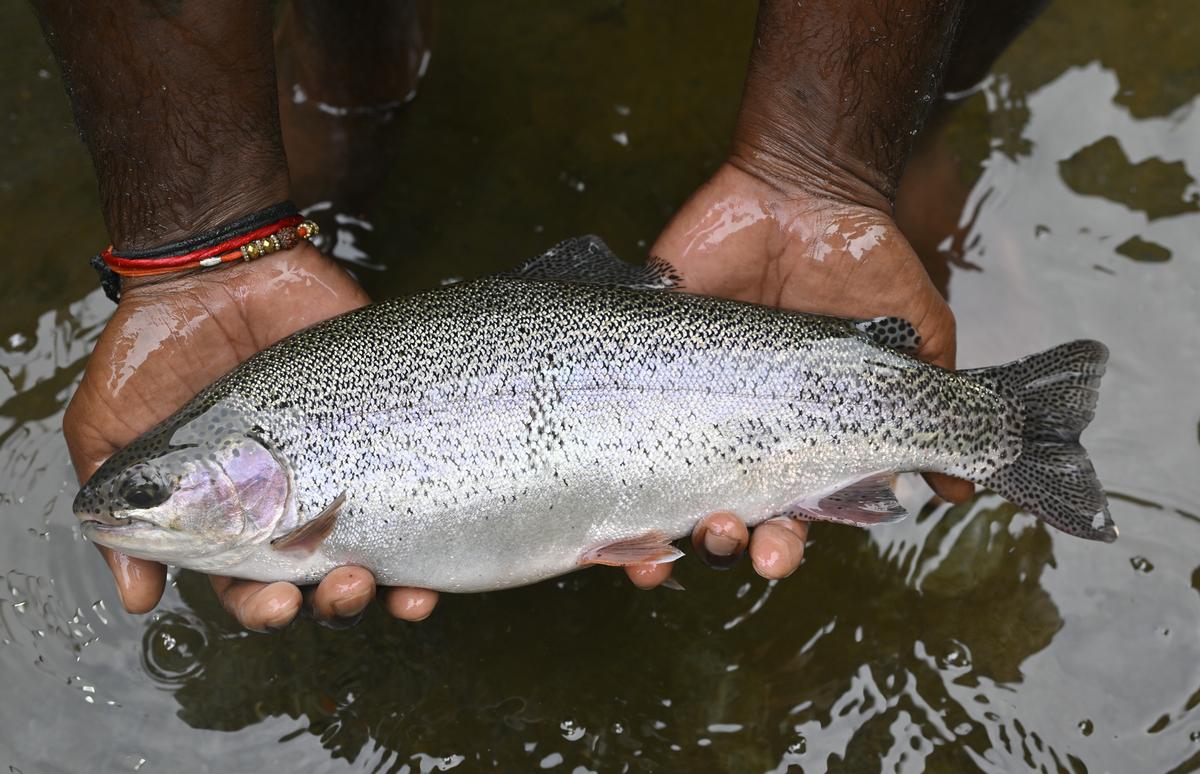
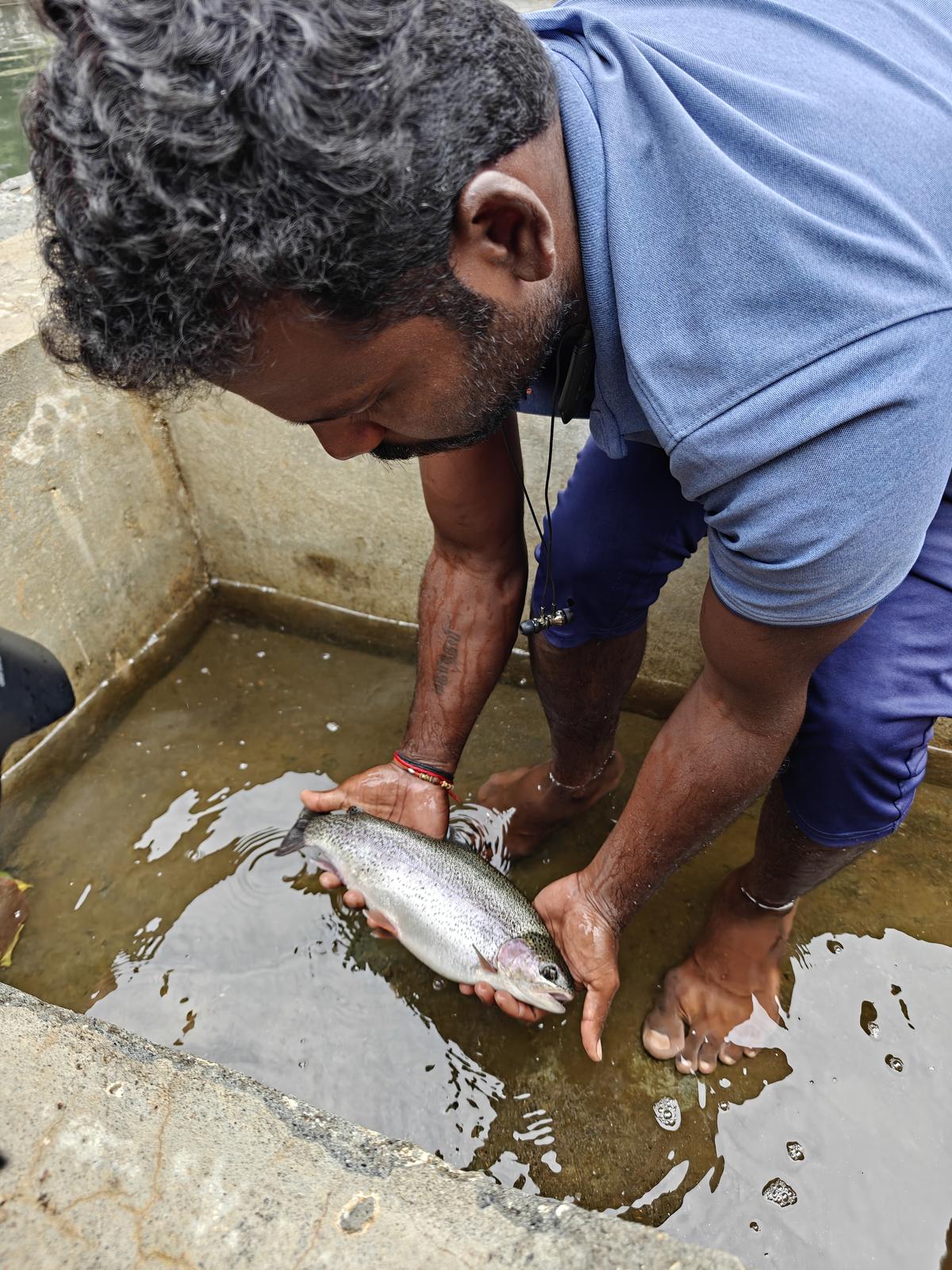
A fully-grown rainbow trout

A fully-grown rainbow trout
| Photo Credit:
SATHYAMOORTHY M

As we stand by the pond, wide-eyed, the trout makes an appearance. It is shimmering in colours of the rainbow, sporting red gills and twinkling eyes. The hatchery, developed by pisciculture expert Henry Charlton Wilson way back in 1907, has been recently renovated and is used for hatching the ‘eyed ova’ of rainbow trout every year. The fingerlings, let in upper reaches of fresh water streams in The Nilgiris, replenishes natural stock of trout.


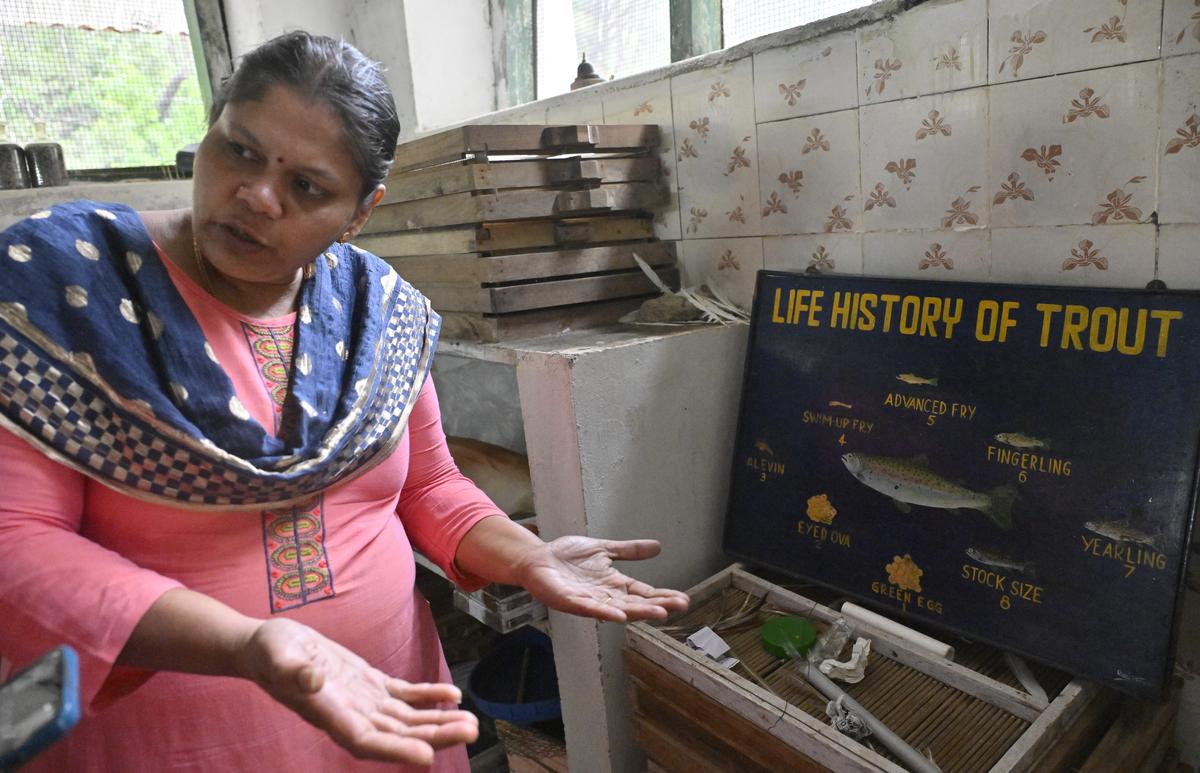
Kousalya Devi S, Assistant Director of Fisheries at the hatchery in Avalanche

Kousalya Devi S, Assistant Director of Fisheries at the hatchery in Avalanche
| Photo Credit:
SATHYAMOORTHY M

“It was European settlers who attempted to introduce trout in the pristine streams here in the 19th century,” says Kousalya Devi S, Assistant Director of Fisheries. It was perhaps the Nilgiris Game Fishing Association, which took the initiative of stocking the streams of the Blue Mountains and threw them open to fishing and angling. It has been documented that from 1866 to 1906, several attempts were made to bring eyed ova of trout from various countries, but the efforts failed.

“In 1906, when the then Governor of the State sought the services of Henry Charlton Wilson, he initiated the development of trout fishery in The Nilgiris on a scientific basis. He surveyed the entire district and selected Avalanche stream as the best suited place for a trout hatchery. Hatching technology using artificial breeding was standardised at the lab here,” she says adding that the first batch of trout from New Zealand was hatched successfully here. In 1943, 25,000 eyed ova were brought from Sri Lanka while in 1960 another 20,00 came from Kashmir. In 1974, as many as 10,000 ova of albino rainbow trout were brought as a gift and introduced in the hatchery.

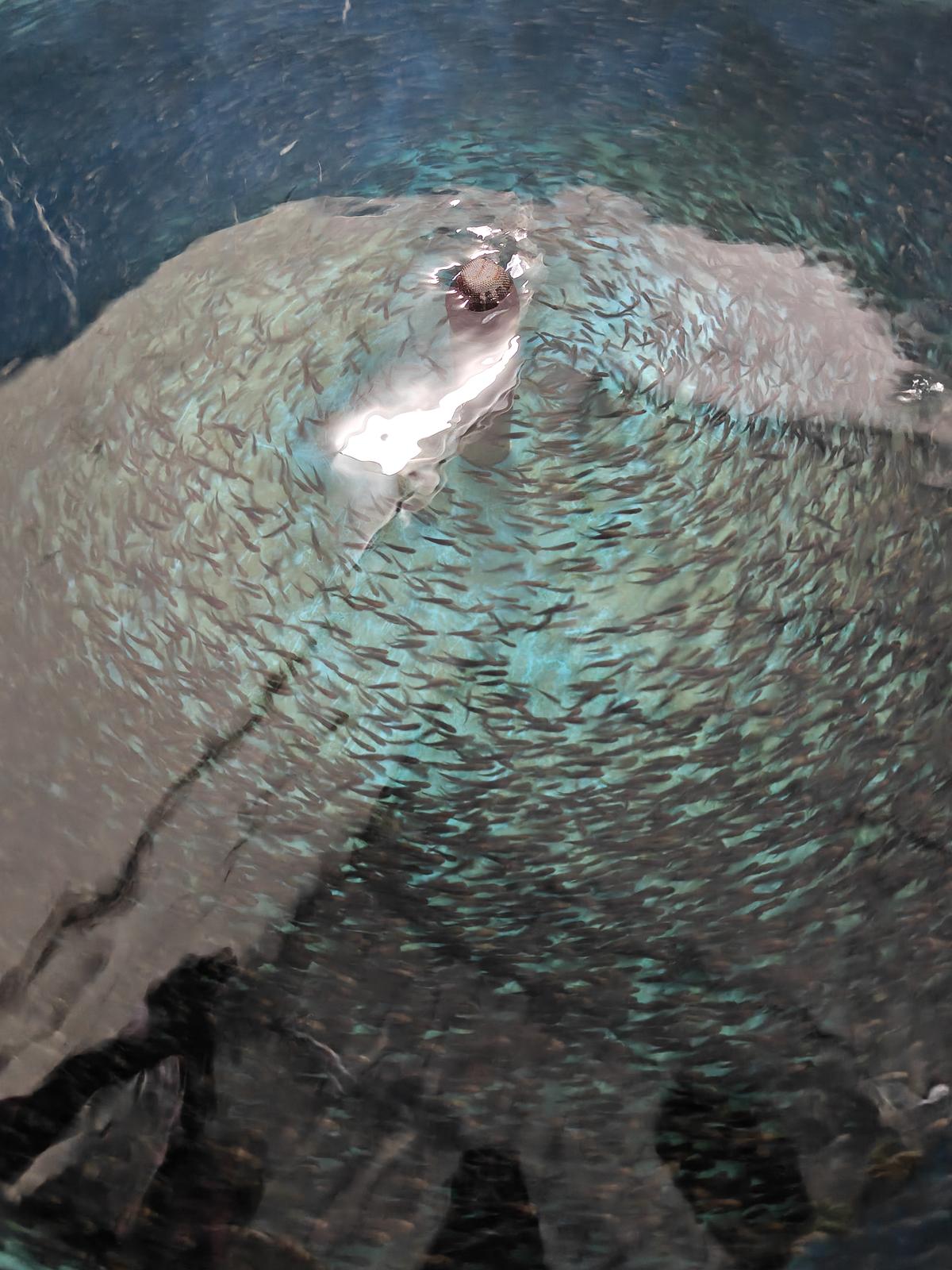
Trout fingerlings at the hatchery. Shot On OnePlus #FramesofIndia

Trout fingerlings at the hatchery. Shot On OnePlus #FramesofIndia
| Photo Credit:
K Jeshi

“The rainbow-tinted body looks magical as it swirls around in running fresh water,” says Kousalya adding that they collected three lakh trout eggs in eyed ova stage from Asia’s largest trout farm in Kashmir. “By bringing eggs from Kashmir, we have restarted a tradition that has its origins some 100 years ago. It’s an 18-day-old ova. In this stage, it can survive for four days without water during which we air transport the boxes. As October to February is the breeding season, we made two trips to Kashmir to collect the best eggs,” she explains.

In India, due to weather constraints, trout farming is limited to the upper Himalayan region and the Western Ghats. The hydro electric reservoirs are particularly suitable as trout thrive in healthy fresh waters and in temperatures between 0 to 20 degrees Celsius. It cannot flourish in standing water and must have access to perennially flowing waters. “The Forest Protection Act (1972) brought a dramatic shift in trout fishery. The water streams of hydroelectric power projects, like Mukurthi Reservoir earmarked as ‘carp waters’ (another variety of fish) and ‘trout waters’ where these fish varieties thrived, became out of bounds,” says Kousalya adding that it reduced the hatchery to a mere heritage structure.

A new lease of life

A proposal with the Special Area Development Project for replenishing trout stocks has now given it a fresh lease of life. “We sourced high protein pellets in varying sizes for different stages to ensure better survival. The fish is also cannibalistic, so only the fittest survive. Of the three lakh eggs, the survival rate has been 55 per cent,” explains Kousalya.

High protein pellets in varying sizes are used as feed for different stages. Shot On OnePlus #FramesofIndia

High protein pellets in varying sizes are used as feed for different stages. Shot On OnePlus #FramesofIndia
| Photo Credit:
K Jeshi

While in Kashmir, trout farming in the backyard is a big draw among tourists, the Avalanche hatchery, the only trout hatchery in South India is taking baby steps. “Once commercial Recirculatory Aquaculture System is in place, it helps farmers use water judiciously. We still have a long way to go. In Kashmir, tourists stay at guest houses at apple orchards, enjoy trout fishing in the streams in the backyard where the locals also engage in trout culture. Once we standardise seed production, we can choose farms in suitable locations like Korakundah. We can educate and train farmers in commercial trout culture.”

A close-up of pink rhododendron. Shot On OnePlus #FramesofIndia

A close-up of pink rhododendron. Shot On OnePlus #FramesofIndia
| Photo Credit:
K Jeshi

Trout is also rich in protein and omega-3 fatty acids, another reason for its popularity. “The meat is buttery and has a delicate taste. It can be grilled or smoked and is one of the most popular fish in European cuisines,” she says, adding, “Trout is an indicative species. When you eat trout, you can be sure that it has come from a place where the environment is still healthy and water is pollution-free.”


Source link

Rare butterfly spotted in The Nilgiris


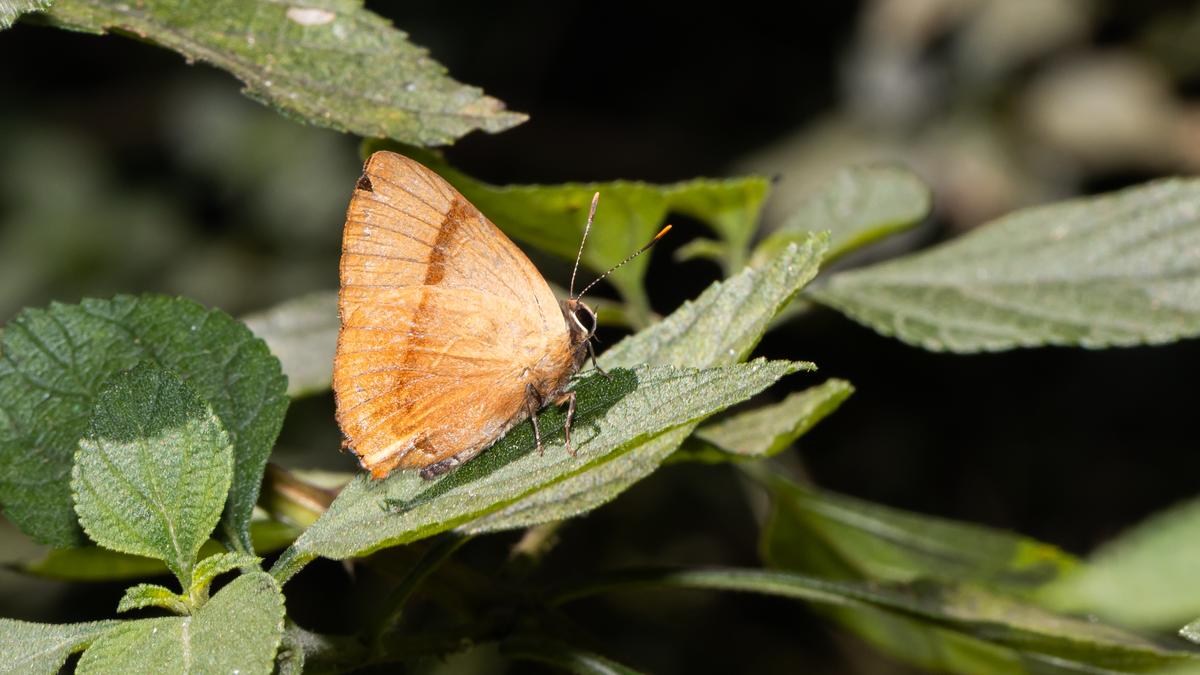
Malabar Flash butterfly

Malabar Flash butterfly
| Photo Credit: Vinod Sriramulu

Butterfly pioneer Wynter Blyth MA mentions a butterfly in his book Butterflies of the Indian Region that came out in 1957. He talks of it as a rare one, observed in the Mettupalayam Ghats and Sri Lanka, in thick jungles often at an elevation between 1000 and 3000 ft. Later, Larsen Torben, who studied butterflies particularly in Asia and Africa, draws a reference to this butterfly in his research paper published in 1987. He mentions that it was recorded from Nadugani area in Gudalur as part of a Japanese butterfly collection.

“They are talking about the Malabar Flash or the Rapala Lankana, a butterfly belonging to the Blues family and considered very rare. It’s a dream species of any butterfly enthusiast,” says Vinod Sriramulu, founding member of Wynter Blyth Association (WBA) in the Nilgiris that creates awareness and works towards conservation of butterflies in the region. “It finds a mention only in the works of these two people so far. We have never documented this species in the last 10 years,” he says adding that he sighted it by chance along the Kundah slopes of the Nilgiris, at an elevation of 1500 ft.

“This make it the first ever photographic record of this species in the Nilgiris as of Feb, 2025,” he says, adding that it has surfaced after a long time, much to the excitement of butterfly enthusiasts.

This sighting has re-established the presence of this rare butterfly in the Nilgiris, a reminder of the thriving bio-diversity of the region. “I was photographing puddling butterflies along the road leading to Kundah. All of a sudden, I noticed a bright one fly by and rest on a leaf for a few seconds, basking in the sun. It flew away shortly thereafter. I waited for a few more hours, and also revisited the forests hoping to catch another glimpse. But that never happened,” says Vinod as he draws attention to the fact that this may be just the second photographic record of the Malabar Flash in Tamil Nadu.

Such fresh sightings of new species always leaves them thrilled, he says. “Until recently, the number of butterfly species and the density of sightings were good. We have documented significant ones like the Spotted Royal, Branded Royal and now, the Malabar Flash, out of the blue. We never anticipated it here as the records date back to the 1940s and 1980s. It’s a reminder that we need to keenly observe host plants, terrain, vegetation etc. A scientific approach will help us unearth more rare butterflies of the Western Ghats that are undocumented so far.”

Talking of phenomenal work done by citizen science forums pan-India in documenting biodiversity, he says websites like Butterflies of India and social media groups like Butterflies of Nilgiris Biosphere keep the buzz going. “We work towards bridging the gap between the scientific community and common people on butterflies and conservation. We documented for the first time the life cycle of Nilgiri Tit, a highlight species of The Nilgiris. WBA members have published the paper in an American Entomology Journal. We also recorded orchid tit butterfly, a rare one. It feeds on orchid leaves. The beautiful Common Banded Peacock is common in the hills but very rare in Kerala and Karnataka,” he says highlighting two critical things that need attention in butterfly conservation. “Fragmentation of habitat because of intense agriculture that has been continuing for decades and unmindful cutting of hedge plants along the roads and forest periphery,” he says, adding, “What seems like a weed might be a nectaring plant of a butterfly.”


Source link

How to look rich: One fashion rule people with old money swear by!


How to look rich: One fashion rule people with old money swear by!

There’s a certain mystique to the way people with old money dress. It’s not loud, not trend-chasing, and definitely not logo-obsessed. Unlike new wealth, which often flaunts status through designer monograms and Insta-ready flash-old money style is all about understated elegance. It whispers instead of shouts. And if there’s one item that truly has no place in an old money wardrobe, it’s clothes with big, bold, obvious logos.

istockphoto-892873040-612x612

Yes, we are talking about those large brand names splashed across T-shirts, jackets, or belts. Think of the giant “G” on Gucci belts, the oversized LV patterns, or even streetwear favourites like Supreme or Off-White with labels so loud they practically announce your bank balance. These may be loved by the nouveau riche, but for those born into legacy, they’re considered gauche.

The psychology behind ‘quiet wealth’

Old money fashion follows one unspoken rule: don’t try too hard. It’s not about proving wealth; it’s about having enough confidence not to. That’s why people from generational wealth, be it European aristocrats, Indian business dynasties, or Hollywood royalty, avoid flashy logos. For them, true luxury is in the cut, the fabric, the fit, and the heritage.
You will notice the same vibe among India’s ultra-elite. Industrialist families like the Ambanis, Poonawallas, and Godrejs don’t need big branding to make a statement. Isha Ambani Piramal, for instance, may own every luxury label on the planet, but you’ll rarely catch her flaunting overt logos. Her style? Classic heirloom jewellery, timeless sarees, and flawlessly tailored silhouettes.
Similarly, Radhika Merchant, now part of the Ambani family, is fast becoming a style icon for the quiet luxury generation. Her wedding wardrobe was full of refined, royal designs by Abu Jani Sandeep Khosla and Manish Malhotra, no need for branded belts or name-plastered shirts.

Bollywood’s old money aesthetic

Even in the world of Bollywood, where fashion often borders on flamboyant, there’s a rising tribe of celebrities who are embracing this low-key, high-impact approach. Take Deepika Padukone for instance. Her off-duty style is often minimalist: neutral tones, solid colours, and structured pieces from designers like Sabyasachi or Louis Vuitton, but never with screaming logos. The same goes for Rahul Khanna, whose wardrobe feels like a masterclass in old-school, effortless tailoring.

deepika_padukone_1699887120939_1699887121055

Another example is Sara Ali Khan, born into the Pataudi and Tagore families, who balances youthful fashion with a deep-rooted sense of legacy. Even when wearing Western wear, she leans towards clean cuts and heritage labels over trends.

The ‘no logo’ rule

So what exactly is the item that people with old money never wear?
Anything with large, conspicuous branding.
This includes:
T-shirts with massive brand names across the chest
Handbags with oversized monograms
Jackets or hoodies with graffiti-style branding

istockphoto-2157447438-612x612

Belts with loud logo buckles
Shoes or caps that scream the label instead of style
These are all seen as markers of insecurity, trying to show status rather than quietly embody it.
Instead, the truly wealthy favour:
Crisp white shirts with mother-of-pearl buttons
Cashmere sweaters in camel, navy, or grey
Well-cut trousers with no visible tags
Loafers or brogues with subtle stitching, not logos
Minimalist bags from heritage houses (e.g. a classic Hermès Kelly without the logo showing)

Why it matters in 2025?

As the fashion world continues to shift towards sustainability, heritage, and quality over quantity, old money style is having a major moment. The idea of owning fewer, better pieces has become aspirational. And the less branded, the better.
For Indian audiences too, the change is palpable. Labels like Raw Mango, Good Earth, and Torani, which focus on craftsmanship and timelessness, are becoming the go-to for luxury seekers. It’s less about who made it, and more about how well it’s made.

Celebrity trainer Yasmin Karachiwala’s go-to-pick for a healthier lifestyle

Even stars like Alia Bhatt and Sonam Kapoor Ahuja, known for their fashion-forward choices are gradually moving away from the overdone designer look to something more grounded and bespoke. You’ll notice them choosing handwoven sarees, vintage-inspired jewellery, and minimalist silhouettes that radiate quiet confidence.
Old money fashion isn’t about what you wear, it’s about how you wear it. The next time you’re tempted by a flashy logo tee or that big-buckled belt, ask yourself: Is this elevating my style or just announcing my spending power?
Take a leaf out of the playbooks of India’s legacy-rich families and Bollywood’s quieter stars. Strip back the noise. Invest in the classics. Let the quality speak for itself.
Because real wealth never needs to shout, it always speaks in whispers.


Source link

walking for less than an hour, thrice a week can have this profound impact on brain


Factors like chronic stress, poor sleep, sedentary lifestyle, and lack of mental stimulation can accelerate this process. However, regular exercise, especially aerobic activity, along with a healthy diet, social interaction, and mental engagement, has been shown to slow hippocampal shrinkage and even promote the growth of new neurons. “We think of the atrophy of the hippocampus in later life as almost inevitable,” Dr. Kirk Erickson at the University of Pittsburgh, one of the authors of the study, had said then. “But we’ve shown that even moderate exercise for one year can increase the size of that structure. The brain at that stage remains modifiable.”


Source link

Jeffrey Epstein accuser Virginia Giuffre, who died by suicide, had developed renal failure after a car accident: Know why it happens


Jeffrey Epstein accuser Virginia Giuffre, who died by suicide, had developed renal failure after a car accident: Know why it happens
FILE — Virginia Roberts Giuffre speaks to reporters in New York on Aug. 27, 2019. Giuffre, a former victim of Jeffrey Epstein’s sex-trafficking ring who said she was “passed around like a platter of fruit” as a teenager to rich and powerful predators, including Prince Andrew of Britain, died on Friday at her farm in Western Australia. She was 41. (Jefferson Siegel/The New York Times)

The death of 41 year old Virginia Giuffre has shocked the entire world. The mother of three had accused US financier Jeffrey Epstein of using her as a sex slave. She had also accused Britain’s Prince Andrew of sexual abuse when she was 17, a minor as per the US law. According to Giuffre’s family, she died at her farm in Western Australia. “She lost her life to suicide, after being a lifelong victim of sexual abuse and sex trafficking,” her family said in a statement provided to AFP by her agent.
Giuffre’s last post on social media was about a severe car crash. In a long post, Giuffre had mentioned how she narrowly escaped the accident and survived, but, with a life threatening renal condition. She had shared a picture of her with bruises. In 2023 she was hospitalized for a spinal surgery.”This year has been the worst start to a new year, but I won’t bore anyone with the details but I think it important to note that when a school bus driver comes at you driving 110km as we were slowing for a turn that no matter what your car is made of it might as well be a tin can. I’ve gone into kidney renal failure, they’ve given me four days to live, transferring me to a specialist hospital in urology,” a part of her social media highlights about her medical condition.

Kidneys are very sensitive to changes in blood flow and pressure

Renal failure after a car accident is a serious and often overlooked consequence of physical trauma. While people typically associate car crash injuries with broken bones or head trauma, internal organ damage, especially to the kidneys, can be just as life-threatening. The kidneys are highly vascular organs, meaning they are rich in blood vessels and very sensitive to changes in blood flow and pressure. When an accident causes severe trauma, the kidneys can be directly injured or affected indirectly by systemic responses in the body.
One major cause of renal failure following a traumatic event like a car crash is rhabdomyolysis. This condition occurs when muscles are crushed or severely damaged, releasing a protein called myoglobin into the bloodstream. Myoglobin can clog the kidneys’ filtering system, causing acute kidney injury (AKI). In many high-impact accidents, even if external injuries seem minor, muscle damage can be significant enough to trigger rhabdomyolysis.
Another cause is hypovolemic shock, which is when the body loses a significant amount of blood due to internal or external bleeding. This reduces blood flow to vital organs, including the kidneys. Since the kidneys require a constant supply of oxygen-rich blood to function properly, even a short period of reduced blood flow can cause acute tubular necrosis—a condition where the kidney tissues start dying due to lack of oxygen. This can lead to temporary or permanent renal failure depending on the severity and duration of the shock.
Blunt force trauma directly to the lower back or abdominal area can also cause physical injury to the kidneys. This might result in bleeding, bruising, or even tearing of the kidney tissues. In some cases, the kidneys may develop blood clots or become swollen, which compromises their function.
After a traumatic accident, the body releases inflammatory chemicals in response to injury. While this is a natural protective mechanism, excessive inflammation can damage organs, including the kidneys. The immune response can become overactive, leading to what’s called “multiple organ dysfunction syndrome” (MODS), where two or more organs, including the kidneys, start to fail.


Source link

Content creator Misha Agrawal died two days before her 25th birthday, leaving internet in disbelief


India’s digital creator community was left heartbroken this morning following the untimely death of content creator Misha Agrawal. Known for her sharp wit and hilarious, sarcastic rants, Misha had built a loyal following of more than 3 lakh people online for keeping things real.

Her passing was announced by her family on April 25 through a note shared on her official Instagram handle, one day after she reportedly died on April 24.

Content creator Misha Agrawal passed away two days before her birthday

The announcement came as a complete shock to her followers, who were preparing to wish her for her 25th birthday on April 26. In the statement, her family expressed deep grief and thanked everyone who had shown love and support to her and her work. They mentioned they were still processing the loss and hoped that people would continue to keep Misha’s spirit alive in their hearts.

Misha Agrawal death reason

While the cause of her death has not yet been revealed, the lack of detail has only added to the disbelief and confusion among fans. Comments quickly flooded the post, with many users questioning whether the news was real or some kind of elaborate prank. The uncertainty prompted more questions than answers.

Misha Agrawal’s sister’s comment

In response to the speculation, someone claiming to be Misha’s sister, Mukta, stepped in via the comment section. She stated that they chose to announce the news after taking some time and asked people to not panic. She acknowledged that people deserved to know the truth but added that the family was not ready to speak about the details just yet.

Redditors speculate Misha Agrawal’s demise

Even Reddit threads began to speculate on the news, with one user suggesting that the passing did occur on April 24 and that an older post shared by Misha’s sister might have been a tribute. The sentiment across platforms remains the same: if true, it is a devastating loss. Although to me, it clearly just looks like a throwback video because today is also her birthday, so unfortunately this is not a prank but the truth.

Meesha Agarwal 💔
byu/Basic-Grocery-961 inInstaCelebsGossip

Misha’s last post dates back to April 4, 2025, a typical funny video that now feels all the more haunting. In a space often dominated by fleeting trends and viral chaos, Misha was a reminder that humour rooted in honesty hits differently.


Source link

“I feel a huge amount of internalized pressure”: Bill Gates-Melinda French Gates’ daughter Phoebe on living with the ‘Gates’ name


"I feel a huge amount of internalized pressure": Bill Gates-Melinda French Gates' daughter Phoebe on living with the 'Gates' name
Credit: Instagram/@phoebegates

Phoebe Gates, the youngest daughter of Microsoft co-founder Bill Gates and philanthropist Melinda French Gates, is stepping into the public eye with a new business venture — and she’s not shying away from talking about the pressure that comes with having one of the world’s most recognizable last names.
In a recent interview with The New York Times, Phoebe, 22, admitted she’s always been aware that people would have opinions about her career path. “Growing up, I realized that people are always going to have thoughts about me,” she said. “If the business is successful, people will say, ‘It’s because of her family.’”
“And a huge portion of that is true,” she added. “I never would have been able to go to Stanford, or have such an amazing upbringing, or feel the drive to do something, if it wasn’t for my parents. But I also feel a huge amount of internalized pressure.”

2

Credit: Instagram/@phoebegates

Phoebe and her former Stanford roommate, Sophia Kianni, recently launched Phia, a shopping comparison app that helps users find cheaper alternatives for products like clothing and jewelry. The app notifies users if an item is overpriced and suggests better deals elsewhere online.
Despite the anticipated criticism, Phoebe emphasized that the idea stemmed from their shared experience as regular shoppers. “We’re roommates fighting about clothing. We are the girls who are scouring shopping sites for deals. And there are, frankly, thousands of other young women like us,” she told The New York Times.
Phia has already attracted high-profile support. The venture secured funding from a venture capital firm, and celebrity mentor Kris Jenner is among the names in their network. Phoebe and Sophia are also set to launch a podcast, The Burnouts with Phoebe and Sophia, under Alex Cooper’s podcast company. Cooper, host of Call Her Daddy, has signed them to the brand.

3

Credit: Instagram/@phoebegates

When Phoebe first told her father about her interest in e-commerce, he admitted he was concerned. “Wow, a lot of people have tried, and there’s some big guys in there,” Bill Gates recalled during the interview. “I thought, ‘Oh boy, she’s going to come and ask.’” He added that while he would have helped if needed, it would have come with strings attached. “And then I would have kept her on a short leash and be doing business reviews, which I would have found tricky, and I probably would have been overly nice but wondered if it was the right thing to do? Luckily, it never happened.”

Bill Gates with his daughter Phoebe

Bill Gates with his daughter Phoebe
Photo: Bill Gates/ Instagram

Phoebe said her mother encouraged her to raise funding independently. “She saw it as a real opportunity for me to, like, learn and fail,” she said.
Phoebe is the youngest of three children. Her older siblings, Jennifer, 28, and Rory, 25, also maintain relatively low profiles. Since their 2021 divorce, both Bill and Melinda have continued their philanthropic efforts independently.

4

Credit: Instagram/@phoebegates

Bill Gates has publicly stated that his children will inherit only a small fraction of his fortune. In a recent appearance on the Figuring Out With Raj Shamani podcast, he said, “My kids got a great upbringing and education, but less than 1 percent of the total wealth because I decided it wouldn’t be a favor to them. It’s not a dynasty. I’m not asking them to run Microsoft. I want to give them a chance to have their own earnings and success. You know, be significant and not overshadowed by the incredible luck and good fortune I had.”
As of April 2025, Forbes ranks Bill Gates as the 13th richest person in the world, with an estimated net worth of $107.6 billion.

Madhuri Dixit’s Husband Drops Relationship Truth Bomb


Source link