Life & Style

A book to help you mend your broken heart


In September last year, a day before her birthday, Milan Vohra, India’s first Mills & Boon author, had an unfortunate experience. “I was trekking in Bhutan and had a retina detachment so in the space of some two or three hours, in the middle of absolutely nowhere, I went blind in one eye,” says the Bengaluru-based writer and advertising professional.

She recalls the darkness that descended on her, “all I could see were the shoes of the person in front of me…one sliver at the bottom,” says Milan, who rushed to Delhi for an emergency surgery, which was followed by three more within months.

The incident, she says, was a wakeup call. “It made me realise that everything is fragile. I had been downplaying the importance of what writing meant to me because I was quite pressed for time and energy, especially as a caregiver and working at a demanding job.”

Lying in the hospital, still struggling to see properly, however, made her reexamine her life and priorities. “I asked myself this question: if I had six months left, what am I going to regret the most?” Not finishing the books, which were important to Milan was top of the list. “They are quite clear in my head. I had to stop procrastinating and buckle down to doing it. After all, nobody else can write your book.”

The incident catalysed her decision to go ahead and write Heartbreak Unfiltered: Things nobody told you about love, loss and letting go (Rupa Publications), a genre-defying collection of stories of heartbreak suffered by real people, interspersed with research, personal anecdotes and mental exercises to help broken-hearted readers come to terms with their loss.

In the thick of all her surgeries, Milan, who had been researching for and thinking about this book for nearly a decade, ended up meeting Dibakar Ghosh, Editorial Director at Rupa Publications. “He got the book right away…connected to it on a heart level and also understood how pressing the need for this book was.”

By the time she actually started putting the book together, Milan had already collected many of the stories that would be part of this book. “Having written romances for years, I find that people easily confide in me about their lives. I listen well, share too from my life, care deeply and remember details.”

For instance, one of the stories titled ‘Hugs for Free: Arun’s story’ emerged out of a chance encounter with a young man in Bengaluru’s Central Business District, back in 2020. “I was walking down the street to my cafe when I saw this person standing there with a board that said, ‘Feeling sad. Need a hug. Come and hug me’.” She promptly did and then stayed a while, watching him hug other people as well. “It wasn’t just a hug in isolation. It was almost as if he was asking people to open up and talk if they felt like it.”

Heartbreak Unfiltered has stories of real people and relationships

Heartbreak Unfiltered has stories of real people and relationships
| Photo Credit:
franckreporter

They went on to exchange numbers and Milan set up a meeting with this young man. It was pouring the day of the meeting, she remembers, and she was worried that he would cancel, but, “he made it, soaked, with an umbrella in his hand, and we had the longest conversation,” says Milan, who changed names and details to protect the identities of those featured.

The initial plan of the book was to have a series of stories about heartbreak, taken from people across gender identities, cultures, age groups, sexual orientations and class divides, says Milan. “I thought that the stories just spoke for themselves, without me needing to add anything. They make you reflect on your own relationships because you can sometimes spot parallels between what was happening in the story and what could have been happening with you.”

However, she kept getting feedback that while the stories were powerful, a reader would need more, so the structure of the book changed.“For instance, understanding attachment styles or the push-pull dynamic is not something a person can take away from a story alone,” says Milan, who added the chapters and exercises to the book to help readers find understanding and work through the heartbreak, something nearly everyone in the world goes through at some point in their lives. ”I hope after reading this book, they will come away inspired to use their heartbreak as an act of resistance to create something bigger than the pain.”

The years spent in advertising, she says, also helped her develop the book. “When I have to crack an advertising brief with too much information and little direction, I distance myself from the information overload and hover over the problem. I tell myself to take a helicopter view of things. I wanted people to look at their relationships, too, with this helicopter view,” says Milan, who has been writing fiction, in addition to copywriting, for many years now.

Heartbreak happens to everyone, says Milan

Heartbreak happens to everyone, says Milan
| Photo Credit:
kaipong

Heartbreak Unfiltered is her first foray into non-fiction, something, she was a little nervous about, at first. “I kept overthinking it, because I was going out of my zone, which is writing fiction. This vision crisis made me realise time is precious. I had to do it,” she says, adding that this is the first time she has funnelled so much of herself into a book. “I am very private in the public space usually, but in this book I talk about vulnerabilities, my weight, work trauma, personal grief … all of that in the context of applying my life hacks to dealing with heartbreak. The book has a lot of truth and I hope that comes across.”

Published – December 10, 2025 02:04 pm IST


Source link

Bangkok’s Fah Beer brings her inventive cocktails inspired by the bustling city’s streets, to Chennai


How does one capture Thailand’s many facets in a cocktail menu? The speedy tuktuks and bike taxis that zip through traffic, rows of snack shops at street markets, the pulsating nightlife, and so much more. 

For Suchada “Fah Beer” Sopajaree, owner-chief bartender of Bangkok bar Lost In Thaislation, crafting a cocktail menu inspired by her city means having a story to tell, and a philosophy to share. “Bangkok is chaotic, fragrant, humid, loud, and deeply emotional, and I love that,” she says. 

On December 12 and 13, Fah Beer brings her whimsical, inventive cocktails and sustainable, zero-waste behind-the-counter mixology to The Park, Chennai, for a two-day popup, One Night in Bangkok, at The Leather Bar and Lotus. 

Gai Yang Sanam Muay

Gai Yang Sanam Muay
| Photo Credit:
Special Arrangement

“The city’s vibrancy inspires me with bold and unapologetic flavours and its contrasts are reflected in my drinks that are sweet and salty, floral and earthy, and refreshing but fiery. The movement; the energy of the streets, markets, and nightlife constantly evolves, and my drinks follow that rhythm,” Fah Beer says.  “I like capturing that Bangkok heat, sometimes through spice, sometimes through aroma, and balancing it with softness so the drink has a story, not just flavour.” 

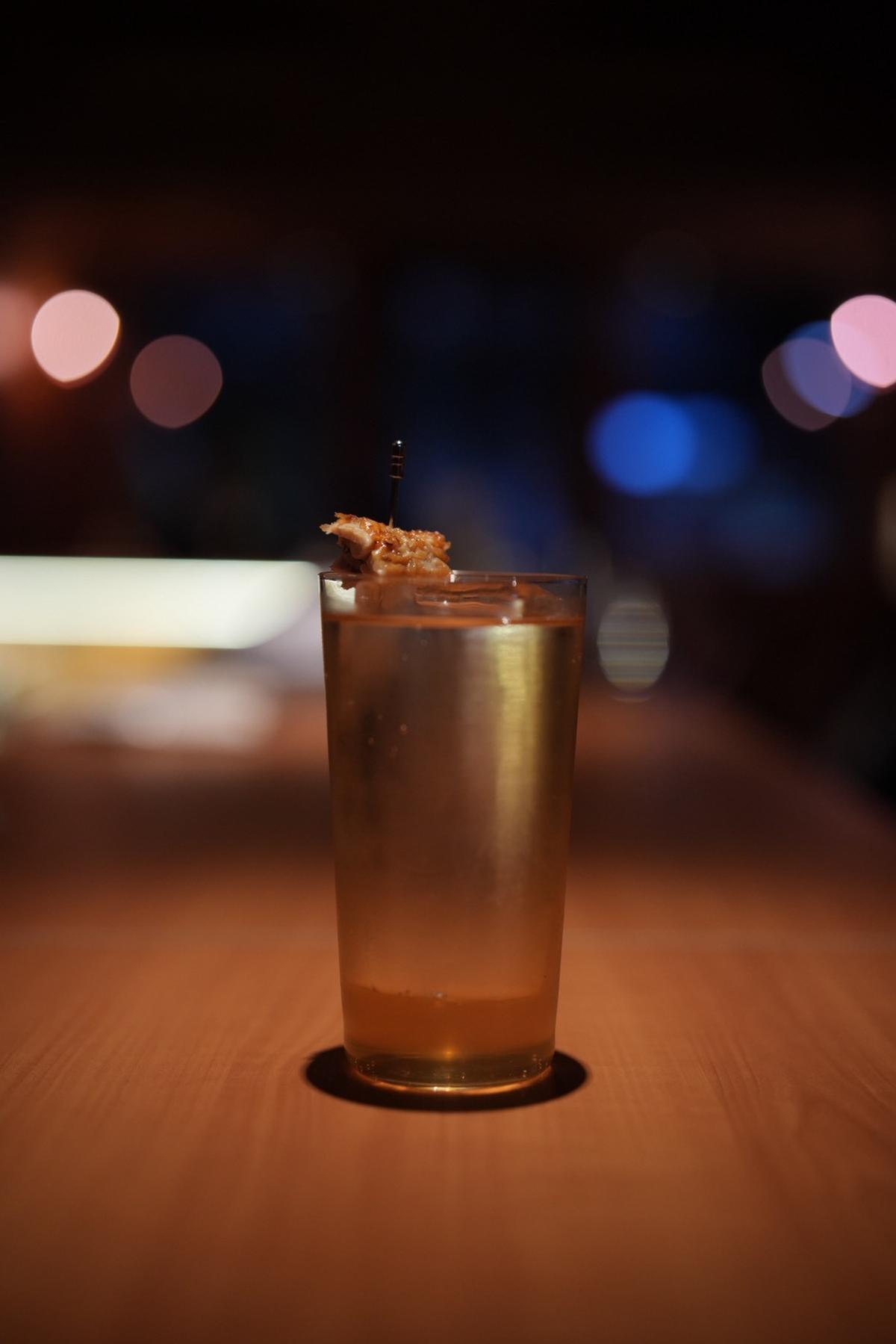
On the menu is Motorbike Taxi, a drink inspired by the crushed ice drinks in plastic bags carried by bike taxi drivers, Gai Yang Sanam Muay, which attempts to infuse the flavours of roast chicken and crisp snacks sold behind bustling Muay Thai stadiums, and the Thai Fruit Cart, an ode to the streetside fruit and juice stands of Bangkok. 

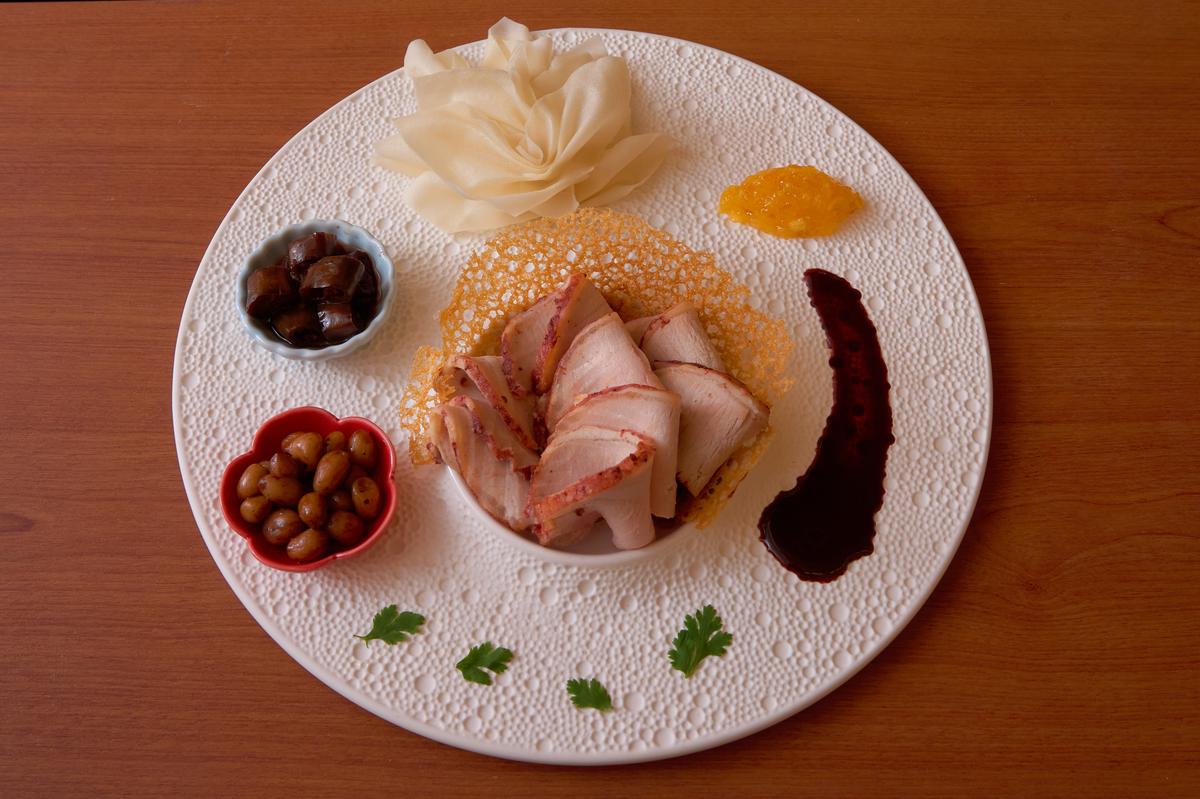
These Bangkok-inspired cocktails will be served alongside snack options that draw inspiration from some classic cocktail favourites which includes a negroni char sui pork and chicken, as well as crisp pina colada chicken filo pastry, grasshopper tofu popcorn and mojito cold ramen with tempura. 

     Negroni Char Sui Pork

Negroni Char Sui Pork
| Photo Credit:
Special Arrangement

Considered among Asia’s most inventive mixologists, Fah Beer, who was formerly at Bangkok’s #Findthelockerroom bar, also co-founded Wasteland with Kitibordee “Gov” Chortubtim and Dharath “Tot” Hoonchamlong, Thailand’s first fully sustainable bar conceived as a community sipping space which transformed what is typically considered waste into flavour-driven cocktail ingredients. 

“When you work behind a bar every day, you begin to understand how much potential is hidden in things people usually throw away: citrus peels, herb stems, tea leaves, even spent fruit pulp .Citrus skins become cordials. Herb stems become tinctures. Overripe fruits become ferments. Even melting ice can be repurposed for dilution-controlled batches,” says Fah Beer, of her zero-waste mixology, which is rooted in respect for ingredients, craft and the environment. 

This philosophy, she says, makes every drink feel more intentional and alive. 

From her popup in Chennai, Fah Beer says people can expect Thai flavours in a way they haven’t tasted before.

“I am excited to showcase tea-driven cocktails that highlight Thai aromatics and signature drinks that blend elegance with playful Thai notes. For me, the popup is also about bringing my bar’s soul to a new space,” she adds. 

On December 12 and 13 at The Leather Bar and Lotus, The Park, Chennai. Contact 9962725601 for more details.

Published – December 10, 2025 01:59 pm IST


Source link

Tata Sierra review — The icon returns with purpose, poise and personality


This is a thoroughly modern SUV, engineered with ambition, executed with confidence, and priced with unmistakable intent. After driving both the Hyperion Petrol AT and Diesel AT in their top-spec, triple-screen-equipped forms, it becomes clear that Tata has not simply revived an icon, it has created one for an entirely new generation.

The first encounter is visual, and what a sight it is. The Sierra turns heads with an ease most SUVs could only aspire to. You notice the stance first — upright yet elegant, assertive without shouting. Its surfaces are smooth and taut, giving it a sense of restraint that makes it look more premium than its segment rivals.

Tata’s design team has pulled off something special here: a silhouette that nods to the past without mimicking it. The gentle taper of the glasshouse, the floating roof effect, the clean beltline, and the crisp lighting signatures come together in a way that feels international in sophistication yet rooted in Sierra DNA. The Red Dot design accolade that sits behind this SUV is not a marketing garnish; it is a genuine endorsement of design executed with clarity and conviction.

A minimalist, premium cabin features a seamless triple-screen layout that transforms every journey

A minimalist, premium cabin features a seamless triple-screen layout that transforms every journey
| Photo Credit:
Special Arrangement

The sense of modern maturity continues the moment you step inside. The Sierra does not overwhelm you with shapes or textures — it calms you. The dashboard has refined minimalism that makes the cabin feel airy and thoughtfully sculpted rather than cluttered. Soft-touch surfaces and high-quality finishes occupy the spaces your hands naturally reach for. The standout, though, is the triple-screen layout. Rather than feeling like three rectangles slapped onto a dashboard, the screens have been integrated with a sense of order and flow.

The driver’s display is crisp and legible, the central infotainment system is fluid and responsive, and the dedicated passenger screen introduces a whole new way to experience journeys. The passenger screen is not a gimmick; it is a genuine luxury. The ability to watch a film, stream content or even play games independently — with audio routed through personal headphones — elevates road trips to another level. It also contributes to the Sierra’s emerging identity as a “personal space” as much as a family SUV. The degree of separation it creates between the driver’s responsibilities and the passenger’s entertainment is something the segment has never seen before.

Perhapsthe cabins’s strongest impression is how spacious it feels. The Sierra’s second row is among the most comfortable in its class, not merely by segment standards but by the standards of SUVs priced significantly higher. The legroom is generous, the seat base is long and supportive, and the backrest angle encourages a relaxed posture. Even three adults can sit here without that awkward shoulder squeeze that plagues so many midsize SUVs. Combined with the expansive glass area and excellent seat height, long journeys become not just doable but genuinely pleasurable. The boot, too, is large and usable, and the powered tailgate adds a layer of ease that families will appreciate.

Spacious second-row comfort that rivals SUVs from a segment above—perfect for long family trips

Spacious second-row comfort that rivals SUVs from a segment above—perfect for long family trips
| Photo Credit:
Special Arrangement

Feature highlights, including ventilated seats, a panoramic sunroof, wireless charging, dual-zone climate control, ambient lighting, a driver’s memory seat, and a full suite of connected-car functions, round out a package that feels properly premium rather than simply feature-heavy. Tata has clearly bench-marked the Sierra against the best in the segment, and the end result feels cohesive and thoughtfully curated.

A well-designed SUV still lives or dies by how it drives, and this is where the Sierra’s engineering depth truly shines. The ride quality reflects a new level of chassis sophistication from Tata Motors. At city speeds, the Sierra glides over imperfections with a plush, almost cushioned feel. As speeds rise, the suspension settles down and tightens up, lending the SUV a planted, confident demeanour that encourages long-distance driving. There’s no bounciness, no wallow — just a steady, mature composure that rivals in this segment still struggle to achieve.

The steering is another highlight. Light and effortless in slow-moving traffic, it progressively gains weight as speeds increase, offering a reassuring sense of control. This duality — easy manoeuvrability in the city and assured stability on the highway — is a fine balance that many OEMs chase but few truly nail. In the Sierra, the steering feels intuitive from the very first turn of the wheel.

The Sierra’s upright stance and taut surfaces give it a confident, international design identity

The Sierra’s upright stance and taut surfaces give it a confident, international design identity
| Photo Credit:
Special Arrangement

Under the hood, the Sierra offers two notably different experiences. The 1.5-litre Hyperion turbo-petrol, delivering 160 PS and 253 Nm, is undoubtedly the more refined and charismatic of the pair. There’s a smoothness to its power delivery that you notice instantly. It gets off the line cleanly, transitions into the mid-range with polished urgency, and pulls ahead with a creamy consistency that makes the SUV feel almost effortless to drive. Even during quick overtakes, the petrol engine remains calm, composed and eager, never strained or vocal. Paired with the well-tuned 6-speed torque converter automatic, the petrol Sierra feels cohesive, responsive and genuinely enjoyable whether you are weaving through traffic or cruising at highway speeds. It is the drivetrain that brings out the Sierra’s premium personality.

The 1.5-litre turbo-diesel, producing 115 PS and 260 Nm, brings a different sort of appeal. It does exhibit the typical diesel clatter on cold starts and at crawling speeds, but once warmed up and past the initial rev zone, it settles into a steady, torque-rich rhythm that suits long-distance driving remarkably well. The mid-range is punchy and confident, making highway overtakes easy and relaxed. This engine, paired with the same 6-speed automatic, delivers a predictable, steady flow of power and is likely to appeal strongly to those who prioritise real-world efficiency and highway touring ability. While it may not match the refinement of the Hyperion petrol, it absolutely holds its own in terms of capability.

When you step back and view the Sierra as a complete package, its intent becomes crystal clear. This is not a product meant to sit quietly in the background. It is Tata taking a firm stand, announcing loudly and unapologetically that it is ready to lead the 5-seater SUV segment.

And the pricing reflects this confidence. With the entire range positioned between ₹11.49 lakh and the upper ₹18 lakh bracket, Tata has dropped the gauntlet squarely in front of the segment leaders. This is not a “value” play. This is a dominance play. The Sierra has the design, the emotional weight, the engineering maturity and the feature depth to go head-to-head with the Hyundai Creta and Kia Seltos — and in many areas, surpass them.

The most remarkable thing about the new Sierra is how complete it feels. It has emotional pull without being sentimental. It has presence without being loud. It has sophistication without being pretentious. And it has everyday usability without being mundane. The Sierra does not simply revive a legend — it evolves it into something India’s new generation of SUV buyers can embrace with pride. If there was ever a comeback story that deserved to become a bestseller, it is this one. Tata has not just brought back an icon. It has built its next one!

Price range: INR 11.49 – 18.49 lakh

Motorscribes, in association with The Hindu, brings you the latest in cars and bikes. Follow them on Instagram on @motorscribes

Petrol or diesel, the Sierra delivers a refined, composed drive that sets a new benchmark for Tata Motors.

Petrol or diesel, the Sierra delivers a refined, composed drive that sets a new benchmark for Tata Motors.
| Photo Credit:
Special Arrangement

Published – December 10, 2025 12:19 pm IST


Source link

From Colonial Kitchens to Kerala Plantations: The story of India’s first Christmas cake


In 1880s Kerala, a plum cake baked for a homesick British planter is said to have been India’s first.

With exposure to European culture and the advantage of home-grown spices, Plantation families took European plum cake recipes and Indianised them using locally available ingredients “Women baked at home, learning through butlers, social clubs, and European missionaries,” says Deepa Gopalakrishnan, assistant professor of history and author of Kerala Bhakshana Charithram – Food History Of Kerala.

This fusion of European technique and plantation produce eventually shaped Kerala’s signature Christmas fruit cake.

Nimmy Paul

Nimmy Paul
| Photo Credit:
Special Arrangement

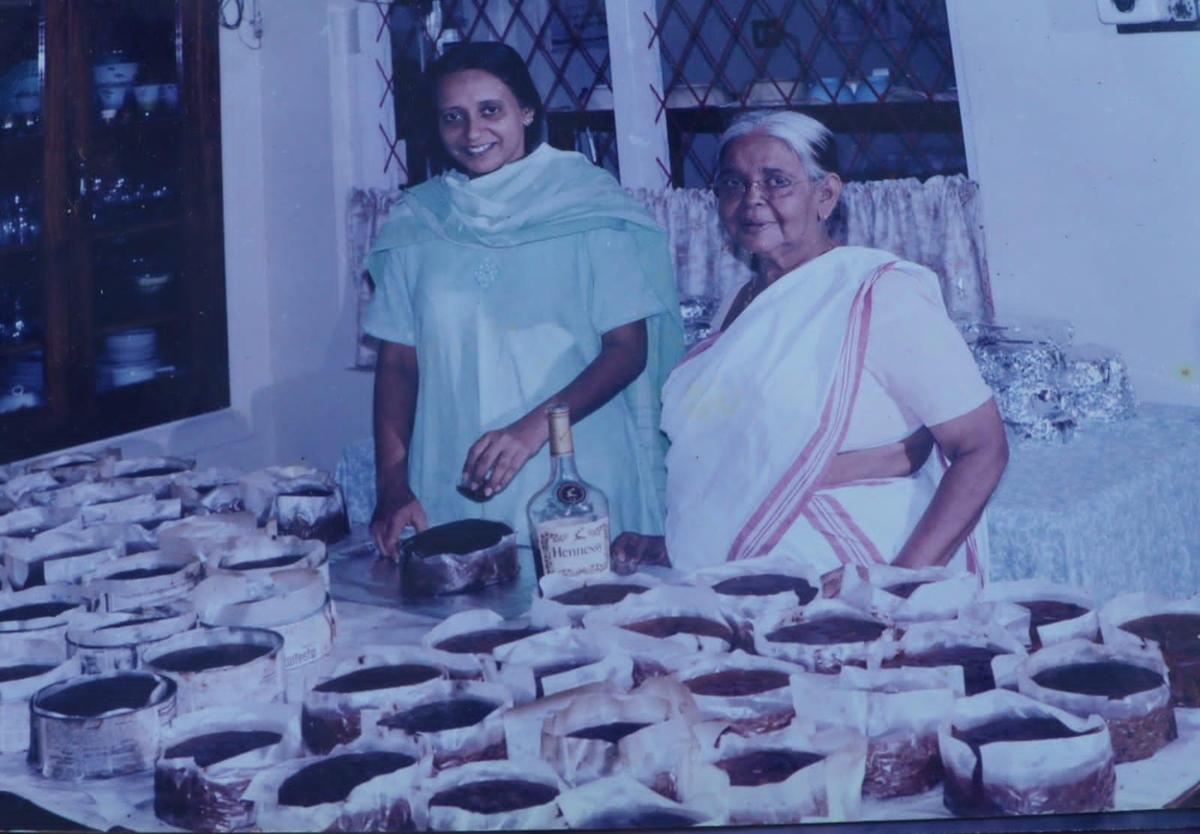
“When we came home from our hostel for the Christmas holidays, we would wake up to the scent of baking from my mother’s kitchen,” says the 65-year-old Nimmy Paul. She went on to start one of the plantation community’s first home-baking enterprises for Christmas plum cakes, starting in 1991 with 100 kilos using her mother’s recipe, sourced from the Rotary Club, where her father was an active member. “Rotary clubs then had British managers, so magazines were easy to find, and my mother kept paper cuttings of the recipes in it,” she recalls. Nimmy baked the old-world way, eventually stopping the sales in 2001 after reaching 1,001 kilos.

At Kallivayalil Bakes, Sheela Tomy has been running her home-based Christmas cake venture for 20 years, using a recipe blended from her mother’s and mother-in-law’s. What began as 30 cakes for a relative in Chennai has grown into 3,500 this year, with the recipe evolving as new ingredients became accessible and better tools helped meet rising demand. Though the 70-year-old doesn’t know how the family first got the recipe, she says that in Pala and Kanjirappally, strongholds of Kerala’s plantation communities, “every family used to bake back then. It was just the norm.”

As the younger generation left the plantations for better education and a more connected life, the baking culture began to fade, observes Nimmy. “But I think it’s reversing now,” she adds.

Mathew Vallikkapan and Silu Joseph

Mathew Vallikkapan and Silu Joseph
| Photo Credit:
Special Arrangement

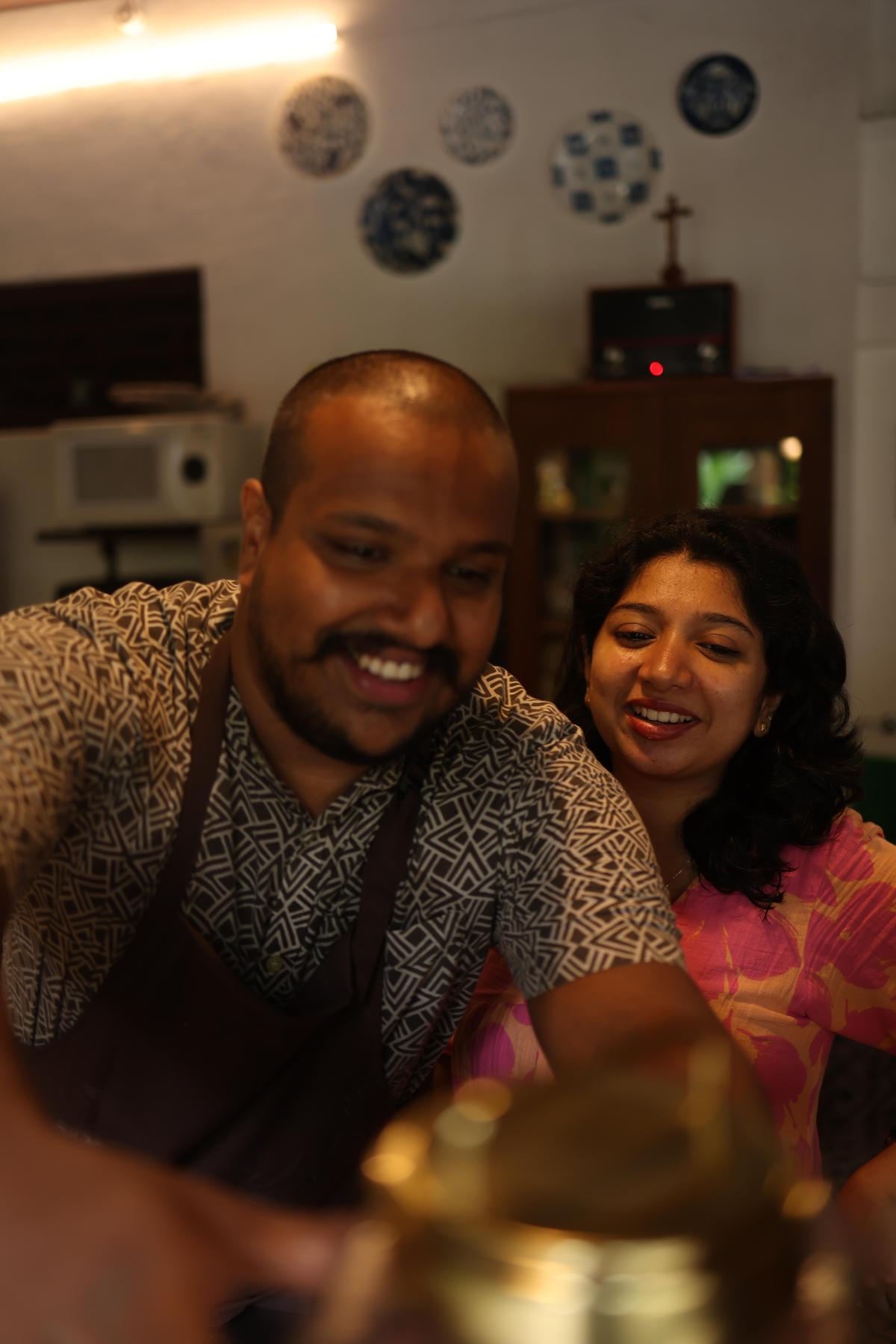
The revival Nimmy speaks of is already taking shape. Fifth-generation planter Mathew Vallikkapan and his wife Silu Joseph are debuting their family Christmas cake this year as a limited-edition batch of 300 Planter’s Fruit Cakes, baked at Taranaki, the in-house bakery at their homestay, Vanilla County at Vagamon.

The recipe, once his grandmother Chinnamma Dominic’s pride, can be traced back to her aunt, a nun who learned it from European missionaries. “In my childhood, the moment the cake cooled, it went straight into the palahara petti (the wooden snack box) and the keys stayed with the women in the family,” he recalls. “They opened it only for Christmas, which made it feel like a special treat.” Though this is his first commercial batch, Mathew, trained in culinary arts in New Zealand, has been baking for years, a passion he believes began with watching his mother bake. 

A home grown recipe

For Nimmy, the charm of those baking days was that only the rum and black raisins were bought from outside. “My mother gathered fruits in season and preserved them until soaking began,” she remembers. Papaya and ash gourd went into sugar preserves, while damson plums were preserved in slaked lime water. Cinnamon, cloves, nutmeg, tender ginger, citrus peels and cashew nuts came straight from their plantation and kitchen backyard. Butter and eggs were from their own cows and hens, and the sugar powder and flour were always ground fresh. “That’s what made a planter’s fruit cake special. It was entirely home-grown and hand-touched from scratch,” she says.

An old photo of Nimmy and her mother

An old photo of Nimmy and her mother
| Photo Credit:
Special Arrangement

Soaking began in August, with the fruits immersed in rum and stored in a bharani, the ceramic jar kept in the ara, the cool inner room of the house. Nimmy recalls her mother always choosing rum over brandy, saying caramelised sugar paired better with it. By October, the baking would begin, with the mixing done in a big uruli (wide-mouthed bowl) using the mathu (the wooden hand-masher). She remembers her mother’s modern oven, while her older siblings recall the clay ovens that came before it. Heritage recipes are not infallible, of course: Nimmy switched to honey instead of liquid glucose to keep the cake moist.

The planter’s fruit cake

For Mathew, the Planter’s Fruit Cake is less a business and more a tribute to his parents and grandparents, a way of keeping their community tradition alive. Hence, he follows his grandmother’s recipe faithfully. Scaling it from the 15–20 cakes his mother once baked to 300 on a commercial scale has been his biggest challenge. He began with a 200-cake trial last year, fine-tuning the measurements and working out the right temperature for the oven.

The process begins with dates, raisins and cranberries set to rest in Old Monk rum. “It takes two weeks for the flavours to develop, but we let it sit for up to one-and-a-half months and start baking in November,” he says, a choice that gives the cake its deep rum note and a generous three-month shelf life. All the spices — nutmeg, clove, cinnamon — come from their farm, and unlike commercial bakeries, he uses their own real vanilla extract instead of essence.

“Though these spices go in small quantities, using high-quality ones has a way of lifting the whole cake,” Mathew says. For nuts, he uses cashews and walnuts, along with pineapple cooked into a marmalade and orange peel, and he works with freshly ground flour and sugar, caramelising the latter for a toasty flavour. Since eggs coagulate in heat, he takes advantage of the plantation hills’ cool mornings, starting his mixing at 5am to 6am. 

Taranaki cake by Mathew Vallikkapan

Taranaki cake by Mathew Vallikkapan
| Photo Credit:
Special Arrangement

The only upgrade he has made is in the tools, drawing from his culinary training to use the right spatula and contemporary panning techniques that make the work more efficient. When it comes to mixing, he still romanticises the idea of hand-mixed batter. And though he uses a modern oven now, he wants to return to his grandmother’s old-school method with borma (a traditional, coconut-shell fired oven) ovens for next year’s Christmas batches.

The borma advantage

Sheela Tomy

Sheela Tomy
| Photo Credit:
Special Arrangement

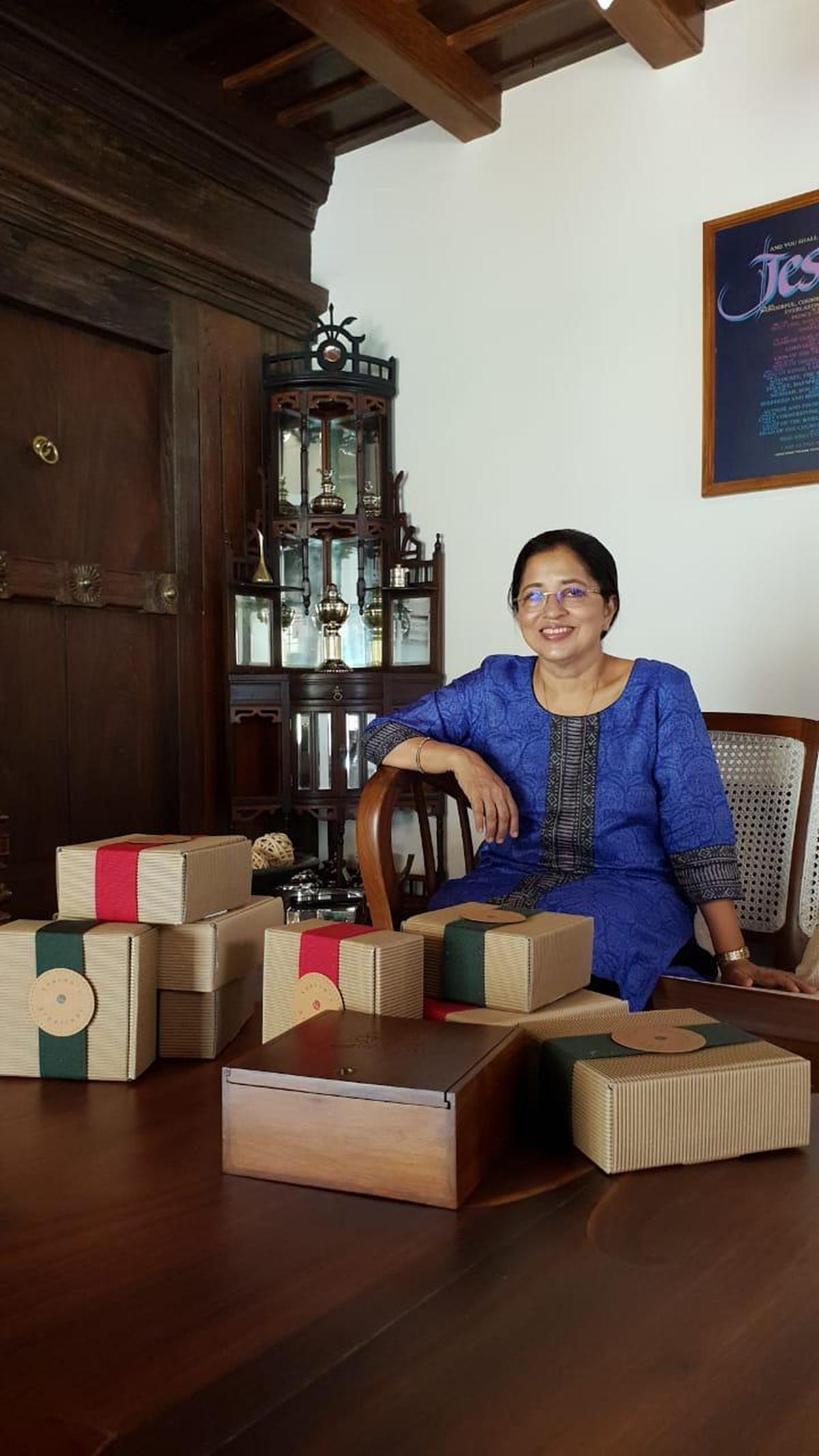
For Sheela, the recipe she inherited has evolved with time, turning into an almost year-long process. What was once a mix of local fruits soaked for a month has grown into a 13-fruit medley that is soaked for six months starting from April. She bakes three kinds of cakes. The Rich Fruit Cake (₹1,500) and Super Rich Fruit Cake (₹1,800) that use local fruits like dates, figs, raisins, orange peel and ginger soaked in wine and rum. The Exquisite Fruit Cake (₹3,800), made in small numbers, adds exotic fruits like apricot, strawberry, blueberry and cranberry, all soaked in rum and packaged in a gifting-style wooden box.

Apart from the fruits and the long soak, the defining feature of her cake is that it is borma-baked. “I didn’t have a borma at first,” she says. “I used a bakery’s borma in Kanjirappally on Sundays because my numbers were small. When demand increased, my husband built one for me.” The work is messy, with ash clinging to every tin that must be scrubbed down, but the taste, she says, makes it worth it. She finishes baking by early November, allowing the cakes to mature in time for Christmas. “Earlier, people wanted fresh cakes, but now they prefer matured ones,” she says. “They’ve begun to understand the difference in taste.”

A few legacy Christmas cakes avaibale in Kerala

Grand Reserve Old Rum Cake by Thelliyankal Bakers A rum cake made with fruit soaked for a full year in wooden barrels, packaged in a clever box styled like a rum bottle.

Mambally’s Royal Plum Cake A non-alcoholic cake from the bakery credited with India’s first plum cake.

Matured Plum Cake by Tocco A homemade plum cake by Annie Philip, made with fruits soaked in rum and allowed to mature for deeper flavour.


Source link

Could IndiGo have hired more pilots to prevent the crisis?


IndiGo has contracted its daily operations from 2,300 to approximately 1,800–1,900 flights

IndiGo has contracted its daily operations from 2,300 to approximately 1,800–1,900 flights
| Photo Credit: Salman Ali

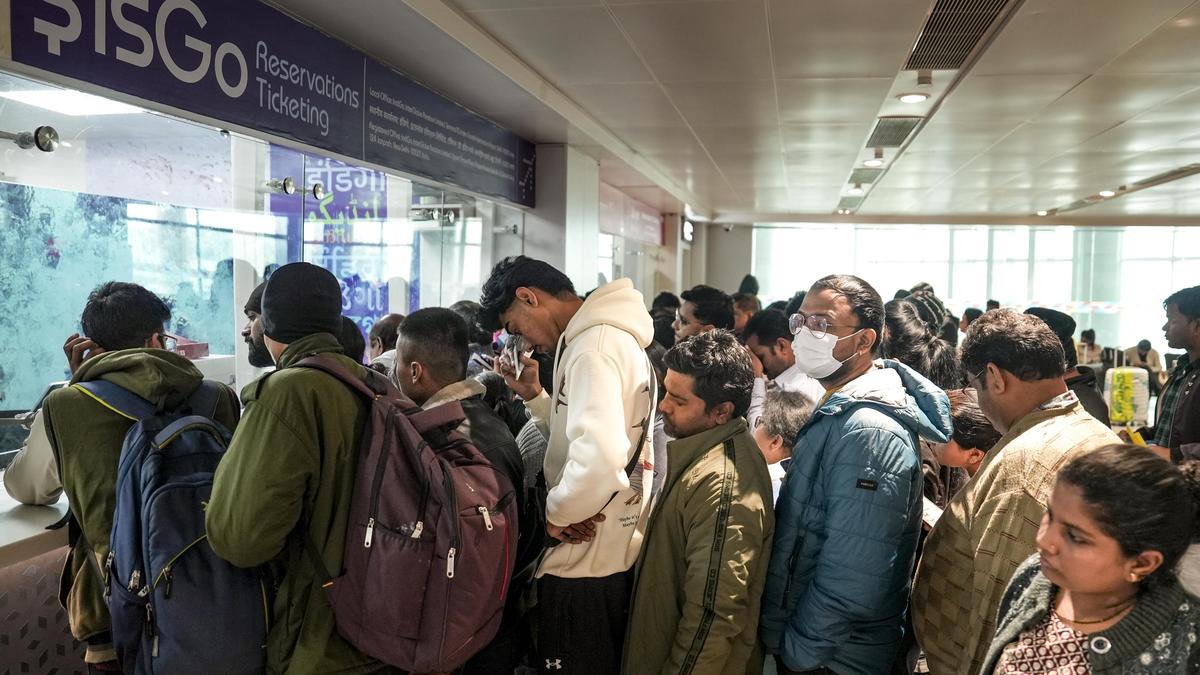
Starting this month, IndiGo’s operations unravelled as thousands of flights were cancelled. The primary trigger was the airline’s failure to prepare for the new pilot rest and duty norms (Phase II), which came into full effect on November 1, 2025.

These stricter mandates — specifically raising the weekly rest period of pilots from 36 to 48 hours and capping night landings — effectively shrank the available pool of pilot hours. The company informed officials that “misjudgement and planning gaps” led to the fiasco.

IndiGo is managing the current crisis by contracting its daily operations from 2,300 to approximately 1,800–1,900 flights. This creates a distinct ‘lose-lose’ scenario: the airline limits its output, and passengers face reduced connectivity. The impact is magnified by IndiGo’s sheer dominance; its market share — measured in Revenue Passenger Kilometres — has climbed from under 40% in 2015-16 to over 60% in 2024-25.

chart visualization

Its nearest competitor, Air India, trails significantly at roughly 14%. With rivals grappling with their own aircraft shortages and scale limitations, the broader industry is ill-equipped to bridge the supply gap left by the market leader.

Could IndiGo have averted this fiasco by aligning its hiring strategy with the impending regulatory shifts? According to a recent report by Mint, the airline intends to onboard over 900 pilots by next December, with an initial intake of about 150 by February. Could this have been done before?

To understand the crisis, consider IndiGo’s massive operational expansion. The chart below plots IndiGo’s share in total industry pilots versus total flying hours. In 2019-20, IndiGo had 44.6% of all pilots and contributed to 42.1% of total flight hours. By 2023-24, its pilot share dipped to 43.6% while flight hours surged to 50.9%.

chart visualization

While this does not strictly prove that pilots are ‘overworked’, it hints at a divergence of operations scaling up significantly, but the pilot workforce not keeping pace.

Capt. A. Ranganathan, a former airline instructor pilot and aviation safety adviser, confirms this. “IndiGo knew very well that they should have hired more pilots by November 1 this year. Despite not doing that, they applied for approval for the winter schedule this year. They actually increased the number of flights, which was approved by the DGCA.”

Would hiring more pilots erode the bottom line of IndiGo, the only consistently profitable Indian carrier? To answer this, we analysed pilot expenditures. In 2023-24, IndiGo spent ₹31,217 million on 5,038 pilots, averaging ₹6.2 million per pilot annually.

chart visualization

This figure is slightly lower than Air India’s, yet higher than SpiceJet’s. The chart below shows the average expenditure incurred by airlines per pilot in 2023-24

chart visualization

With plans to onboard 900 new pilots by next year, a back-of-the-envelope calculation projects an additional annual cost of roughly ₹5,500 million.

This additional ₹5,500 million outlay constitutes merely 6–8% of IndiGo’s Profit After Tax, which stood at ₹81.6 billion in 2023-24 and ₹72.5 billion in 2024-25. The chart below shows the Net Profit or loss recorded by IndiGo after Income Tax in the last decade.

chart visualization

Even if we assume these hires are strictly for compliance rather than expansion, the trade-off is stark: the airline had to forego less than 8% of its surplus to insulate itself from this fiasco. It remains to be seen if the actual losses from the current crisis will outweigh this expense.

According to Mr. Ranganathan, IndiGo will in fact struggle to complete these additional hires. He noted that the airline delayed promoting many Senior First Officers to Captains, prompting an exodus of pilots. He also highlighted that allowances have been cut.

The data for the charts were sourced from the Handbook on Civil Aviation Statistics and other reports published by the Directorate General of Civil Aviation


Source link

Badshah wants to bring the party home with his new vodka, Shelter 6


The thing about celebrity spirits is that they usually arrive with the same enthusiasm as a nightclub fog machine — loud, dramatic, and often masking a lack of clarity. So when rapper and singer Badshah announced he was launching a vodka, the general expectation was: here we go again. But Shelter 6, created with the Cartel Bros, lands with an unusually measured proposition. Instead of promising a revolution, it promises a space, as Badshah puts it, “where people can show up as themselves without performing for anyone.”

For someone who headlines festivals and has built a career on spectacle, his attachment to intentional moments is surprising. But he is quick to clarify: “Shelter 6 is a vibe, yes, but not a manufactured one. I’ve always hosted people. Even though I don’t drink, I’m very particular about the energy when people gather. It shouldn’t feel like a checklist. It should feel like belonging.”

The vodka is six-times distilled in Russia, drawing from glacial lake water, which lends it a clarity the team cannot stop talking about. Normally, that level of emphasis suggests insecurity. Here, it reads more like pride in the process. “There are too many spirits driven by marketing,” Badshah says. “I didn’t want that. If I’m building something, it has to stand on its own, even if my name wasn’t on it.”

He also seems aware of the scepticism surrounding celebrity brands. “This is not a vanity project,” he insists. “People can tell when something is fake. Today’s audience is smart. They’ll sniff out anything that is just a label slapped onto a bottle.”

The taste test, conducted with the seriousness of someone grading a college viva, reveals a vodka that behaves better than expected. Neat, it is almost translucent on the palate — no harsh burn or an aggressive ethanol spike. On the rocks, it loosens further, letting a faint minerality peek through. In a Martini, it is clean but not characterless; in a Highball, it vanishes politely, which is exactly what a decent, premium vodka should do.

Badshah

Badshah
| Photo Credit:
Special arrangment

Still, it is not a vodka that wants to be bullied with syrups and mixers. Use citrus sparingly; avoid unnecessary sweetness; let it sit with ice and minimal interference.

The brass tacks

The bottle itself is a sleek metallic number — modern, confident, and intentionally avoiding the “look at me” flamboyance often associated with celebrity spirits. Badshah says this was deliberate. “I wanted it to feel premium but not pretentious. Something you could take to a house party or display in your bar without it screaming for attention.”

This balance — premium yet accessible, cool yet unforced — is where the Cartel Bros’ involvement becomes visible. Mokksh Sani, co-founder, speaks about the process with the kind of practicality that keeps the project grounded. “We never wanted Shelter 6 to feel like a product cooked up in a boardroom,” he says. “From day one, the focus was quality. If you strip away the name, the bottle, the story — does the vodka hold up? That was the test.”

He adds, “Badshah and I have both been involved in every detail. This isn’t a celebrity lending his face. This is two teams building something from scratch.” On attitude, he echoes Badshah’s stance: “Drink if you want to. Don’t drink if you don’t. But if you do, choose something that respects the process.”
Badshah goes further: “Drinking should never be mindless. I’ve always said — do anything with intention. Shelter 6 is crafted with intention, so it should be consumed the same way.”

Badshah with the Cartel Bros

Badshah with the Cartel Bros
| Photo Credit:
Special arrangment

There is also the matter of ambition. The team intends to capture 25% of the Indian vodka market and reach a valuation of ₹700 crore within three years. This is not casual dabbling; it is a massive blueprint, one that recognises India’s fast-growing appetite for premium spirits.

And then, of course, there is the name: Shelter 6. “It was instinctive,” Badshah says. “Shelter felt warm, welcoming. And the number 6 is our distillation process, yes, but it’s also a number that has always meant something to me. Putting it together felt natural.”

When asked what the vodka would sound like if it were a track, he laughs. “It would start minimal — smooth, almost quiet. Then it would build. And when the drop comes, it hits confidently, not chaotically.”

Whether Shelter 6 succeeds depends on the market. But for now, it stands apart for one reason: it is not selling a fantasy. It is selling a feeling. And in the ever-loud world of Indian pop culture, a little quiet confidence is oddly refreshing.

Shelter 6 costs ₹1,999 in Maharashtra

Published – December 09, 2025 11:37 pm IST


Source link

Inippu in Thiruvananthapuram serves sweets and seasonality


Inippu, meaning ‘sweet’ in Tamil, underscores what lawyer-turned-pastry chef Sruthi Anil set out to achieve when she gave that name to her eatery located at Kannammoola in Thiruvananthapuram – a cosy outlet featuring desserts showcasing seasonal ingredients.

The eatery displays a humble front, with single units of desserts, neatly arranged inside a glass case, without jostling each other for space under the warm lighting from a wicker lantern. An incomplete basque cheesecake, Korean cream cheese buns, dessert tubs, and cookies are on show for customers to choose from before being served at an optimum temperature.

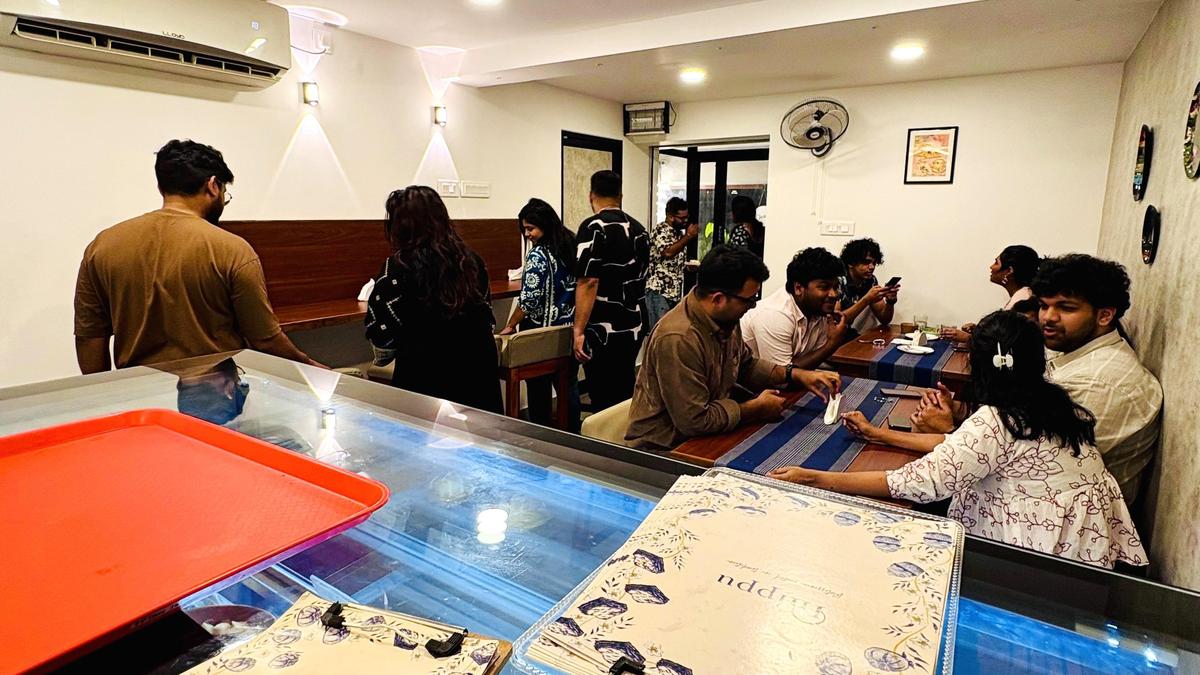
The interiors, with limited seating and floral table mats, create a warm, welcoming ambience resembling a quaint European bakery.

“When people ask me, ‘Why start a patisserie?’ my only answer is ‘Why not?’ ” says Sruthi, 33, who started Inippu in July. “It is the kind of food I enjoy eating and know how to make well,” adds Sruthi, who holds a diploma in pastry making from the Academy for Pastry and Culinary Arts, Bengaluru.

“I have always wanted something of my own,” says the pâtissier, who worked in litigation for five years after completing a degree in law. “The cafe was a retirement plan until the pandemic gave me a different perspective on life. I took a leap of faith by leaving my job. And after getting my diploma, I worked across eateries, cafes and cloud kitchens to understand how a kitchen works holistically,” says Sruthi.

Customers at Inippu

Customers at Inippu
| Photo Credit:
SPECIAL ARRANGMENT

The menu

Inippu has a dynamic yet limited menu consisting of sandwiches, dessert tubs, pastries, cheesecakes, toasts and beverages, prepared in finite portions. From the classic burnt basque cheesecake to the cream cheese chicken sandwich, the space does not scream big and bold, but subtle and succinct flavours.

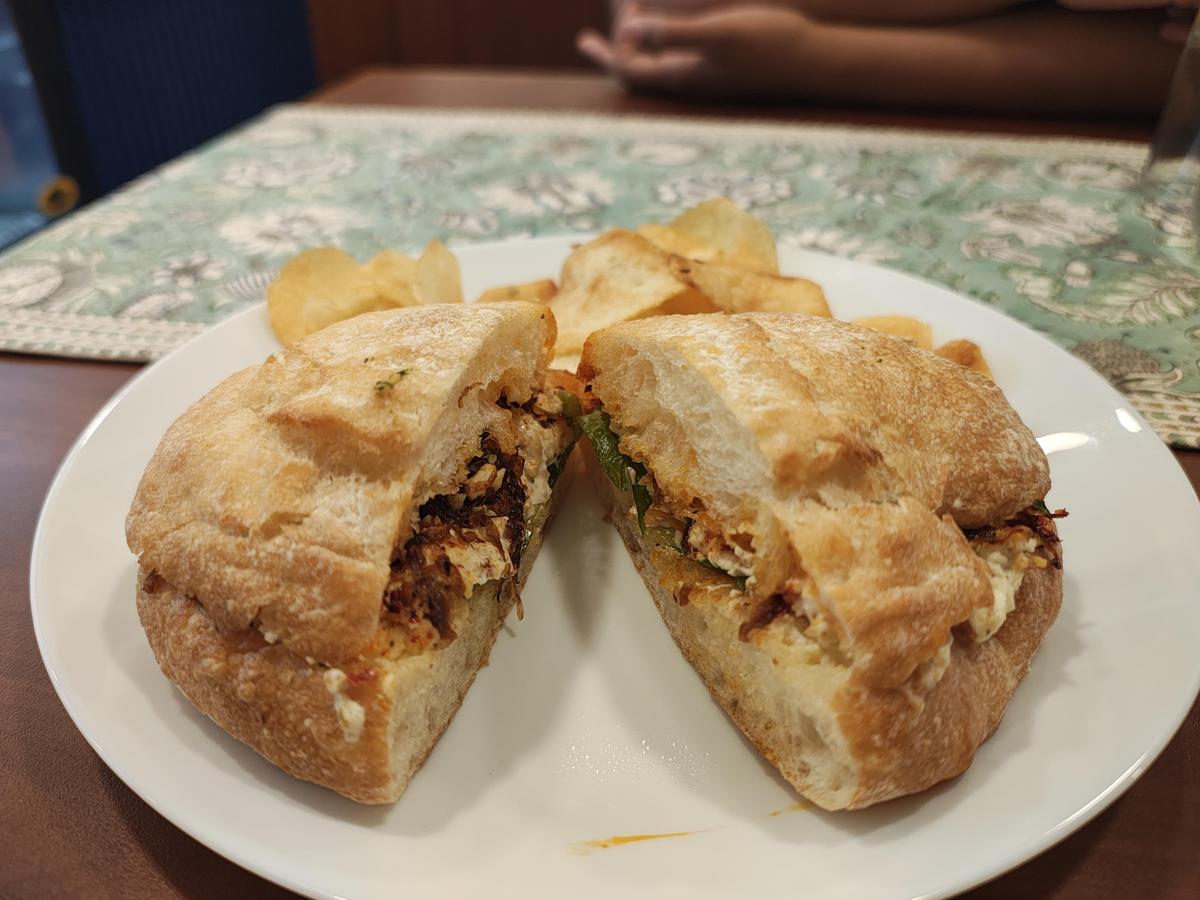
The savoury options at Inippu feature four types of sandwiches: cream cheese chicken with chilli oil and caramelised onions, egg salad with tomato chilli jam, red pesto with confit garlic and basil chicken, and garlic yoghurt with salsa chicken. The sandwiches use freshly baked ciabatta, an Italian white bread variety.

Cream cheese chicken with chilli oil and caramelised onions sandwich at Inippu

Cream cheese chicken with chilli oil and caramelised onions sandwich at Inippu
| Photo Credit:
SPECIAL ARRANGMENT

The smooth filling of cream cheese chicken with chilli oil and caramelised onions sandwich contains shredded chicken folded into a the slightly acidic cream cheese. The caramelised brown onions combine with the spicy chilli oil, cutting through the richness of the rest of the mixture. The crunch from the bread crust and its soft inside work perfectly for the sandwich, which pairs well with a thick, milky, iced Milo, topped with a pinch of salt.

The pâtisserie also has a toast menu featuring seasonal fruits and a dense Hokkaido bread (Japanese milk bread), topped with a smooth anglaise (custard).

Currently, Inippu serves tiramisu French toast, blackberry vanilla toast, and strawberry French toast. This menu changes according to availability of the ingredients.

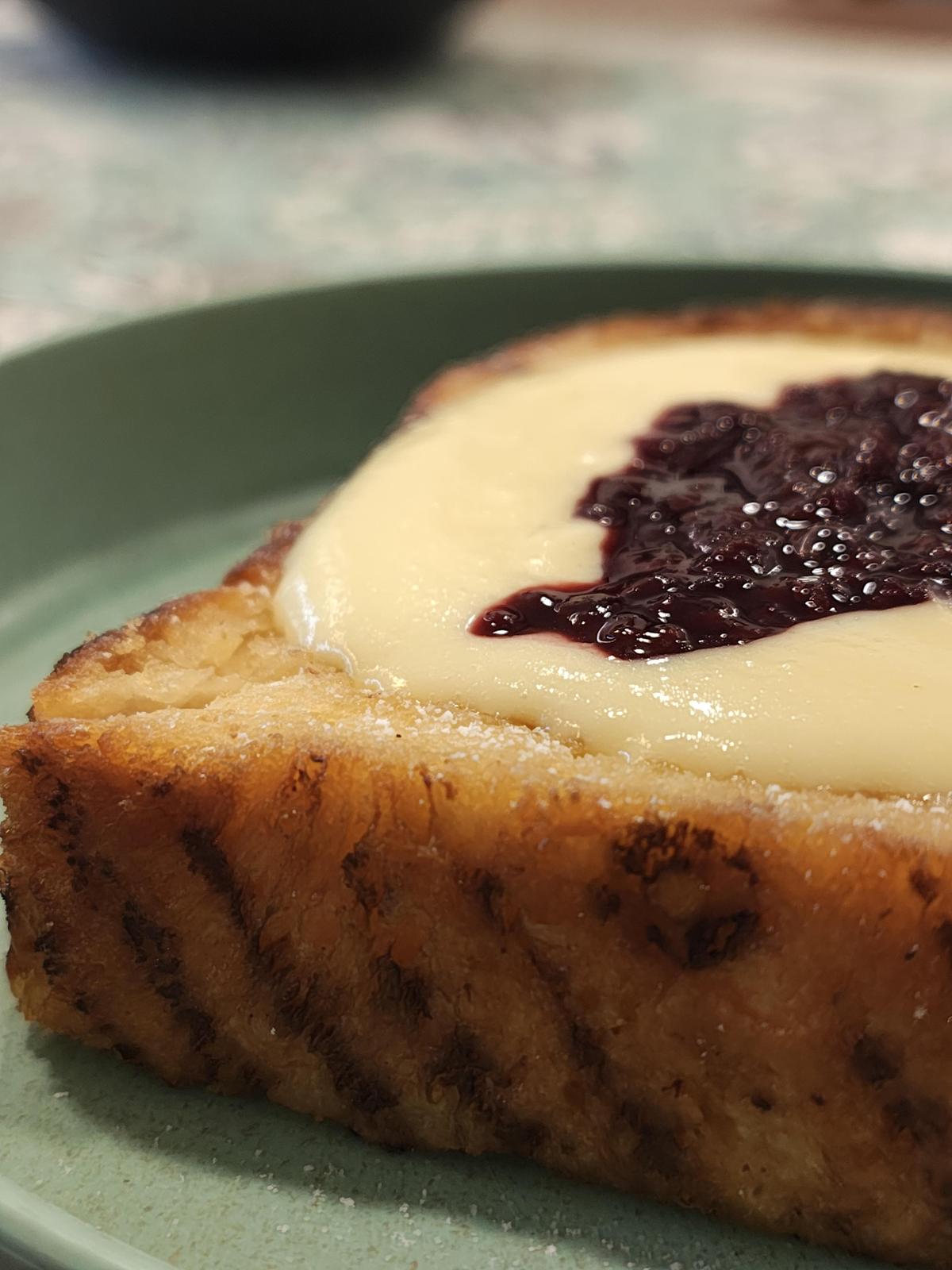
The blackberry vanilla toast has a thick slice of slightly charred, toasted bread, topped with a blackberry compote and vanilla cream cheese anglaise. The blackberries are reduced with sugar to lose the moisture and attain a jam-like consistency, while retaining their tartness. The sour compote on top of the smooth, sweet vanilla-cream cheese anglaise is soaked in by the dense slice of bread. The moist slice of bread, with the silky anglaise and tangy fruit, makes for a satisfying bite.

Blackberry vanilla toast at Inippu

Blackberry vanilla toast at Inippu
| Photo Credit:
SPECIAL ARRANGMENT

The basque cheesecake is a light rendition of popular desserts with notes of orange subtly singing through each bite. The cake is airy, smooth, and not overtly sweet.

Sruthi says, “We want to serve laminated desserts like croissants. We would like to expand to a bigger space and list Inippu on online delivery apps.”

Cost for two ₹900. Open from Tuesday to Sunday at 11.30am to 8.30pm.

Published – December 09, 2025 05:30 pm IST


Source link

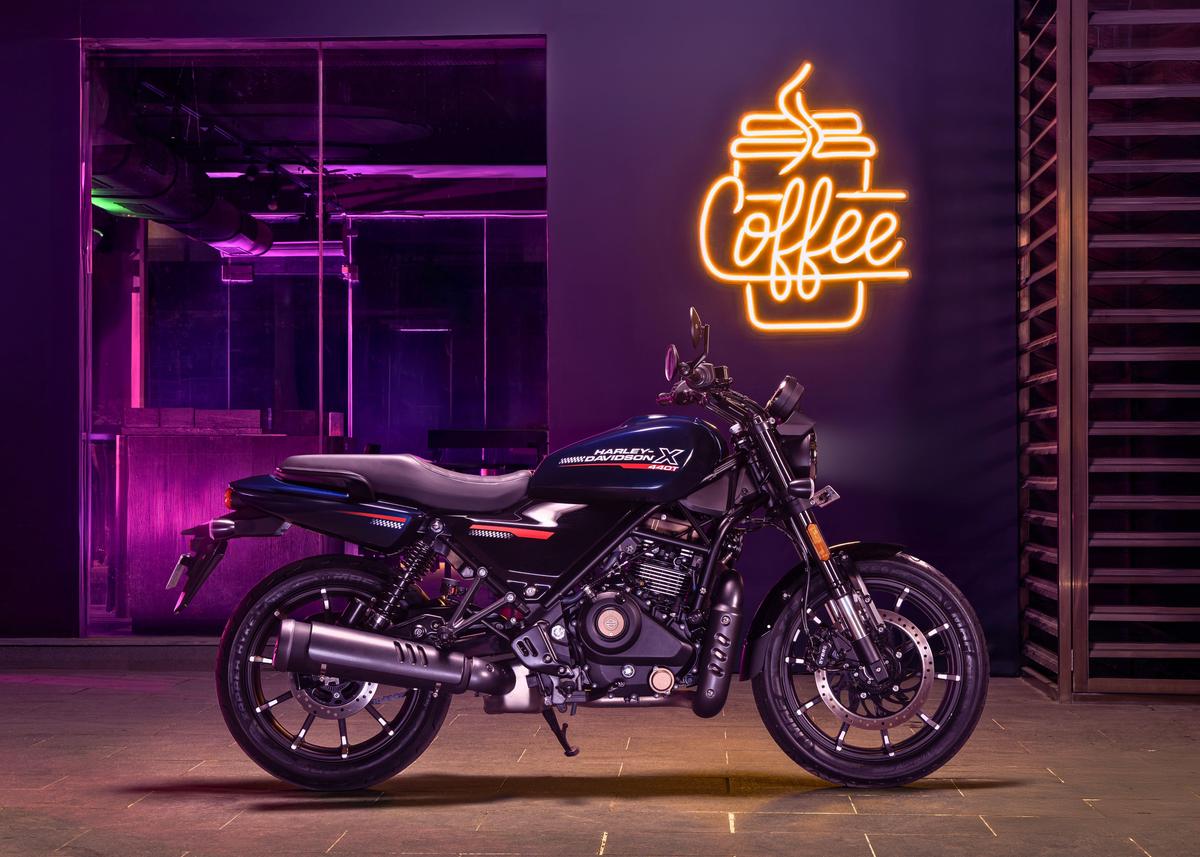
Harley-Davidson X440T launched: Refined midsize motorcycle with modern rider features


Actor Ahaan Pandey joins Harley-Davidson India as brand ambassador alongside the launch of the X440T.

Actor Ahaan Pandey joins Harley-Davidson India as brand ambassador alongside the launch of the X440T.
| Photo Credit: Special Arrangement

The Harley-Davidson X440T marks the next step in the brand’s co-developed midsize lineup with Hero MotoCorp, arriving as a measured but meaningful evolution of the successful X440. While the foundation remains familiar, the X440T broadens the motorcycle’s appeal with updated rider aids, improved everyday usability, and subtle stylistic revisions meant to make it more in tune with the expectations of 2025’s urban motorcyclist.

New ride-by-wire technology adds Road and Rain modes, along with switchable traction control and rear ABS.

New ride-by-wire technology adds Road and Rain modes, along with switchable traction control and rear ABS.
| Photo Credit:
Special Arrangement

Stylistically, the X440T retains the muscular stance of the original model but adopts a more contemporary finish at the rear. A redesigned sub-frame enables a cleaner and tighter tail section, paired with new grab handles that enhance pillion comfort and ergonomics. The silhouette continues to lean toward a roadster-inspired form—compact, upright, and visually planted—yet feels more cohesive thanks to the refreshed proportions. The front end maintains a strong identity with its circular headlamp and stout forks, giving the bike a distinctly purposeful look.

The X440T continues with the 440cc oil-cooled engine, tuned for smooth city torque and relaxed cruising.

The X440T continues with the 440cc oil-cooled engine, tuned for smooth city torque and relaxed cruising.
| Photo Credit:
Special Arrangement

Mechanically, the X440T continues with 440cc oil-cooled engine that anchors the platform. Tuned for a broad spread of usable torque at city speeds, the motor’s character remains focused on tractable and predictable delivery rather than outright performance. Its strength lies in its ability to navigate traffic with minimal effort while still offering enough pull for relaxed highway cruising. The engine’s refinement has improved steadily since the platform’s introduction, and the X440T benefits from the cumulative fine-tuning carried out over the last two years.

One of the most noticeable updates is the introduction of ride-by-wire, which enabled two riding modes: Road and Rain. Each mode offers a distinct throttle map, giving riders a more controlled experience tailored to changing conditions. The inclusion of switchable traction control and switchable rear ABS further modernises the motorcycle’s behaviour, allowing riders to manage their level of electronic intervention based on preference or terrain.

A redesigned sub-frame and new grab handles give the X440T improved ergonomics and a sharper rear profile.

A redesigned sub-frame and new grab handles give the X440T improved ergonomics and a sharper rear profile.
| Photo Credit:
Special Arrangement

The X440T also introduces a Panic Braking Alert system—an uncommon feature in this segment. During sudden, heavy braking, all indicators flash rapidly to signal an emergency braking event to following vehicles. It is a subtle but practical safety enhancement, particularly suited to unpredictable city traffic.

Suspension duties continue to be handled by upside-down forks up front and twin shocks at the rear, calibrated for a balance of firmness and comfort. The setup remains oriented toward stability and predictable handling, characteristics that made the original X440 accessible for new riders while still offering enough engagement for more experienced motorcyclists.

Alongside the launch, Harley-Davidson India has brought actor Ahaan Pandey on board as its new brand ambassador. His involvement signals a clear push to position the X440T as a motorcycle that appeals to younger, style-conscious riders entering the premium space for the first time.

The Harley-Davidson X440T retains its muscular roadster stance with a cleaner, more contemporary tail section.

The Harley-Davidson X440T retains its muscular roadster stance with a cleaner, more contemporary tail section.
| Photo Credit:
Special Arrangement

With a starting price of ₹2,79,500 (ex-showroom), the Harley-Davidson X440T presents itself as a refined, feature-rich alternative in the midsize segment. It strengthens the platform with updates focused on usability and relevance, while preserving the core identity that introduced a new wave of riders to the Harley-Davidson brand in India.

Motorscribes, in association with The Hindu, brings you the latest in cars and bikes. Follow them on Instagram on @motorscribes


Source link

World Disability Day Anthem 2025 released by singer Sunil Koshy


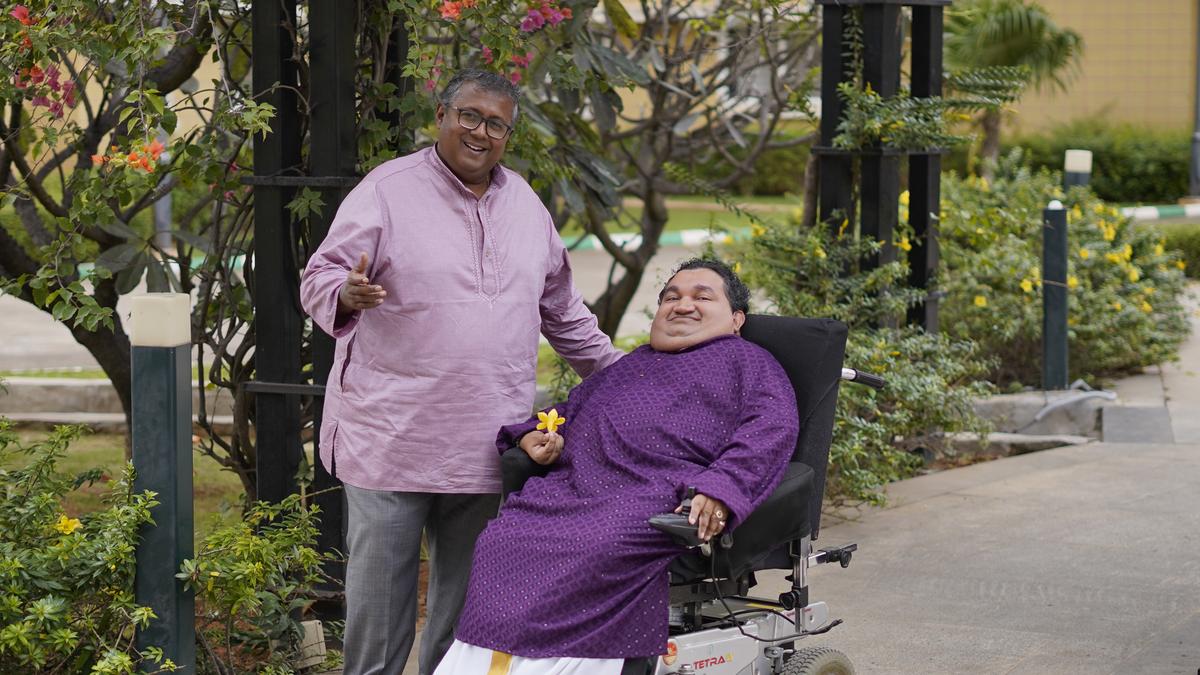
Singers Sunil Koshy and Sai Kaustuv Dasgupta

Singers Sunil Koshy and Sai Kaustuv Dasgupta

‘Chamakta Sitaara’ is a new song composed by musician Sunil Koshy and lyricist Sahil Sultanpuri for World Disability Day 2025.

Born out of a collaboration between From Mug to Mike, an initiative for “bathroom singers” helmed by Sunil, and IIM Bangalore, the aim of the track was not to just send a message, but to shine a spotlight on the hidden talents of the differently abled.

Sunil, a techie-turned–musician and entrepreneur, says much of his musical inspiration is drawn from social issues and real, lived stories. He believes music is the most powerful form of communication, and describes this anthem as a response that grew out of conversations with people with disabilities.

“There is already so much sadness around us; what we need to do is spread happiness and a sense of empowerment,” he says, adding that when he works with people with disabilities, he sees “so much joy on their faces.”
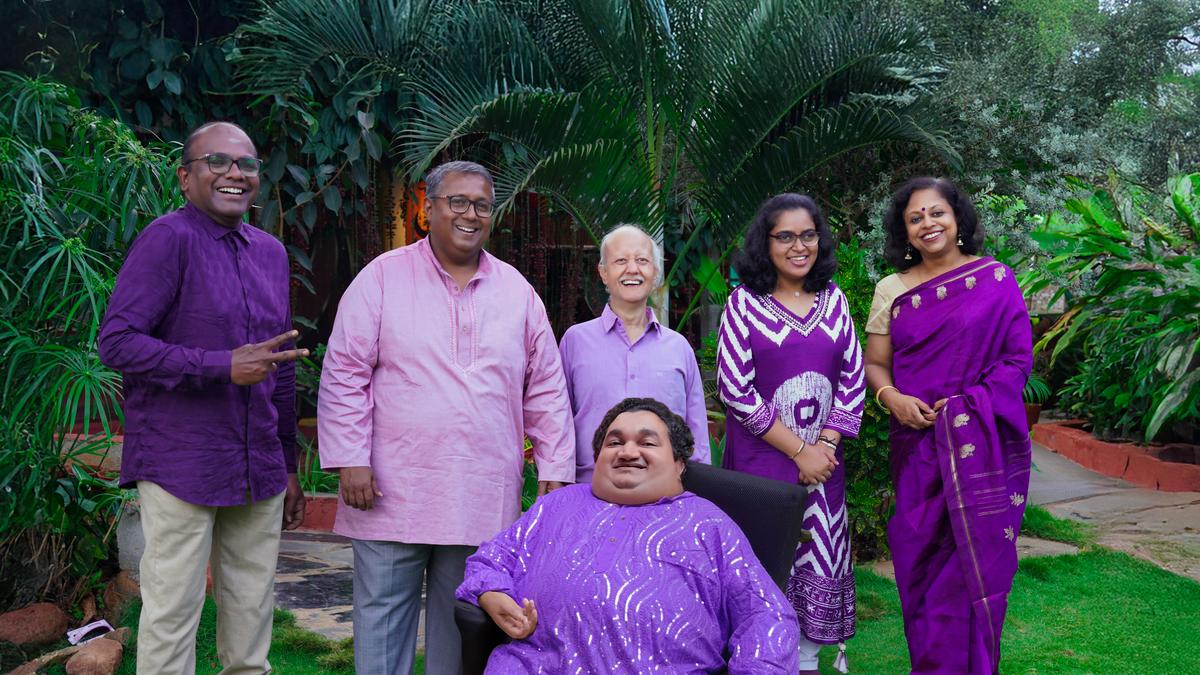
The ensemble of singers

The ensemble of singers

The anthem, conceptualised by Sunil’s wife and co-founder of From Mug to Mike, Archana Hallikeri, comes to life through a diverse ensemble of singers including, India’s Wheelchair Warrior, Sai Kaustuv Dasgupta; Nidhi Srivastava, a pursuits and go-to-market strategist; Shradha Muralidharan, a passionate singer who actively supports the neurodiverse community; BK Srinivas, a retired banker; Dr. Jai Ganesh, a dentist, and Sunil himself.

‘Chamakta Sitaara’, Sunil says can be described as “a blend of EDM and a new-gen feel.” Paired with Sultanpuri’s Hindi lyrics, the song brings forward larger meanings of inclusion and disability. It is designed for accessibility, as Sunil imagines a diverse audience and hopes its visibility helps listeners connect with the message.
Chamakta Sitaara can be heard on YouTube and social media.


Source link

Homegrown artists creating 2026 calendars


We help you knock off one more thing for your 2025 to-do list: shopping for that perfect calendar for the coming year. This time around, homegrown artists have taken their love for cities and its architecture, food, and everyday life to craft these calendars. Some that grow with you over the years and can be used beyond 2026. 

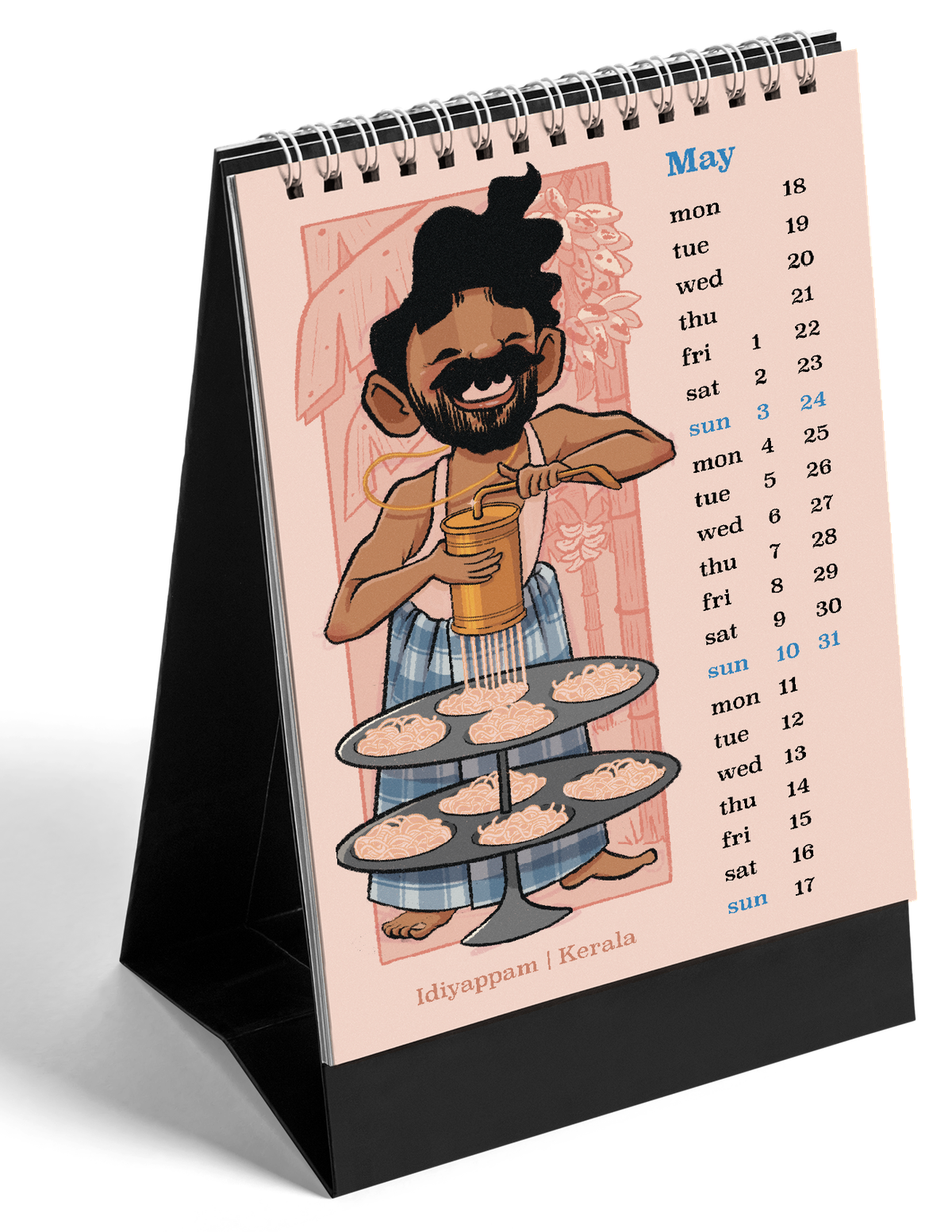
The noodle calendar illustrator Vijaya Aswani

The noodle calendar illustrator Vijaya Aswani
| Photo Credit:
Special Arrangement

CALENDARS

Noodles of the world @Spree Firit

What better way to kickstart the year than with some culinary inspiration? Illustrator Vijaya Aswani has dedicated her 2026 calendar to the noodle and its various versions across the world. January is dedicated to Japan’s ramen, April to India’s falooda, October to the fideuà from Spain, and December to the Malaysian me goreng, for instance. “The calendar has 12 noodle-shaped dishes from around the world and their chefs. I love drawing noodles that look edible in 2D along with colourful, traditional outfits on my warm, smiling characters,” says the Bengaluru-based artist. “My favourite layout is the idiyappam and stew one for the month of May. The spread has a Malayalee character making massive idiyappams in his checkered blue mundu.”

₹690 on www.spreefirit.com

Art by Saara ST

Art by Saara ST
| Photo Credit:
Special Arrangement

Art forward @Saaras Art Desk

Art became Saara ST’s lifeline in 2019 when everything around “felt uncertain and out of control”. “I was at a point where most people would have given up, and many even questioned why I still chose to draw. But art was the only thing that made sense to me when nothing else did. It gave me peace when I had none, and slowly, it gave me back myself,” says the full-time artist based in Tirunelveli who dabbled in portraits, zentangle patterns, and mandalas before turning to digital art in 2019. “When I discovered digital art, I felt a new world had opened before me. I learned the tools one by one, often by trial and error, and over time, it became my language,” says Saara, whose 2026 calendar is titled The Artist’s Way. “It is an ode to the artists’ way of living, the everyday chaos, little messiness and the quiet magic that comes with creating. The calendar encourages everyone to choose any kind of art to engage with.” 

₹850 on saarasartdesk.com

Madras Inherited x Binsan Oommen Baby Madras calendar

Madras Inherited x Binsan Oommen Baby Madras calendar
| Photo Credit:
Special Arrangement

Cityscapes @Madras Inherited

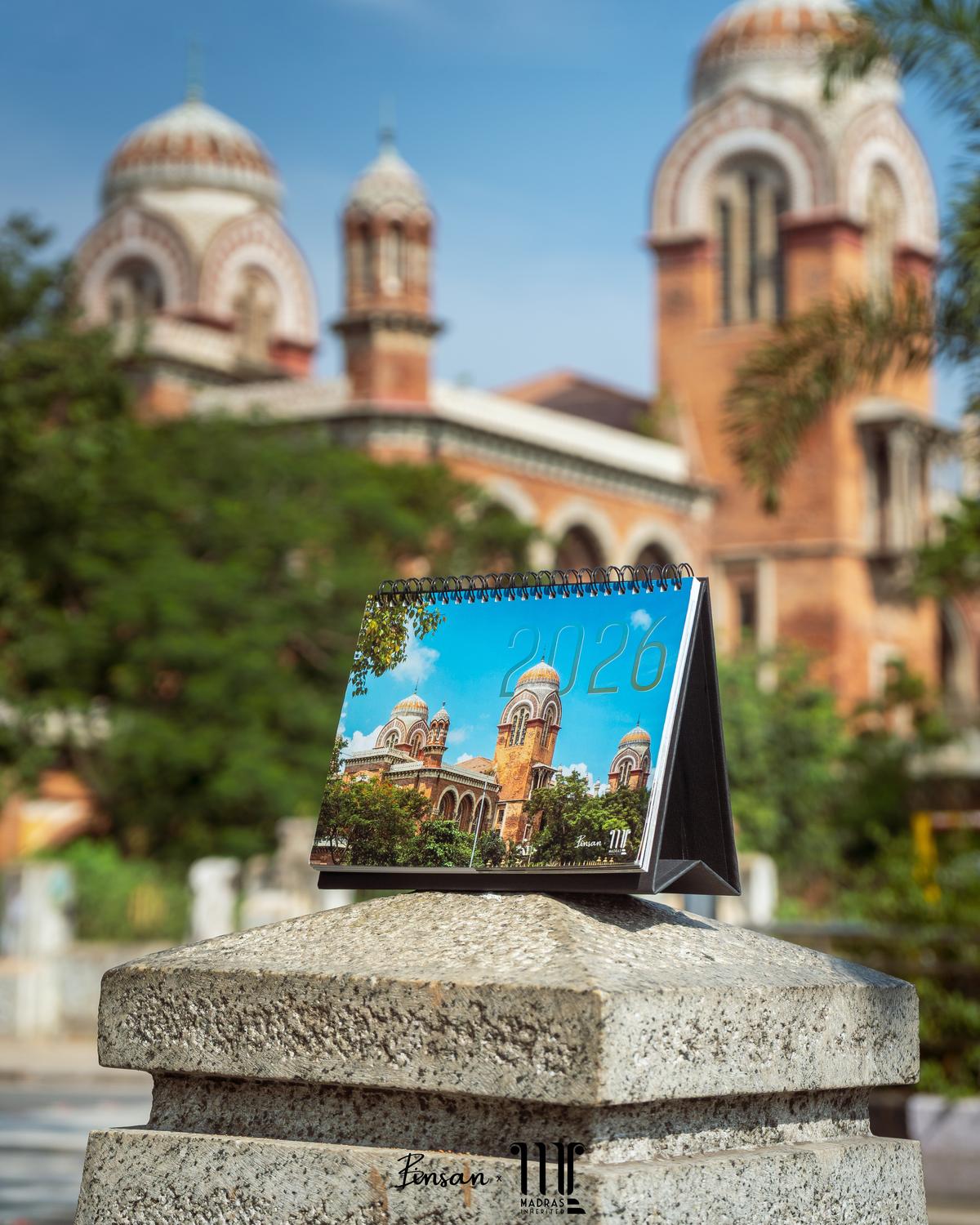
This year, the city-based initiative that spotlights Chennai’s heritage has dedicated its annual calendar to the city’s Indo-Saracenic style of architecture. Now in its sixth edition, the Madras Inherited x Binsan Oommen Baby Madras calendar features vibrant photographs of Central Station, Madras University, among others. “This distinctive style, unique to Chennai, gained prominence after 1857, a period marked by significant shifts in Indian policies and principles. While some view it as the pinnacle of Indo-European architectural innovation, it can also be interpreted as a strategic political instrument used by colonisers to shape Madras’s visual narrative,” says Ashmitha Athreya, trustee. At the end of each month, each calendar page can be turned into a picture card/ postcard. “The QR code located at the back of every picture contains something unique,” she adds. 

₹549. Details on madrasinherited.in

Art n Dreams’ easel-mounted desktop calendar for 2026

Art n Dreams’ easel-mounted desktop calendar for 2026
| Photo Credit:
Special Arrangement

Abstract expressions @Art n Dreams

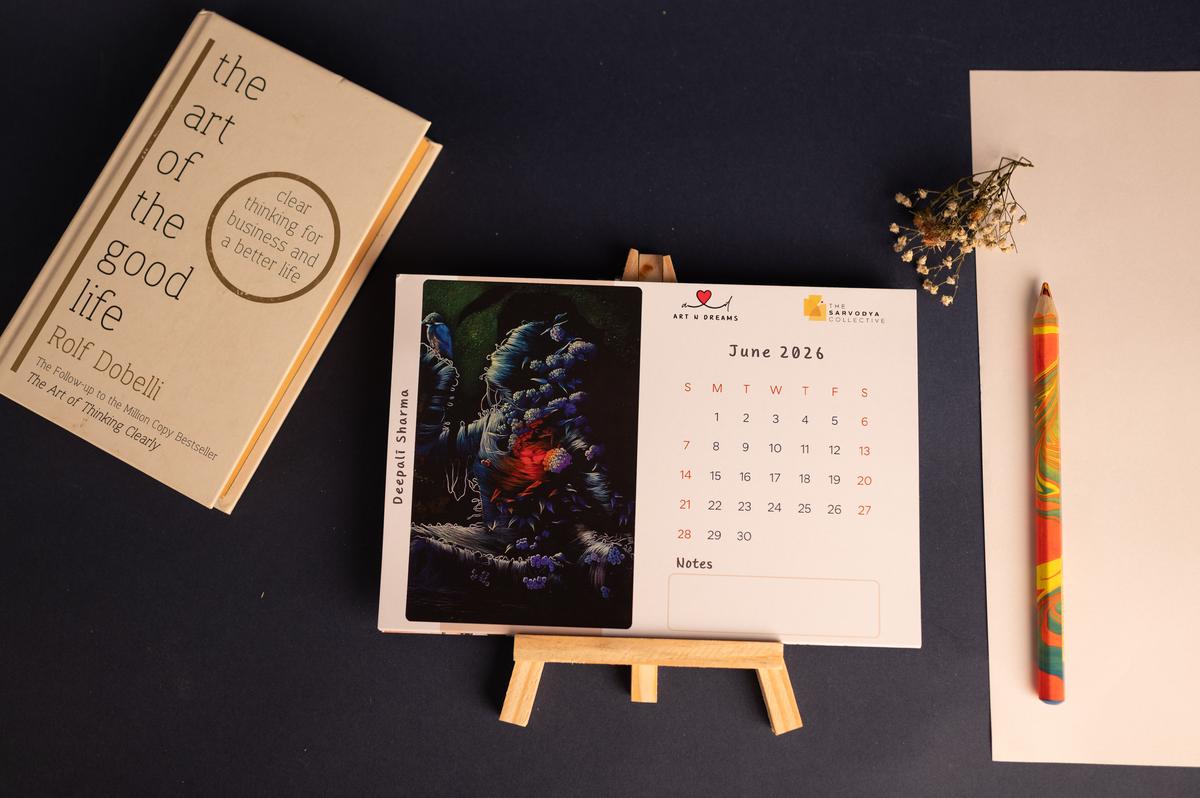
Inspired by his younger brother Pranav Aggarwal, a 13-year-old artist with Down Syndrome, Gurgaon-based Lakshya launched a platform to showcase the work of neurodiverse artists. Their easel-mounted desktop calendar for 2026 features original artworks from 13 emerging neurodiverse artists. “From Pranav’s whimsical interpretations of everyday joys to the abstract expressions of fellow contributors, the designs draw from themes of resilience, joy, and self-discovery, rendered in mediums like acrylics, watercolors, and photography,” says Lakshya, adding that they also retail candles, bags, coasters, laptop covers, and more. The calendar also features profiles of the artists, their creative journeys, and the hurdles they have overcome in their journey. 

₹400. @artndreams.co on Instagram

A snapshot of Archana & Co.’s calendar

A snapshot of Archana & Co.’s calendar
| Photo Credit:
Special Arrangement

Kitty paws @Archana & Co.

This one is for cat aficionados. Design consultant Archana Rajagopal made her first calendar in 2019 and it has been an annual affair since. “I draw on my life and musings for inspiration. When I got my first cat, I found my favourite muse. I now have four cats, and they’re the heart of my calendars,” says the Mumbai-based artist. The 2026 calendar is Archana’s third cat calendar, but it takes a slightly different approach from the previous ones. “While my earlier ones featured cheeky life lessons, this one is warmer: it’s an affirmation calendar, where each month offers gentle encouragement and hope for difficult days. All of this comes from how I imagine my cats would use affirmations,” she says.

₹870 on aandcostore.com

The perpetual Bee Vibe calendar by Nikila Perumal

The perpetual Bee Vibe calendar by Nikila Perumal
| Photo Credit:
Special Arrangement

Evergreen calendars @Picky Artz

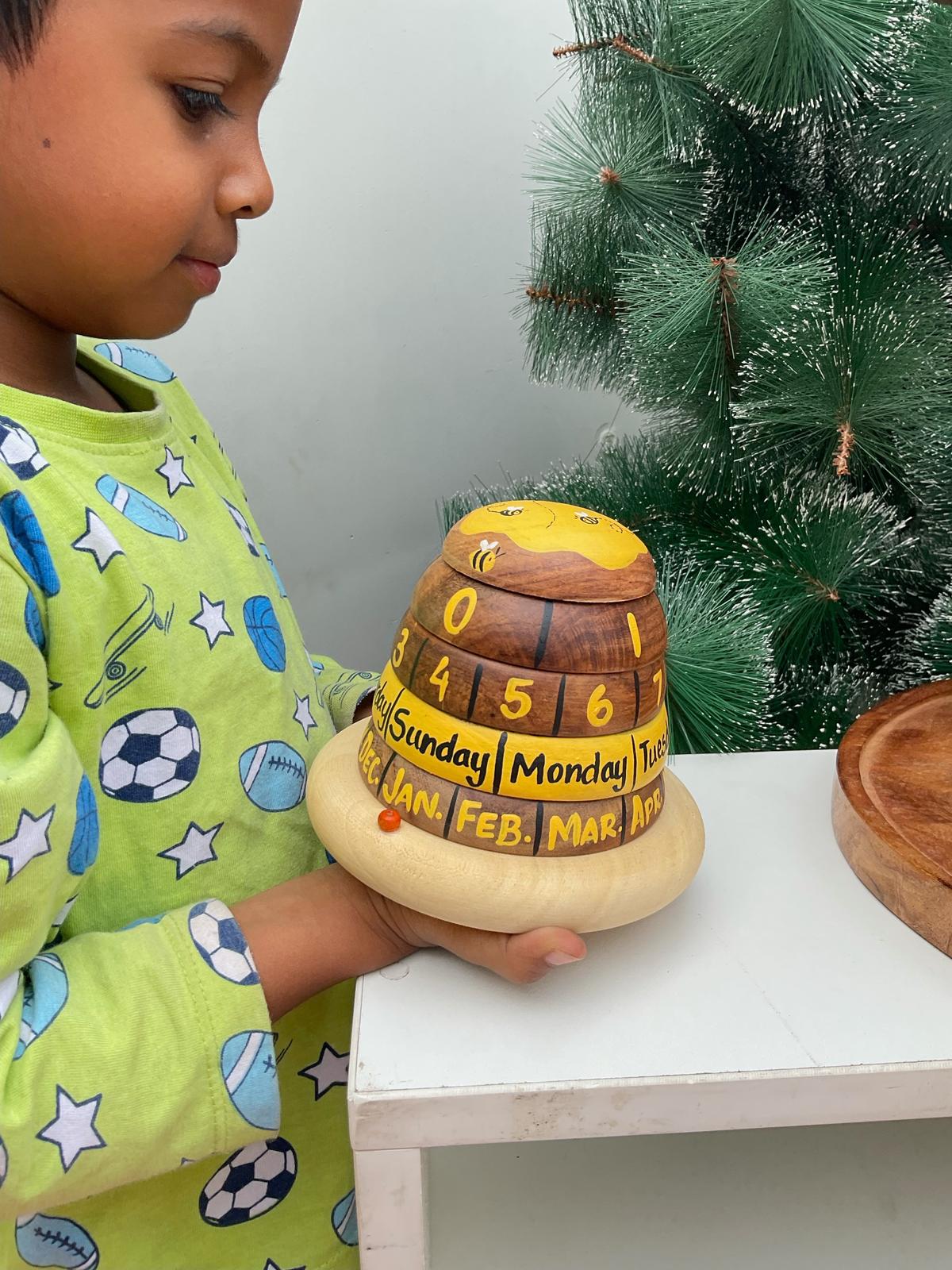
While most calendars turn into art prints (at best) after the year is done, these two variants by artist Nikila Perumal are long-lasting variants. Titled Bee Vibe (₹1,499) and Evergreen Aura (₹1,799), the wooden calendars are crafted in wood and hand painted with non-toxic colours. “Each piece is created to be long-lasting, functional, and environmentally conscious, offering a timeless alternative to disposable annual calendars,” says the Coimbatore-based artist. “These are perpetual calendars and are meant to stay with you forever. Simply rotate the wooden blocks to set the correct month and date. Two numbered blocks allow you to display any date from 1–31, and a slim month block lets you switch the month easily. The mechanism is simple, durable, and designed for everyday use,” explains Nikila. The Evergreen Aura calendar symbolises “growth, grounding, and balance” and its design draws from trees. As for the quirky Bee Vibe, it centres around the honey bee and “nudges you to embrace your authentic self and live with joy”, says the artist who also crafts handcrafted wooden art, peg dolls, and décor.

@picky_artz on Instagram

A snapshot of Abhirami Vaithiyanathan’s calendar

A snapshot of Abhirami Vaithiyanathan’s calendar
| Photo Credit:
Special Arrangement

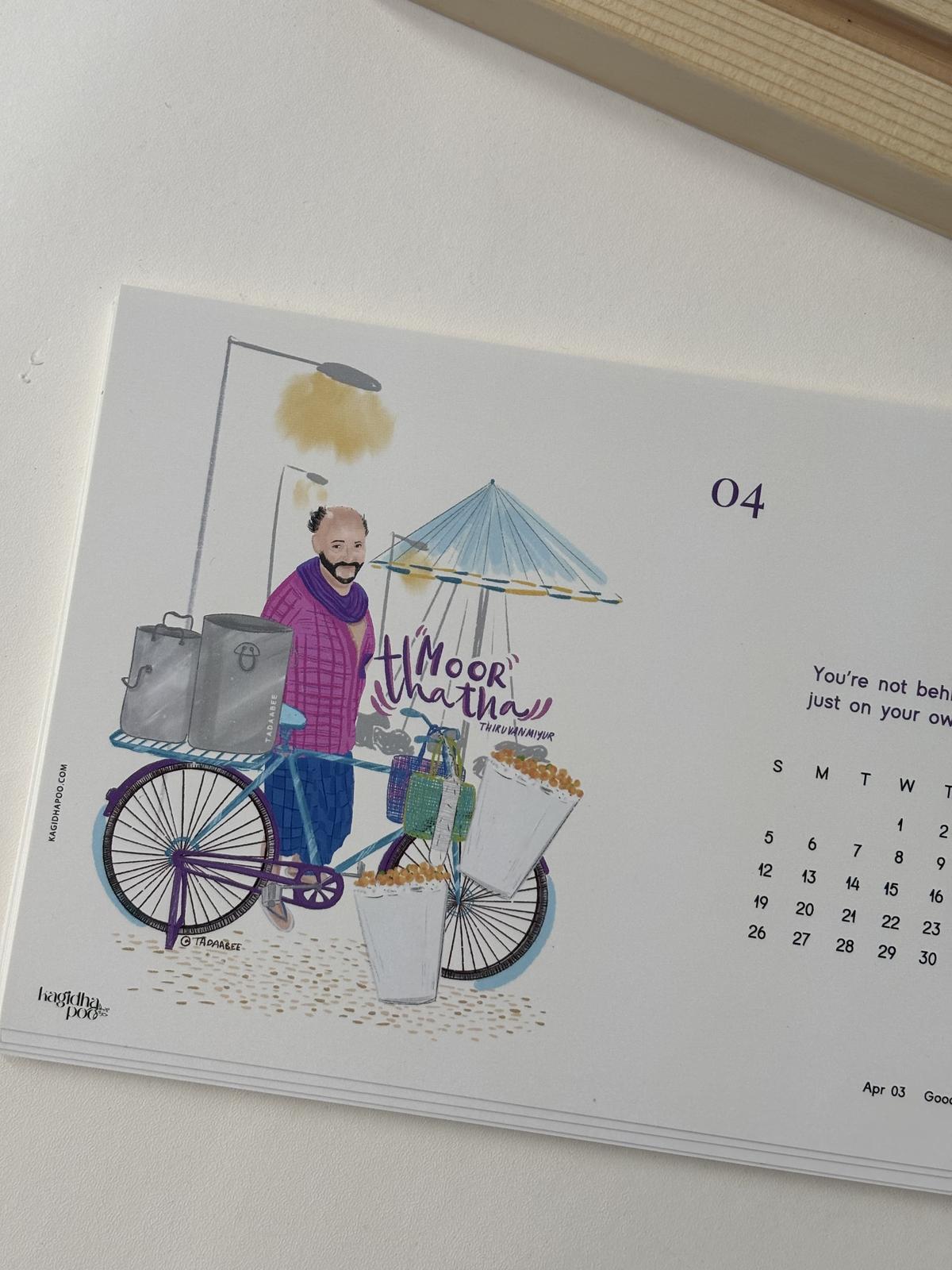
Chennai-inspired @Kagidha Poo

Inktober prompts turn into vibrant calendars at Abhirami Vaithiyanathan’s brand that she launched in 2024. “I began illustrating under the name Tadaabee in 2021, mostly personal art inspired by everyday life in Chennai. I sold stickers and prints at small pop-ups, and as the products evolved into planners, notebooks and calendars, I launched Kagidha Poo as a dedicated merchandise brand.” The 2026 calendar collection features Comfort of Home dedicated to the everyday joys of a home; Chennai Food Trail that showcases Chennai’s iconic local food joints; A Year in Ink that was born out of an Inktober challenge; and A Year in Goals that is a “reminder of every New Year’s resolution we make and hilariously fail to stick to”, says Abhirami. 

Upwards of 999 on kagidhapoo.in

The calendar at Kaapi Clan

The calendar at Kaapi Clan
| Photo Credit:
Special Arrangement

Miniatures and more @Kaapi Clan

This newly-launched art brand by visual artist Sujata Gupta features her art in watercolours, with a special focus on florals and miniature paintings. In 2023, she printed her first batch of miniature desk calendars, and that was the seed that led her to launch the brand earlier this year. The 2026 edition is Sujata’s fourth calendar series and has a Cozy Garden Corners-themed variant; a colourable calendar themed on Jaipur titles; and another colourable one called Small Wonders that features ecological sites. “My watercolour hand paintings are printed on the calendars. Their mini size makes it easy to carry along too,” says the artist based in Dharmasala who also designs journals, colouring books, colourable sheets, planners, desk-friendly collectibles, and illustrated bookmarks.

Upwards of ₹399. @kaapi.clan on Instagram

A spread from Mounica Tata’s calendar for 2026

A spread from Mounica Tata’s calendar for 2026
| Photo Credit:
Special Arrangement

State of whimsy @Doodleodrama

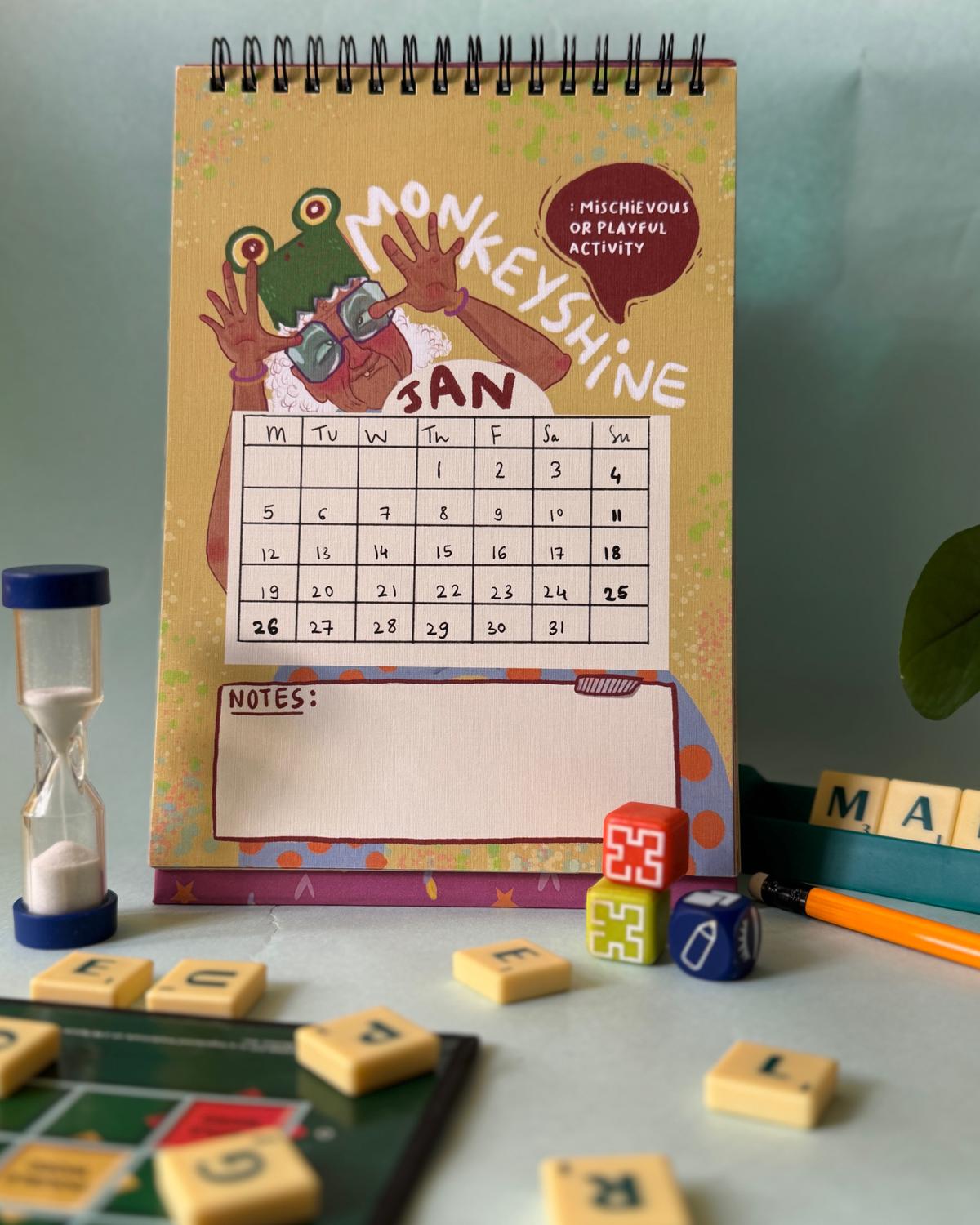
Designer Mounica Tata’s calendar for 2026 is aimed at nudging people to find light and laughter, everyday. Titled State of Play, it is designed “to adopt silliness and whimsy in all current situations, and to be in a state of ‘play’ quite literally”. “All the characters in the calendar are goofy looney old folks, further driving the idea that no matter what age we are, we must never lose our whimsy and wonder,” says Mounica. Each month’s spread highlights one long forgotten English word “that’s silly, light, nonsensical, and perhaps a little mad”. The calendar comes with space to write, a page for yearly goals, and important dates and notes for each month. “There are also two sticker sheets in the calendar and the stand (cardboard back) is also fully printed.”

₹800 on doodleodrama.com


Source link