Life & Style

A team of researchers from Maharaja’s College, Kochi, discovers four new species of lichens from Western Ghats


The ‘Lichenology Lab’ at a corner of the Department of Botany at Maharaja’s College, Kochi, is unassuming at first sight. A few steel cupboards have been packed against its walls and cardboard boxes, files and books are piled neatly on the desks. This seemingly ordinary space, however, opens the doors to a fascinating world of lichens. A herbarium, it houses over 4,000 dried specimens of lichens. 

So what are lichens? Associate Professor of Botany and in-charge of the Lichenology lab at the college, Stephen Sequiera, explains: “They are organisms formed from a symbiotic relationship between a fungus and algae or cyanobacterium. Though they are commonly found on trees, rocks and soil, they still remain largely unexplored,” he says.

Stephen and his doctoral scholars Arun Christy, Aswathi Anilkumar and Arsha S Mohan have discovered four new species of lichens from the Western Ghats, a milestone in biodiversity research. While the discoveries reaffirm the lichen diversity of the Western Ghats, they also highlight the importance of their conservation and sustainable utilisation, says Stephen.
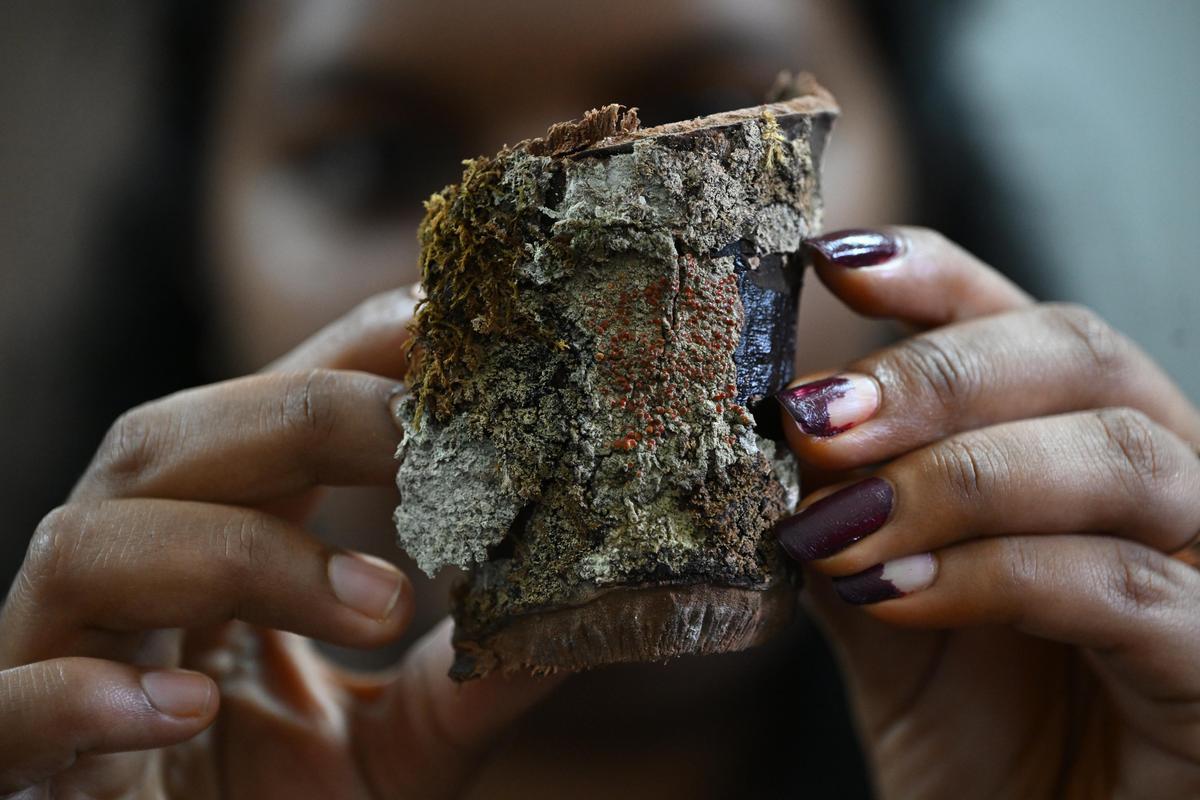
Lichen Haematomma sp

Lichen Haematomma sp
| Photo Credit:
THULASI KAKKAT

Newly-identified species

The newly identified species – Parmotrema sahyadricum (discovered from Wayanad), Solenopsora rhizomorpha (from Eravikulam and Mathikettanshola National Parks), Buelloa ghattensis (Mathikettanshola National Park) and Pyxine janakiae (Mathikettanshola National Park) – have been published in international scientific journals. The work that started in 2022 resulted in these discoveries. The team also recorded more than 50 species of lichens which are new reports to the Kerala part of the Western Ghats.

Solenopsora rhizomorpha

Solenopsora rhizomorpha
| Photo Credit:
Special Arrangement

The collection at the lichen herbarium at the college is one of the most extensive ones at college level and matches that of the Kerala State Council for Science, Technology and Environment (KSCSTE)-Kerala Forest Research Institute (KFRI) and the KSCSTE-Jawaharlal Nehru Tropical Botanic Garden and Research Institutes (JNTBGRI) in Kerala.

Looking for lichens

Lichens are all around us, if we observe them closely, they reveal their secret worlds to us, says this bunch of researchers. They can look very different based on where they grow, appearing as fungal formations on tree trunks and as grass on the soil or rocks. In the herbarium, in their dried form, they appear reduced to a grey smear or a discoloured knot of thread. 

Parmotrema nilgherrense

Parmotrema nilgherrense
| Photo Credit:
THULASI KAKKAT

Out of the 3,000 species of lichens in India, 1,706 of them are found in the Western Ghats, says Stephen, who has been studying lichens since 1998, when he was pursuing his doctoral programme at the KFRI, Peechi, Thrissur. He completed a KSCSTE-funded research project on the lichens of Kerala, in 2022, under which he developed a dedicated Lichen House at the Malabar Botanical Garden and Institute for Plant Sciences (MBGIPS) in Kozhikode. This facility, Stephen says, has over 100 species and was set up for the benefit of students, researchers and the general public, to see and explore lichen species that may otherwise go unnoticed. Even lichen species that are found in higher altitudes can be seen at the facility.

Biomonitoring agents

Kerala has over 800 species of lichens, he adds. Lichens play a vital role as biomonitoring agents owing to their carbon sequestration ability and sensitivity to air pollution. They absorb pollutants directly from the air; thereby indicating the health of the environment. “In 2022, as an experiment, we collected lichens from Wayanad and planted them in the Manjummel-Edayar region. After 28 days, when we checked, we could confirm the presence of heavy metals such as Copper, Zinc and Lead in them, which indicates the level of air pollution in the region,” says Stephen, who has described nearly 15 new species of plants from Kerala, including orchids, balsams and bamboos. 

Pyxine janakiae

Pyxine janakiae
| Photo Credit:
Special Arrangement

Lichens also act as fertilisers in forests, as they break down rocks, disintegrating it to soil, fixing nitrogen and letting other life forms grow. “Lichens have medicinal properties too. Some species have anti fungal, anti tumor and anti cancer properties, they are used as food preservatives and flavouring agents as well,” Stephen explains.

Stone flower lichen, popularly known as kalpasi in Tamil and Dagad Phool in Hindi, is widely sold as a flavouring agent, especially in biryanis. Forest dwellers and indigenous communities, who know the medicinal value of some lichen species collect and sell them, too. 

For the young scholars Arun, Ashwati and Arsha, who chose to study lichens, they are a constant source of inspiration. “There is still very little literature on lichens, and to a researcher, they hold huge potential,” says Arun.


Published – November 07, 2025 04:28 pm IST


Source link

Hyundai Venue: A big change, but at what cost?


The new Hyundai Venue no longer feels like a compact SUV. It looks and behaves like something far more grown up — and that is entirely by design. Hyundai has re-engineered and redesigned it to be taller, wider, and longer in wheelbase, giving it a stronger, more confident stance that is reminiscent of the Creta. The design is bold and assertive, dominated by Hyundai’s parametric grille, horizon-style LED DRLs, and connected LED tail lamps. There is a sense of substance now, a hint of SUV maturity that the old Venue never quite managed to pull off. Even the N Line variant doubles down on that image, with red accents, R17 alloys, and twin-tip exhausts that lend it a sportier, more dynamic personality.

Inside, Hyundai has truly raised the bar. The cabin feels richer, more layered, and clearly built to impress. The twin 12.3-inch curved panoramic displays immediately dominates the dashboard — one for the instrument cluster and the other for the infotainment hub, both powered by Hyundai’s NVIDIA-based ccNC system. It is fast, slick, and visually stunning. The materials, too, are mostly excellent, from the soft-touch panels to the leatherette upholstery and ambient lighting. The Bose sound system, wireless smartphone connectivity, and voice-enabled sunroof all contribute to a cabin experience that feels one step ahead of its class.

Twin 12.3-inch curved displays and premium materials give the cabin a distinctly upmarket vibe.

Twin 12.3-inch curved displays and premium materials give the cabin a distinctly upmarket vibe.
| Photo Credit:
Special Arrangement

There is a sense of space and comfort that the older Venue lacked. The rear seats now recline, knee room has noticeably improved , and thoughtful additions such as the rear sunshade and a 4-way powered driver’s seat give it a distinctly premium touch.

Hyundai has done its homework on comfort and convenience. But not every choice feels inspired. The moulded plastic on the centre console, for instance, does not quite match the overall premium feel of the cabin. It is hard, a bit hollow, and somewhat out of place in an otherwise well-finished interior. Then there is the placement of the reverse lights — tucked low into the rear bumper. For India’s chaotic traffic and tight parking spaces, that is a practical misstep. In a country where tight squeezes, impatient bikers, and fender-benders are part of daily life, that design detail could prove costly. Small issues? Yes. But ones that could bother everyday owners more than Hyundai might expect.

Out on the road, the new Venue delivers exactly what you would expect from a modern Hyundai — refinement. The suspension setup is well-judged, offering a planted, composed ride over rough patches while keeping things smooth in the city. It feels more mature , calmer than before, and perfectly suited to the daily grind as well as long weekend drives. The steering is light but direct, the brakes feel solid, and the cabin insulation keeps most of the outside world where it belongs — outside.

Reclining rear seats, ambient lighting, and a powered driver’s seat make the Venue feel a class above.

Reclining rear seats, ambient lighting, and a powered driver’s seat make the Venue feel a class above.
| Photo Credit:
Special Arrangement

The engine lineup, however, feels all too familiar. Hyundai continues with the 1.2-litre naturally aspirated petrol, the 1.0-litre turbo-petrol, and the 1.5-litre diesel. While they are all proven units, they don’t exactly inject excitement into the mix. The 1.2 NA engine, in particular, feels underwhelming — it struggled to make the smaller Exter feel lively, and in the heavier Venue, it feels even more sluggish. The turbo-petrol is smoother and pairs well with the 7-speed DCT, but its character leans toward comfort rather than thrill. The diesel remains the practical choice — torquey and efficient — but it doesn’t elevate the driving experience.

And that’s where the Venue begins to lose ground to its rivals. The Skoda Kushaq and VW Taigun mid variants, with their TSI engines, feel more engaging to drive. The Mahindra XUV 3XO brings punchy performance, robust value, and a sense of freshness to the table. Even the Kia Sonet, which has consistently outsold the Venue since launch, manages to feel a touch more cohesive in how it balances style, power, and polish. Hyundai’s refinement remains its biggest strength — but also, perhaps, its limitation.

With over 65 safety features and Level 2 ADAS, the new Venue brings Hyundai’s most advanced safety suite yet.

With over 65 safety features and Level 2 ADAS, the new Venue brings Hyundai’s most advanced safety suite yet.
| Photo Credit:
Special Arrangement

Safety, though, is one area where Hyundai has clearly stepped up. The new Venue gets over 65 safety features, 33 of which are standard, along with Level 2 ADAS. The chassis uses 71% high-strength steel, there are six airbags, ESC, all-disc brakes, and a host of driver-assist functions. It is a genuine move forward — one that finally puts Hyundai in a stronger safety conversation in India.

Yet, even as the Venue impresses, a note of concern lingers. And the pricing tells its own story. The base variant at ₹7.89 lakh is mostly a formality — a marketing number anchored by that underpowered 1.2-litre engine. The real Venue — the one with the features, tech, and power trains people will actually want — costs between ₹13 to ₹15.69 lakh. And at that price, it’s treading in the same waters as its own sibling, the Creta, and segment rivals like the mid level variants of the Seltos, Kushaq, and Taigun. The irony is hard to ignore: the compact SUV that once sat neatly below the Creta is now knocking on its door.
And that poses a bigger problem for Hyundai. The Creta has been the brand’s lifeline in India — its one true blockbuster. The Verna, Alcazar, and Exter have not managed to deliver consistent numbers, leaving Hyundai’s SUV strategy resting almost entirely on the Creta’s shoulders. By pushing the Venue upward, Hyundai risks cannibalising its own star performer — and just as the Creta prepares to face fresh heat from the new Kia Seltos launching this December. The Venue’s climb upmarket, combined with the Seltos’ renewed assault, could squeeze Hyundai from both sides — its compact SUV competing internally, and its bestseller facing external pressure.

The Venue’s upmarket move reflects Hyundai’s confidence — but also its toughest balancing act yet.
Hyundai Venue 2025 review

The Venue’s upmarket move reflects Hyundai’s confidence — but also its toughest balancing act yet.
Hyundai Venue 2025 review
| Photo Credit:
Special Arrangement

Then there’s the timing. The compact SUV segment is already overflowing with strong contenders. The Kia Sonet remains a customer favourite, the Mahindra XUV 3XO is rewriting the value equation, the Tata Nexon continues its stronghold, and the quietly emerging Skoda Kylaq brings solid build and TSI performance to the mix. The Venue, though improved in every measurable way, feels like it is entering a conversation that has already moved on.
There’s no questioning the effort behind this car. It is stylish, comfortable, loaded with features, and undoubtedly safer than ever before. It reflects Hyundai’s growing engineering maturity and its understanding of Indian buyer aspirations. Yet ambition and timing don’t align perfectly. The new Venue represents a significant step forward — one that commands respect. Yet, it also feels like a car caught between its own identity and its maker’s ambition.

Hyundai has built a fine SUV here, but whether it’s the right car for this moment and this market remains uncertain. The Venue’s success is far from assured, and for once, Hyundai might find itself waiting to see if India agrees with the price of progress.

Hyundai Venue Price Range: 7.89 lakh – 15.69 lakh (ex-showroom)

Motorscribes, in association with The Hindu, brings you the latest in cars and bikes. Follow them on Instagram


Source link

Second edition of Manotsava, a festival on mental health, to be held in Bengaluru


The second edition of Manotsava, a festival on mental health, will focus not only on mental illness “but also on well-being,” says Rohini Nilekani, chairperson of Rohini Nilekani Philanthropies (RNPF), which is organising the event in partnership with the National Institute of Mental Health and Neurosciences (NIMHANS), and the National Centre for Biological Sciences (NCBS). “We learnt a lot last year, and the team has really worked hard to apply it,” she says of the festival, which will be held on November 8 and 9 at The Lalit Ashok, Bengaluru.

At the 2024 edition of Manotsava 

At the 2024 edition of Manotsava 
| Photo Credit:
Special Arrangement

Themes that will be explored at the festival include maternal mental health, workplace burnout, technological tools to support mental health, genetic research, psychedelics, the science of the gut-microbiome and the impact of sexuality on mental health. Dr Pratima Murthy, Director, NIMHANS, says that some sessions will examine mental health across different life stages of human beings, including pregnancy, adolescence and ageing and explore “how do you make it a very positive experience and recognise mental health distress and disorders that can come in.”

The other aspects the festival will examine are the changing times we live in, both the challenges and opportunities presented by them, as well as the linkages between mental, social, physical, and spiritual well-being.

At the 2024 edition of Manotsava 

At the 2024 edition of Manotsava 
| Photo Credit:
Special Arrangement

These ideas will be disseminated at the festival via panel discussions, talks, stalls, exhibits, workshops, discussions and a music performance. There will also be a series of pre-fest events as well as a dedicated children’s zone at the festival.

LS Shashidhara, director of NCBS, elaborates on the diverse nature of the events and participants at Manotsava: “In a festival like this, hundreds of people can come and congregate to understand different issues and ways to prevent some of these tensions and anxieties.” Additionally, “they also have the opportunity to interact with scientists, clinicians and experts,” so that “they become more knowledgeable and can help spread this message to others.”

Rohini Nilekani, Dr Pratima Murthy and LS Shashidhara

Rohini Nilekani, Dr Pratima Murthy and LS Shashidhara
| Photo Credit:
Special Arrangement

The keynote speakers at the event are Dr Richie Davidson (Centre for Healthy Minds), Rohini Nilekani (Rohini Nilekani Philanthropies), Kiran Mazumdar-Shaw (Biocon Groups) and Nithin Kamath (Zerodha). The list also includes Dr Prabha Chandra (NIMHANS), Prof Vidita Vaidya (TIFR Mumbai), Dr Kaz De Jong (Médecins Sans Frontières), Dr Amit Malik (Amaha), and Prof Surya Dolla (IIT Bombay), among others.

The festival will not shy away from having difficult conversations about mental well-being. One such panel discussion is titled ‘Suicidality – A Concern for All.’ Among the panellists is Neha Kirpal, co-founder of Amaha Health and part of the founding cohort of the India Mental Health Alliance, who lost her younger sibling to suicide and feels strongly about the importance of speaking about the issue. In her opinion, when a suicide happens, a lot of attention is devoted to examining the proximate trigger that leads to a tragedy of this nature, such as examining the type of fans being installed in dorm rooms.

Neha Kirpal

Neha Kirpal
| Photo Credit:
Special Arrangement

“But we are not looking at the reasons why the crisis is coming about in the first place. It could be loneliness, lack of connection, peer pressure, bullying or drug addiction,” says Neha, co-author of Homecoming, an anthology that brings together the lived experiences of women leaders navigating severe mental health conditions. “Looking at the cause, rather than just treating the symptoms and outcomes, is really important. Otherwise, we will always be playing catch-up.”

To know more, log in to www.nationalmentalhealthfestival.com

Published – November 07, 2025 11:15 am IST


Source link

The Taj Mahal speaks for itself | At DAG’s new ‘The Mute Eloquence of the Taj Mahal’ exhibition


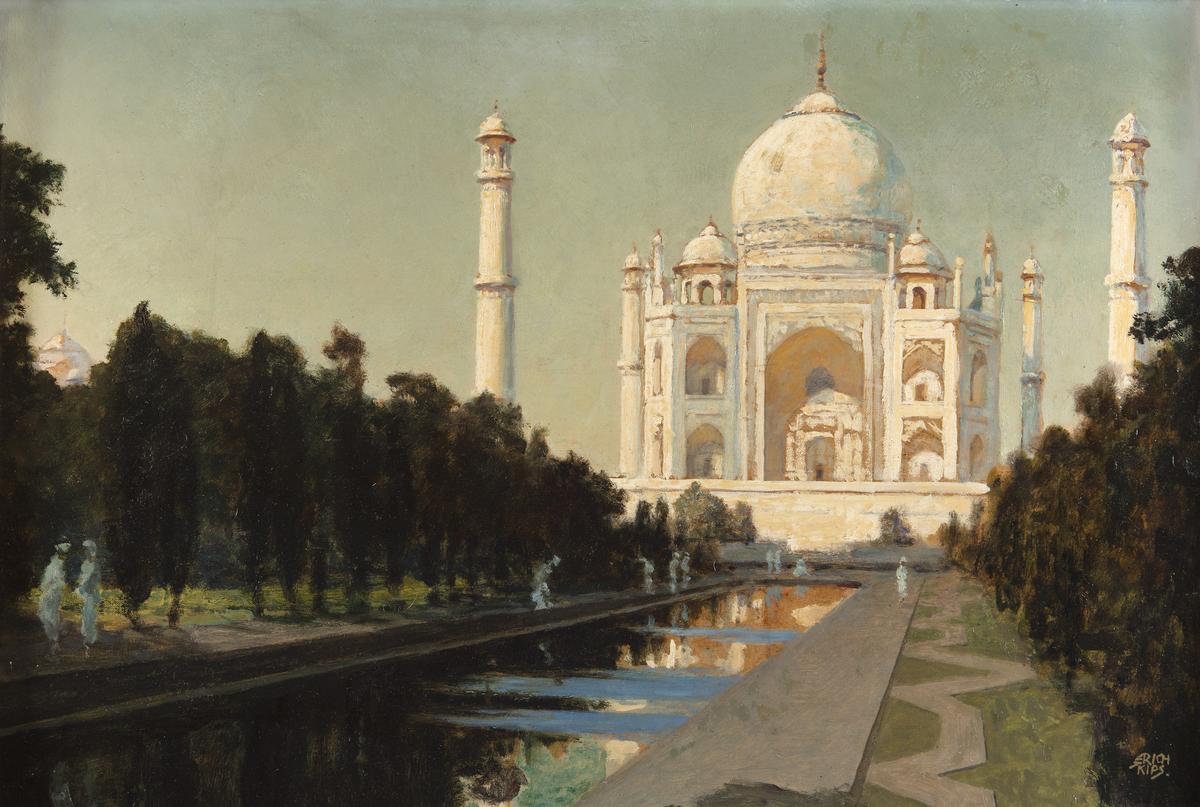
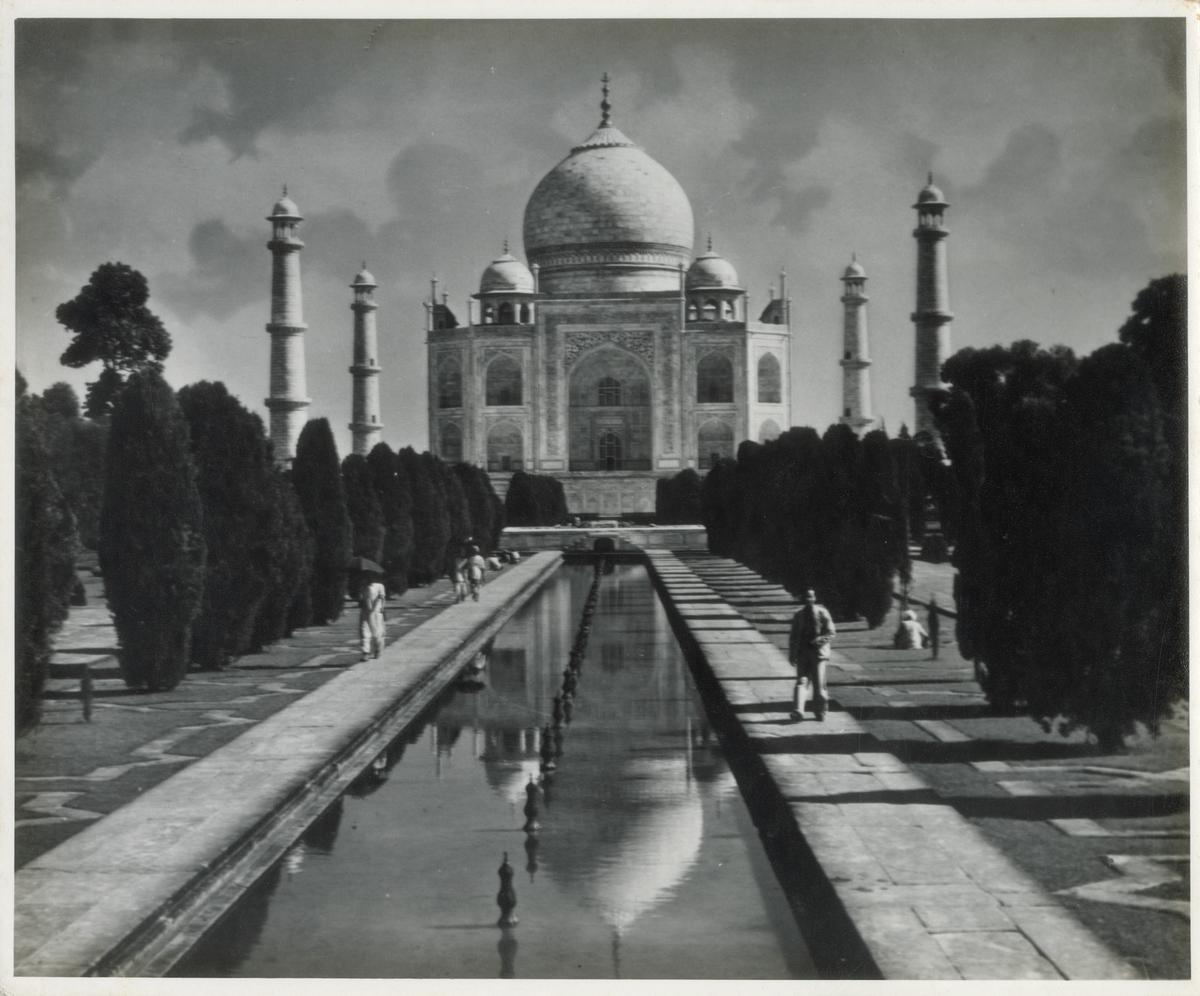
The first unobstructed view of the Taj Mahal from the Darwaza-i-Rauza (grand entranceway) is one of the most recognised images from India. However, the image would have looked strikingly different had Mughal emperor Shah Jahan’s original vision endured.

The manicured lawns of today, that follow the Char Bagh design, had in the original layout featured abundant fruit trees and flowering beds to create a lush garden based on the Quranic vision of paradise. It was Lord Curzon who, during his tenure as Viceroy of India, got the trees cut to cater to more European sensibilities.

Erich Kips’ Taj Mahal

Erich Kips’ Taj Mahal
| Photo Credit:
Courtesy DAG

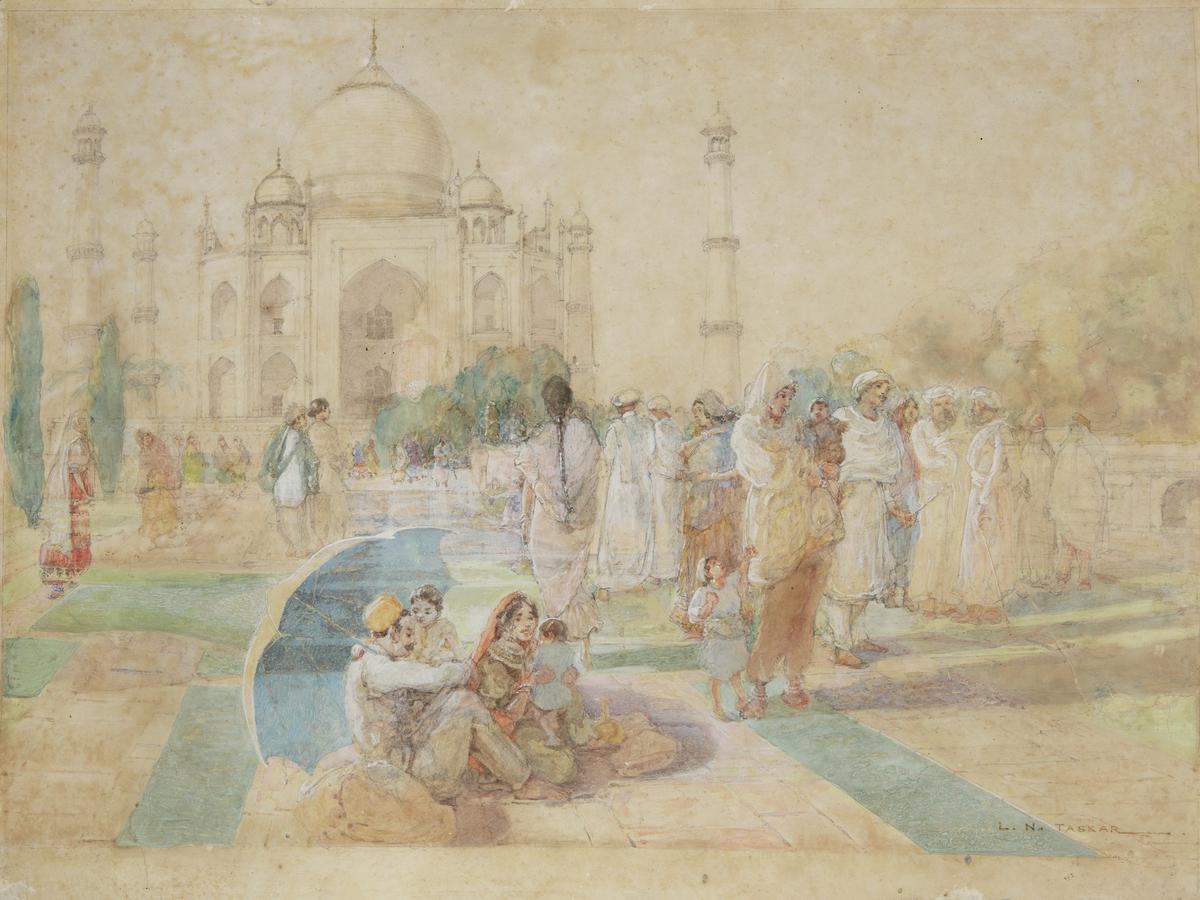
While you can still read about the Mughal emperor’s paradisiacal garden in textual accounts from that period, DAG has put together a visual narrative — through over 200 photographs, paintings and postcards spanning from the 18th to mid 20th century. Curated by historian Rana Safvi, the collection of Company School paintings alongside works by foreign and modern Indian artists takes viewers through the Taj Mahal and its complex over the years.

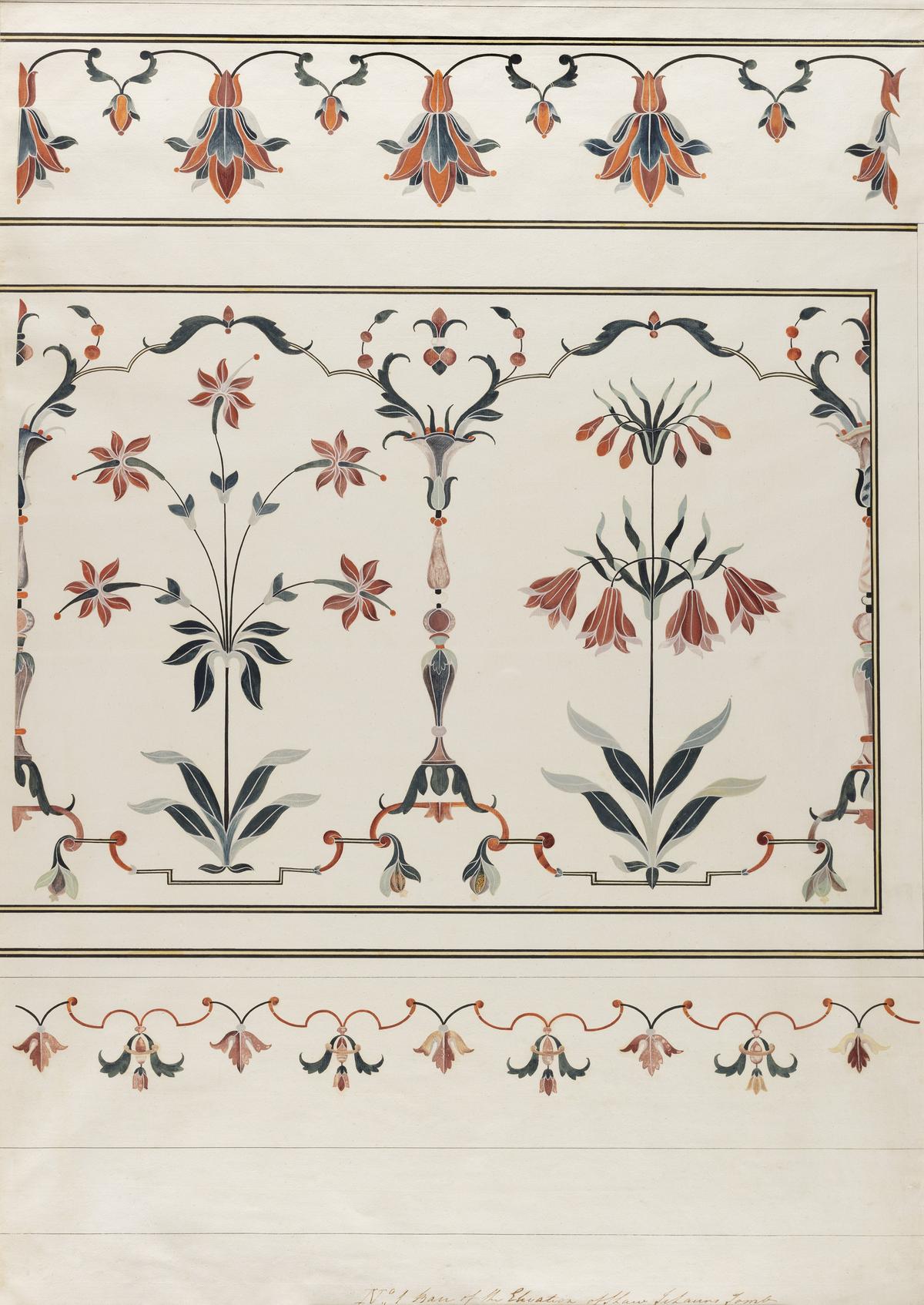
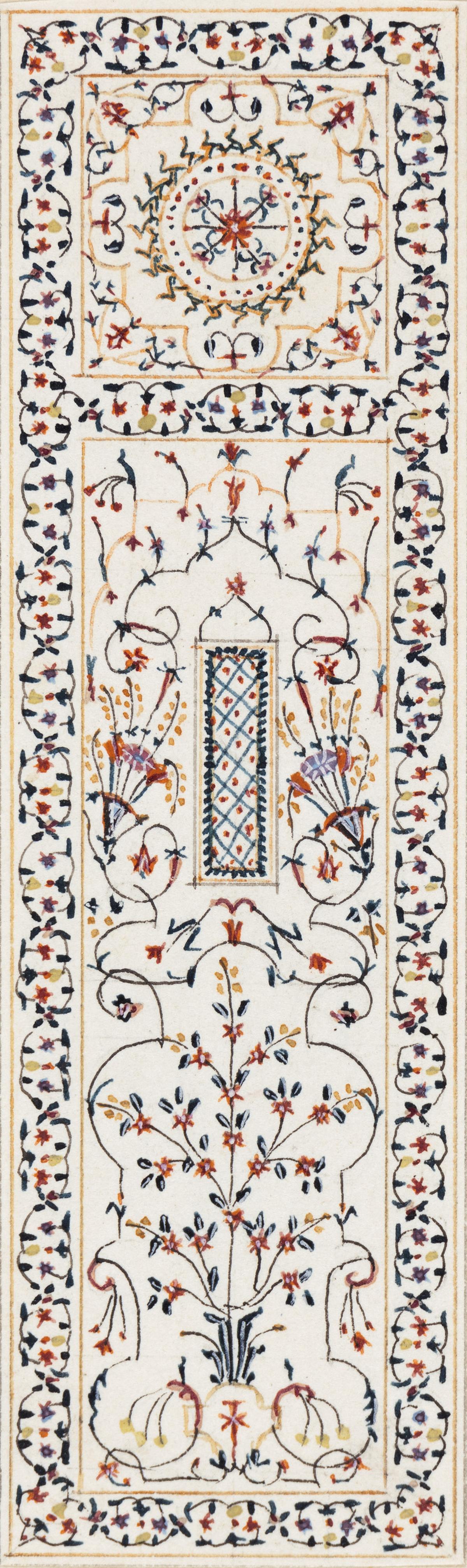
Titled The Mute Eloquence of the Taj Mahal, it tells the story of the mausoleum by sometimes zooming into the language of the flowers expressed through the beautiful pietra dura inlay work on the cenotaph or taking a macro view of how the Taj cast its shadow over Agra. The exhibition positions the Taj as ‘speaking’ to the visitors, offering them an immersive look at its stunning architecture, its history of imperial ambition, and its enduring love story — all while staying a mute sentinel.

Detail of pietra dura work on the cenotaph of Shah Jahan at the Taj Mahal by  Agra artist (Company School)

Detail of pietra dura work on the cenotaph of Shah Jahan at the Taj Mahal by Agra artist (Company School)
| Photo Credit:
Courtesy DAG

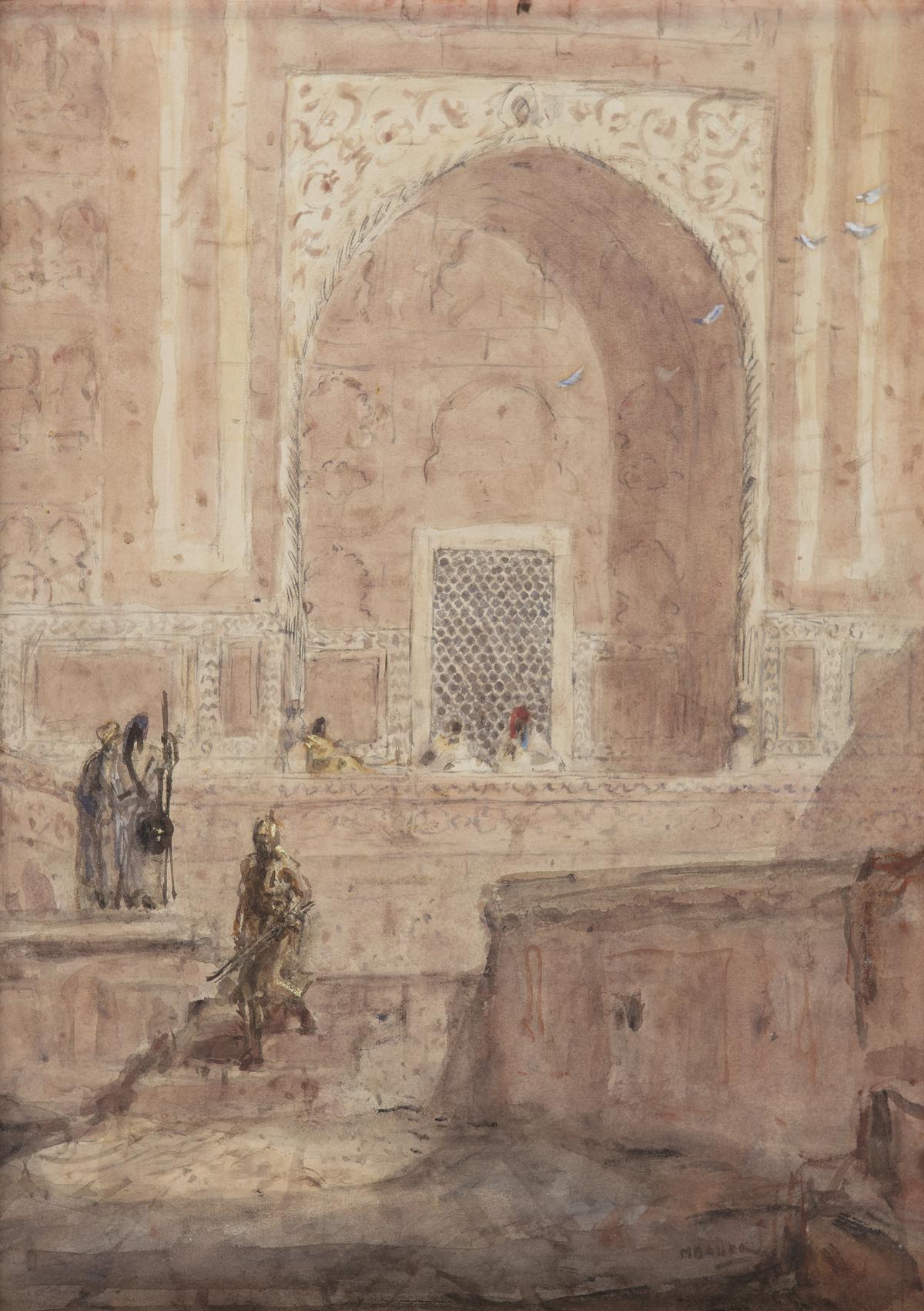
Marius Bauer’s Indisch Paleis (Indian Palace | The Gateway of the Taj Mahal)

Marius Bauer’s Indisch Paleis (Indian Palace | The Gateway of the Taj Mahal)
| Photo Credit:
Courtesy DAG

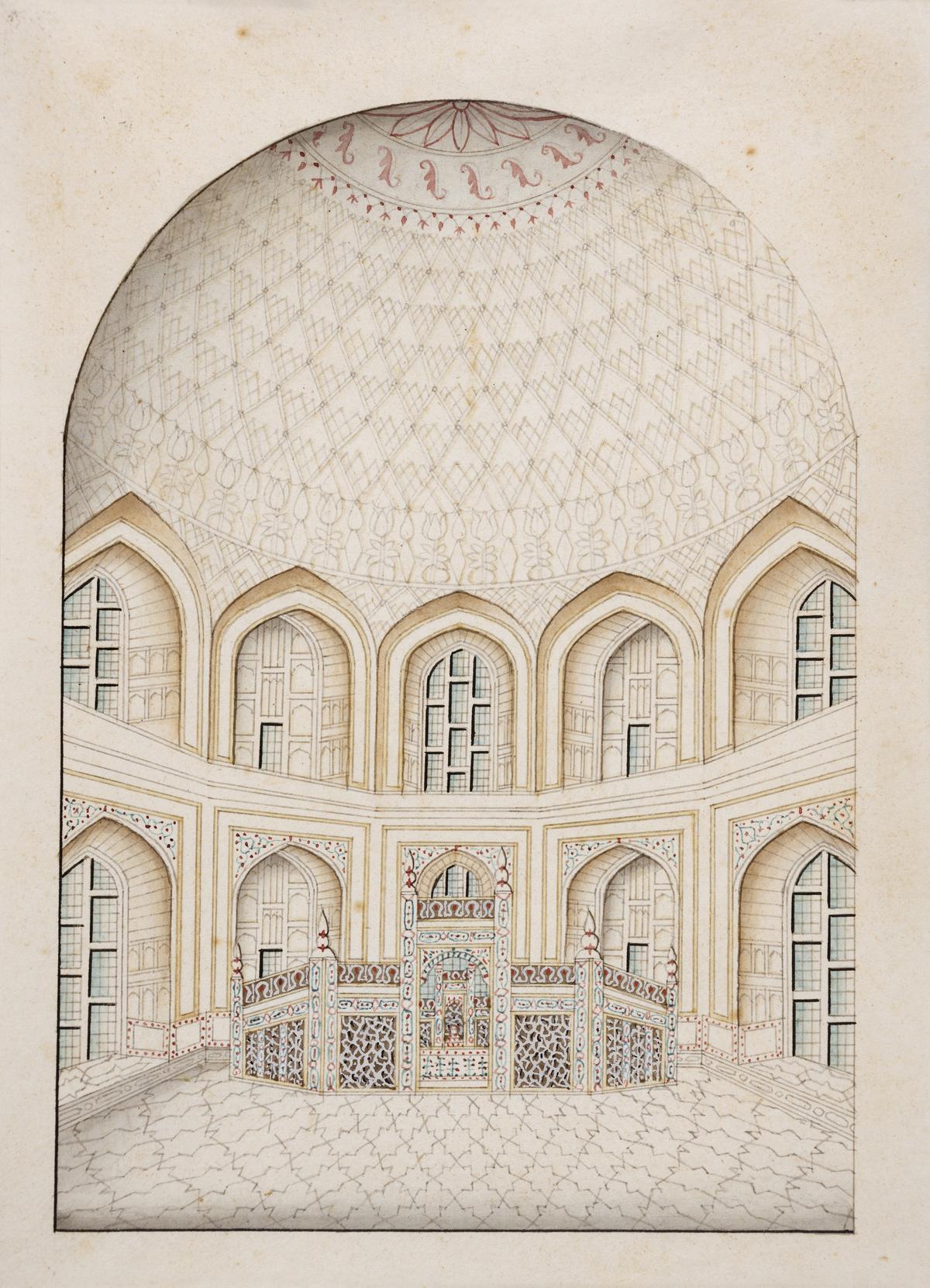
Interior of the Taj Mahal by an Agra artist (Company School)

Interior of the Taj Mahal by an Agra artist (Company School)
| Photo Credit:
Courtesy DAG

Design speak

Rana says she took a cue from Shah Jahan’s court chronicler Abdul Hamid Lahori, who spoke of the ‘mute eloquence’ of what he called the ‘Rauza-i Munawwara’ (the illumined tomb), to curate the show. She shows how the tomb’s design and details, such as the careful selection of quotations from the Quran and the decorative flowers that adorn it, like the reverse tulip used to depict gloom, tell us of the beliefs and aspirations of the people who built the 7th Wonder of the World.

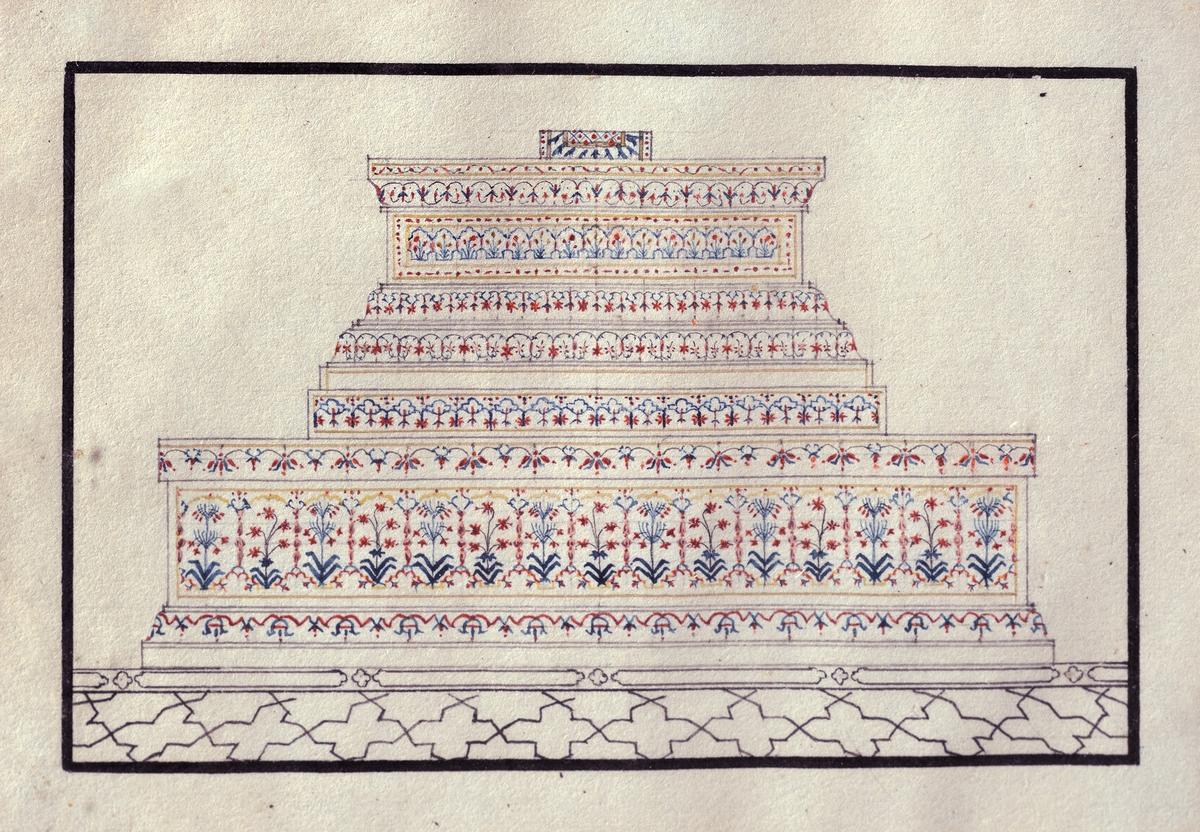
The top of the cenotaph of Shah Jahan by an Agra artist (Company School)

The top of the cenotaph of Shah Jahan by an Agra artist (Company School)
| Photo Credit:
Courtesy DAG

The Tomb of Shah Jahan by an Agra artist (Company School)

The Tomb of Shah Jahan by an Agra artist (Company School)
| Photo Credit:
Courtesy DAG

Having studied the Taj Mahal as a student, it was when Rana was studying sufisim (and learning Shah Jahan had been trained as a Sufi, which gives immense importance to life after death) that she once more started reading and researching it. “The Taj Mahal’s design is based on the theme of morality, resurrection and divine harmony of the Islamic vision of jannat [paradise]. Shah Jahan, who at that time controlled almost a quarter of the world’s GDP, set about to build a veritable ‘paradise on earth’ as a resting place for Mumtaz Mahal,” she says, explaining that the exhibition takes one through the monument’s conception, construction, and evolution (as envisioned by the emperor), to the Taj that we know today as a symbol of romance.

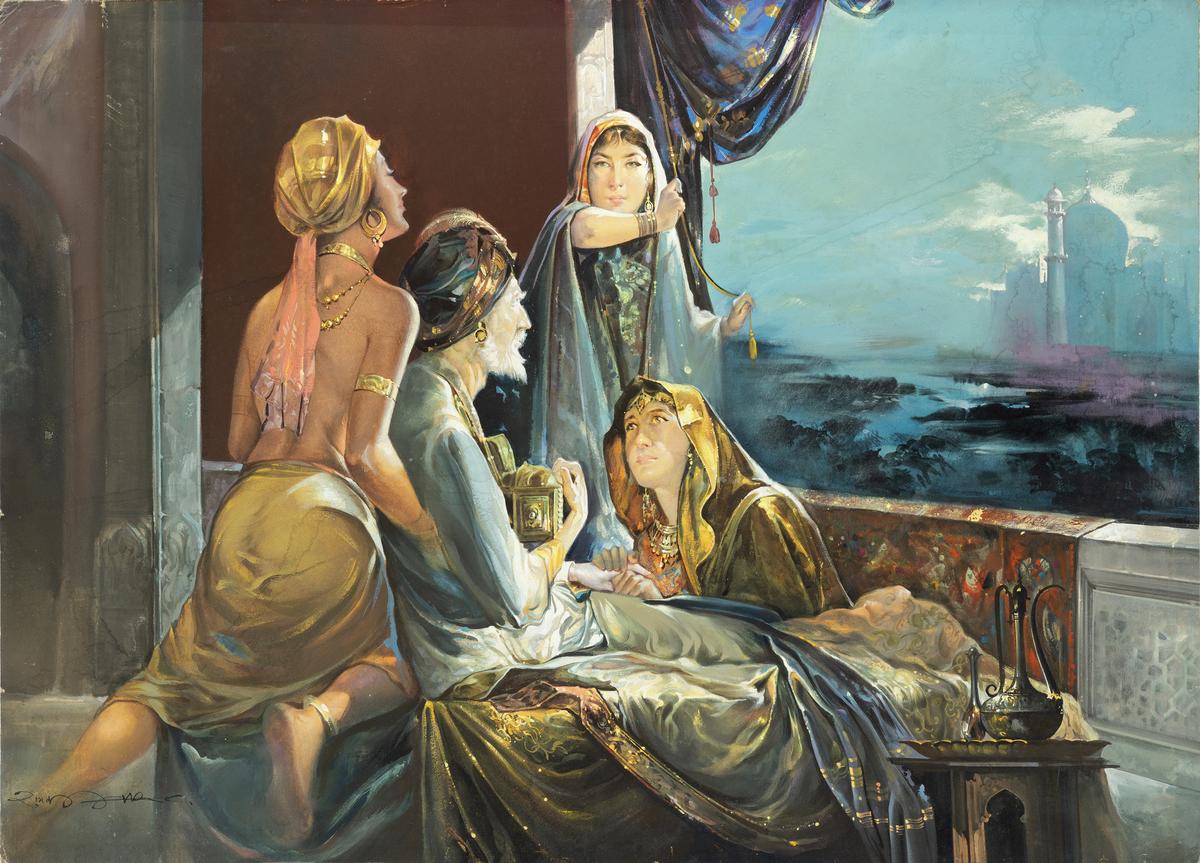
Untitled (The Last Days of Shah Jahan) by an unidentified artist (after Cecil Burns)

Untitled (The Last Days of Shah Jahan) by an unidentified artist (after Cecil Burns)
| Photo Credit:
Courtesy DAG

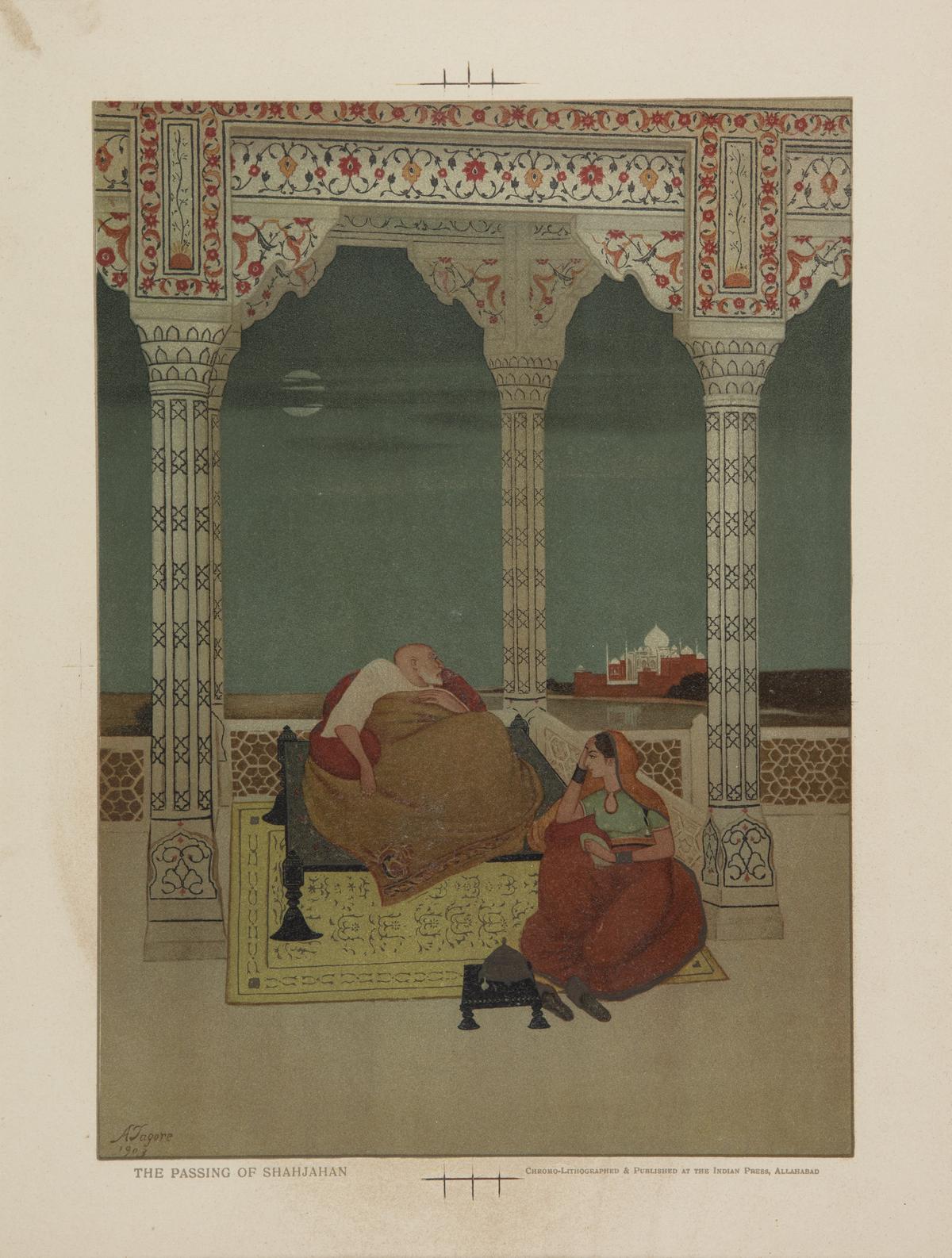
The Passing of Shahjahan by  Abanindranath Tagore

The Passing of Shahjahan by Abanindranath Tagore
| Photo Credit:
Courtesy DAG

Debunking ‘The Taj Story’

Incidentally, the exhibition coincides with the release of The Taj Story. The film stars Paresh Rawal, and draws on writer P.N. Oak’s book that makes an argument that the tomb was originally a Shiva temple. “Taj Mahal is not a symbol of love but a symbol of atrocity and genocide,” goes a line in the film, and it has sparked discussions on the monument — its Hindu motifs, such as the kalash, and the PILs filed in the Allahabad High Court on the 22 rooms that remain out of public view in the basement of the monument — despite the ASI releasing photographs in 2022 debunking claims.

Poster of The Taj Story starring Paresh Rawal

Poster of The Taj Story starring Paresh Rawal
| Photo Credit:
Special arrangement

At a time of historical revisionism and heritage politics, when chapters on Mughal history are being deleted from the Class VII NCERT textbooks, cities are being renamed to “restore” their ancient identity, and even the Taj has become contested territory, the exhibition is a form of public scholarship. “My style is never to contradict or fight with anybody. I just state facts,” says Safvi, commenting on the release of the film and the controversy surrounding it. “The court poets of the Mughals were very meticulous about record keeping and their works contain detailed descriptions of the Taj Mahal, the land it sits on, and why the particular site was chosen.” She also states that the mausoleum is a culmination of Indo-Islamic architecture and, therefore features like the kalash are a part of its design.

The Taj Mahal, Agra (unidentified photographer)

The Taj Mahal, Agra (unidentified photographer)
| Photo Credit:
Courtesy DAG

L.N. Taskar’s Untitled (Taj Mahal)

L.N. Taskar’s Untitled (Taj Mahal)
| Photo Credit:
Courtesy DAG

So, while the 400-year-old monument remains a mute narrator and spectator, perhaps we should look at the exhibition and make up our own minds.

The Mute Eloquence of the Taj Mahal’ is on at the DAG till December 6.

Published – November 07, 2025 07:17 am IST


Source link

Danish Mahal: inside Lucknow’s Urdu landmark


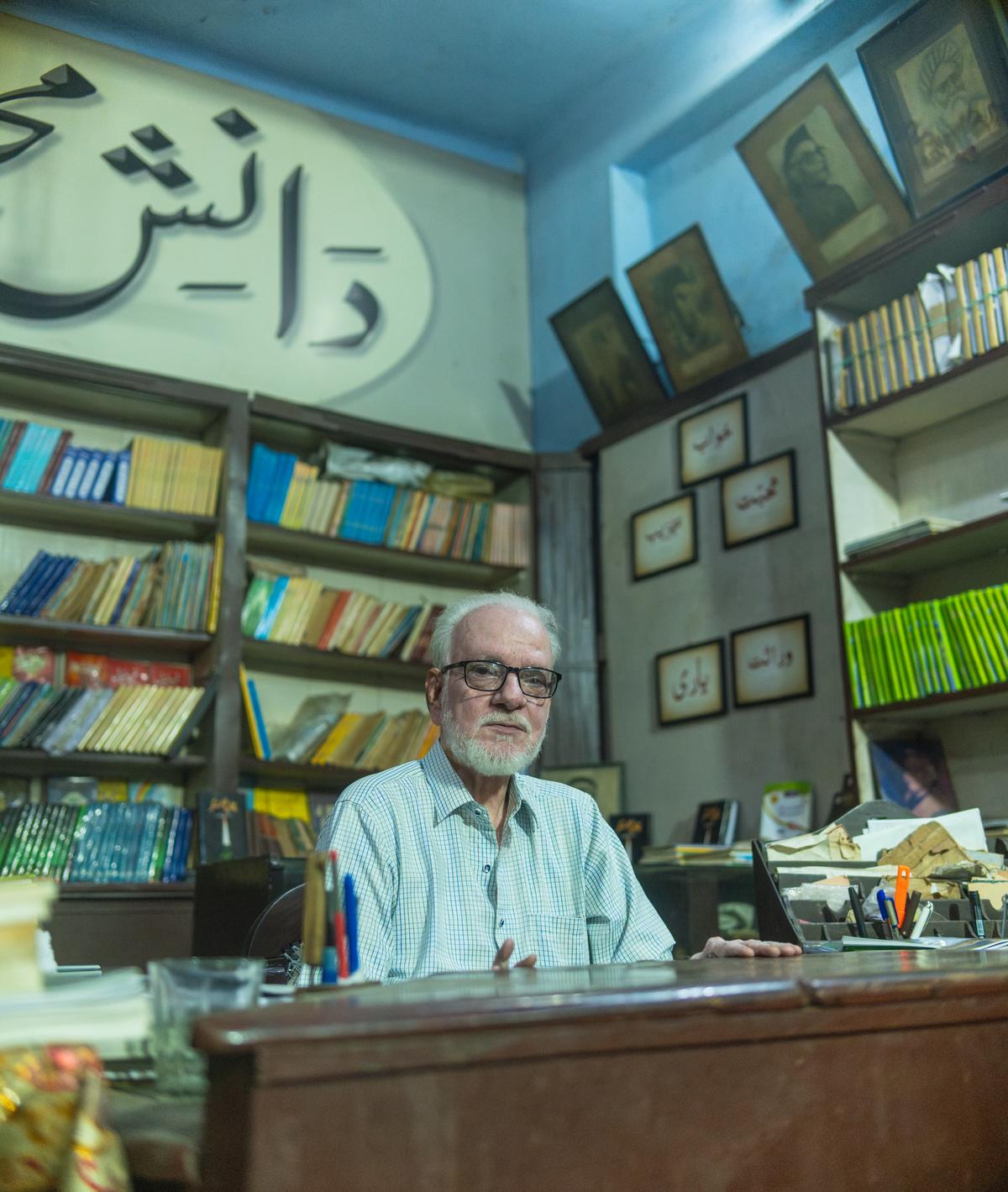
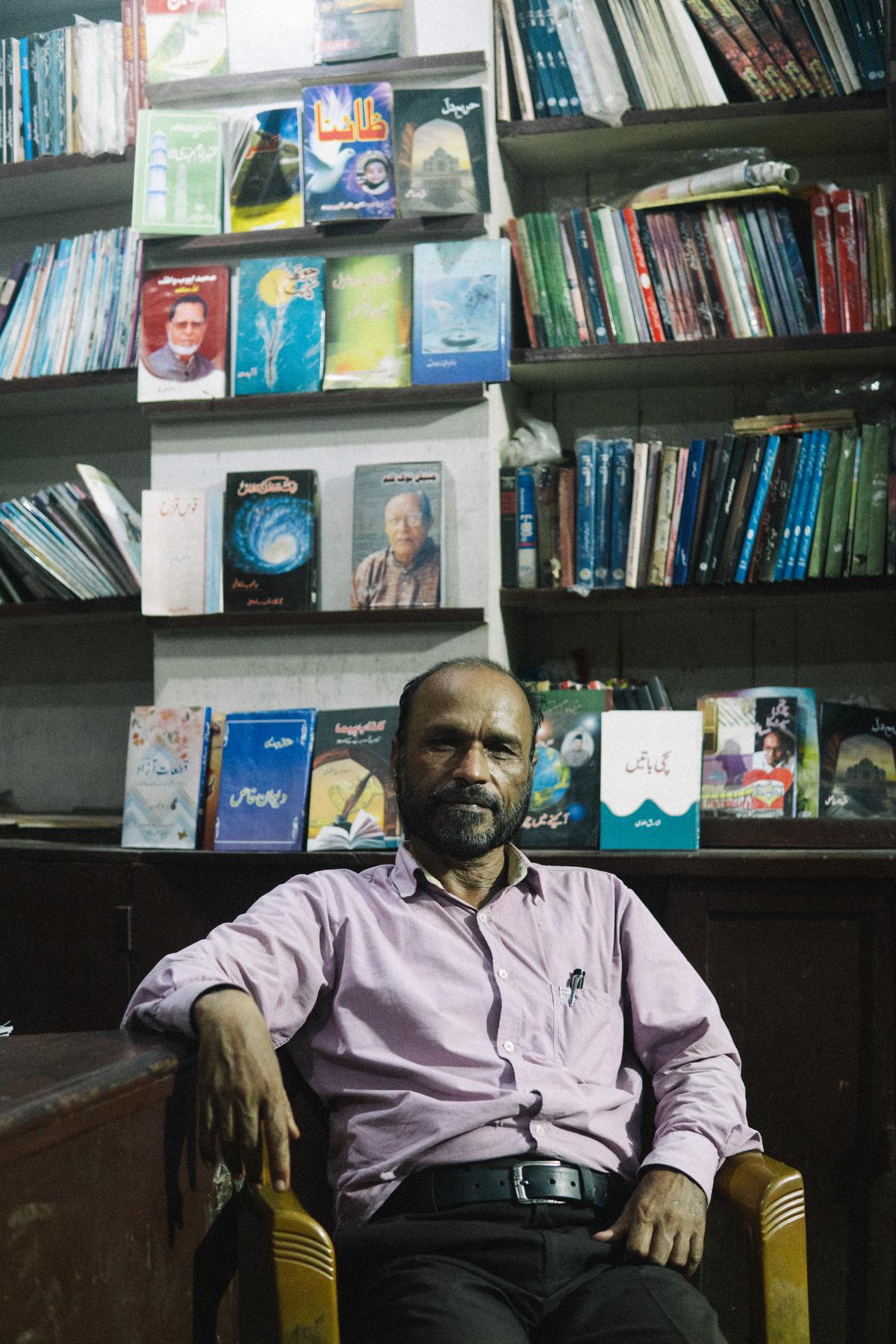
It is while flipping through the yellowed pages of an old feedback register at Danish Mahal that I spot Manzoor Parwana. Seated quietly in his chair, sipping a glass of tea, the 77-year-old retired officer from Lucknow’s Agriculture Department exudes calm dedication, seemingly inseparable from the ancient walls around him.

Down the narrow, bustling lanes of Aminabad, in the heart of Lucknow, Danish Mahal is an Urdu bookstore that has long been a sanctuary for poets, scholars, writers, and thinkers. It occupies the ground floor of a multi-purpose structure, with a simple verandah acting as a buffer from the lively street. Many argue that calling it merely a bookstore understates its value. It’s better seen as a maqam-e-hikmat (place of wisdom), tarbiyat-gah (centre for nurturing), and taleem-gah (institution of learning).

Manzoor Parwan

Manzoor Parwan
| Photo Credit:
Monis Khan

Parwana has been coming to Danish Mahal for over two decades; it’s a part of his daily routine now. Over the years, the bookstore has welcomed countless visitors, and not all of them Muslim. Lovers of Urdu writing and poetry, such as author Himanshu Bajpai and poet Abhishek Shukla return again and again. “Urdu was widely spoken across India during the British rule, transcending religious and regional boundaries. The misconception that it is exclusive to Muslims is rooted in colonial-era divisions and does not reflect its true heritage.”

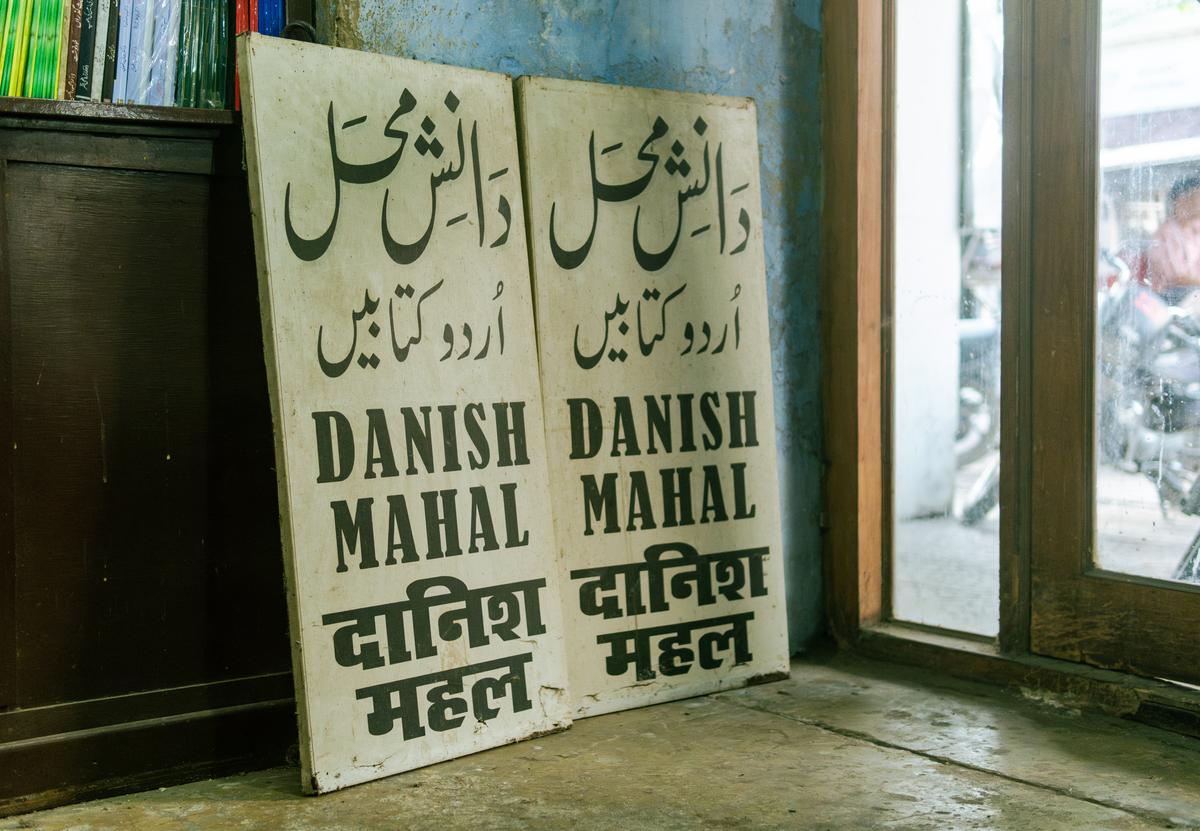
Danish Mahal’s entrance

Danish Mahal’s entrance
| Photo Credit:
Monis Khan

Protecting its legacy

Established in 1939 — as an outlet of Maktaba, the Urdu publishing house, before it separated — Danish Mahal was envisioned as a welcoming haven for enthusiasts of the language. Here, under the warm glow of lamps and the musk of vintage volumes, literary luminaries such as Maulvi Abdul Haq (revered as the Father of Urdu), Islamic scholar Abdul Majid Daryabadi, Urdu professor Syed Ehtesham Hussain, and poets Josh Malihabadi and Munawwar Rana gathered to converse about the beauty of the language.

Many even paused to write their reflections in that very register. “We used to engage in deeply nuanced literary conversations. But over time, that vibrancy faded. Now, we lack such voices…most of them have passed away,” Parwana laments.

“It saddens us to witness Urdu’s decline from school syllabi to street signs. Yet, amidst these changes, Danish Mahal stands resilient in safeguarding the city’s rich literary heritage. Despite numerous challenges, it remains a sanctuary for Urdu enthusiasts, offering a diverse collection of literature and a space for learning and reflection.”Mohd Haroon RasheedEditor of Urdu daily Avadhnama, who describes the store as “wahid idara” (the only institution) for literary Urdu books

Mohd Haroon Rasheed

Mohd Haroon Rasheed
| Photo Credit:
Monis Khan

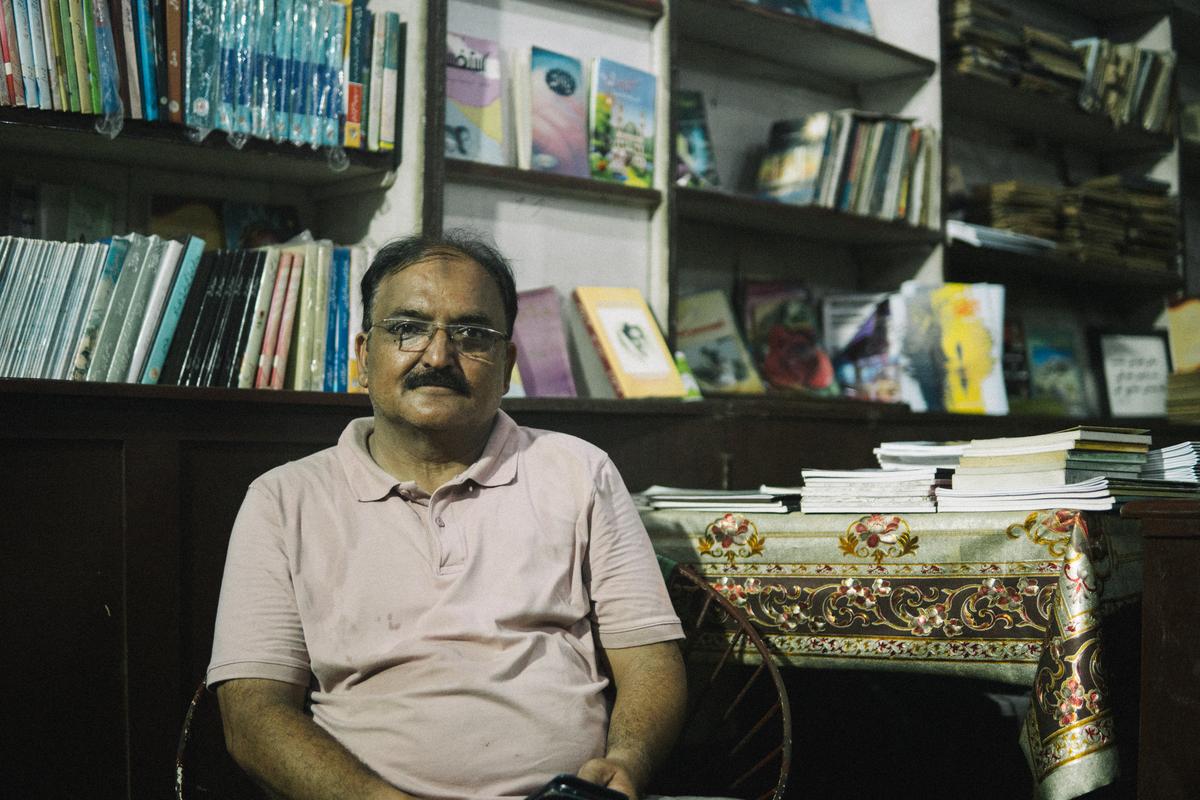
Naeem Ahmed, 55, is the fourth-generation owner of the bookstore. “I feel that as Urdu fades from our streets, signboards, and school curriculum, Danish Mahalstands firm, playing a vital role in preserving Lucknow’s Urdu heritage,” he says. Yet, the signs of decline are unmistakable. Danish Mahal is seeing a steady dip in book purchases and readership. Colleges and universities, which used to place regular orders, have largely stopped doing so. “Buying power has decreased significantly. Institutions such as the Uttar Pradesh Urdu Academy offer discounts to consumers, yet never extend them to independent bookstores like ours, making it difficult for us to sustain operations,” says Ahmed.

Owner Naeem Ahmed

Owner Naeem Ahmed
| Photo Credit:
Monis Khan

Several neighbouring bookstores in Aminabad have shut down. “Danish Mahal survives because of devoted readers, writers, and Urdu lovers. I’m determined [to keep it going], though staying open is hard,” he says. The bookstore hasn’t organised a formal literary event since its heyday, but Ahmed is keen to change that. “We aim to restore the bookshop, revive literary meet-ups, and invite Urdu-language musicians and artists so Danish Mahal becomes a lively, creative space. We’ll also enhance our social media presence to showcase the Urdu classics.” A move that will find fans among its regulars. “The bookstore stands as a rare living link to the city’s rich Urdu-adab heritage,” says Parwana, adding that preserving the literary landmark is essential.

Mohammad Zafar, 60, a retired insurance professional from Faizabad, is another regular. “If I’m visiting relatives in Lucknow, a trip to Danish Mahal is non-negotiable,” he says. “I used to drop by every two or three months to pick up books and magazines, but now that they take [online] orders, it’s much easier for book lovers like me.”

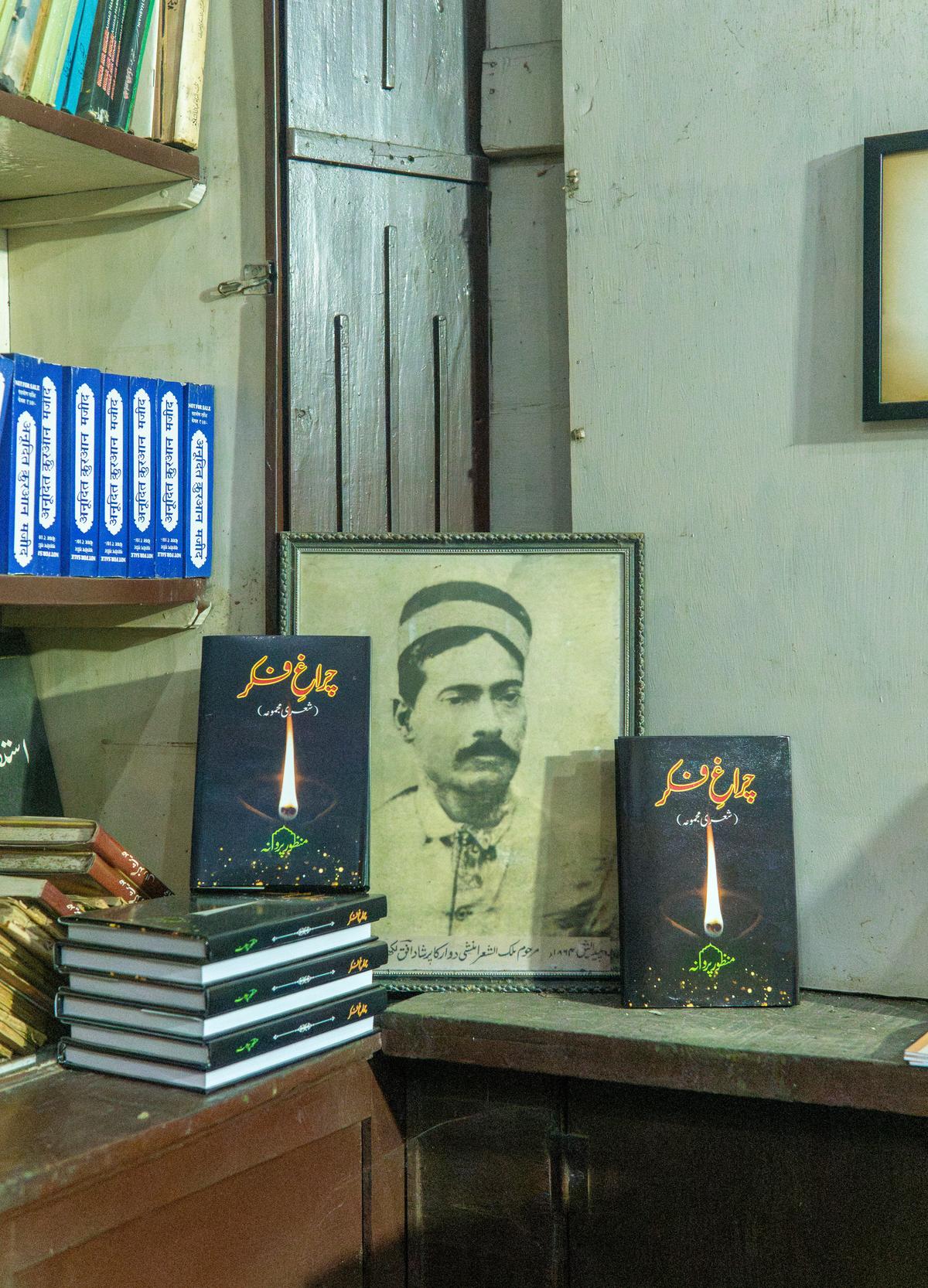
Memorabilia at Danish Mahal

Memorabilia at Danish Mahal
| Photo Credit:
Monis Khan

Generations of book lovers

Youngsters are not immune to the charm of this place. Faiz Yunus Majzoob, a 27-year-old pursuing his master’s at Lucknow University, recalls his first visit in 2012. “It was to find an Ibn-e-Safi [Pakistani fiction writer] Urdu novel that I couldn’t find elsewhere. From then, Danish Mahal has called me back. I often end up crouched in a corner, utterly lost in a book.”

For many young people, however, its aesthetic appeal is the main draw. “My generation seems to lack the patience for reading, and treat bookstores more as social media props,” states Majzoob. “Take Faqir Chand [the family-run bookstore] in Delhi’s Khan Market. It’s less a place to browse books than a hotspot for Instagram selfies.” That said, he says some do visit, “especially to pick up [Pakistani poet] Jaun Eliya’s poetry, which gives me hope”.

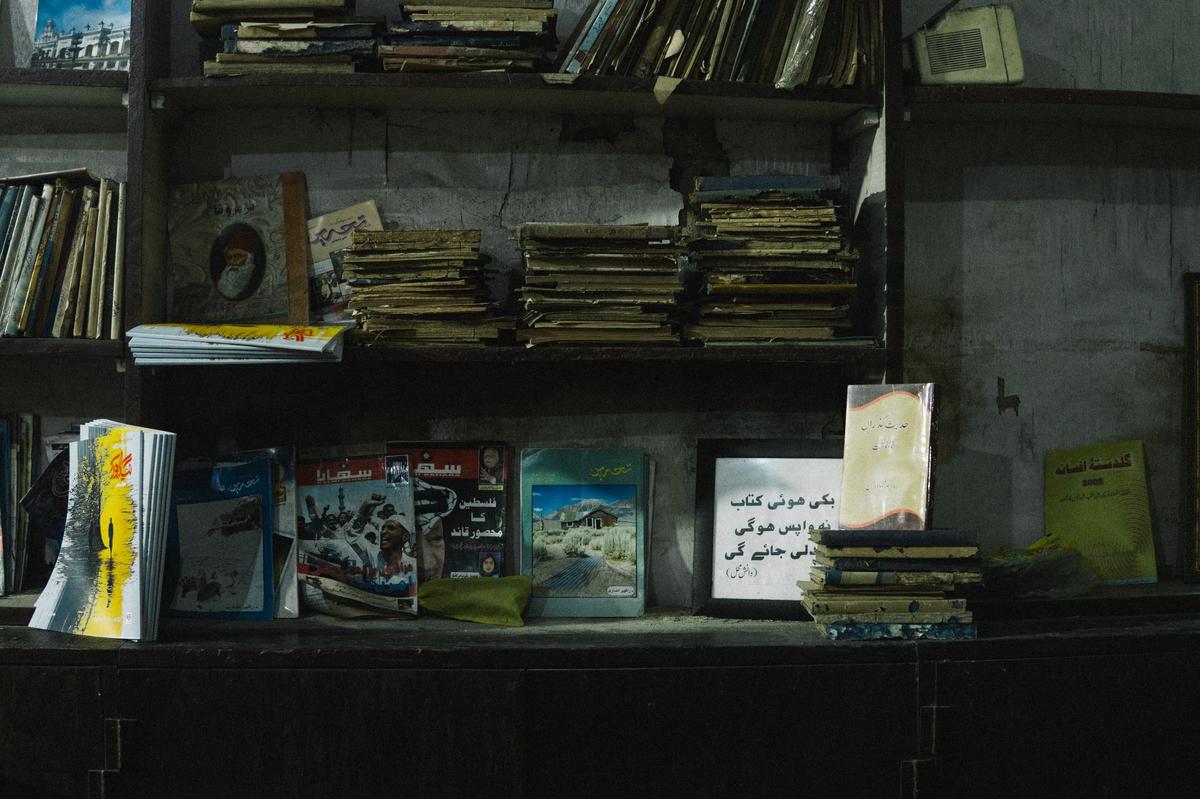
Urdu books at Danish Mahal

Urdu books at Danish Mahal
| Photo Credit:
Monis Khan

To Reshma Parveen, head of the Urdu department at Khun Khun Ji Girls PG College, Danish Mahal is a tarbiyat-gah (centre for nurturing). She believes that “while challenges persist, the enduring passion for Urdu will ensure its survival”, leading it to continue as a vital institution of knowledge, literature, and language.

She recalls a serendipitous meeting at the store years ago. “I had been searching for a book on [Urdu poet] Mir Taqi Mir for my research, but it was unavailable in the market. Then, I met short story writer and journalist Abid Suhail Sahab at Danish Mahal. He told me, ‘I have the book… you can have it.’ I visited his home in Aliganj [about 8 km from Danish Mahal] to collect it, and the warmth he showed left a lasting impression. To this day, that beautiful volume [written by Urdu writer and philanthropist Maqbool Ahmad Lari] remains on my bookshelf,” Parveen says. She and others cherish the countless connections forged through Danish Mahal where “simply asking for a book might lead to you forming deep, enduring bonds”.

The writer is an independent journalist based in Lucknow.

Published – November 07, 2025 07:07 am IST


Source link

This feast in the paddy fields of South Goa celebrates local harvest and Goan traditions


A previous edition of The Feast in the Fields

A previous edition of The Feast in the Fields
| Photo Credit: Special arrangement

In Cansaulim, a quaint village lined by a secluded, golden beach on one side and the legendary Three Kings Chapel on the other, another edition of The Feast in the Fields returns, this year on November 23. 

Picture this: A tractor languidly hums on one side of a baandh, green paddy fields shimmer on a sun-filled Sunday.  A long table groans under the weight of traditional Goan delicacies. Sweet strains from a cello mingle with peals of laughter. The buzz of conversation is a palpable background score. This annual community-style dining experience held in the rice fields is immersive, joyful and more than just a meal. I was there last year, and the spice-scented memories have stayed with me. 

Guests at the event

Guests at the event

Lost traditions 

The Feast in the Fields is organised by Hansel Vaz, (the founder of homegrown feni brand Cazulo Premium Feni), Goan chef Ralph Prazeres, and the platform Urbanaut. “For the first two years, I tried to revive the lost tradition of growing our aromatic Goan rice, giresal. This rice, indigenous to Goa, was always served to family and very close kin, on special occasions. Due to lack of pollination and rains, the crops failed and I was very distraught, and finally resorted to our usual variety. But, in the process, I learnt a valuable lesson on the vagaries of agriculture; that too, from my household help. That a harvest must always be celebrated,” says Hansel. 

This year will be even more special, because the food is the handiwork of Ralph, the owner of Padaria Prazeres a bakery-cafe. Ralph is an alumnus of Le Cordon Bleu in London, and has worked at restaurants such as St John’s, Clos Maggiore, The Rosewood London and Bao.

The Feast in the Fields

The Feast in the Fields
| Photo Credit:
Special arrangement

The menu

The event will have a multi-course harvest with vegetarian and non-vegetarian options, and two feni cocktails. This year, as Ralph joins the celebration, curating a new menu that reimagines Goan-Portuguese flavours, I ask him how he feels about it all. “I’m very excited to be a part of the fest this year. Back in the day, cooking was done on fire. We have seen this at my grandmother’s place and it used to bring such joy and bonding. This technique will be fun to recreate. Secondly, community style cooking is also something I’m looking to do more of,” says Ralph, asking me to watch out for the star dish, his special feijoada, with spicy bean, Goan sausage and pork belly. But, quite honestly, I am looking forward to his famous pasteis de nata, the very best, buttery, flaky, Portuguese egg-tarts in all of Goa, that he has promised to finish with. 

“At Feast in the Fields we want to create a truly one-of-a-kind, exceptional community experience; open to all, yet exclusive by its uniqueness and authentic curation,” shares Samyukta Ranganathan, founder of Urbanaut. 

Prices for the experience start at ₹29,490. On November 23, 12.20pm. At Cansaulim. For details, visit urbanaut.app


Source link

Inside Chorus, a new voice in Indian craft and couture in Mumbai’s Kala Ghoda


In India’s evolving luxury landscape, Moonray made its debut in 2021 as a free-spirited offshoot of Chanakya International, the heritage atelier founded in 1984, best known for its embroidery collaborations with global houses such as Dior. Co-founded by Karishma Swali and her daughter Avantika Swali, Moonray channelled Gen Z’s creative energy into Chanakya’s artisanal mastery. The vision was to democratise couture by blending sustainability with accessibility. The brand made upcycled denim desirable, reimagined traditional embroidery in relaxed silhouettes, and introduced vegan accessories crafted from organic cotton and natural indigo dyes. It spoke to a new generation that valued style and responsibility in equal measure.

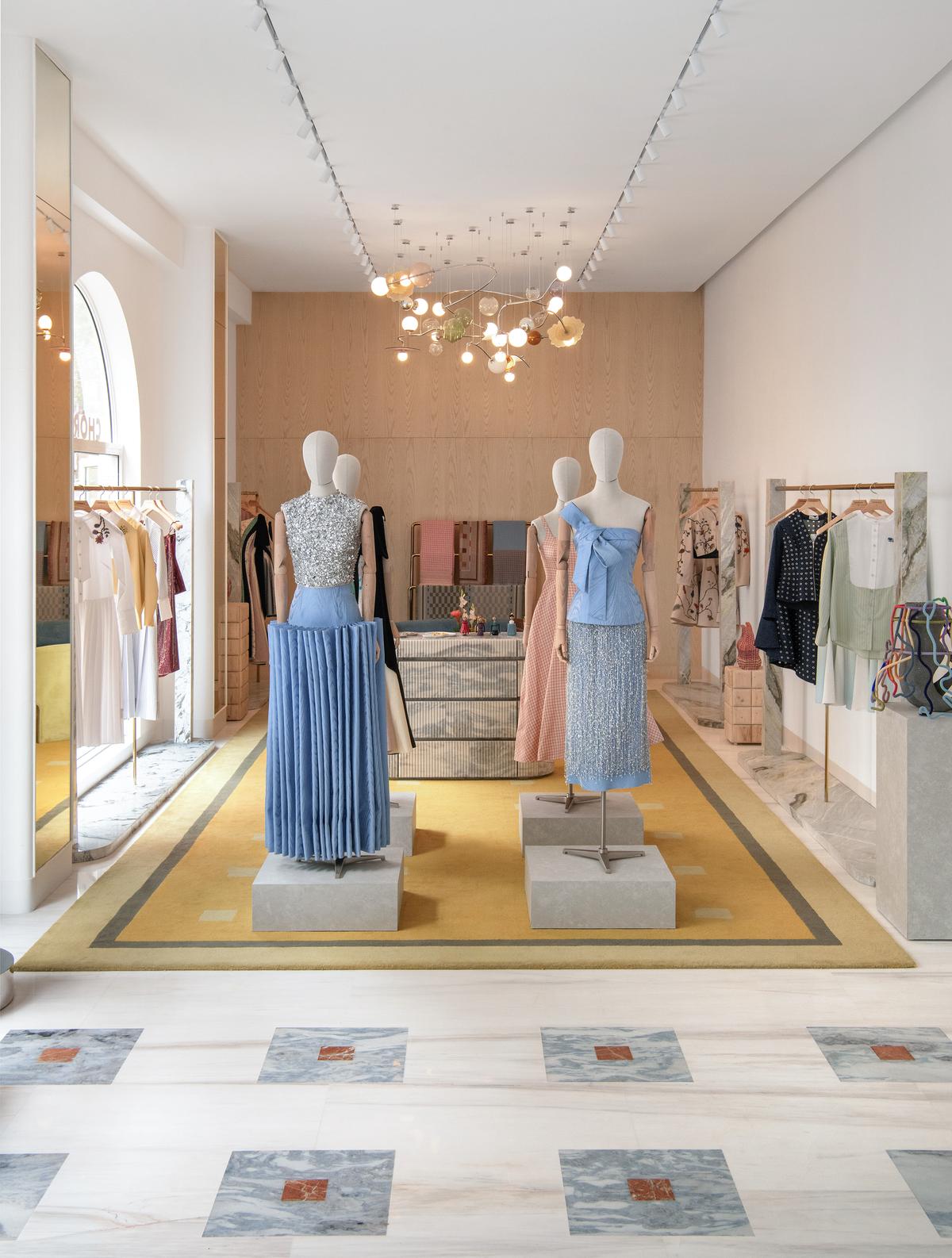
Inside the Chorus flagship store

Inside the Chorus flagship store
| Photo Credit:
Special arrangement

“Moonray was always about ease and freedom,” Karishma recalls. “We wanted to preserve the soul of craft, but without the stiffness that often comes with couture. It was about joy, movement, and a more human connection to what we wear.” That philosophy resonated. Moonray became known for its ability to bridge couture’s grandeur with everyday elegance, transforming high-end techniques into wardrobe staples. But even as it established its voice, the Swalis were already thinking bigger.

Tradition, the contemporary way

Cut to 2025, Moonray has now evolved into Chorus, a multidisciplinary atelier. Under the Swali family banner, the transition marked what Karishma calls “a new chapter — one that invites more voices while safeguarding craft and consciousness.” While Moonray’s upcycled denim remains a signature, Chorus expands the canvas, folding that youthful spirit into a wider universe that now includes couture, ready-to-wear, wellness, home, and even a café.

At the heart of this vision is the brand’s new flagship in Mumbai’s Kala Ghoda — a three-storey space designed by Karishma and the Chorus Design Collective. The gallery-like interior blends natural stone, warm woods, and monumental embroidered artworks to create what she calls “a dialogue between earth, air, light, and water.”

Chorus concept

Chorus concept
| Photo Credit:
DRIU CRILLY & TIAGO MARTEL

The ground floor hosts Chorus Ready-to-Wear, where architectural silhouettes meet sustainable materials. Blue marble interiors evoke the sky, while ochre stone details bring warmth. A curved cove showcases pieces from Chorus Concept — including woven raffia, ceramic objects, and handmade jewelry that blur the line between art and design. Upstairs, Chorus Wellness extends the brand’s tactile philosophy into self-care. “For us, it’s about expanding the idea of craft,” says Karishma. “We wanted to take that sensitivity into daily rituals — through candles, soaps, and oils that celebrate natural processes.”

Chorus concept

Chorus concept
| Photo Credit:
DRIU CRILLY & TIAGO MARTEL

On the top floor sits Chorus Café, envisioned as a community space where design, dialogue, and creativity meet. There is also Chorus Edition, a couture sanctum that draws on Chanakya’s 40-year savoir-faire. Here, 13th-generation artisans reinterpret traditional needlework and weaving into modern forms.

Chorus cafe

Chorus cafe

Chorus wellness

Chorus wellness
| Photo Credit:
Ryan Martis

“Through Chorus, we realised that the voice of craft transcends disciplines,” Karishma explains. “We’ve always looked at craft not only through fashion but also through culture and the arts — it’s a fertile platform that lets us collaborate, to move beyond boundaries.”

Modern luxury

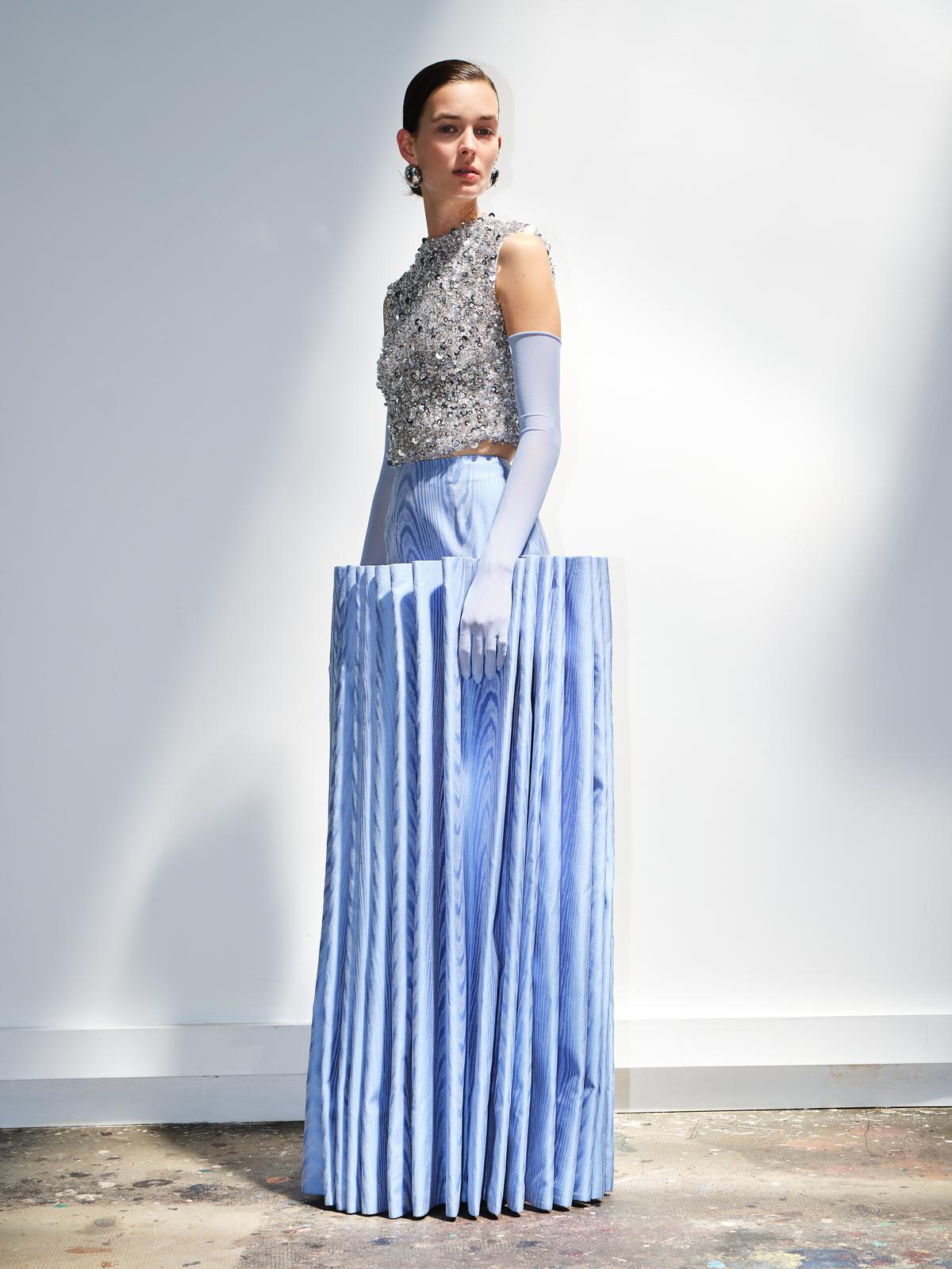
This cross-disciplinary spirit finds form in the Autumn/Winter 2025 collection, titled Other Worlds. The line marks a quiet shift — deliberate, curious, and rooted in feeling. Chorus draws from the infinite possibilities of craft but refracts them through a contemporary lens: proportions shift, surfaces disrupt expectations, and familiar silhouettes take on new dimensions. Floral motifs recur throughout, embroidered, sculpted, or imagined in the weave. “They’re not literal blooms,” Karishma notes. “They’re like memories—flowers with too many petals, leaves that hold stories.” In some pieces, petals unfold across hems or shoulders; in others, 3D crystal brooches gather into delicate, wearable bouquets.

Looks from the RTW collection

Looks from the RTW collection
| Photo Credit:
DRIU CRILLY & TIAGO MARTEL

The brand’s signature organic denim remains central — handwoven from rain-fed kala cotton and dyed with natural indigo. Chorus also collaborates with heritage looms in Tamil Nadu and the weaving communities of Maheshwar, weaving old-world precision into new-world design.

“Our ready-to-wear is advanced contemporary,” Karishma says. “It’s everyday, but elevated by the quiet intelligence of handcraft. With Edition, we explore rarer textile histories through a modern lens. And with Concept, we let curiosity lead — creating objects of beauty and meaning. Each vertical is a voice, and together they form a conversation led by courage, curiosity, and freedom of expression.”

Looks from the RTW collection

Looks from the RTW collection
| Photo Credit:
DRIU CRILLY & TIAGO MARTEL

And perhaps that is what defines this new phase best. Chorus is not just a label — it is an ecosystem, one that honours legacy while creating space for discovery. In Karishma’s words, “It’s not about being old or new, couture or contemporary. It’s about creating something that feels alive.”

Published – November 06, 2025 02:48 pm IST


Source link

Quiz | Easy like Sunday morning: What has November 9 ever given us?


A molecular biologist from Madurai, our quizmaster enjoys trivia and music, and is working on a rock ballad called ‘Coffee is a Drink, Kaapi is an Emotion’. @bertyashley

Quiz | Easy like Sunday morning: What has November 9 ever given us?

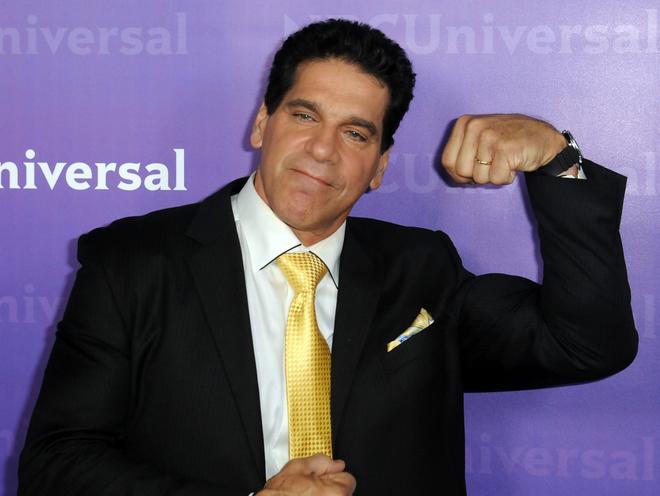
Lou Ferrigno won two Mr. Universe titles, but is most famous as the first actor to play an ‘angry’ version of David Banner.

START THE QUIZ

1 / 10 |
On November 9, 1842, the very first U.S. design patent was issued to George Bruce of New York City. This established a new form of intellectual property rights for something based on how it looks. What did he design, which one would now say is a ‘serif’?


Source link

Breitling is all set to launch two new sister brands — Gallet and Universal Genève


Georges Kern is a man on a mission. Ever since he took over the reins of Breitling in 2017, he has transformed the brand that was once known for hard-nosed tool watches into one that balances heritage, elegance, performance and contemporary cool. After the successful relaunches of three of the Flying B’s most iconic families — Chronomat, SuperOcean and Navitimer — and the addition of the Lady Premier, a new range of watches designed only for women, Georges, who was in India last week for the launch of Breitling’s first boutique in Mumbai spoke about Breitling’s evolution. On the cards is the plan to launch two new sister brands — Gallet and Universal Genève — under what he calls his “House of Brands”.

Georges Kern, CEO of Breitling

Georges Kern, CEO of Breitling
| Photo Credit:
Special arrangement

Excerpts from the interview:

Q: Do you intend to claim woman’s watch category with the Lady Premier?

Georges: A brand’s essence does not change. Some are naturally masculine, others feminine — Cartier is more feminine, Breitling more masculine, and perhaps only Rolex appeals to both genders in equal measure. But that does not mean a masculine brand can’t make watches for women. Models designed for women account for about 17% of our turnover; we think that can reach 25%.

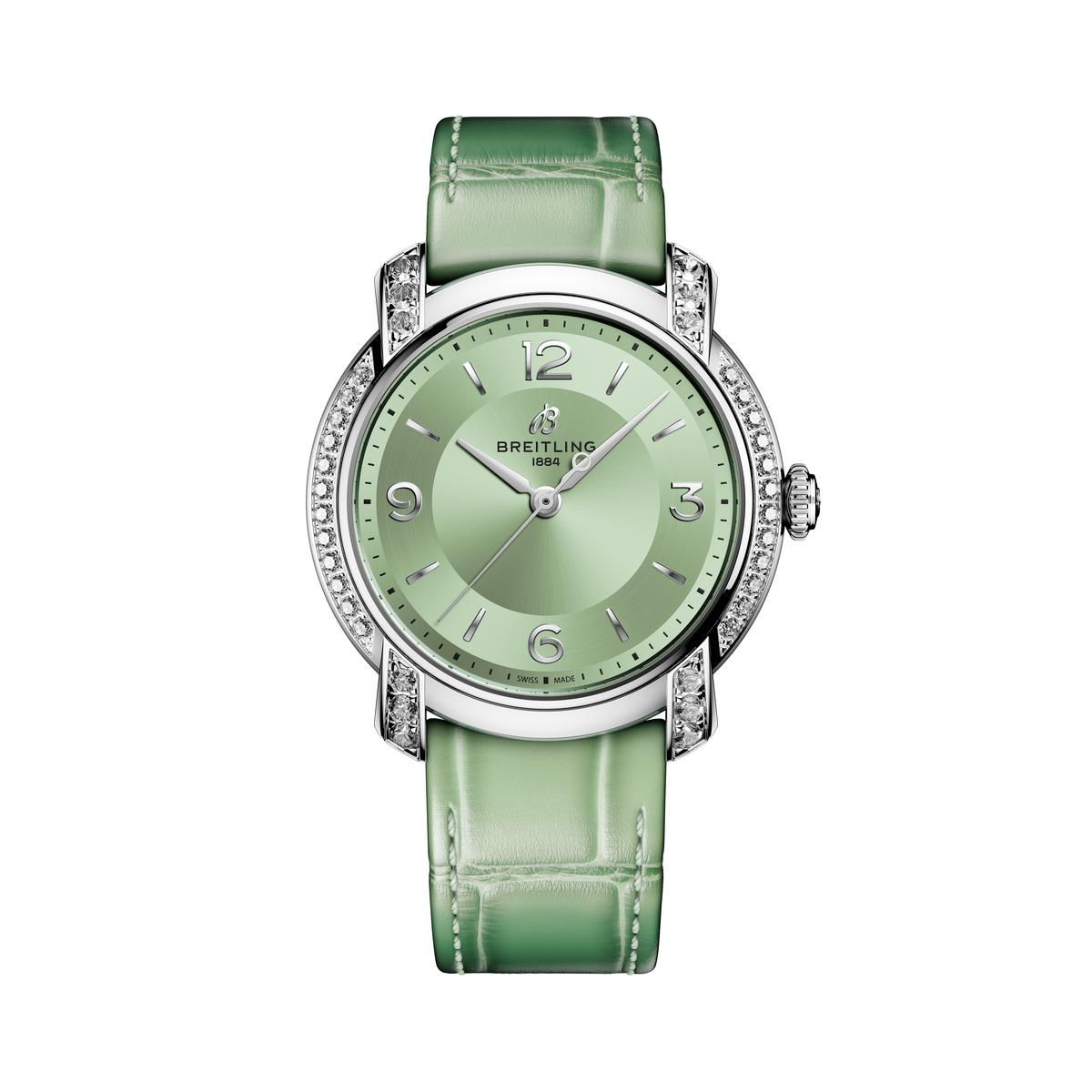
Over the past few years, we have built that segment step by step — first, sports pieces such as the SuperOcean and Chronomat range for women, then the more elegant Navitimer, and now the Lady Premier. You must do the right thing at the right moment. Eight years ago, Breitling’s image was “big, loud pilot watches”— like a Hummer. Today, we are more like an Aston Martin SUV: powerful, but elegant. The Lady Premier completes our presence in the female segment with a refined, smaller-sized option that works beautifully in markets like India and Asia.

After the successful relaunches of three of the Flying B’s most iconic families — Chronomat, SuperOcean and Navitimer —  Breitling launches Lady Premier, a new range of watches designed only for women

After the successful relaunches of three of the Flying B’s most iconic families — Chronomat, SuperOcean and Navitimer —  Breitling launches Lady Premier, a new range of watches designed only for women
| Photo Credit:
Special arrangement

Q: Since you took over as the CEO, Breitling has become more elegant and less about instruments for professionals. What does that change mean for the brand?

Georges: Transformations are always tricky. We had to move fast: refresh distribution, boutiques, advertising, and highlight products that embodied the new look.

The real breakthrough was the Chronomat. We launched it right before the pandemic, investing heavily when everyone else paused. When markets reopened, demand exploded. The Chronomat — with its bullet bracelet — captured our modern-retro philosophy and showed people that Breitling could be cool, elegant and versatile. Then came the renaissance of the Navitimer.

Social media confirmed the shift. Other Swiss brands can be conservative; our advertising, boutique design and even the Lady Premier film show that we’re approachable and a little daring.

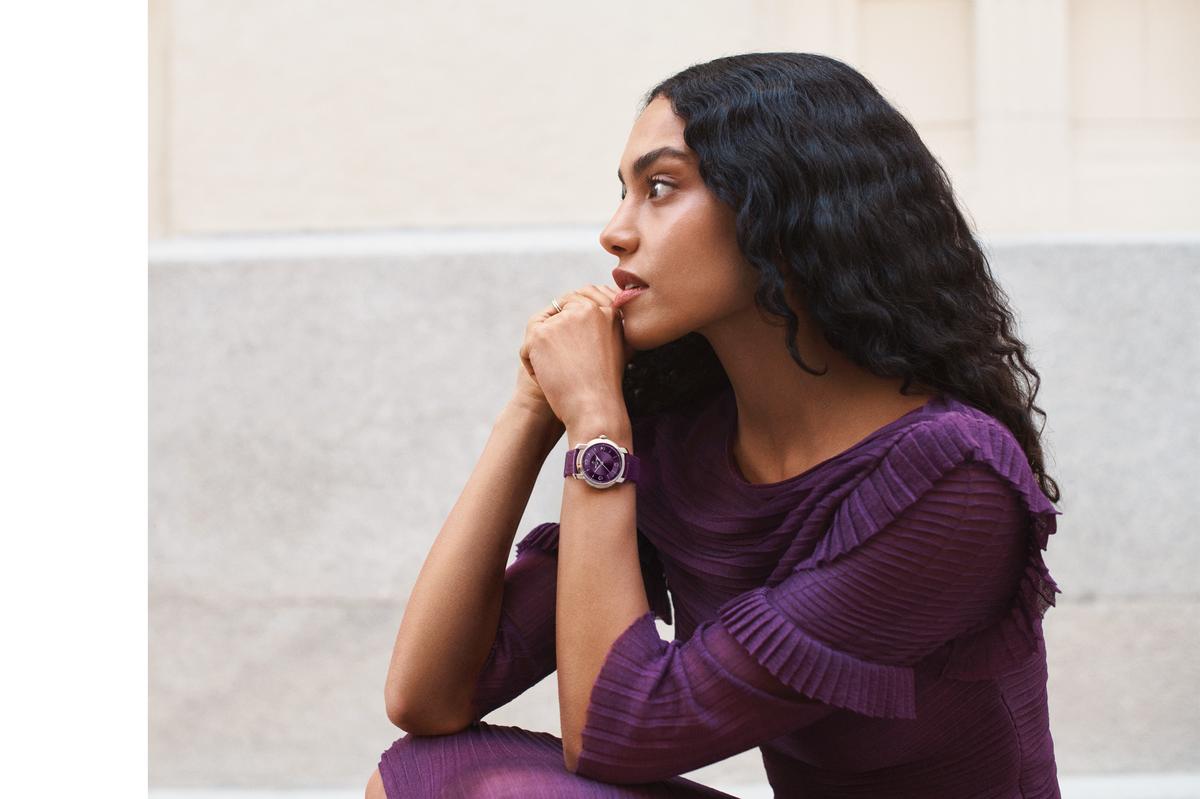
The sage-coloured Breitling Lady Premier

The sage-coloured Breitling Lady Premier
| Photo Credit:
Special arrangement

Q: You are expanding despite the tariffs and geopolitical turmoil. How do you sustain momentum?

Georges: We just announced a major partnership with the The National Football League, a professional American football league in the United States, and for the first time they have worked with a luxury brand. The U.S. sales are 25% of our turnover. To offset tariffs, we raised prices four percent in the U.S. and two percent elsewhere. I am convinced the tariff issue will soon normalise.

Europe is weak, but Latin America is strong, as are parts of the Middle East. Japan cooled slightly after a great year, and India is rising fast. .

We recalibrate investments rather than change strategy: double down on the U.S. and India, slow in Europe.

Aubergine-coloured Lady Premier

Aubergine-coloured Lady Premier
| Photo Credit:
Special arrangement

Q: You are visiting India for a second consecutive year. How do you see this market?

Georges:

We had three boutiques 18 months ago; now we have seven and plan 10. The limitation is not demand but the lack of luxury malls. More are coming, hopefully. Encouragingly, more Indians are buying locally rather than in Dubai or London. What’s missing is the full experience: the Rue Saint-Honoré or Avenue Montaigne feel. Once that retail infrastructure is ready, every luxury brand will follow.

In November, at the Dubai Watch Week, Breitling will present its House of Brands — three complementary marques: Gallet, Breitling and Universal Genève

In November, at the Dubai Watch Week, Breitlingwill present its House of Brands — three complementary marques: Gallet, Breitling and Universal Genève
| Photo Credit:
Special arrangement

Q: You are reviving not one but two historic names. How will Gallet and Universal Genève flank Breitling?

Georges: In November, at the Dubai Watch Week, we will present our House of Brands — three complementary marques. Galletwill cover the CHF 2,500–4,500 range. Breitling will remain our core, CHF 3,500–50,000 and Universal Genève will start around CHF 15,000 and go up. Gallet will be a sister brand, clearly marked Manufactured by Breitling, but with its own history and design. It was used by the Wright Brothers, worn by President Truman; it produced the first GMT, the Flying Officer.

When we aimed to reposition Breitling as a 100% manufacture brand, we left behind entry-level pieces like the Colt. Gallet fills that gap with authenticity and accessibility. Universal Genève is a different story — if Gallet is smart, Universal is brilliant. It occupies the high-luxury space, with an average price near CHF 30,000.

It’s about everyday wearability and design, not complications. We’ll offer micro-rotor automatics and chronographs — because people expect that at this level — and a steel automatic micro-rotor will start around CHF 15,000. But the real focus is aesthetic excellence and effortless luxury.

Published – November 06, 2025 12:42 pm IST


Source link

Huma Qureshi shares why female-led stories still have to fight for screen space


A rare combination of grit and grace, Huma Qureshi is one of the few actors who constantly challenges patriarchal moulds and conventional tropes that define the Hindi film heroine, both in mainstream and independent cinema. With the fourth season of Maharani set to stream this week and Bihar going to vote in a keenly contested election, the actor, who plays the Chief Minister of the State in the political drama, speaks her mind on a range of subjects in a freewheeling conversation with Anuj Kumar.

Grit, grace and glory
| Video Credit:
The Hindu

Both in the Maharani and the ongoing Bihar election campaign, women voters are at the centre of politics. What is your take?

As long as it stems from a real space of actually including women in decision-making, policymaking, and making them real participants rather than indulging in tokenism or merely paying lip service, it is a welcome change.

When the series started, the character of Rani Bharti seemed like a reflection of Rabri Devi in Patna. By the fourth season, she has evolved into an Indira Gandhi-like figure, headed to Delhi.


It is unfortunate that we have very few examples of women in politics. When you play a female politician, you are cast in one of the two moulds. The intention was never to create a character based on a real-life politician. One can call Maharani a political fantasy fiction where the makers take actual incidents that have happened and put a spin on them. Rani Bharti is the leader we don’t have, but perhaps the kind of politician we need.

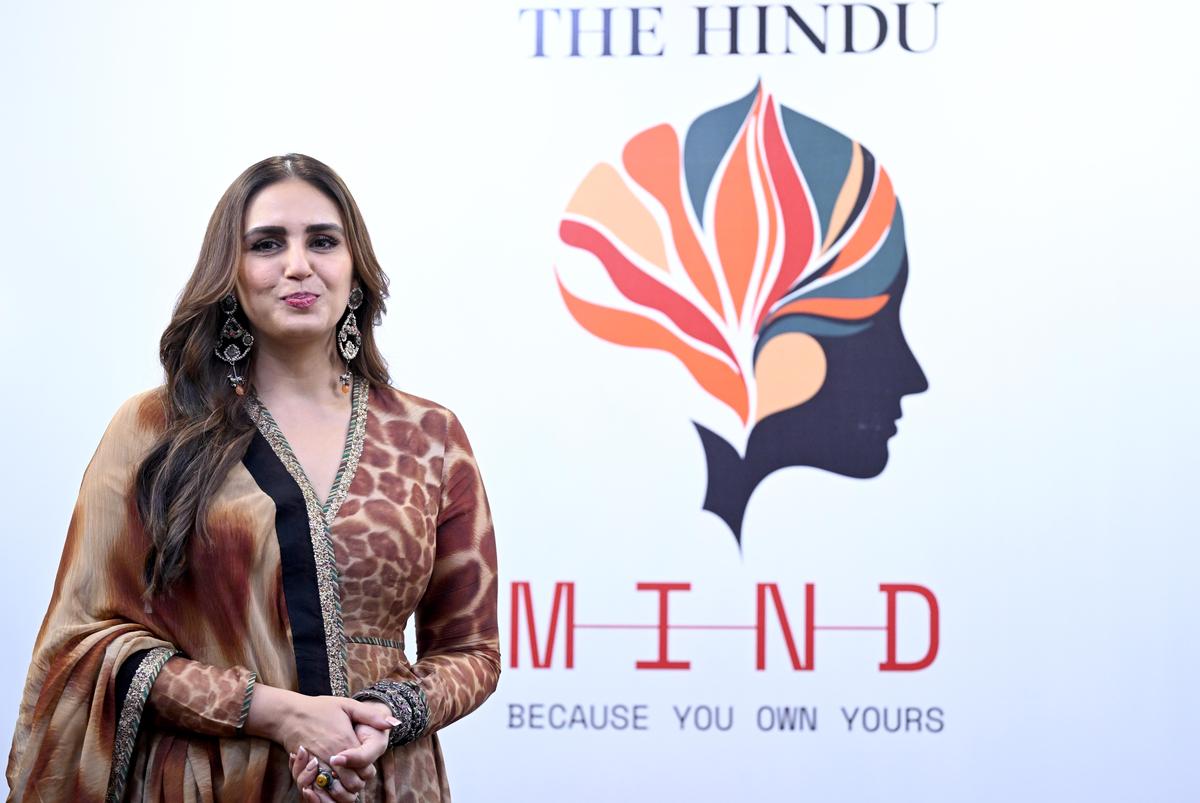
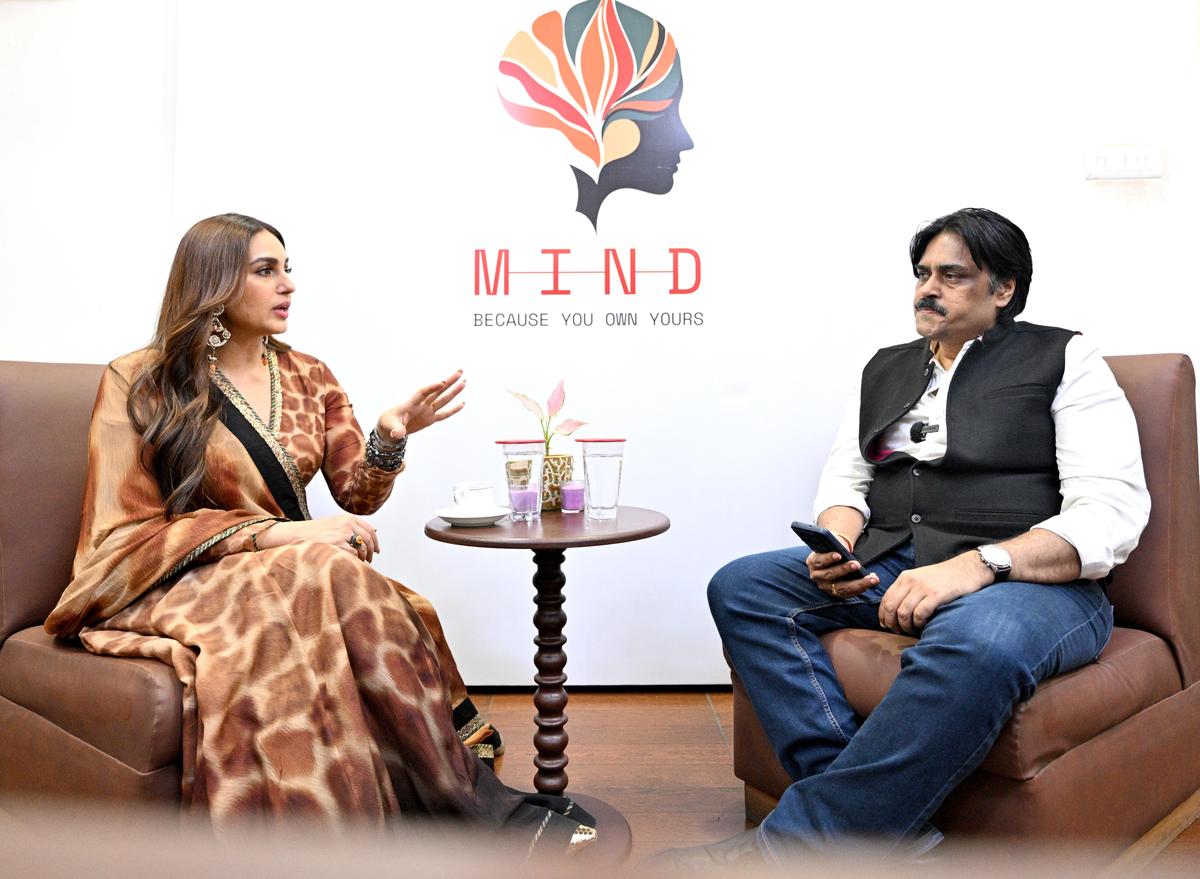
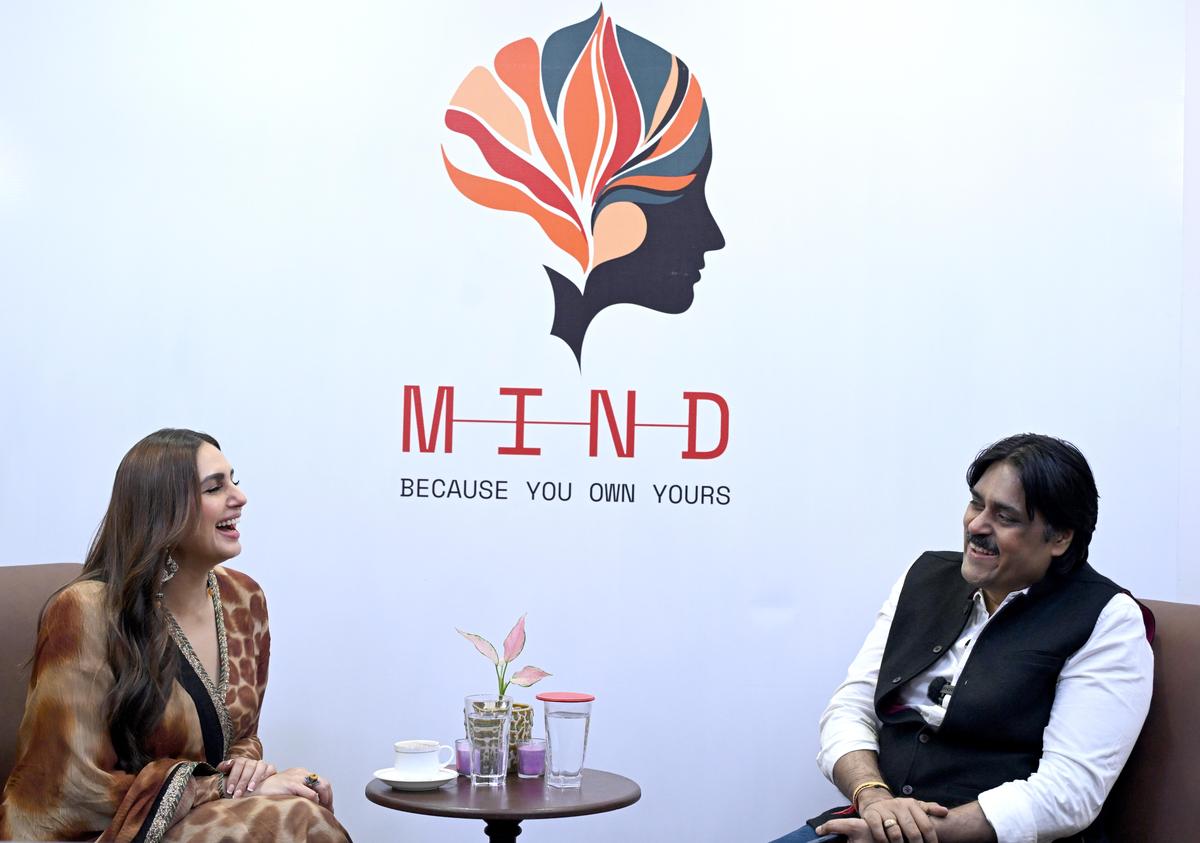
Actor Huma Qureshi along with Anuj Kumar, Deputy Editor, Metro Plus The Hindu during 'The Hindu MIND Series' in New Delhi on November 01, 2025.

Actor Huma Qureshi along with Anuj Kumar, Deputy Editor, Metro Plus The Hindu during “The Hindu MIND Series” in New Delhi on November 01, 2025.
| Photo Credit:
Shashi Shekhar Kashyap

Do you have a method of putting together such characters? Do you read bills and legislation alongside the script?


I am not a big fan of actors talking at length about their method. It just romanticises the idea of preparation a bit by saying that we forego food for three days or tie a leg to the chair.

Between action and cut, I fully surrender to what I am doing in that moment. I don’t have a blockage like ‘Oh! Huma would not do this’. Automatically, I feel my body, my shoulders, my core shifts into that space. It just happens very subconsciously. I wish I had the time or the inclination to read legislation. I rely on common sense and basic core principles of humanity. They serve me just fine.

Does being a writer help you understand and portray characters more effectively?


Better, I don’t know, but all good actors are, in a sense, storytellers. They have to be a bit of a writer and a director to understand the inner journey of the character. For instance, the lines could be I am hungry and when was the last time you saw your wife, it is the actor’s responsibility to bridge the gap.

From Gangs of Wasseypur to Bayaan, you tend to play characters that speak up or challenge authority and don’t forfeit their agency. Is it by chance or is there a plan to it?


That’s the Delhi University chhatra (student) in me! I would put it down to the time I spent in Gargi College, an all-girl institution, and the way we were raised in my house, as well as outside. There was no separation of work between boys and girls. If I did a play and the lights needed to be fixed, I would not call a male colleague. When I reached the film sets, I found there are certain jobs that men do and some jobs that are assigned to women. I felt that’s not fair. Now I find more women working in the camera department. I approach them and tell them, no matter how hard it gets, just keep doing it, because what they are doing is very important. When I find women who congratulate me on being able to speak in front of an authority that was not fair to them, after watching my character, I see it as a victory.

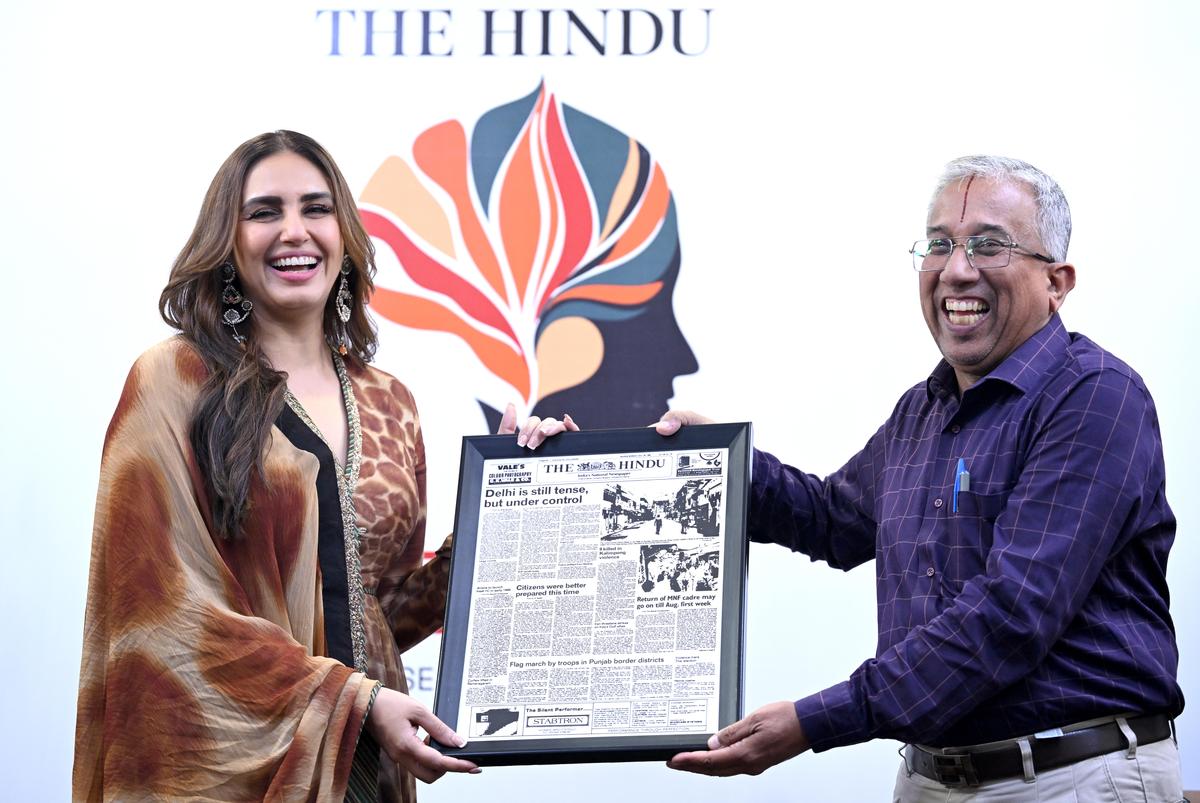
Actor Huma Qureshi along with S. Ramanujam (Assistant Vice President, Admin, The Hindu) during 'The Hindu MIND Series' in New Delhi on November 01, 2025.

Actor Huma Qureshi along with S. Ramanujam (Assistant Vice President, Admin, The Hindu) during “The Hindu MIND Series” in New Delhi on November 01, 2025.
| Photo Credit:
Shashi Shekhar Kashyap

The gaze on the Hindi film heroine is changing. Is it for real?


It’s slow, but it’s changing. I believe that if a plane shifts even by one degree by the time it reaches its destination, it is a different city. We are in the right direction. In comparison to the past, many of my female colleagues are creating female-centric content in OTT and mainstream spaces. Female actors are taking on a wide range of subjects, including action films. However, a lot more needs to be done. There is a mental block regarding the theatrical release of female-led films. The hero’s film receives a much wider release because those who run the business believe that more people want to watch films about those subjects, which is not necessarily true. Here, the mindset of the society comes in. One film or role alone is not enough. It has to be like a cultural movement.

In LeilaTees, and Kaala, you play characters who are targeted because of their inter-faith relationships. How do you see this expression of hate in films and society?


We live in a multicultural country. Even within mainstream religions, there are so many sub-sects and beliefs. The way I was raised, I was taught that faith is a matter of personal choice, and I don’t need to discuss it or flaunt it. However, for a lot of people, it’s a burning issue. If they need to speak about it, I don’t feel the need to join them. For example. I’ll never do a propaganda film for the simple reason that I would not be able to sleep at night after being part of a film that moves people emotionally to hate another human being.

Of course, throughout recorded history, people have committed many horrible acts, but they have also performed many lovely deeds. If you only focus on the bad, we are actually creating a bigger culture of fear and hostility. So let’s correct the focus.

It is unfortunate that we have very few examples of women in politics, says Huma Qureshi.

It is unfortunate that we have very few examples of women in politics, says Huma Qureshi.
| Photo Credit:
Shashi Shekhar Kashyap

What was it like working with Rajinikanth in Kaala?


It was like one tick off the bucket list. When Pa Ranjit, a fantastic filmmaker, offered me the part, I jumped because we had always admired Rajini sir. The experience was very fulfilling. Beyond all the stardom and euphoria lies a straightforward person with simple values who is very easy to talk to. I really enjoyed my conversations and the time I spent with him.

You were supposed to start your career with a Tamil film. Isn’t it?


Yes, I was replaced after being signed for a film with Ajith sir. Destiny is such that years later, I got to work with him in Valimai. The greatness of Ajit sir is when we met on the sets, he walked up to me and the first thing he said was, ‘I am so sorry, I had nothing to do with it.’ I didn’t expect him to remember it at all.

Like Mohsina of GOW, you seem to like both red and green. After playing strong characters, you also turn up in mainstream projects and a glamorous song appearance…


I take my agency as a human trait. When it seeps into my characters, it’s not intentional. As a female actor, I don’t want to be put in a box. I want to be part of a Jolly LLB and perform a so-called hot song in Maalik. I do a Bayaan and Delhi Crime in the same year because I can.

How do you process the so-called item songs?


I enjoy songs personally, as long as a woman is expressing her sensuality and sexuality in a way where she is enjoying it. I feel women are not really encouraged to normalise their own feelings and desires. As long as the song represents that, I am okay with it. However, if it is only for the male gaze, then that is problematic. And you know the difference immediately!

The actor plays the Chief Minister of the State in the political drama.

The actor plays the Chief Minister of the State in the political drama.
| Photo Credit:
Shashi Shekhar Kashyap

From Anurag Kashyap, Subhash Kapoor, and Sriram Raghavan to Deepa Mehta and Gurinder Chadha, you worked with an eclectic mix of filmmakers. Tell us your one takeaway.


Forget acting, I am a better person just by watching them. It started during Badlapur, when I was working with Sriram. I was too new, I heard a narration, but I didn’t understand what we were making. Sriram is a great filmmaker, but he is not a very expressive person when it comes to narrating scripts or ideas, which I later realised is his superpower. When I received the script, which I still have, with notes indicating what my character, Jhimli, is thinking at particular points in time. I just fell in love with his process. I said to myself, ‘Wow, here is a director who’s actually sent me a printed script that explains the mental space of the character throughout the film.’ Isn’t it beautiful?

At one point in time, we had a feeling that you would be part of the Sanjay Leela Bhansali’s universe. Why did you not take that route or detour?


It was offered to me, but I could not do it for some reason. I love Sanjay sir. I loved working with him for a short period during the song in Gangubai Kathiawadi, and it would be a privilege to be directed by him, as he is a genius. The way he looks at women, the way he frames and positions them, and the kind of visual aesthetic he has, it’s really unmatched.

And you fit in that space…


I fully fit in that world! It hurt when Heeramandi could not happen, but it was not meant to be for various reasons. I would love to be directed by Sanjay sir. In fact, I told him after we shot the song for Gangubai: ‘You know the song is your forte, but I have to do scenes because that is my forte.”

But curiously, you are exploring the evil side with the third season of Delhi Crime.


My problem is that I have this urge to try what I haven’t done before. I am a huge fan of the franchise. When I watched the first season, I fell in love with it. I was very mindful of the fact that this is Shefali Shah’s show, and she is incredible in it. The makers wanted to introduce a new antagonist, and the writing hooked me. It is the ‘worst’ character I have played so far (laughs).

How did you find and justify the darkness of a child trafficker to yourself?


Don’t know, maybe I am that person! It really disturbed me because I have certain values and morals that I hold dear while the character relishes her evilness. I have always played either positive or grey shades, but this is dark, and I am a feminist, someone who has strong opinions about girls’ rights. However, as actors, we also have to play parts that portray the other side, and being part of it will bring more attention to it. I was watching an old interview of Leonardo DiCaprio where he talked about the disturbance he felt when he did Django Unchained, where he plays this white plantation owner during the slavery period who spits on his co-actor in a scene. However, the fact that he did that part, or an actor who is popular in a certain sense, does something, it actually highlights the cause and the issue even more. We are not trying to glorify the character. It is what it is. I think I did the right thing, as it was really creatively fulfilling. I had fun, as at some point, I felt like I could do anything I liked. I can be so terrible, and it’s okay!

A rare combination of grit and grace, Huma Qureshi is one of the few actors who constantly challenges patriarchal moulds and conventional tropes that define the Hindi film heroine.

A rare combination of grit and grace, Huma Qureshi is one of the few actors who constantly challenges patriarchal moulds and conventional tropes that define the Hindi film heroine.
| Photo Credit:
Shashi Shekhar Kashyap

Over the last few years, female actors have taken a significant step into production. You are also launching a company with your brother. What’s behind this trend?


Frustration. I can do so much more, but people are not making those subjects. We have a company called Saleem Siblings. We continually emphasise that the industry should operate in a certain way. We have ideas, but we don’t find the right partners. Of course, it is scary being a first-generation producer, but I see it as learning a new job profile to explore subjects that nobody else is making and to voice stories that have not been told. Our first film, Baby Do Die, will be released next year. It is an action thriller about a Maharastrian female assassin. The title is a play on her name, Baby Karmarkar. The way I look at it is either we win or we learn.

Between the lines

On veteran acting coach NK Sharma

With his guidance, I became comfortable with who I was. I didn’t feel like I had to dim my shine. He has produced some big achievers, but I think I am his favourite student.

On a career in Tamil films

After working with Rajini and Ajith sir, I need to work with one more superstar, and I am done.

On a male love interest in a female-led film

It’s nice, but it’s not a necessity.

Will AI get the Qureshi stare right?

I doubt. We have to live with AI, but it’s time to discuss the ethics of AI.


Source link