Trending

India Suspension Of Visa Services For Pakistan: 14 types of visas cancelled for Pakistani nationals: Who has to leave and by when? | India News

14 types of visas cancelled for Pakistani nationals: Who has to leave and by when?
Representative image (Picture credit: PTI)

NEW DELHI: India on Friday announced the suspension of visa services for Pakistani nationals with immediate effect and revoked all existing valid visas issued to them, except for long-term, diplomatic, and official visas.
The move comes amid heightened tensions between the two countries following Tuesday’s terror attack on tourists at Pahalgam’ Baisaran meadow in Jammu and Kashmir, which claimed the lives of 25 Indian nationals and one Nepali citizen. As part of its countermeasures, the government has revoked most visas issued to Pakistani nationals with immediate effect.
Saarc visas will expire on April 26, while medical visas will remain valid until April 29.
Visas of all other categories will cease to be valid after April 27. Any Pakistani citizen who fails to exit India by the specified deadline will be treated as an overstaying foreign national.
Who has to leave and by when
Amid confusion on which visas have been revoked, exit deadlines, and which visas are still valid, the home ministry Friday issued a communication to all state governments, stating:

  • Those with SAARC visas have to leave by April 26.
  • Those with visas on arrival, business, film, journalist, transit, conference, mountaineering, student, visitor, pilgrim, group tourist and group pilgrim visas issued to Pak minorities — April 27
  • Those with Medical visas have to leave by April 29.
  • From now on, no new visas will be issued to any Pakistani national.
  • Diplomatic and official visas issued to Pakistani nationals remain valid for now, unless visa holder is expelled.

Long-term visas (LTV) remain valid. So, who can get an LTV?
The following categories of Pakistani nationals, coming to India with a valid passport and visa and seeking permanent settlement with a view to acquire Indian citizenship, are eligible:

  • Members of minority communities in Pak—Hindus, Sikhs, Buddhists, Jains, Parsis, Christians
  • Pakistani women married to Indian nationals and staying in India
  • Indian-origin women holding Pak nationality, married to Pak nationals and returning to India due to widowhood/divorce and having no male members to support them in Pakistan
  • Cases involving extreme compassion

LTV for 5 yrs at a time may be granted to the first 3 categories. In case of category 4, the initial LTV is granted only for 1 year. Extension of LTV granted on a 2-year basis.
India has also taken a series of diplomatic steps, including declaring Pakistani defence, military, naval and air advisors as persona non grata and ordering them to leave within a week.
Simultaneously, India will withdraw its defence-related advisors and five support staff from its own High Commission in Islamabad. The number of staff at both high commissions will be cut down from 55 to 30 by May 1, 2025.
Additionally, the Centre has announced the suspension of the Indus Water Treaty and closure of the integrated check post at the Attari border.
Following the closure of the Attari border after the Pahalgam terror attack, many Pakistani nationals began returning home. As per ANI, a Pakistani national who was heading back to Pakistan said, “We have to return within 15 days, while we were on 1.5 months of visa… Islam doesn’t teach murder of innocents… Whoever did this should be hanged on the spot.”




Source link

‘Reprehensible act of terrorism’: UNSC strongly condemns Pahalgam attack | India News


'Reprehensible act of terrorism': UNSC strongly condemns Pahalgam attack

NEW DELHI: The United Nations Security Council on Friday condemned the recent terrorist attack in Jammu and Kashmir on 22 April, which left at least 26 dead and scores injured.
In a press statement released, Council’s President Jerome Bonnafont expressed deep solidarity with the victims’ families and the governments of India and Nepal, while also wishing a swift recovery for the injured.
“The members of the Security Council underlined the need to hold perpetrators, organisers, financiers and sponsors of this reprehensible act of terrorism accountable and bring them to justice,” the statement read.
“They stressed that those responsible for these killings should be held accountable, and urged all States, in accordance with their obligations under international law and relevant Security Council resolutions, to cooperate actively with all relevant authorities in this regard,” it added.
The Council reaffirmed that terrorism in all its forms remains one of the gravest threats to global peace and security. The statement highlighted the indiscriminate nature of such violence, stressing that no ideology or motive justifies the targeting of innocent civilians.
The statement also reiterated that terrorism is unjustifiable under any circumstances, regardless of political, ideological, or religious motivations. The UNSC stressed the importance of a comprehensive approach, urging member states to combat terrorism within the framework of international law, including human rights and humanitarian obligations.
By referencing the UN Charter, the Council also stressed on the necessity of lawful and coordinated measures to address security threats while safeguarding fundamental freedoms.
The attack, carried out by terrorists at Baisaran meadow in Pahalgam on April 22, is one of the deadliest in the Valley since the 2019 Pulwama strike in which 40 CRPF jawans were killed. The attack was one of the biggest terror attacks in the region after the abrogation of Article 370 in 2019.


Source link

Pak Flag Removed From Desk Where Now-Suspended Simla Agreement Was Signed


New Delhi:

The Pakistani flag on the historic table at the Himachal Pradesh Raj Bhawan, on which the Simla Agreement was signed, has been removed – a day after Islamabad suspended the 1972 accord while trying to mirror India’s decisions over the Pahalgam terror attack.

The glossy wooden table on which the agreement was signed is kept at the Kirti Hall in the Raj Bhawan in Shimla. The desk is situated on an elevated red-coloured platform and has a plate that reads “Simla Agreement was signed here on 3-7-1972”. The area is cordoned off with brass railings.

While two chairs are kept behind the table, a photograph of the then Prime Minister Indira Gandhi and the then Pakistan Prime Minister Zulfikar Bhutto signing the agreement has been kept on one side of the historical desk. Many photographs of the India-Pakistan Summit of 1972 hang on the wall behind the table.

Both India and Pakistan’s flags were kept on the table, however, only the Indian flag stands still now.

Latest and Breaking News on NDTV

What is the Simla Agreement?

On December 16, 1971, over 90,000 Pakistani troops surrendered in East Pakistan (now Bangladesh) following decisive battles fought on the eastern and western fronts over two weeks. This led to a ceasefire in the western sector too, resulting in the end of the war and Indian victory and the birth of Bangladesh.

The Simla Agreement was a peace treaty signed between Prime Minister Indira Gandhi and Pakistan Prime Minister Zulfikar Ali Bhutto on July 3, 1972. It aimed to “put an end to the conflict and confrontation that have hitherto marred their relations and work for the promotion of a friendly and harmonious relationship and the establishment of durable peace in the sub-continent”.

The Simla Agreement brought into existence the Line of Control, a boundary demarcating the positioning of the armies of both sides.

The agreement has been violated in the past by Pakistan.

Pakistan suspends Simla Agreement

Days after New Delhi took strict action against the Pahalgam terror attack in Jammu and Kashmir, Pakistan stopped the Simla accord. Islamabad’s decision to “exercise its right to hold the Simla Agreement” came after over 50 years.

It said that any move to divert water meant for it under the Indus Water Treaty will be considered an “Act of War” as it announced the suspension of trade, bilateral accords, including the Simla Agreement, and airspaces with India. Pakistan also suspended all visas under the SAARC Visa Exemption Scheme (SVES) issued to Indian nationals and deems them cancelled with immediate effect, except Sikh religious pilgrims.

Pahalgam terror attack, India’s measures

Twenty-six people, including one Nepali national, were killed and many others were injured as multiple terrorists descended on Baisaran Valley, known as “Mini Switzerland” – a tourist hotspot with rolling hills and verdant orchards – and opened fire on Tuesday. Eyewitnesses said that as the gunshots rang out, there was panic among the tourists who ran for cover. However, there was no place for them to hide in the wide, open space.

A massive hunt has been launched to track down the terrorists, with the Army, Central Reserve Police Force (CRPF) and Jammu and Kashmir police cordoning off the area.

Taking strict action, India decided to suspend the decades-old Indus Waters Treaty with Pakistan indefinitely. With this, the water supply from the Indus River and its distributaries – the Jhelum and Chenab, may be diverted or stopped. Apart from this, the integrated check post Attari-Wagah border will be closed, and those Pakistani nationals who have crossed over with valid endorsements have been asked to return through the route before May 1. Pakistani nationals will also not be permitted to travel to India under the SAARC Visa Exemption Scheme (SVES) visas.

Prime Minister Narendra Modi has also vowed to “identify, track and punish” every terrorist and their “backers” who were behind the Pahalgam attack.


Source link

Houses Of 5 Terrorists Across J&K Razed Days After Pahalgam Attack


New Delhi:

Days after the Pahalgam terror attack that killed 26 people, the houses of five terrorists, including a Lashkar-e-Taiba (LeT) commander, have been destroyed across Jammu and Kashmir on Friday night. According to officials, the latest actions were taken in Shopian, Kulgam, and Pulwama districts as the security forces have intensified the crackdown on LeT operatives and suspects linked to the deadly attack.

Pahalgam Terror Attack: Live Updates

In Shopian’s Chotipora village, the house of LeT commander Shahid Ahmed Kutte was razed and reduced to rubble. Kutte has been active in terror-related activities for the past three to four years and is accused of playing a major role in coordinating anti-national operations, officials said.

Another house of an active terrorist, Zahid Ahmed, was demolished in Kulgam’s Matalam area.

While, in Pulwama’s Murran area, the house of a terrorist, Ahsan Ul Haq, was razed to the ground with an explosion. Ahsan, who underwent terror training in Pakistan in 2018, had recently re-entered the Valley, raising concerns among intelligence agencies.

Another double-storey home of LeT terrorist Ehsan Ahmad Sheikh, who has been active since June 2023, was torn down.

The residence of the fifth terrorist, Haris Ahmad, who has also been active since 2023, was razed in a blast in Pulwama’s Kachipora area.

Sources said that a case has been registered against all terrorists.

On Thursday night, the houses of two LeT terrorists, Adil Hussain Thoker and Asif Sheikh, who were behind the Pahalgam attack, were destroyed in separate blasts. Sources said that some explosives were kept inside their houses.

The Anantnag Police on Thursday had released sketches of Thoker and two other terrorists suspected to be involved in the Pahalgam attack. Officials said that the two other suspects – Hashim Musa alias Suleman and Ali Bhai alias Talha Bhai – were Pakistani nationals and announced a reward of Rs 20 lakh for information leading to their arrests.

Twenty-six people, including one Nepali national, were killed and many others were injured as multiple terrorists descended on Baisaran Valley, known as “Mini Switzerland” – a tourist hotspot with rolling hills and verdant orchards – and opened fire on Tuesday. Eyewitnesses said that as the gunshots rang out, there was panic among the tourists who ran for cover. However, there was no place for them to hide in the wide, open space.

A massive hunt has been launched to track down the terrorists, with the Army, Central Reserve Police Force (CRPF) and Jammu and Kashmir police cordoning off the area.

Taking strict action against the deadly attack, India suspended the Indus Water Treaty, citing “sustained cross-border terrorism by Pakistan”. Prime Minister Narendra Modi has also vowed to “identify, track and punish” every terrorist and their “backers” who were behind the Pahalgam attack.


Source link

‘Janata sab yaad rakhegi’: RJD slams PM Modi and Nitish for holding rally in poll bound Bihar just days after Pahalgam terror attack | India News


'Janata sab yaad rakhegi': RJD slams PM Modi and Nitish for holding rally in poll bound Bihar just days after Pahalgam terror attack

NEW DELHI: The Rashtriya Janata Dal (RJD) launched a strong criticism against Prime Minister Narendra Modi and Bihar chief minister Nitish Kumar for conducting a political rally in Bihar while the nation mourned the victims of the recent Pahalgam terror attack in Jammu and Kashmir.
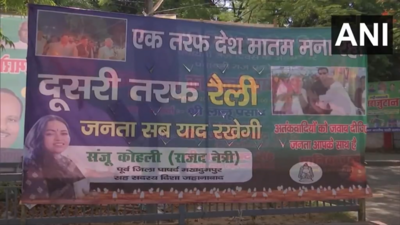
RJD leader Sanju Kohli put up posters featuring PM Modi and Nitish Kumar, bearing the message: “Ek taraf matam mana raha hai, doosri taraf rally. Janata sab yaad rakhegi” (On one side, the country is mourning, on the other side, a rally. The public will remember everything).
This follows Prime Minister’s rally in Bihar’s Madhubani, from where he issued a stern warning to terrorists on April 22, pledging to “identify, track, and punish” those responsible for the Pahalgam terror attack that claimed 26 lives.

Poll

What influences your vote the most during elections?

Addressing his first public gathering since the attack, PM Modi expressed the nation’s grief and assured decisive action against the perpetrators. “On April 22, terrorists killed innocent people of the country in J&K’s Pahalgam… The country is sad and in pain after this incident. We stand with the families of the victims. The terrorists will not be spared, strong action will be taken against them,” PM Modi said.
Ahead of PM Modi’s rally, RJD took a jibe at PM Modi and alleged that the state administration is pressuring local officials and representatives to ensure crowd attendance at the event.
“The pyres of the victims of the Pahalgam terrorist attack have not yet been lit, but the country’s Prime Minister will come to Bihar tomorrow to campaign and deliver speeches because Bihar is holding elections this year,” RJD had said in a post on X.
“The Nitish-BJP government is exerting immense pressure on BDOs, DTOs, DMs, SPs, and others to mobilize crowds. On government orders, officials are intimidating and threatening panch, sarpanch, ward members, committee members, and mukhiyas to gather and bring crowds. They are being forced to go to Madhubani,” it added.
The attack, carried out by terrorists at Baisaran meadow in Pahalgam on Tuesday, is one of the deadliest in the Valley since the 2019 Pulwama strike in which 40 CRPF jawans were killed. The attack was one of the biggest terror attacks in the region after the abrogation of Article 370 in 2019.


Source link

Trump Says J&K Attack “Was Bad One”; UNSC Sends Strong Message


Pakistani Hindu refugees living in India are gripped by fear as the deadline approaches for Pakistani nationals to leave in the aftermath of the Pahalgam attack.

At a refugee colony in Rajasthan’s Jaisalmer, NDTV found several families who had entered India through the Wagah-Attari border. “Eklavya Bhil Basti” in Mulsagar village hosts over a thousand Hindu refugees from Pakistan who have come to India on short-term visas. But the April 27 deadline for Pakistani nationals has left them worried.

Kheto Ram, who used to live in Sindh, had left Pakistan due to continuous harassment, selling everything that they owned there. He and his family – his wife and two sons – had arrived in India just hours before the Pahalgam attack unfolded on Tuesday.

Speaking to NDTV, Mr Ram said the attack had left him fuming. As tensions between India and Pakistan escalated, the thought of returning to a “hell like Pakistan” has left him disturbed. For him, “dying in India is acceptable, but not returning to a hell like Pakistan.”

He said he has appealed to the government and the prime minister to consider his case, stating that his entire family had moved to India after selling everything they had in Pakistan.

Balam, another man from Sindh among the refugees at Eklavya Basti, his wife and young son are not keen on returning to Pakistan. Death is better than that, Balam said while his wife pleaded, “We left everything we had, please don’t send us back.”


Source link

The Link Between A Student Visa To Pakistan And Pahalgam Attack


Quick Take

Summary is AI generated, newsroom reviewed.

Adil Ahmed Thoker, a key suspect in the April 22 Pahalgam massacre, returned to India after training in Pakistan. He coordinated with other terrorists, leading to the attack on tourists that left 26 dead.

New Delhi:

Adil Ahmed Thoker, one of the terrorists involved in the Pahalgam massacre of April 22, which saw 26 people gunned down, went to Pakistan in 2018 and returned six years later with three to four terrorists, sources said. 

Adil Ahmed Thokar, a native of Gurre village in Bijbehara in Anantnag district of Jammu and Kashmir, is believed to be one of the principal architects of the terror attack in Pahalgam’s Baisaran.

From J&K Village to Pakistan

In 2018, Adil Ahmed Thoker left his home in Gurre and travelled to Pakistan on a student visa. According to intelligence officials, Thoker had already shown signs of radicalisation before his departure. Intelligence sources say he was in contact with individuals linked to banned terrorist organisations operating from across the border, even before leaving India.

Once in Pakistan, Thoker disappeared from public view. He severed communication with his family, and no trace of his presence could be established for nearly eight months. Intelligence agencies monitoring his digital footprint lost him. A parallel surveillance operation focused on his home in Bijbehara did not yield any major breakthroughs either.

According to intelligence sources, Thoker was undergoing ideological and paramilitary training during this time. He came under the influence of handlers associated with Lashkar-e-Taiba (LeT), the terrorist organisation based in Pakistan. 

Re-entry Into India

By late 2024, Adil Ahmed Thoker resurfaced in intelligence assessments – but this time inside India.

According to intelligence sources, Thoker crossed the Line of Control (LoC) in October 2024 through the rugged and remote Poonch-Rajouri sector. The terrain in this area is notoriously difficult to patrol, with steep hills, dense forests and a border that has historically been exploited for illegal crossings.

Thoker was accompanied by a small group of three to four individuals, one of whom was a Pakistani national identified as Hashim Musa, another prime accused in the Pahalgam terror attack also known by his alias Suleman. It is now believed that Thoker was instrumental in facilitating Musa’s entry into Indian territory.

After crossing into Jammu and Kashmir, Thoker avoided detection by staying off grid and using forested and mountainous routes. He was tracked briefly in Kishtwar before making his way to Anantnag, possibly through the hilly belts of Tral or via interior tracks used by terrorists in the past, sources said.

Sheltering A Foreign Terrorist

Once in Anantnag, Thoker is believed to have gone underground. Intelligence sources say that he sheltered at least one of the Pakistani nationals he had infiltrated with, possibly in forest encampments or in isolated village hideouts.

He remained in hiding for several weeks, during which he is suspected to have reactivated contact with dormant terrorist cells. Officials believe that he was actively scouting for a suitable location and opportunity to launch a high-impact attack that would cause mass casualties and attract international attention.

This period also coincided with the gradual re-opening of tourist spots in the region following the conclusion of the annual Amarnath Yatra. Baisaran meadow, closed earlier for security reasons, had begun to see tourist footfall again from March 2025.

This, security agencies believe, gave Thoker and his team a clear window of opportunity.

The Baisaran Attack

On the afternoon of April 22, around 1:50 PM, the attackers, including Thoker, emerged from the dense pine forest surrounding Baisaran. Armed with assault rifles, they moved swiftly toward areas where tourists had congregated.

According to survivors, the attackers asked some victims about their religion. In several instances, they demanded that individuals recite Islamic verses. Those who failed or hesitated were shot. Many victims suffered gunshot wounds to the head.

Security officials now confirm that the group consisted of at least five terrorists. They divided into smaller units, targeting three specific zones within the meadow. The entire attack lasted less than ten minutes. By the time help arrived, it was already too late for most. Among the dead were 25 tourists and one local pony operator. Two security personnel, one from the Navy and another from the Intelligence Bureau, also lost their lives in the attack.

Thoker Named As Suspect

Thoker was formally named by the Jammu and Kashmir Police as one of the three principal suspects involved in the Baisaran massacre. The other two are identified as Pakistani nationals – Hashim Musa alias Suleman and Ali Bhai alias Talha Bhai.

Sketches of the three have been released. A reward of Rs 20 lakh has been announced for credible information leading to their capture. Security forces have launched a district-wide search across Anantnag, Pahalgam, and adjacent forest belts.

On Thursday night, houses belonging to Thoker and another accused, Asif Sheikh of Tral, were destroyed in explosions. Officials said that during search operations, security personnel discovered that explosives had been stored inside the houses. These were likely intended either for future use or as a defensive measure. 

Asif Sheikh is believed to have played a secondary role, possibly offering logistical or technical support. His involvement is under investigation.


Source link

“Don’t Send Us To Hell Like Pakistan,” Plead Hindu Refugees In India


Quick Take

Summary is AI generated, newsroom reviewed.

Pakistani Hindu refugees fear returning after the cancellation of visas

India had issued a Sunday ultimatum for Pakistani nationals to leave

Current long-term visas for Hindu citizens from Pakistan remain valid

Jaisalmer:

Pakistani Hindu refugees living in India are gripped by fear as the deadline approaches for Pakistani nationals to leave in the aftermath of the Pahalgam attack. The ultimatum has left them worried due to the worsening condition of Hindu minorities in Pakistan.

India has given a Sunday ultimatum to Pakistani nationals to leave after the massacre of 26 civilians by terrorists in Jammu and Kashmir earlier this week. It will not impact long-term visas that are already issued to Hindu citizens of Pakistan, the government has clarified. However, no such relief has been extended to short-term visa-holders.

This has left several Hindu refugees fearing for their lives in case they have to return to Pakistan. Having fled religious persecution in the neighbouring country, they feel that returning to Pakistan could be dangerous for them.

“Accept Death, Not Pakistan”

At a refugee colony in Rajasthan’s Jaisalmer, NDTV found several families who had entered India through the Wagah-Attari border. “Eklavya Bhil Basti” in Mulsagar village hosts over a thousand Hindu refugees from Pakistan who have come to India on short-term visas. But the April 27 deadline for Pakistani nationals has left them worried.

Latest and Breaking News on NDTV

Kheto Ram, who used to live in Sindh, had left Pakistan due to continuous harassment, selling everything that they owned there. He and his family – his wife and two sons – had arrived in India just hours before the Pahalgam attack unfolded on Tuesday.

Speaking to NDTV, Mr Ram said the attack had left him fuming. As tensions between India and Pakistan escalated, the thought of returning to a “hell like Pakistan” has left him disturbed. For him, “dying in India is acceptable, but not returning to a hell like Pakistan.”

He said he has appealed to the government and the prime minister to consider his case, stating that his entire family had moved to India after selling everything they had in Pakistan.

Latest and Breaking News on NDTV

Balam, another man from Sindh among the refugees at Eklavya Basti, his wife and young son are not keen on returning to Pakistan. Death is better than that, Balam said while his wife pleaded, “We left everything we had, please don’t send us back.”

Hindu refugees fear that if they return to Pakistan, they may again be subjected to religious persecution – the very reason why they had to seek refuge in India.

According to a latest report by the US Commission on International Religious Freedom (USCIRF), the condition of religious minorities in Pakistan has been worsening. They continue to bear the “brunt of persecution and prosecutions under Pakistan’s strict blasphemy law,” the report said, urging the US government to redesignate Pakistan as a “country of particular concern”.


Source link

Strong Message From UN Security Council After Pahalgam Terror Attack


United Nations:

The UNSC has “condemned in the strongest terms” the terrorist attack in Jammu and Kashmir, stressing that those responsible should be held accountable and the organisers and sponsors of this “reprehensible act of terrorism” should be brought to justice.

The 15-nation Council issued a Press Statement on ‘terrorist attack in Jammu and Kashmir’ in which the members “condemned in the strongest terms the terrorist attack in Jammu and Kashmir” on April 22, during which at least 26 people were killed and many more injured.

“The members of the Security Council underlined the need to hold perpetrators, organisers, financiers and sponsors of this reprehensible act of terrorism accountable and bring them to justice,” the press statement said.

“They stressed that those responsible for these killings should be held accountable, and urged all States, in accordance with their obligations under international law and relevant Security Council resolutions, to cooperate actively with all relevant authorities in this regard,” it said.

A press statement is a declaration to the media made by the President of the Security Council on behalf of all 15 Members.

France is President of the Council for the month of April and the press statement was issued by Council President Permanent Representative of France to the UN Ambassador Jerome Bonnafont.

It is learnt that the US had floated the draft statement, which was then discussed by Council members.

Pakistan currently sits in the UN Security Council as a non-permanent member. A press statement requires agreement from all Council members and is a negotiated text.

The members of the Security Council expressed their deepest sympathy and condolences to the families of the victims and to the Government of India and the Government of Nepal, and wished a speedy and full recovery to those who were injured. In the April 22 terror attack in Pahalgam, 25 Indians and one Nepali citizen were killed. The victims were mostly tourists from all across India.

The UNSC members reaffirmed that terrorism in all its forms and manifestations constitutes one of the most serious threats to international peace and security. They reiterated that any acts of terrorism are criminal and unjustifiable, regardless of their motivation, wherever, whenever and by whomever committed.

They reaffirmed the need for all States to combat by all means, in accordance with the Charter of the United Nations and other obligations under international law, including international human rights law, international refugee law and international humanitarian law, threats to international peace and security caused by terrorist acts.

Meanwhile, Stephane Dujarric, Spokesman for Secretary-General Antonio Guterres, responding to a question on the situation between India and Pakistan at the daily press briefing Friday, said that “we continue to follow the situation with very deep concern”.

“And we, of course, reiterate our condemnation of the attacks in Jammu and Kashmir, which, as you know, killed about 26 civilians. And we again urge both the Government of India and the Government of Pakistan to exercise maximum restraint to ensure the situation does not deteriorate further.”

To a question on whether the Secretary-General, who is currently in Rome to attend the funeral of Pope Francis, plans to speak to leaders of India and Pakistan once he is back in New York, Dujarric said, “I hope to have something to share with you” on that.

Dujarric rejected a comment that the “two nuclear countries” might go to war, and the situation is meriting such little attention.

“Let me just say, I don’t agree with your comment… we are paying very close attention to the situation between India and Pakistan,” Dujarric said.

(Except for the headline, this story has not been edited by NDTV staff and is published from a syndicated feed.)


Source link

Iran’s Mediation Offer To India, Pakistan With A 13th Century Poem


New Delhi:

As diplomatic and military tensions between India and Pakistan simmer following Tuesday’s deadly terrorist attack in Pahalgam, Iran has stepped forward with an offer to mediate between the two countries. Citing centuries-old civilizational ties and invoking a Persian poem from the 13th century, Tehran said it is ready to help defuse tensions in the region. 

Iranian Foreign Minister Seyed Abbas Araghchi on Friday described both India and Pakistan as “brotherly neighbours”.

“India and Pakistan are brotherly neighbours of Iran, enjoying relations rooted in centuries-old cultural and civilizational ties. Like other neighbours, we consider them our foremost priority. Tehran stands ready to use its good offices in Islamabad and New Delhi to forge greater understanding at this difficult time,” he said. 

Mr Araghchi’s statement was accompanied by a quotation from Bani Adam, a famous 13th-century Persian poem written by legendary Iranian poet Saadi Shirazi. 

“Human Beings are members of a whole, In creation of one essence and soul, If one member is inflicted with pain, Other members uneasy will remain,” the poem reads. 

Bani Adam, or “Sons of Adam,” was also quoted by former US President Barack Obama in a New Year’s message to the people of Iran in 2009. 

In parallel with Iran’s mediation overture, Saudi Arabia has also sought to de-escalate the situation. According to the Saudi Foreign Ministry, Prince Faisal bin Farhan held separate phone calls with External Affairs Minister S Jaishankar and Pakistani Foreign Minister Ishaq Dar.

“Had a telecon with Foreign Minister @FaisalbinFarhan of Saudi Arabia. Discussed the Pahalgam terrorist attack and its cross-border linkages,” Mr Jaishankar said in a statement. 

The mediation offer came amid concerns over the possibility of escalation between India and Pakistan. On Tuesday, 26 tourists were killed in a terror attack in the town of Pahalgam in Jammu and Kashmir. India has directly blamed Pakistan for orchestrating the attack through cross-border support for terrorist groups. Pakistan has denied involvement. As tensions grew, military exchanges along the Line of Control (LoC) have also been reported.

India responded to the Pahalgam attack with a series of stringent diplomatic and economic measures. On Wednesday, the government suspended the Indus Waters Treaty, a 65-year-old bilateral agreement governing river water sharing. New Delhi also shut down the Attari land border crossing, expelled Pakistani military attaches, and downgraded diplomatic ties.

Additionally, the government directed all Pakistani nationals who had entered the country via the Attari crossing to exit Indian territory by May 1.

On Thursday, Islamabad announced the closure of its airspace to Indian commercial flights and suspended all trade with India, including commerce routed through third countries.


Source link