NEW DELHI: Sunrisers Hyderabad defeated Chennai Super Kings by five wickets in their Indian Premier League clash on Friday, keeping their play-off hopes alive. With this loss, CSK are now virtually out of the race for the knockouts, while SRH remain in contention—at least mathematically. Asked to bat first, Chennai Super Kings were bowled out for 154. In response, SRH chased down the target in 18.4 overs, thanks to key contributions from Ishan Kishan (44), Kamindu Mendis (32*), and Nitish Reddy (19*). This marked Sunrisers Hyderabad’s first-ever win over CSK at the MA Chidambaram Stadium. While SRH’s clinical bowling performance was the highlight on the field, it was co-owner Kavya Maran’s animated reactions during the chase that stole the spotlight online. Her emotional response during the 16th over, in particular, went viral on social media. The moment came when CSK’s Noor Ahmad overstepped, gifting Kamindu Mendis — then on 15 — a free hit. But Mendis couldn’t make the most of the opportunity, swinging hard and missing a wide delivery that turned away. The result: a dot ball.
Sachin Tendulkar at 52: Power, Pride, and a Nation’s Pulse
Credit goes to Dhoni for standing outside the off stump, which prompted Noor to bowl in that specific area, resulting in a dot ball. Kavya Maran’s reaction, a mix of disbelief and frustration, was caught on camera and quickly made the rounds on social platforms, sparking widespread discussion. WATCH: With the victory, SRH leapfrogged Rajasthan Royals to move into seventh place on the points table. Meanwhile, CSK, with just two wins from nine matches, are all but out of the tournament.
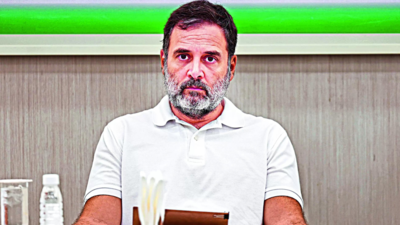
NEW DELHI: Taking serious objection to Congress MP Rahul Gandhi‘s remarks against V D Savarkar, Supreme Court virtually gagged him on Friday, warning him of suo motu action if he derided the freedom fighter and Hindutva proponent in the future. “…This is not the way you treat our freedom fighters,” Justice Dipankar Datta said. A bench of Justices Datta and Manmohan granted relief to Gandhi by staying summon issued to him by a lower court, but only after giving him a history lesson and reminding him him that his grandmother Indira Gandhi too had praised Savarkar. The complaint was lodged after Gandhi, on Nov 17, 2022, allegedly described Savarkar as “receiver of pension from Britishers”, and “a servant of Britishers” at a press conference in Akola, Maharashtra. “Does your client know Mahatma Gandhi also used ‘your faithful servant’ while addressing the Viceroy?” the bench asked senior advocate Abhishek Manu Singhvi, who was representing Rahul Gandhi.
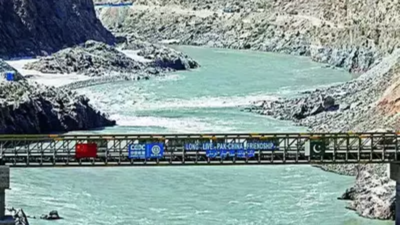
NEW DELHI: A day after India formally communicated to Pakistan that it was keeping Indus Waters Treaty (IWT) between the two countries in abeyance, Union home minister Amit Shah on Friday held a meeting on how swiftly the decision could be implemented and finalised a detailed roadmap, including quick desilting of rivers and dams as an immediate step to prevent the flow of river waters to the neighbouring country. The meeting, attended by Jal Shakti minister C R Paatil and senior officials, is learnt to have discussed implementation modalities in view of creating additional water storage infrastructure and speeding up work on hydro-power projects as medium- and long-term measures so that waters of the western rivers – Indus, Jhelum and Chenab – can be adequately used by India. Desilting of rivers and dams will be done on priority. It will augment supply of water to the India side, resulting in slightly lesser flow to Pakistan which already faces a deficit of 32% in meeting its irrigation and drinking water needs. “A roadmap was prepared in the meeting. Three options were discussed. Govt is working on short-term, medium-term and long-term measures so that not even a drop of water goes to Pakistan. Soon, desilting of rivers will be done to stop the water and divert it,” Paatil told the media after the meeting. At present, India doesn’t have the capacity to store even 3.6 MAF of water on the western rivers, the share which was allowed to it under IWT. Similarly, 3,482 MW capacity of hydro-power generation has been constructed by India out of an estimated power potential of 20,000 MW which can be harnessed from the western rivers. Speeding up work on Kishanganga and Ratle hydro-electric projects will solve the problem to a great extent. Untapped irrigation potential was one of the key points which drew attention of policymakers, specifically in view of maximising use of water from the western rivers. This potential cannot be tapped unless India increases its storage capacity and redirects surplus flow from J&K to Punjab, Haryana and Rajasthan. Work on Tulbul project on Jhelum, suspended since 1986, will help as the accompanying barrage will have a storage capacity of around 0.3 MAF of water.
Trousers of 20 men were pulled down to find out faith before they were killed, find officials NEW DELHI: The trousers of around 20 victims of the dastardly Pahalgam attack – all males – were found unzipped or pulled down by the team of officials that carried out the first examination of the 26 lifeless, bullet-riddled bodies, in what is being seen as a confirmation that terrorists had established the faith of the tourists before killing them. A team comprising officers of the Army, J&K police and J&K administration found to their horror that clothing from the lower body of 20 of the 26 victims had been forcibly dislodged, with their pant zippers undone, pants pulled down, exposing their underwear or private parts. The victims’ kin were possibly too much in shock to have noticed the state of the clothing on the bodies; even the staff retrieved the bodies as they were, simply covering them with a shroud. It was only the team of officers tasked with a thorough examination of the bodies – possibly for the purpose of recording finer details to be included in the FIR – that noticed the tell-tale signs of how the terrorists had subjected the male victims to the medievalesque, barbaric faith-determination test, by having their lower garments undone, just to establish their faith. Eyewitness accounts have confirmed that the terrorists had checked for faith of each of the victims by asking for their identity proof like Aadhaar card or driving licence, etc, ordering them to recite the kalma (Muslim prayer verse) and asking them to remove their lower clothing so that they could check for circumcision. Once their Hindu identities were established through these 3 ‘tests’, the terrorists shot the victims at close range. Twenty-five of the 26 people killed in Tuesday’s attack were Hindus, all of them males. Investigation into the massacre, meanwhile, gathered steam, with sources saying nearly 70 overground workers (OGWs) and known terror sympathisers from various places like Tral, Pulwama, Anantnag and Kulgam are being questioned by a joint team of J&K police, Intelligence Bureau and RAW officials. “Initially, the probe team rounded up 1,500 OGWs to examine their possible role. These have been narrowed down to 70 OGWs strongly suspected to have helped Pahalgam attack team with logistics. We hope to narrow the search further and get to the real culprits soon,” a J&K administration officer said.
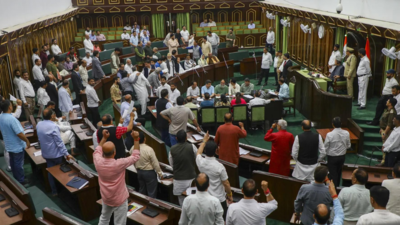
JAMMU: Lieutenant governor Manoj Sinha has called a special J&K assembly session on April 28 over the Pahalgam terror attack following advice from the Omar Abdullah-led govt. The move came on a day when Army Chief General Upendra Dwivedi met Sinha and was urged to take effective steps to bring the Pahalgam attackers to justice. The Omar-led National Conference (NC) govt had on Wednesday requested Sinha to call the special session. That was a day after the attack. “I, Manoj Sinha, Lieutenant Governor of the Union Territory of Jammu and Kashmir, in exercise of powers conferred upon me under section 18(1) of Jammu and Kashmir Reorganisation Act, 2019, do hereby summon the Assembly to meet at Jammu on April 28, 2025, at 10.30 A.M. All members are requested to kindly attend,” the LG’s official order stated. The assembly had wrapped up its budget session on April 9, capping a tumultuous time during which opposition and governing NC members demanded debates on the new Waqf law piloted by the BJP-led govt at the Centre.
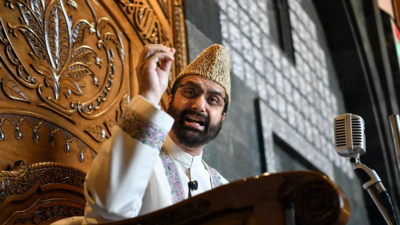
SRINAGAR: Kashmir’s chief cleric Mirwaiz Umar Farooq returned to Srinagar’s Jamia Masjid to deliver his Friday sermon after restrictions of over a month, condemning the Pahalgam massacre and paying tributes to the victims. Mirwaiz and the others observed a minute’s silence in solidarity with the relatives of all those who lost their dear ones in the terror attack. Mirwaiz reminded his audience that the authorities had put him under house arrest ahead of previous Friday prayers in the past month. “Sadly, during this time, we had to witness a terrifying attack, which has left our hearts bleeding. The manner in which a carnage was carried out, more than two dozen people killed after ascertaining their identities and in front of their families, is shocking and chilling beyond belief,” Mirwaiz said. The chief cleric recalled the 1990 day when his father was shot dead by terrorists. “Who better can understand the pain and grief of loss of the families affected (in Pahalgam) than people who have suffered it (terror) for decades and still continue to. Today is the 36th martyrdom anniversary of my father, Mirwaiz Molvi Mohammad Farooq.” Mirwaiz told the gathering that “our hearts go out to these families who will never see their loved ones again, and our prayers are with them and we pray for speedy recovery of the injured.” Mirwaiz underscored Kashmiris’ famed hospitality, saying they had always opened their hearts and homes to outsiders, especially tourists. “People of Kashmir once again upheld the tradition of outreach, help, and humanity in this distressing time. Locals helped those at the (Pahalgam) spot to flee, even at risk to their own lives, in which pony operator Adil Hussain died. We pay homage to this brave young Kashmiri,” Mirwaiz said. He pointed out that other locals ferried the injured, some on their backs, to hospitals, while a complete shutdown was observed in memory of those killed. “The people of Kashmir sent a strong message of their total disapproval of such actions and solidarity and sympathy with the bereaved, standing shoulder to shoulder with them.” He requested authorities to allow him to visit the injured in hospitals and Adil’s family to pay condolences. Mirwaiz struck a note of caution and anguish at “a large section of mainstream media spreading communal rhetoric of hate against Kashmiris”. This, he said, has made Kashmiris across India vulnerable, forcing hundreds, especially students, to leave. “I appeal to govts in different states to ensure the safety of our students and all other Kashmiris,” Mirwaiz said.
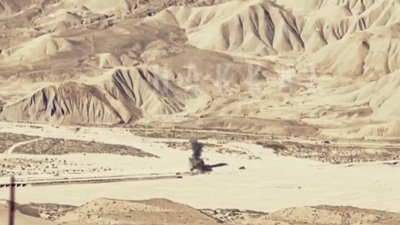
The Balochistan Liberation Army (BLA) on Friday claimed responsibility for a deadly roadside bomb attack in Quetta that killed ten Pakistani military personnel and injured three others. The blast occurred in the Margat area on the outskirts of the Balochistan capital, targeting a vehicle reportedly belonging to a bomb disposal squad. According to The Balochistan Post, the device was a remote-controlled improvised explosive device (IED). Soon after the blast, the BLA released a video showing the attack in a remote and hilly area. While police at first reported four deaths, the BLA later said in a statement that ten soldiers were killed and the vehicle was completely destroyed. “Freedom fighters targeted a Pakistani Army convoy with a remote-controlled IED in Margat. The vehicle was destroyed, and all 10 soldiers on board were killed,” said BLA spokesperson Jeeyand Baloch. This attack is part of a series of strikes by the BLA. In March, the group hijacked the Jaffar Express train, resulting in around 60 deaths, another major act in the long-running conflict between the Baloch insurgents and the Pakistani government.
India and Pakistan will figure out relations between themselves, US President Donald Trump said on Friday as tensions soared between the two neighboring countries after a terror attack in Jammu & Kashmir’s Pahalgam that was the worst in nearly two decades.
Trump, speaking to reporters on Air Force One, cited historical conflict in the region and said he knew both countries’ leaders, but did not answer when asked whether he would contact them.
“They’ll get it figured out one way or the other,” he said as he traveled aboard his plane. “There’s great tension between Pakistan and India, but there always has been.”
On Tuesday, 26 men were killed at a tourist site in Kashmir, shot dead in a meadow. India has said there were Pakistani elements to the attack, a claim Islamabad denies.
Relations between the two South Asian nations have deteriorated in the days following the attack, with India setting aside a critical water sharing pact and Pakistan closing its airspace to Indian airlines. Their trade is also at risk.
On Friday, Indian stock markets fell on fears of fresh tensions as Indian authorities searched for terrorists in the region, before markets recovered some losses.
(Except for the headline, this story has not been edited by NDTV staff and is published from a syndicated feed.)
MUMBAI: International students will be able to breathe easy, at least for now, as the Trump administration appears to have backtracked on the abrupt, unlawful SEVIS termination of hundreds of international students. Immigration attorneys are reporting that since Thursday evening, Student and Exchange Visitor Information System (SEVIS) records have been quietly reinstated for a large number of international students across the US, including those students who are not involved in lawsuits filed to challenge termination of their records. According to attorneys, news is pouring in from the international student community and from educational institutions of a terminated status suddenly becoming ‘active’. In many cases, Designated School Officers (DSOs) have informed students of the reactivation of their SEVIS records. For instance, ‘The Daily Californian’, an independent, student-run newspaper which covers the UC Berkeley campus and Berkeley city, has reported: “At UC Berkeley, 12 students have had their status restored today after 23 were terminated since April 4.” SEVIS is the web-based information system that the US agencies use to track and monitor international students during their duration of study. On abrupt termination of SEVIS – an exercise that began in mid-March, affected students were informed by DSOs to self-deport, resulting in several lawsuits being filed. Initially – as of Thursday, educational institutes were unaware for the reasons for reactivation. However, immigration attorneys state that some institutions have now been informed that Immigration Customs and Enforcement (ICE) is developing a policy that will provide a framework for SEVIS record terminations. “Until such a policy is issued the SEVIS records will remain active/will be reactivated. ICE will not modify the SEVIS records solely based on the NCIC finding that resulted in the recent SEVIS terminations…,” states the communication. The National Crime Information Center (NCIC) is a central database for crime-related information in the US, maintained by the Criminal Justice Information Services Division (CJIS) of the Federal Bureau of Investigation. It provides access to virtually all law enforcement agencies nationwide and enables rapid exchange of information. The New York Times reports that “The Trump administration on Friday abruptly walked back its cancellation of more than 1,500 student visas held by international students, announcing a dramatic shift by ICE during a court hearing in Washington. Joseph F. Carilli, a Justice Department lawyer, said that immigration officials had begun work on a new system for reviewing and terminating visas for international students and that until the process was complete, agencies would not make additional changes or further revocations.” The paper also quotes him as saying that the government was prepared to file the policy change across other lawsuits, potentially providing some reprieve for students who had sued to have their visas reinstated and remain in the country through graduation ceremonies in the spring. The grounds on which action was taken against international students for F-1 visa revocation and/or SEVIS termination were arbitrary. Based on the recent statement by ICE, in many cases it was presumably based on NCIC data. As reported by the American Immigration Lawyers Association (AILA) and other advocacy groups, not all instances of termination related to campus activism. Some related to minor infractions with police such as not wearing a seatbelt, tickets for illegal parking, or speeding tickets or even instances of domestic violence where even the victim is taken into custody. In other cases, the international students had no run-in with the police at all. According to immigration attorneys, during the recent court hearings US agencies have not been able to offer any tangible explanation for the abrupt termination of SEVIS records, except to counter that it does not result in irreparable harm. With Indian students being the largest cohort, they were the most impacted by the abrupt SEVIS terminations. Hundreds of students have filed lawsuits with various district courts challenging their SEVIS termination – which made them vulnerable to devastating immigration outcomes such as detention and deportation, as well as irreparable harm. Many others are lining up to file individual lawsuits or join class action suits. Courts such as Georgia, New Hampshire, Minnesota, Washington and Wisconsin have granted temporary restraining orders. As reported by TOI recently, pursuant to an order of a district court (Northern District of Georgia) SEVIS records of all 133 students who were party to a lawsuit were reinstated by the Department of Homeland Security (DHS) retroactive to March 31. Jonathan Wasden, an immigration attorney, said, “We are seeing many SEVIS status being reactivated in cases of our clients who had obtained temporary restraining orders. It seems that the DHS is slowly working its way out of the hole it dug for itself. We are also hearing that DHS has been reactivating SEVIS in cases where these international students have not sued. The heavy lift may be done here and the agency may be backing off on this issue.” Some immigration attorneys are asking international students to approach their DSOs to check their SEVIS records, before planning any further course of action. On the other hand, due to the uncertainty involved, several students have decided to proceed with their plans of a lawsuit. IMMPact Litigation a joint venture of four law firms, is all set to file a class action suit in the coming week, as many questions still remain unanswered – including those relating to unlawful presence, OPT unemployment accrual (while the students could not work), or whether revoked visas will be reinstated again.
The suspension of the Indus Waters Treaty was announced by India on Wednesday.
Both short-term and long-term options were discussed at Friday’s meeting
Desilting of existing dams is one of the options in the short-term
New Delhi:
Emphasising the importance of suspending the Indus Waters Treaty, Union Jal Shakti Minister CR Patil has said India will ensure that not even a “drop of water” from the Indus river goes to Pakistan.
Mr Patil said this in a post on Friday after a meeting at Home Minister Amit Shah’s residence, which was also attended by External Affairs Minister S Jaishankar and top officials.
“The historic decision taken by the Modi government on the Indus Water Treaty is completely justified and in the national interest. We will ensure that not even a drop of water from the Indus River goes to Pakistan,” Mr Patil wrote in Hindi on X.
The suspension of the Indus Waters Treaty of 1960 was announced by India on Wednesday as part of a series of steps taken after the dastardly terror attack in Jammu and Kashmir’s Pahalgam in which 25 tourists and a local were killed. The Jal Shakti Ministry then sent a letter on Thursday to Syed Ali Murtuza, Secretary in the Ministry of Water Resources of Pakistan, notifying the decision.
“The obligation to honour a treaty in good faith is fundamental to a treaty. However, what we have seen instead is sustained cross-border terrorism by Pakistan targeting the Indian Union Territory of Jammu and Kashmir,” the ministry said in the letter.
Priority Areas
Top officials said a detailed plan for India’s next steps was discussed in the meeting at Mr Shah’s residence and it was decided that the implementation of the treaty’s suspension will begin immediately.
“Several long-term plans are on the table but the priority is a plan that can serve as a blueprint for the immediate and mid-term future,” an official said.
As part of the Indus Water Treaty, which was brokered by the World Bank, India has full right over the three eastern rivers in the Indus system – Ravi, Beas and Sutlej – while Pakistan gets access to around 135 million acre feet (MAF) of water from the three Western rivers – Indus, Jhelum, and Chenab – all of which flow downstream to the country from India.
Among the options that are on the table in the short term, the Centre is looking at de-silting existing dams on the Indus, Jhelum and Chenab and increasing reservoir capacity, all of which will reduce the water flowing into Pakistan.
Pakistan has been objecting to two hydroelectric projects by India – Kishenganga on a tributary of the Jhelum and Ratle, which is under construction on a tributary of the Chenab. The suspension of the treaty will allow India to ignore Pakistan’s objections.
In the longer term, building new dams and infrastructure on these rivers is also something that is being considered.
Legal Response
The officials said a legal response is also being drafted in case there is any pressure from the World Bank or any other international institutions. Diplomatic efforts will also continue to ensure other countries know why India took the step.
“The government’s intent is also to ensure that people in India face no or very little inconvenience because of this. The Jal Shakti, Home and Ministry of External Affairs are working on this in a coordinated fashion,” an official said.
Pakistan has already indicated that it is rattled by the suspension of the treaty. “Any attempt to stop or divert the flow of water belonging to Pakistan as per the Indus Waters Treaty… will be considered as an Act of War and responded with full force across the complete spectrum of National Power,” Pakistan’s government said in a statement on Thursday.