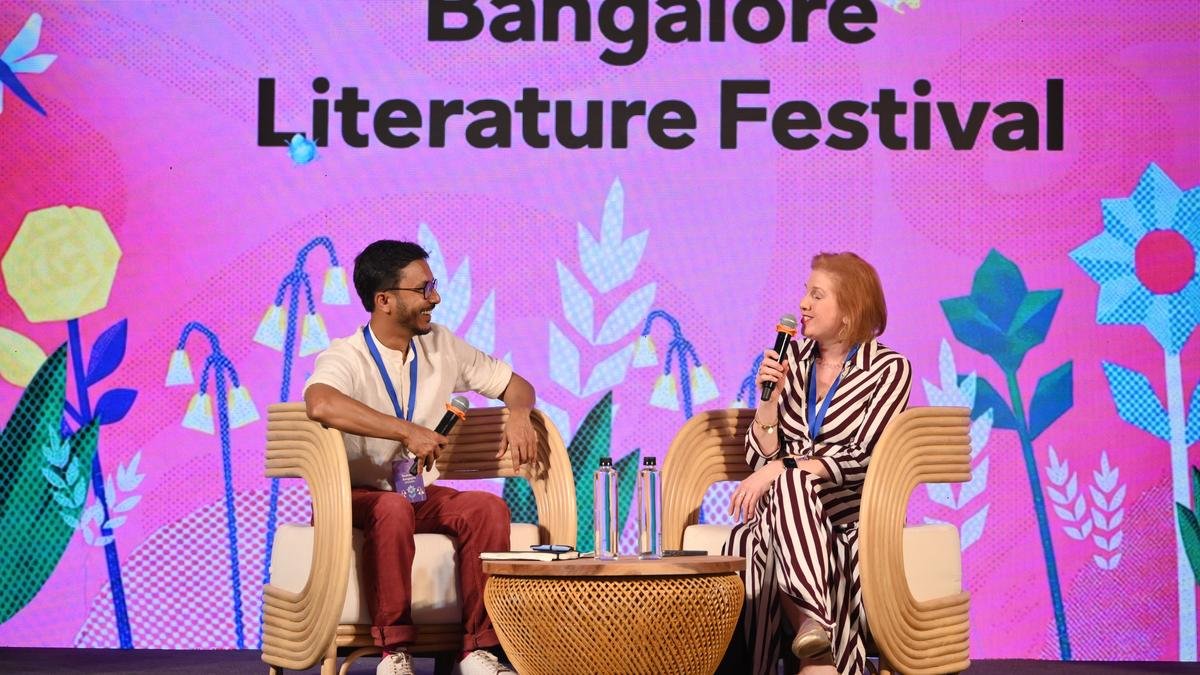
When British crime writer and former police officer Clare Mackintosh’s son, Alex, died in 2006, at just five weeks old, she thought that grief would kill her. “It felt like a physical trauma, which I hadn’t been prepared for. I knew that grief would be sad, and I anticipated crying. But my limbs hurt, my hair fell out, and my chest was so tight I couldn’t breathe,” remembers the former police officer, speaking at the sidelines of the recently concluded Bangalore Literature Festival. But she also recalls being told by a stranger back then that it wouldn’t always hurt as much as it did at that moment.
“I didn’t believe her,” says Clare, comparing grief to a long journey, one that you are very aware of when it starts. But then, as time goes on, she says, you get engrossed in a book or a conversation or your thoughts, and when “you look out, however far into that journey, you realise that the landscape has changed. You were in the city, and now there are fields and trees.”
It was encountering this changed landscape of grief that propelled her to write I Promise It Won’t Always Hurt Like This: 18 Assurances on Grief, her second work of non-fiction, published in 2024. According to her, the book evolved out of a Twitter post she wrote on December 10, 2020, 14 years after her son’s passing. “I tweeted about her (the stranger), and my own promises, and I talked a little about what I feel are the symptoms of grief.” The tweets resonated with millions of people, and they went viral. “It became undeniable that there was a hunger for more honest conversations about grief. And that’s when I decided to write this.”
This is not the first time that ideas about grief have segued into her writing, though. “I was about six books in before someone said to me, ‘Oh, you often write about grief’. And then, I looked at all my books, and I thought, ‘Gosh, I do often write about grief,” says Clare, pointing out that all novels are, in part, autobiographical, especially debut novels. “We put so much of ourselves in them.” Grief, in her view, is complex and not only about people dying. “It is a sadness, a loss. You know, I felt immense grief when I left the police because it was part of my identity and my life,” she says.

Clare Mackintosh
| Photo Credit:
Special Arrangement
Clare, who grew up reading books by Enid Blyton, Agatha Christie and Ruth Rendell, spent around 12 years in the police force, a job, she says, women tend to do particularly well “because your greatest weapon is your mouth. We’re very good at negotiating and empathising and talking out of a situation rather than rushing in with physicality.”
Besides, as someone who “was always a storyteller…interested in stories and the journeys that we take in life,” the police force suited her because it was very much about those stories, finding people’s truths and also learning how easy it is for our lives to change, she says. “If you live a safe life, free from crime, don’t commit crime and are not a victim of crime, it is not always through your own doing, but often because of circumstances. Being in the police really taught me that.”
She began writing a little after her son died, a blog that began garnering “quite a big following. And slowly, I was starting to write more for the audience, the first time I’d really written for someone else,” says Clare, who quit the force in 2011.
That decision, she says, stemmed from an interaction she had with her husband after showing him the results of a 360-degree assessment, a performance review tool she had taken at work because she was due for a promotion. “It talked about how I was really positive, how my door was always open, and I was always ready to help… all the good stuff,” she remembers.
And yet, when she showed the result to her husband, he turned around and told her that he did not recognise the woman in the report. “It prompted a lot of reflection and conversation, and I realised that, like a lot of people, I was using all the best bits of me at work and bringing the leftovers home to my family,” says Clare, who went on to quit the force soon after.
And since the only other thing she knew how to do was write, she wrote, freelancing for a while before publishing her debut novel, I Let You Go, in 2014. “That book sold a million copies, was translated into 40 languages, and we sold the screen rights. And I’ve been a full-time author ever since.”
Clare is today the author of eight novels, including a three-book series, The Last Party, A Game of Lies, and Other People’s Houses, starring DC Ffion Morgan, a character she loves because “she is strong and feisty, and very complicated. I also love that she is fiercely Welsh and speaks Welsh at home,” says Clare, who believes that crime novels, which depict ordinary women finding their inner strength, appeal to female readers.
She brings up a quote, often attributed to Eleanor Roosevelt, ‘A woman is like a tea bag – you can’t tell how strong she is until you put her in hot water.’ “It is a bit corny, but I love it. That, for me, sums up a huge number of the female-led crime novels.”
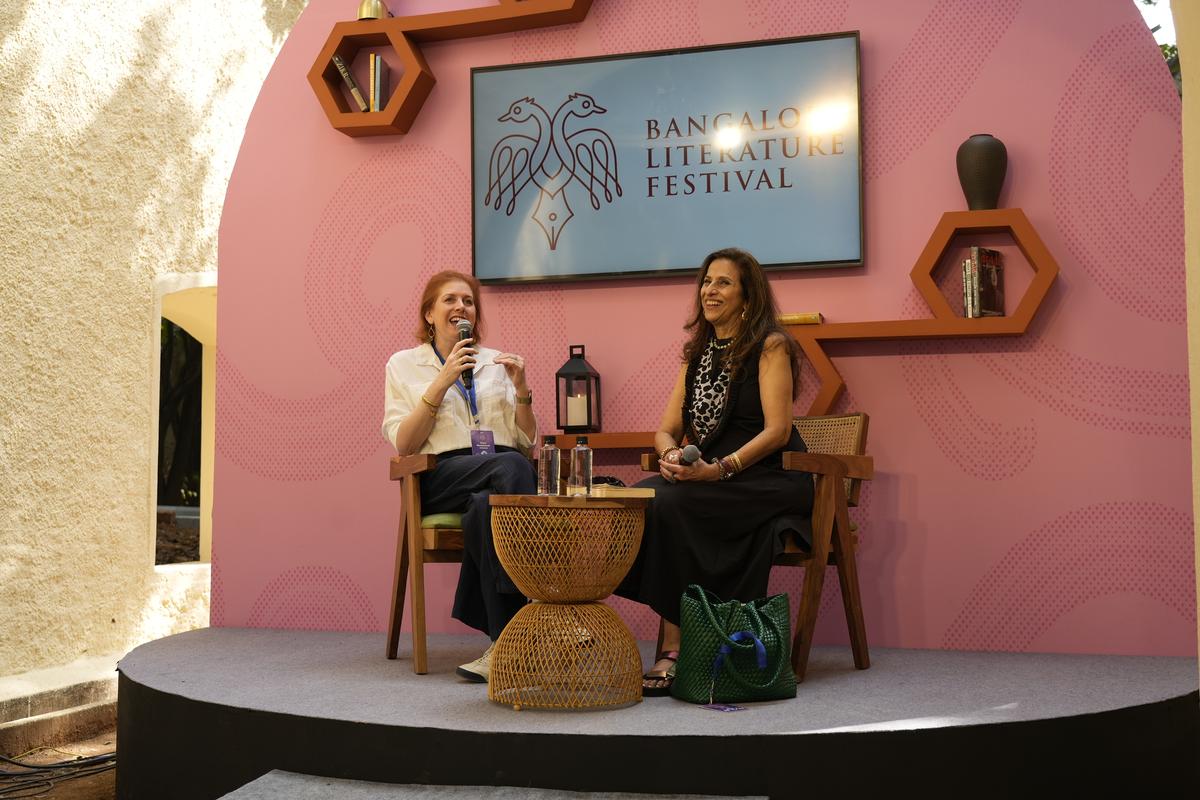
Clare in conversation with Shobhaa De at the Bangalore Literature Festival
| Photo Credit:
Special Arrangement
She is now busy revising her ninth novel, It’s Not What You Think, which promises to be a gripping psychological thriller and will be out in March next year. The book, explains Clare, tells the story of a woman called Nadeeka, who is driving home in a rush because she thinks she is about to catch her partner red-handed at home with another woman.
When she arrives, however, she finds him dead. “Her house is a crime scene, and she thinks that it is the worst thing that could happen to her,” she says, giving us a sneak peek. “But she is very wrong, because things get a lot worse.”