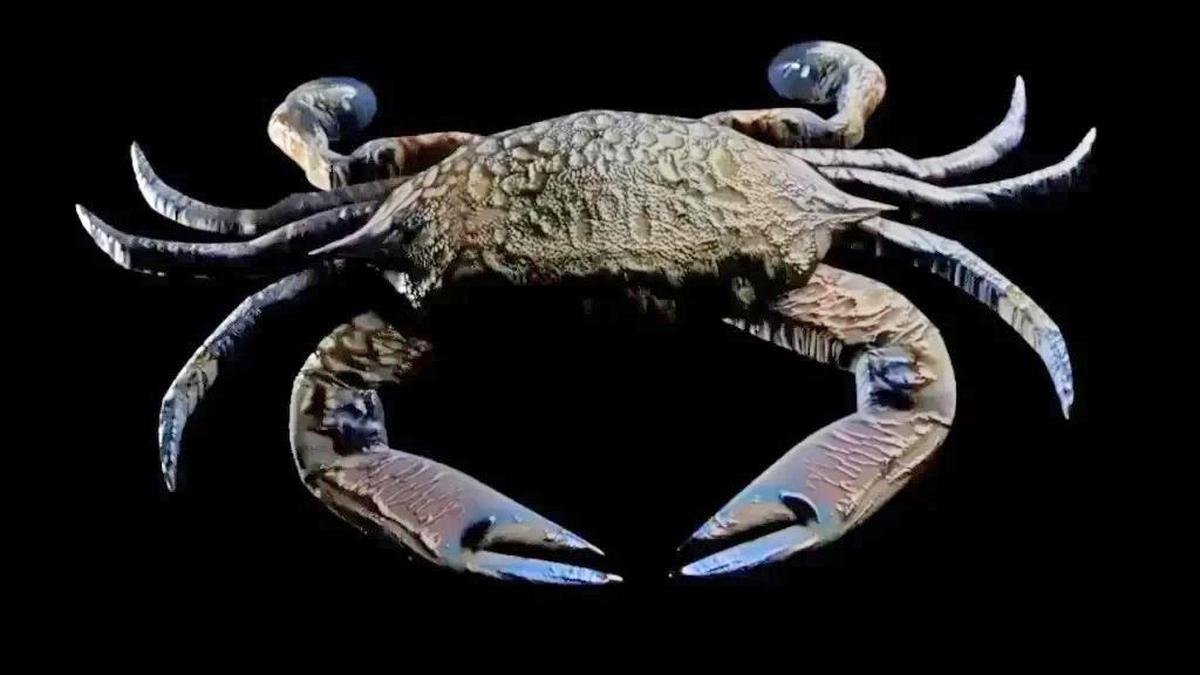

The blue crab
| Photo Credit: Special Arrangement
Did you know this fun fact? Female crabs often carry their eggs in a special area known as a ‘brood pouch’ or ‘eggsac’ located on the underside of their body. Once the eggs are ready to hatch, they just have to come close to the waves, raise their claws, and hop to release the eggs into the sea.

A pictorial guide on blue crabs packs information on an interactive e-learning platform. Besides scientific description, one can learn that crabs, the crustaceans, is a group that evolved hundreds of millions of years ago! And blue crabs are sexually dimorphic, indicating that males have blue colouration and females are brownish in colour. Launched by Zoo Outreach Organisation, with the National Geographic Society, the programme called Magic of the Ocean: Empowering Ocean Literacy, is designed to equip teachers and students with knowledge about the Indian Ocean, its biodiversity, fisheries, livelihoods, and the seven principles of ocean literacy.
It aims to empower educators in ocean literacy so that they become powerful agents of change.“Ocean literacy is not just about knowing the ocean — it’s about understanding our connection to it,” says Sanjay Molur, executive director of Zoo Outreach Organisation. “This platform empowers teachers and students to become part of that connection and inspire real change.”
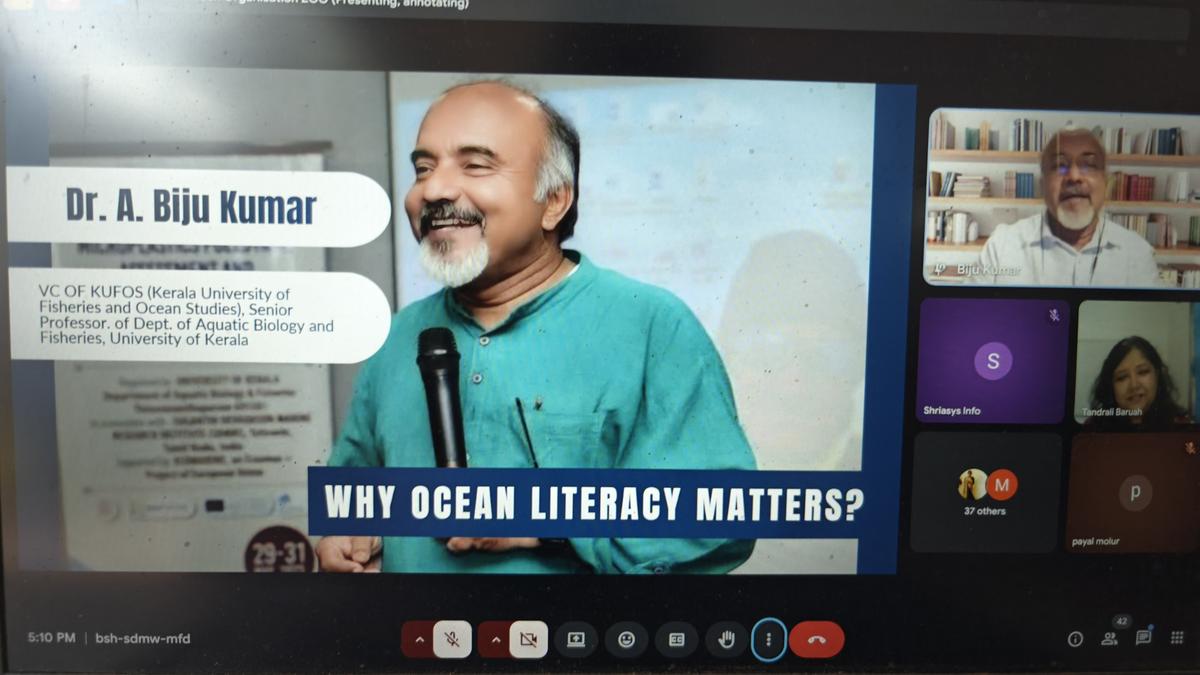
At the launch, over 50 participants pledged to bring ocean literacy in to their classes.
| Photo Credit:
Special Arrangement
A marine calendar draws attention to important marine dates that can be an occasion for celebration among students. While November 21, World Fisheries Day, highlights sustainable fisheries, June 16, World Sea Turtle Day honours sea turtles. Other significant dates include World Seagrass Day, International Seal Day, World Dugong Day and more. The mascot for the online initiative is Dr Monta Ray, a giant oceanic manta ray that pops up as a guide in the classroom to teach and explore marine life. Recently, it was launched at Vidya Vanam Higher Secondary School in Anaikatti following which over 50 participants pledged to bring ocean literacy in to their classes. The platform is an initiative under the United Nations Decade of Ocean Science for Sustainable Development. The content is mapped to different subjects taught in schools through interactive lesson plans, animations, videos, and games.

Conceptualised and developed by the Zoo Outreach Organisation team it brings together teachers who have co-created content alongside researchers, ensuring that each lesson is scientifically sound, culturally relevant, and inclusive. By making ocean science engaging and accessible, the aim is to build a community of young ocean champions ready to take collective action for conservation.
To know more, visit 1ocean.zooreach.org/magicoftheocean/
or email 1ocean@zooreach.org
Published – March 11, 2026 04:20 pm IST