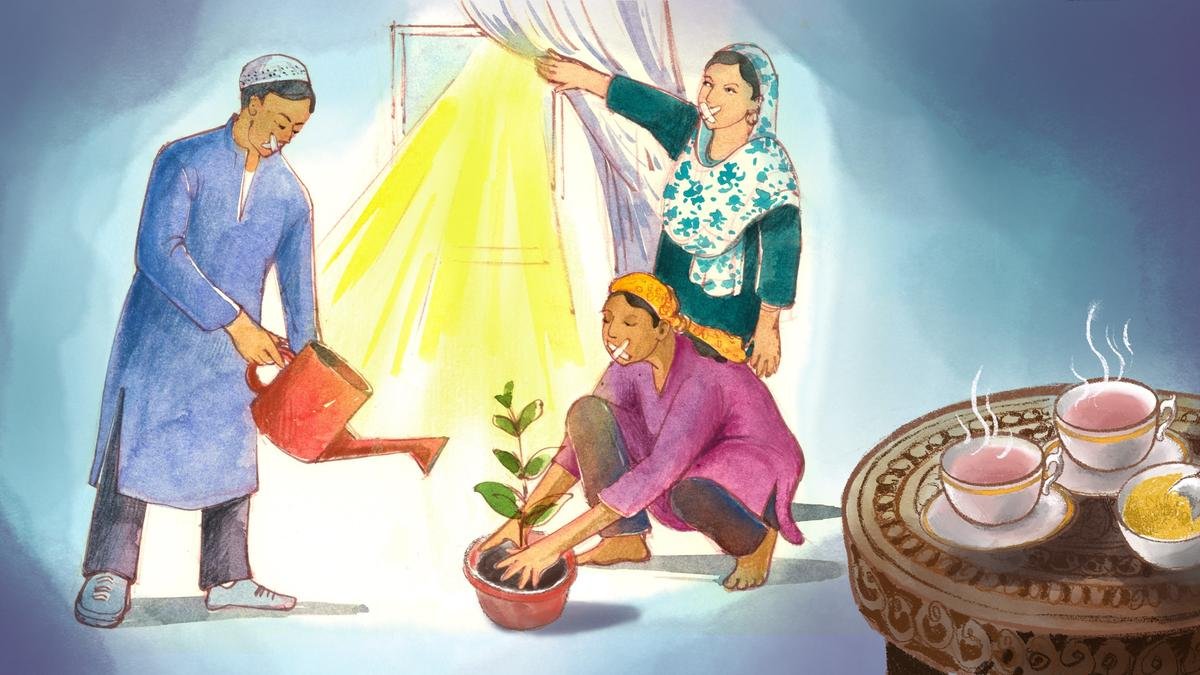
On a warm afternoon, we were sitting in Phuphee’s kitchen toasting makkai (corn) to make soatt (ground corn). Phuphee would make large batches of makkai saott around late August when the last of the corn is harvested. We were chatting, when someone ran in shouting. It was a lady from the village and she begged Phuphee to come straight away as someone’s noashe (daughter-in-law) had been possessed by a jinn.
Phuphee grabbed her keep (top part of the Kashmiri burqa) and the three of us ran into the village where everyone was gathered around Dar Sahab’s house. Even from a distance we could see the youngest daughter-in-law looking wild, her hair flying around her. She kept screaming at her mother-in-law who looked visibly scared.
As soon as the mother-in-law saw Phuphee, she started weeping and asking her to cure the girl of the jinn. The daughter-in-law, whose name was Shama, continued screaming, repeating the same thing over and over again: ‘Baeti ches insaan [I am also human].’
Phuphee went over to Shama and held her hands in her own until she started to calm down. Phuphee then took off her keep and wrapped it around Shama and led her into the house. She asked the mother-in-law to make a cup of nun chai with a dollop of ghee. From her pocket, she handed her a small packet with makkai soatt and instructed her to put it in the tea. Phuphee and Shama went upstairs and an hour later, Phuphee emerged on her own.

‘She is sleeping now. Do not disturb her. Let her rest,’ Phuphee instructed them.
She took the mother-in-law into the kitchen. Ten minutes later she came out, and we left. As we walked back home, I asked Phuphee what had happened to Shama.
She motioned for us to sit under a chinar tree. She took a couple of cigarettes from her pheran pocket and lit them. After she had smoked for a couple of minutes, she said, ‘Shama has a very serious illness. She has to have treatment for a long time. The treatment is long and difficult, and the cure isn’t guaranteed. She is unable to do anything at home now. She cannot look after the house or the children or even herself for that matter.’
Phuphee went quiet and smoked her cigarettes. It seemed like she was trying to solve something in her mind. When she had finished, we got up and went home. Once she got back, she asked one of the helpers to bring us nun chai and soatt. I asked her if she had given the mother-in-law a taaveez for Shama. She smiled as she mixed spoonfuls of soatt into the nun chai for me.
‘When I mix the soatt with the tea, it seems to disappear, but it is still there. It is the same with words,’ she said.
Phuphee explained that Shama’s mother-in-law had two sons. Both were married. Shama was the eldest daughter-in-law. When the younger son got married, his wife had become very unwell for a number of years. Though she had recovered and lived a normal life, she was constantly reminded of the time when she had been riddled with illnesses. Now, Shama had become unwell. And it had transpired that the mother-in-law went around telling everyone about how ‘goednyeth aes laktyis sakhti, waen che baedyis [first the youngest son had a difficult life and now the eldest]’.
Someone in the village had relayed this information to Shama. Upon hearing these words, Shama had felt a fire take hold of her heart. What had particularly angered her was that her mother-in-law had made no comments about how awful it was for Shama to be in this situation. Shama had asked Phuphee, ‘Why when I am the one who is ill, is my discomfort secondary to everyone else’s? How has it become about the discomfort of others?’
‘What did you say?’ I asked Phuphee.
‘I said nothing. Shama already knows the answers,’ Phuphee replied.
I sat there wondering what she already knew.

‘But did you give them a taaveez?’ I asked impatiently.
Phuphee sighed.
‘Yes I did, but it was not for Shama. I told her the jinn had not possessed Shama. It had possessed her [mother-in-law] and the only way to kill it was through abstinence of speech. She must limit what she says to the absolute minimum and she must never speak more than two words in front of Shama because that would especially strengthen the jinn,’ Phuphee said.
She then got up, gave me a kiss on my forehead, and said, ‘Never, forget this. There is a special place in hell for women who deprive other women of their autonomy. Men make the shackles, but it is often other women who throw away the key.’ And she walked out to grind the rest of the corn.
I sat there, overwhelmed. Many years later, I understood why she had shut the mother-in-law’s mouth. It was an act that seemed insignificant, but it gave Shama a little space. In a world designed by men and propagated by many women, a world where women have no ownership over anything, not even their pain or discomfort in illness, Phuphee had managed to lift the mother-in-law’s foot off Shama’s neck long enough for her to breathe.
Saba Mahjoor, a Kashmiri living in England, spends her scant free time contemplating life’s vagaries.
Published – November 28, 2025 11:48 am IST