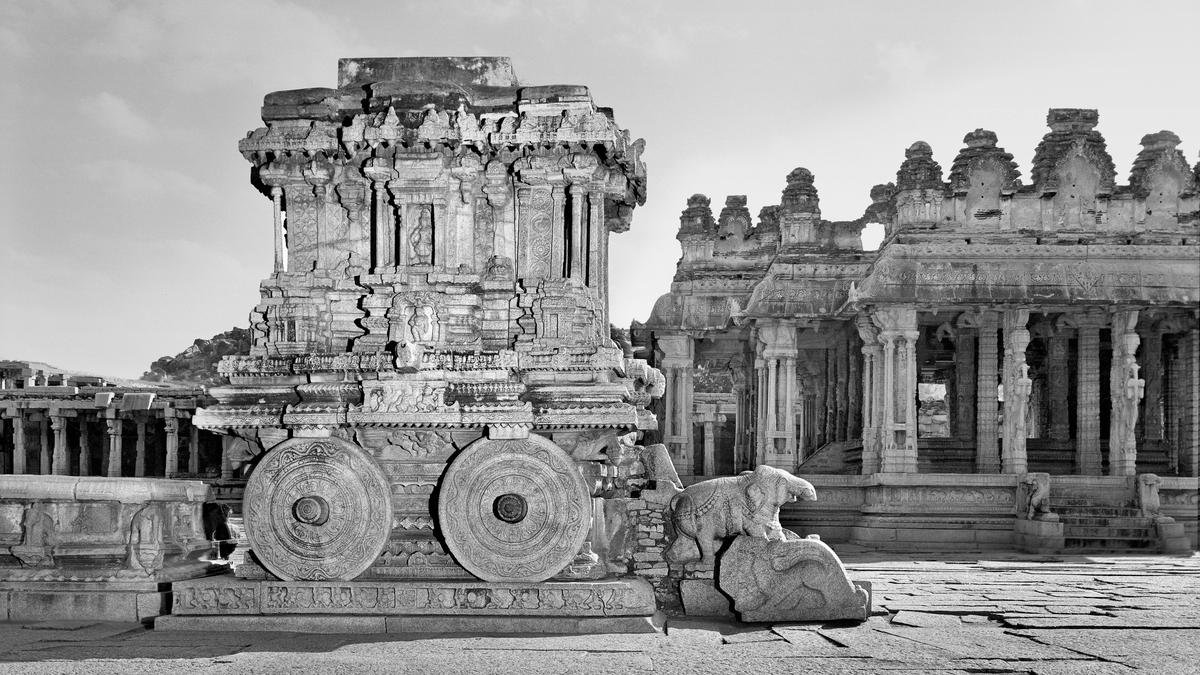
The Vijayanagara empire dominated the geopolitical landscape of the Deccan from the 14th to the 16th centuries before its destruction and abandonment. Vijayanagara, which means the City of Victory, continues into our times with the ruins at Hampi, now a World Heritage Site of immense cultural significance and newfound interest. The book City of Victory: Hampi Vijayanagara (Pictor), by archaeologists George Michell and John M. Fritz (with photography by John Gollings), is therefore not another architectural guidebook but a definitive visual and historical portrait of a city that was once the thriving capital of the most important Hindu kingdom in medieval South India.
The book is an updated presentation of the 1991 book by the authors. The older edition — with Michell’s lifelong work on Deccani architecture and its dissemination, alongside Fritz’s studies — was a landmark publication that brought early scholarly attention to Hampi. The new edition is designed for contemporary readers; Michell has reorganised the scholarship, updated the documentation work (that has continued since 1991), and published it in large format.
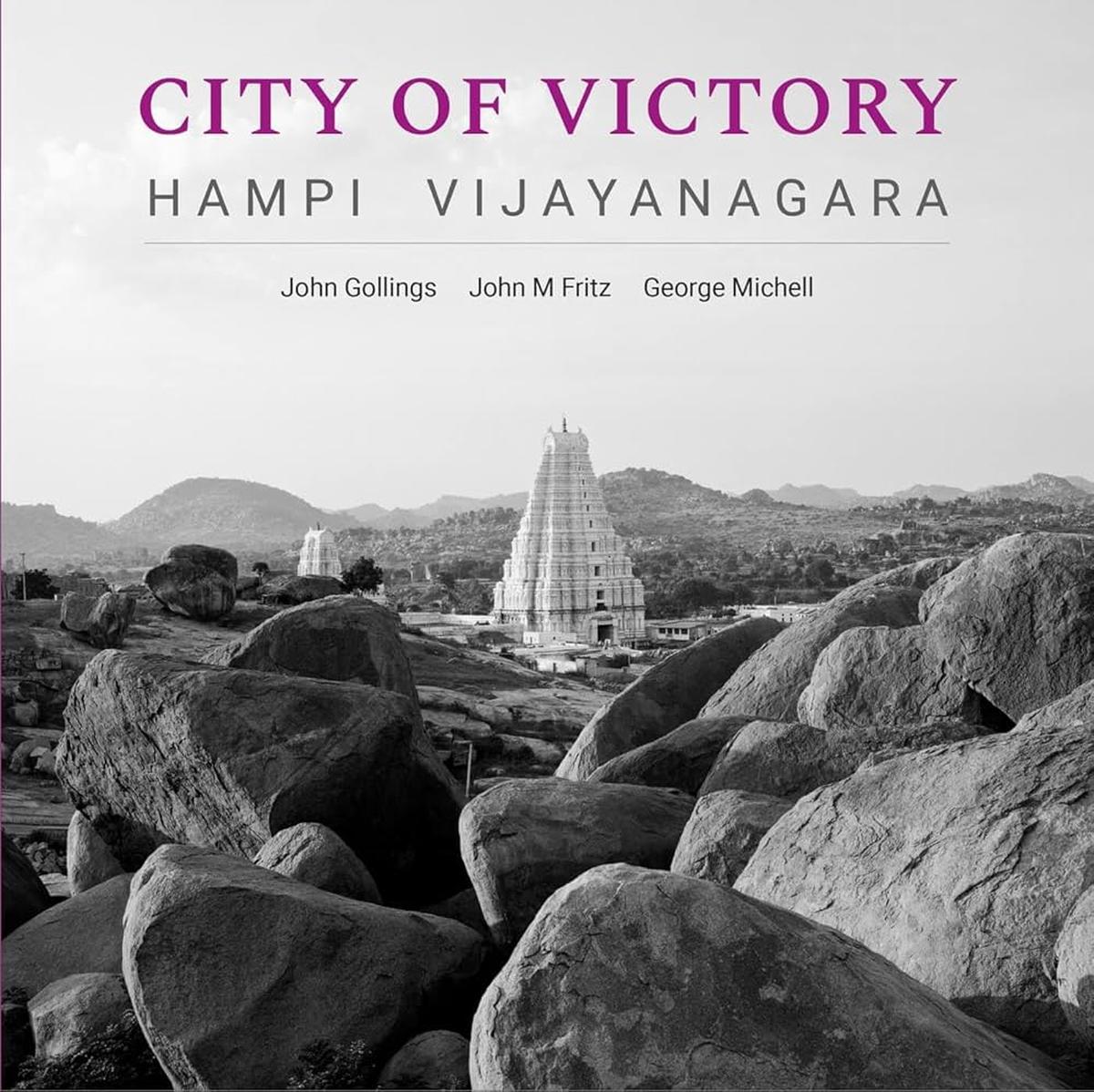
The book City of Victory: Hampi Vijayanagara
A few weeks ago, I had a chance to attend the photo exhibition that accompanied the book launch, at Bengaluru’s Venkatappa Art Gallery. To my luck, architectural photographer Gollings was on site for a walkthrough of the black-and-white photographs. Produced over 45 years, his lens captures buildings suspended in sweeping stone terrains, each shot a careful composition. One image was particularly arresting: the monumental 6.7-metre monolithic Lakshmi Narasimha at Hampi. Weathered, immense, and dignified even in ruin, it is among the most recognisable icons of Vijayanagara, commissioned by King Krishnadevaraya in 1528.
But something felt subtly unfamiliar. The deity, seated cross-legged in formidable calm, seemed familiar and yet altered. Gollings explained the shift. “In the 1980s, well-meaning conservators from the Archaeological Survey of India introduced a stone yogapatta — a supporting band across the knees — to stabilise the sculpture,” he said. “In doing so, they inadvertently transformed the iconography.” The original sculpture, once depicted with the goddess seated upon Narasimha’s lap, had long lost its form. With the addition of the band, the image was reinterpreted as Yoga Narasimha, the ascetic manifestation we recognise today.
It was a quiet revelation. What centuries had weathered and neglect had sustained, restoration had subtly redefined.
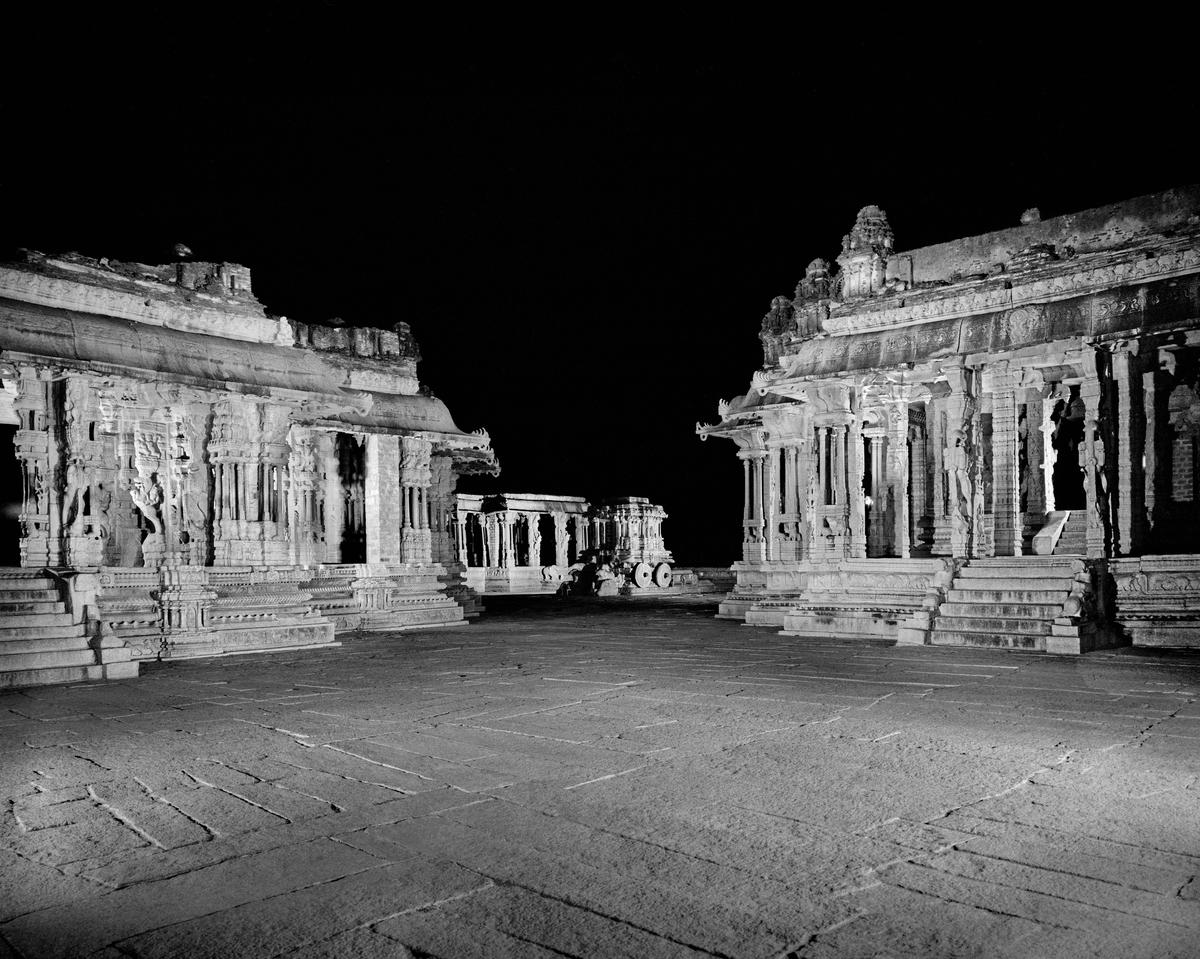
The historic Vijaya Vitthala Temple complex in Hampi
| Photo Credit:
John Gollings
An empire’s timeline
The text by Michell and Fritz reflects decades of documenting Vijayanagara, and weaves historical narrative with architectural documentation and insight. Fritz is with us no more, but Michell spoke about his work at the launch, echoing the author’s deep familiarity with the site. It was Fritz’s idea, he said, to organise photographs into ‘areas of interest’ — landscapes, prestigious temples and so on. This shines through in the book as they establish the empire’s timeline, delve into religious architecture and its central role in urban planning of the time, and guide the reader’s journey through the city.
In its heyday, Hampi must have astounded visitors. Temples, palaces and market streets unfolded across a surreal boulder-strewn terrain. Sacred shrines lined the banks of the Tungabhadra, the region’s life force. Massive granite blocks were carved into mandapas along the water, which could withstand seasonal flooding. Elsewhere, rocks were cut into reservoirs serving temples located away from the river. Replete with explanations that expand historic spatial logic, and supplemented by maps, drawings and plans, the book is of use to the casual reader and the scholar.
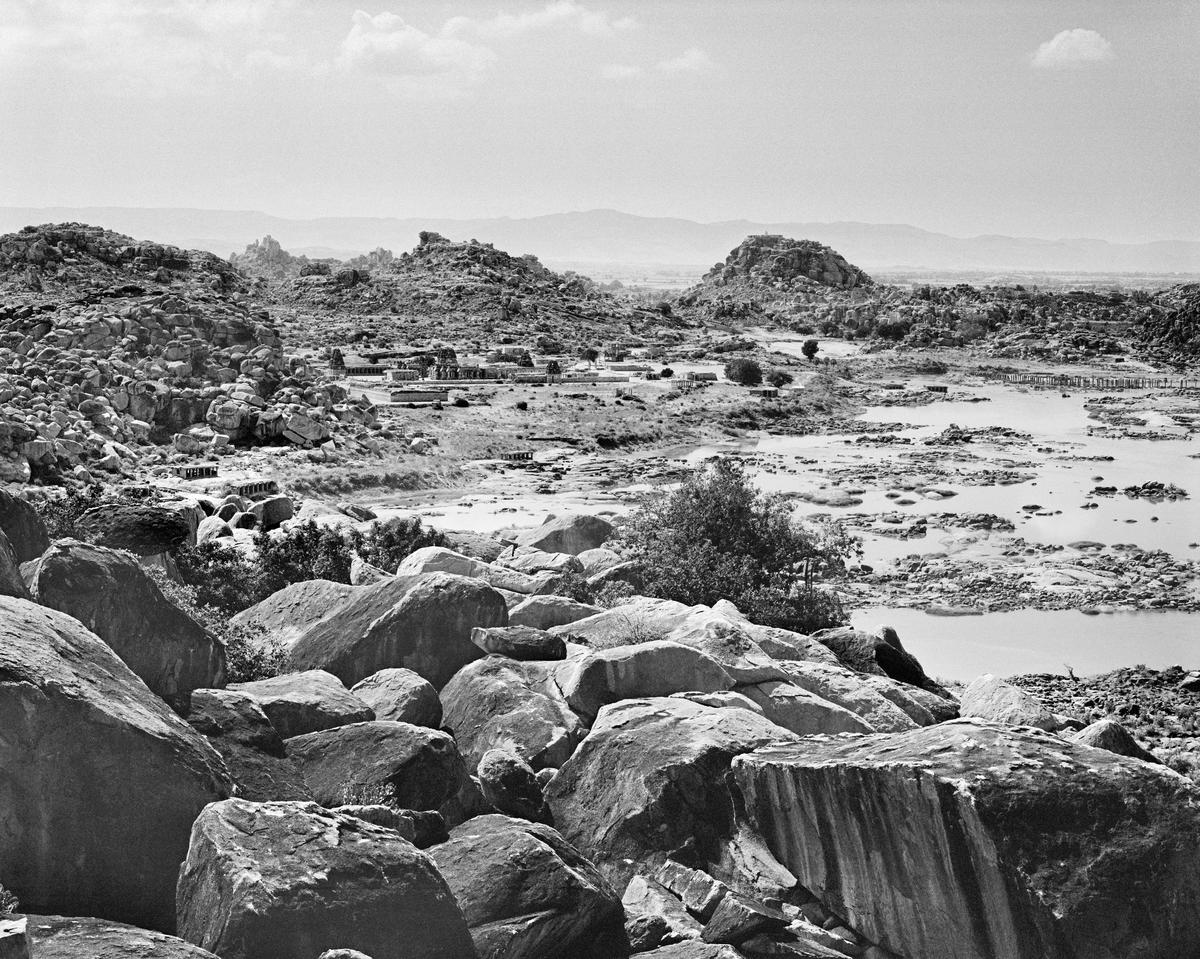
The dramatic expanse of the rocky landscape of Tungabhadra valley. The remains of an extraordinary architectural complex defines this land, as ruins of temples, pavilions and structures.
| Photo Credit:
John Gollings
Evocative journey
The real treat, of course, is Gollings’ photography. The Australian brings a rare sensitivity to the visual storytelling of Vijayanagara’s ruins. His images capture the monumental scale of the site’s granite landscape and the intricate details of its sculptural forms with dramatic light and shadow. He sometimes foregrounds the images with humans, or familiar plants or stones, enabling the viewer’s discernment of scale, while elsewhere details are photographed as documentation, enabling study and reflection. The photos also span the medium from early analogue processes to large-format film and digital imaging, reflecting a consistent embrace of technological shifts without surrendering his craft.
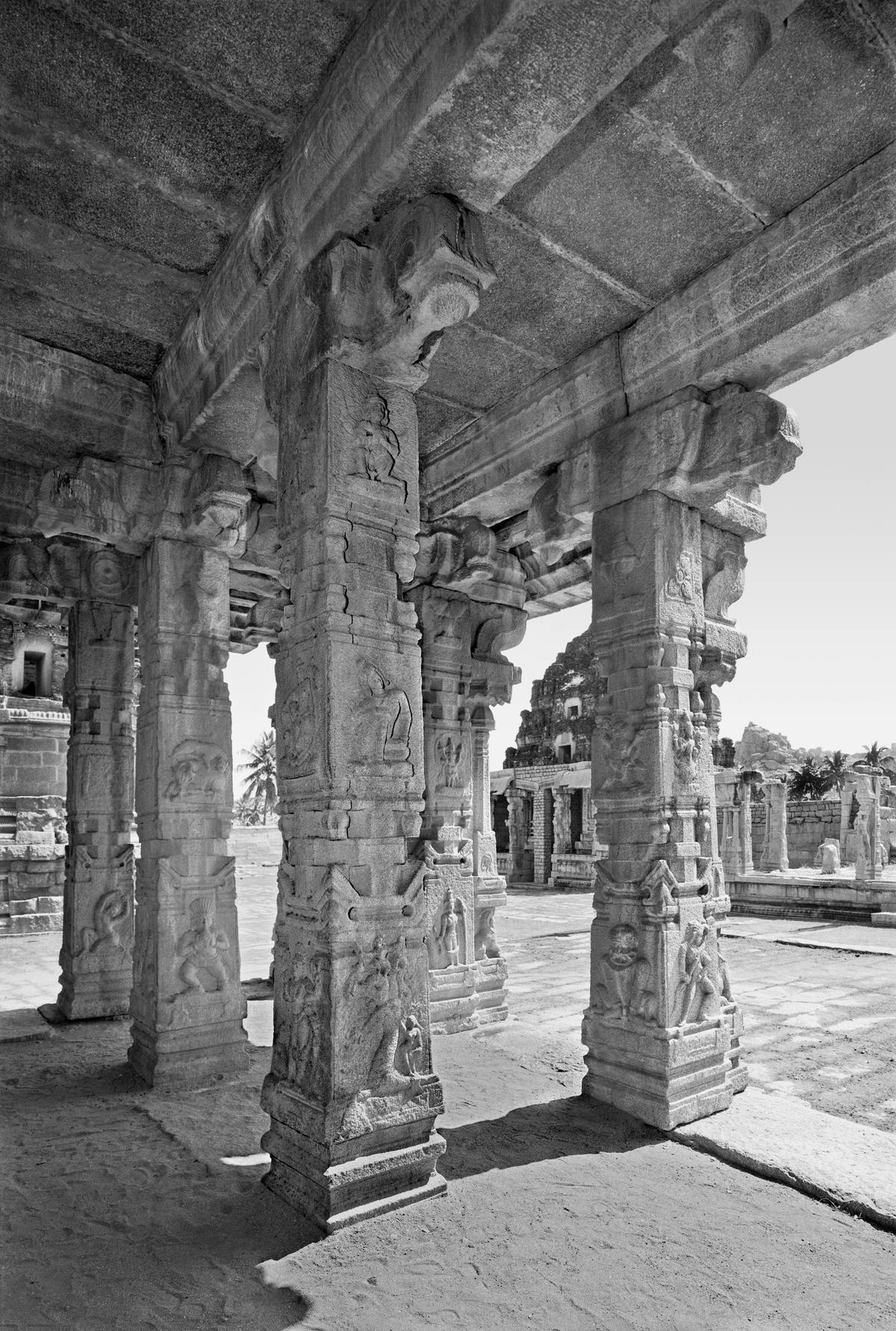
The photographs enable easy architectural reading. Here, a mandapa with carved columns in the Tiruvengalanatha temple beneath Matanga Hill.
| Photo Credit:
John Gollings
City of Victory stands out as one of the most compelling books on Vijayanagara available today. It balances narrative, analysis and visual beauty — and offers scholarly depth and an evocative journey through a city that may lie in ruins, but continues to live in stone, in memory and, through its pages, in light.
The writer is the founder-director of Eka Archiving Services.
Published – March 07, 2026 06:11 am IST