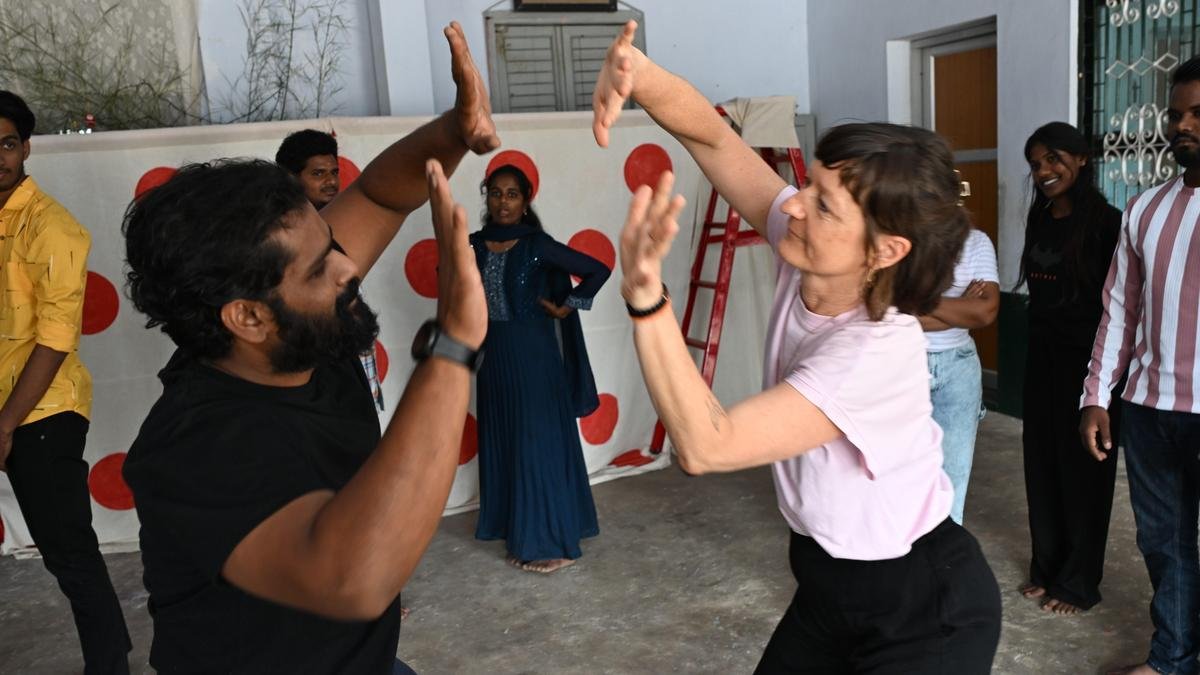
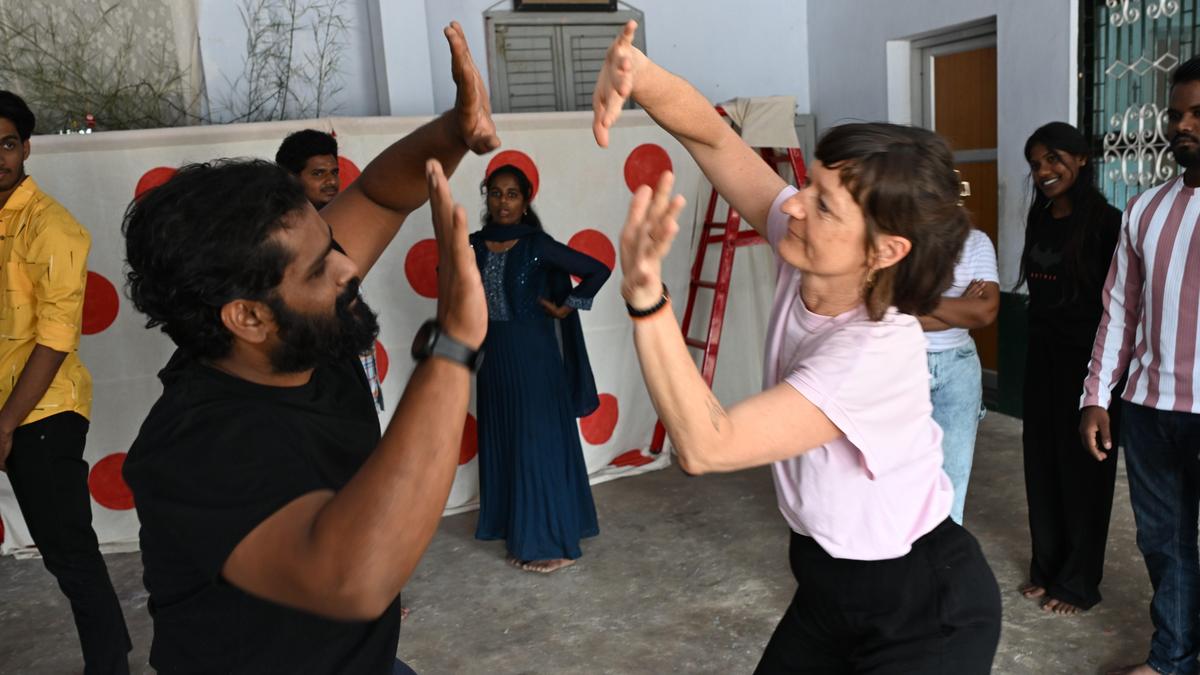
Manuela Runge, a Zurich-based theatre and dance artist, conducting a workshop for amateur actors in Tiruchi.
| Photo Credit: M MOORTHY
On a Saturday morning, with the cows lowing in the background, and the wind whistling through the trees at a farm in a suburb of Tiruchi, a small group of amateur artistes practices the art of mirroring, following the lead of Swiss theatre and dance pedagogue Manuela Runge, learning to mimic each other’s movements without touching.
Manuela, a German national based in Zurich, has nearly 20 years experience in teaching theatrical skills and dance to children, young adults and people with disability.
Currently on a personal visit to southern India, Manuela has been conducting workshops for students in Tiruchi, Chennai, Tirunelveli and Dindigul.
Mirroring is among the many techniques the teacher-artiste uses to help actors ease their body language on stage.
The performing arts, especially theatre, can be a powerful tool to help children hailing from troubled backgrounds find positive role models outside their familiar social circles, she says. “I know this is true because my father was a heavy drinker and prone to violent behaviour. My parents separated when I was six years old. My mother raised me and my older brother. Theatre was where I could see the different possibilities for the future,” says Manuela.
Theatre is also a family and a place to belong, she adds. “Very often you can see others with similar problems here. It is a safe space where you do not feel alone. And this gives you power.”
The learning curve
Manuela, wanted to be an actor from an early age. “But I was too shy to go to acting school. I got employed as a school teacher, and that’s when I realised that I could channel my interest in performing arts by teaching theatre to children,” she says.
Delving into theatre pedagogy, she realised that drama need not be only about dialogues and declamation. Manuela specialises in training people to feel physically comfortable while performing in front of an audience. “Through acting, we can connect with each other, perform together and express ourselves through our actions, because not everyone can use speech the same way,” she says.
It is rewarding for a teacher to see her students gaining confidence with each rehearsal. “In the beginning they doubt themselves. But after a while, acting gives them power and helps them find their voice. They learn that it is okay to make mistakes and this makes them more open to others’ ideas.”
Currently she is helping actors grasp the art of how to be in the moment during a live performance. “It is a reaction-based activity like billiards or football. I teach students to study their co-actors to see how they can connect on stage,” she says.
On a sabbatical from full-time teaching in Switzerland for the next few months, Manuela is discovering the vicissitudes of India’s theatrical traditions. “I am impressed by the purity of craft that young people display on stage. Indian artistes are passionate about their art, be it dance or theatre.”
Published – January 09, 2026 01:55 pm IST