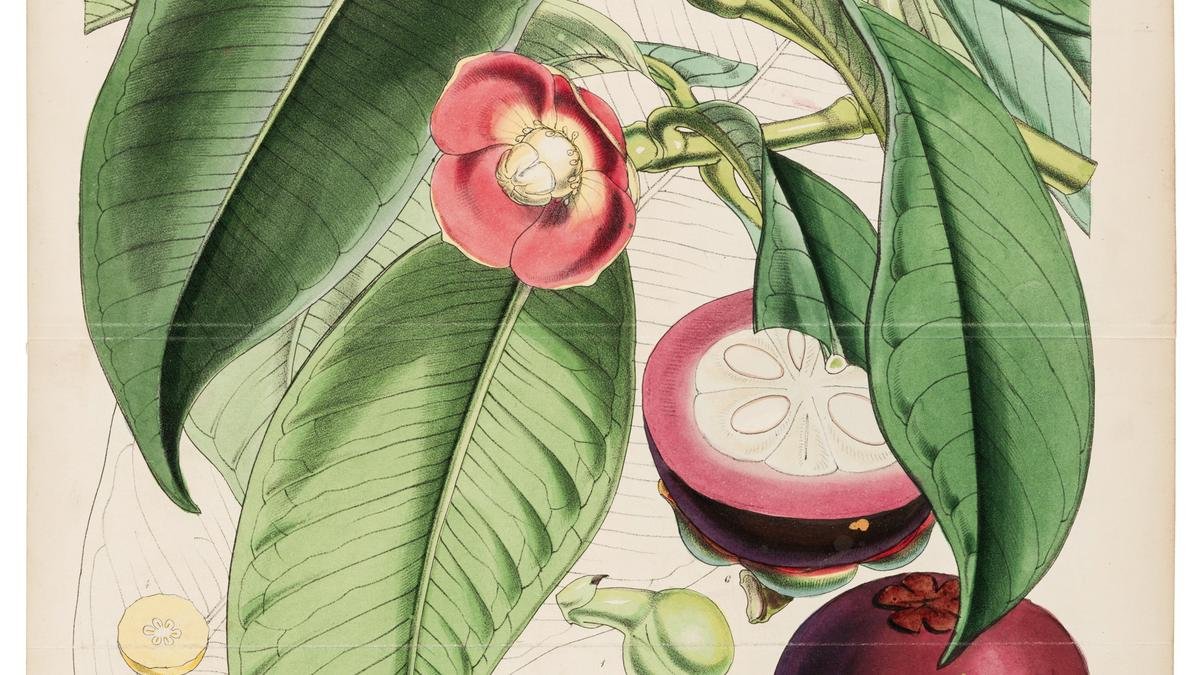
The year was 1847. Joseph Dalton Hooker, a close friend of Charles Darwin and the son of William Jackson Hooker, the first director of the Royal Botanic Gardens, better known as Kew Gardens, found himself on a ship sailing to India. “His father gave him a £400 allowance and sent him as a plant collector for Kew,” says Shrey Maurya, Research Director of Impart, who is leading us on a walkthrough of Paper Gardens: Art, Botany, and Empire, a new exhibition at the Museum of Art & Photography (MAP), Bengaluru.
On this journey, JD Hooker meets Lord and Lady Dalhousie, who are on their way to Kolkata to assume their official positions as the Viceroy and Vicereine of British India, according to Shrey, also the curator of this exhibition exploring the history of botanical illustration in colonial India and the often-uncredited Indian artists behind these works.
“When he reaches Darjeeling and starts climbing in search of plants, he quickly discovers that the known species of rhododendrons are nothing. He “discovers” 33 new species of them in India,” Shrey says.
In the classic tradition of English naturalists, where “to name is to claim”, he christened these plants after prominent British botanists and wealthy patrons, including Lady Dalhousie, with whom he had travelled to India, says Shrey as we walk past lithographs of these bright blooms taken from The Rhododendrons of Sikkim-Himalaya, a book about these discoveries that Hooker published in 1849, even before he left India.
“It functioned not only as surveys of specific plant groups and landscapes but also as records of extensive fieldwork that depended heavily on the knowledge and labour of local communities who guided collectors and botanists through these regions,” Shrey explains, adding the book set off a rhododendron craze in England, since the flower fits into the idea of the great British Garden, “a very contained wilderness.”
Hooker would return to England carrying nearly 30,000 specimens from India, including rhododendron seeds and cuttings, many of which flourished in English soil and today, “is one of the most invasive species there.”
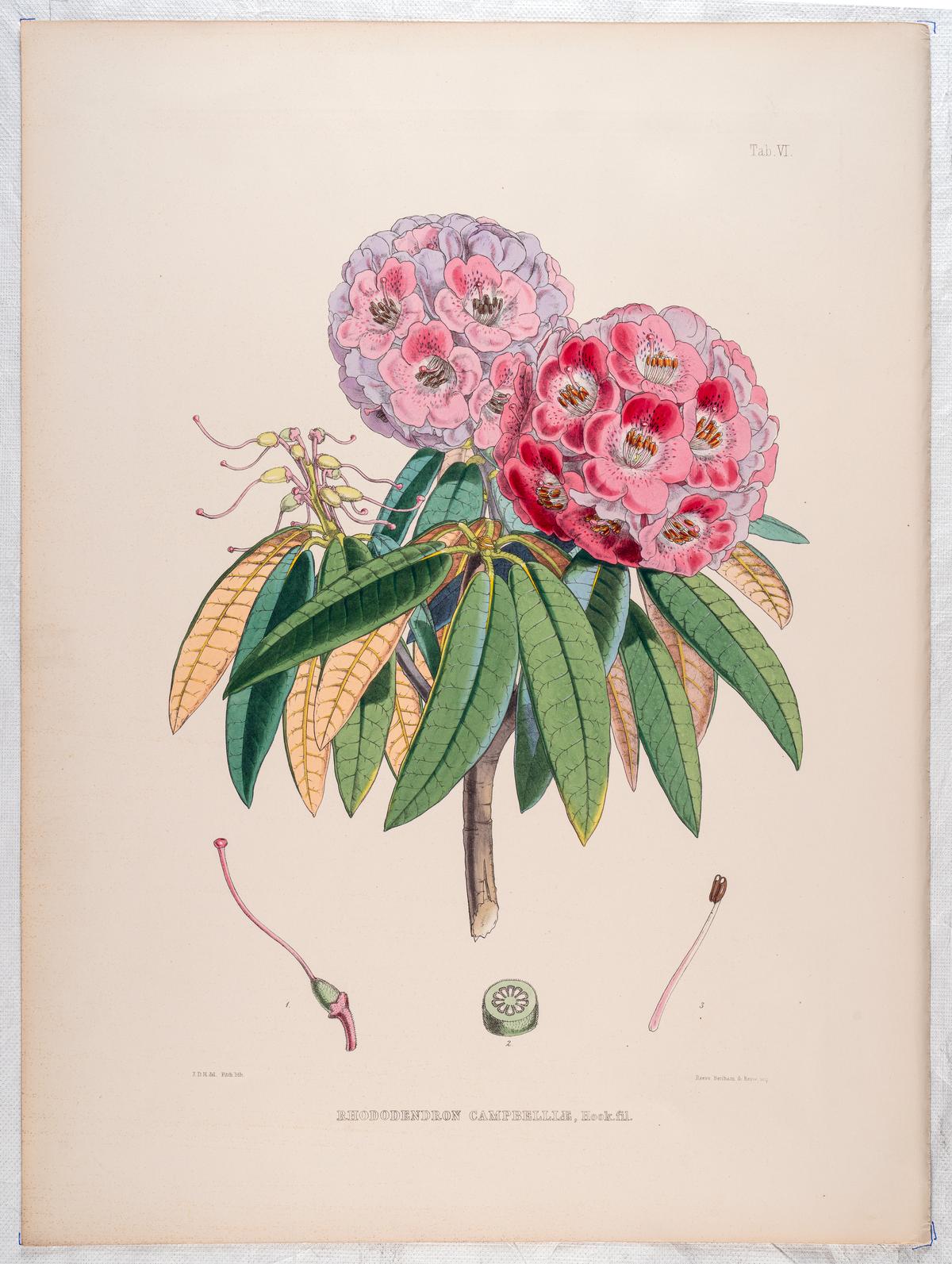
A lithograph of Rhododendron campbelliae from The Rhododendrons of Sikkim-Himalaya, authored and illustrated by Joseph Dalton Hooker, with lithography by Walter Hood Fitch
| Photo Credit:
MAP Bengaluru
Paper Gardens: Art, Botany, and Empire, a collaboration between Impart and the Museum of Art & Photography, is filled with artwork like these rhododendron lithographs that offer a peek into the legacy of an empire, one that described and recorded Indian flora to not just deepen its understanding of botany, but also to find ways of exploiting them for economic reasons.
In the process, this botanical enterprise often erased the contributions of local gardeners, plant collectors, indigenous knowledge holders, and artists, who were a crucial component of it.
Lalbagh Botanical Garden in Bengaluru
| Photo Credit:
Special Arrangement
These natural history surveys fulfilled yet another important objective of the British Raj. In the 19th century, botany, as well as other sciences like zoology, geology and geography, emerged as specialised disciplines. This meant that practices integral to understanding newly conquered territories, botanical surveys, in particular, were important — they became a means of mapping, cataloguing and evaluating unfamiliar terrains, and were closely aligned with imperial ambitions to understand, organise and economically exploit colonised landscapes.
“Historical records show how closely related conflicts and botanical surveys were, with the latter often occurring in parallel with or soon after British annexations and territorial consolidation across the subcontinent,” Shrey reveals, pointing out that, in addition to trained botanists, Company surgeons, surveyors, military officers, and civil administrators were also instrumental in documenting the flora of particular regions in the subcontinent.
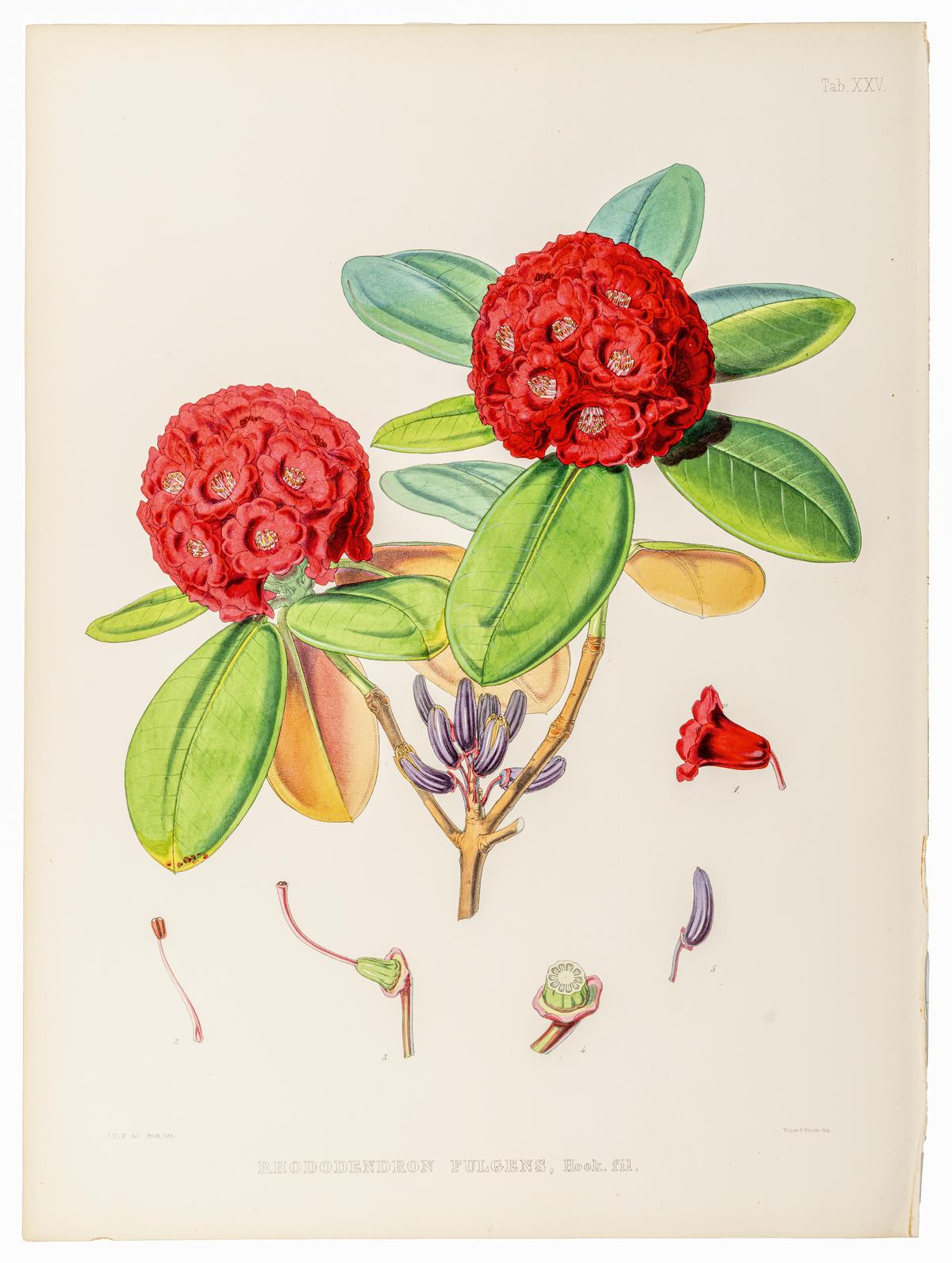
A lithograph of Rhododendron fulgens from The Rhododendrons of Sikkim-Himalaya, authored and illustrated by Joseph Dalton Hooker, with lithography by Walter Hood Fitch
| Photo Credit:
MAP Bengaluru
Another symbol of this imperial control, in her opinion, was seen in the way British botanical gardens, particularly Kew, came to stand at the centre of a global network of colonial garden institutions, receiving specimens from all over the world, and playing a leading role in organising and classifying botanical data and formalising plant classification and nomenclature. ”These scientific networks also intersected with broader colonial ideologies, including assumptions of European intellectual authority and racial hierarchy, which shaped how knowledge was collected, credited, and circulated,” she says, pointing out that while the Linnean binomial naming system continues to structure modern botany to this day, local plant knowledge lives alongside this system, and in fact is more accessible and in use in everyday lives than scientific nomenclature. “In everyday practice across South Asia, people continue to identify plants through regional languages and vernacular classifications, which often reflect long-standing ecological familiarity and practical use.”
These scientific networks also intersected with broader colonial ideologies, including assumptions of European intellectual authority and racial hierarchy, which shaped how knowledge was collected, credited, and circulated. While the Linnean binomial naming system continues to structure modern botany, local plant knowledge lives alongside it and, in fact, is more accessible and in use in everyday life than scientific nomenclature, she says. “In everyday practice across South Asia, people continue to identify plants through regional languages and vernacular classifications, which often reflect long-standing ecological familiarity and practical use.”
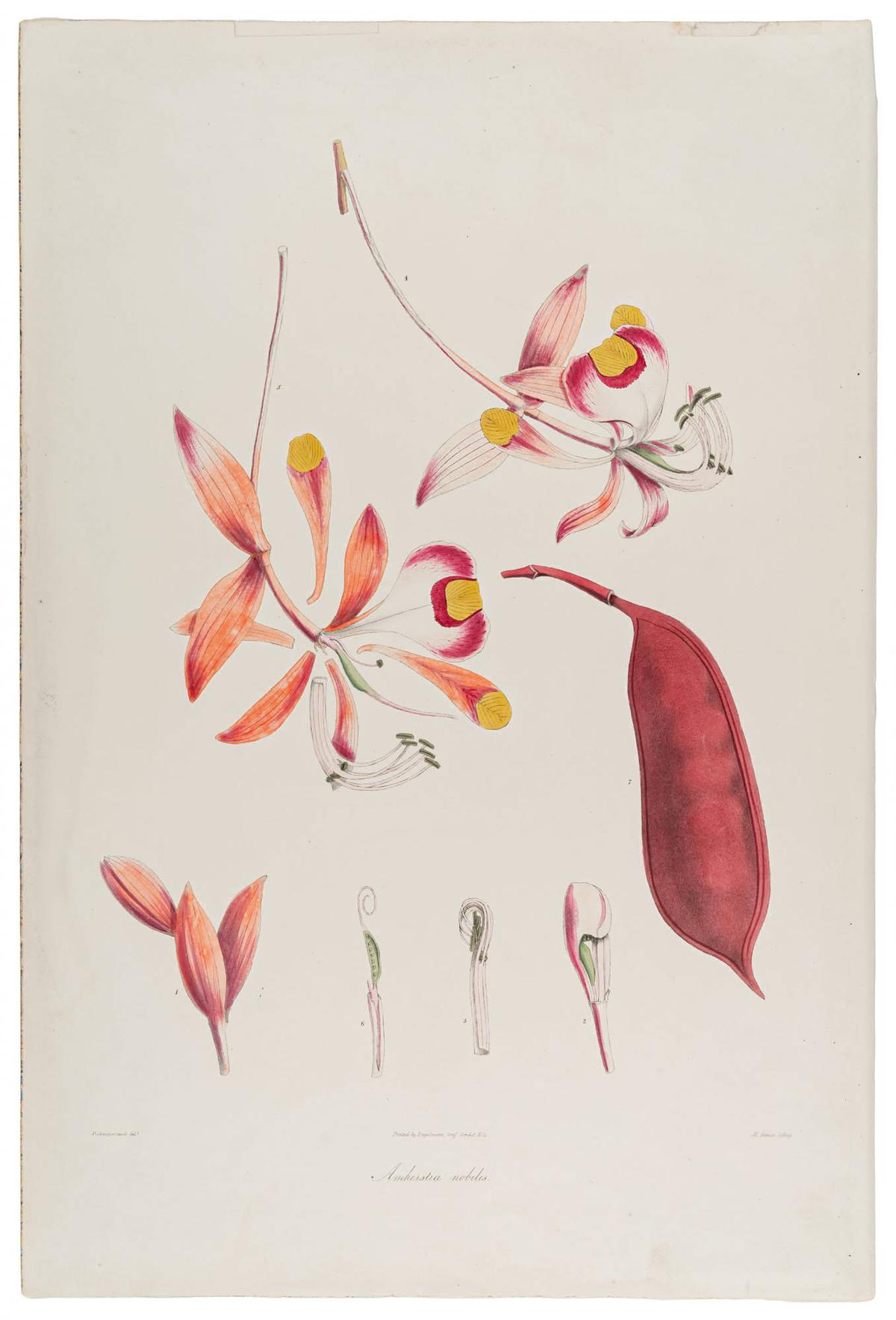
A lithograph of Amherstia nobilis from Plantae Asiaticae Rariores, or, Descriptions and Figures of a Select Number of Unpublished East Indian Plants, Volume 1 , authored by Nathaniel Wallich with artwork by Vishnupersaud and lithography by Maxim Gauci
| Photo Credit:
MAP Bengaluru
The expansion of botanical science into colonial territories had other consequences that continue to shape ecological and conservation debates today. Imperial botanical networks moved species across continents in search of commercially valuable plants (for plantations, timber, and ornamental plants), with institutions such as the Royal Botanic Gardens, Kew and the Royal Botanic Gardens, Calcutta, coordinating these global exchanges of seeds and specimens between colonial gardens, says Shrey.
This circulation, in turn, led to the introduction and acclimatisation of many non-native plants, some of which later became invasive and significantly altered local ecosystems. “In cities such as Bengaluru, gardens like Lalbagh Botanical Garden became important nodes in these exchanges, where foreign species were tested, cultivated, and distributed, contributing to the layered botanical landscape visible today.”
Britain’s Kew Gardens were crucial in coordinating global exchanges of seeds and specimen
| Photo Credit:
Special Arrangement
Some of the exhibition’s key highlights, according to Shrey, include works by artists such as Vishnuprasad and Gorachand, both of whom were head artists at the Royal Botanic Garden in Calcutta at different points in time, and also worked closely together, “whose paintings demonstrate the extraordinary observational skill and precision that botanical illustration demanded,” Shrey says.
There are also drawings by Govindoo and Rungiah from Icones Plantarum Indiae Orientalis, “remarkable both for the minute detailing of individual plants and for the sheer scale of the project, which involved the production of hundreds of botanical images to document the region’s flora.”
The exhibition, she says, also includes early photographs of Lalbagh Botanical Garden and the city of Bengaluru, offering a glimpse into the garden’s transformation from a royal pleasure garden into a colonial botanical garden and illustrating how British landscaping ideas shaped the visual and botanical character of the city.
“Together, these works reveal the scale, ambition, and collaborative nature of botanical knowledge-making in the subcontinent.”
Paper Gardens: Art, Botany, and Empire will be on at MAP, Bengaluru, till July 5